
33 Books Written

“My work has been motivated,” Wendell Berry has written, “by a desire to make myself responsibly at home in this world and in my native and chosen place.” In Home Economics , a collection of fourteen essays, Berry explores this process and continues to discuss what it means to make oneself “responsibly at home.”His title reminds us that the very root of economics is stewardship, household management. To paraphrase Confucius, a healthy planet is made up of healthy nations that are simply healthy communities sharing common ground, and communities are gatherings of households. A measure of the health of the planet is economics—the health of its households. Any process of destruction or healing must begin at home. Berry speaks of the necessary coherence of the “Great Economy,” as he argues for clarity in our lives, our conceptions, and our communications. To live is not to pass time, but to spend time.Whether as critic or as champion, Wendell Berry offers careful insights into our personal and national situation in a prose that is ringing and clear.

The Gift of Good Land: Further Essays Cultural and Agricultural
by Wendell Berry
Rating: 4.4 ⭐
• 2 recommendations ❤️
The essays in The Gift of Good Land are as true today as when they were first published in 1981; the problems addressed here are still with us and the solutions no nearer to hand. One of the insistent themes of this book is the interdependence, the wholeness, the oneness of people, the land, weather, animals, and family. To touch one is to tamper with them all. We live in one functioning organism whose separate parts are artificially isolated by our culture.The twenty-four essays in this collection cover a variety of subjects; the author’s journeys to the Peruvian Andes, to the desert of southern Arizona, and to Amish country to study the evolution of ancient native agricultural practices. In “Solving for Pattern,” Mr. Berry lists fourteen critical standards for solving agricultural problems that can just as easily be used as standards for solving personal and family problems. In the title essay, the author examines our Judeo-Christian heritage to discover parallels with the Buddhist doctrine of “right livelihood” or “right occupation.” He develops the compelling argument that the “gift” of good land has strings attached. We have it only on loan and only for as long as we practice good stewardship.
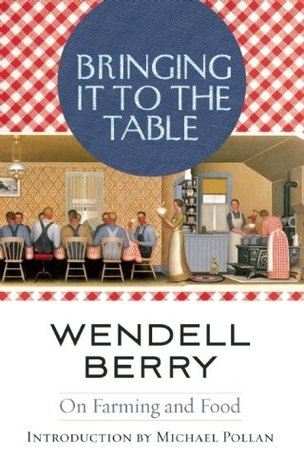
Only a farmer could delve so deeply into the origins of food, and only a writer of Wendell Berry’s caliber could convey it with such conviction and eloquence. Long before Whole Foods organic produce was available at your local supermarket, Berry was farming with the purity of food in mind. For the last five decades, Berry has embodied mindful eating through his land practices and his writing. In recognition of that influence, Michael Pollan here offers an introduction to this wonderful collection.Drawn from over thirty years of work, this collection joins bestsellers The Omnivore’s Dilemma, by Pollan, and Animal, Vegetable, Miracle, by Barbara Kingsolver, as essential reading for anyone who cares about what they eat. The essays address such concerns as: How does organic measure up against locally grown? What are the differences between small and large farms, and how does that affect what you put on your dinner table? What can you do to support sustainable agriculture?A progenitor of the Slow Food movement, Wendell Berry reminds us all to take the time to understand the basics of what we ingest. “Eating is an agriculture act,” he writes. Indeed, we are all players in the food economy.

“This is a book about Heaven,” says Jayber Crow, “but I must say too that . . . I have wondered sometimes if it would not finally turn out to be a book about Hell.” It is 1932 and he has returned to his native Port William to become the town's barber. Orphaned at age ten, Jayber Crow’s acquaintance with loneliness and want have made him a patient observer of the human animal, in both its goodness and frailty. He began his search as a "pre-ministerial student" at Pigeonville College. There, freedom met with new burdens and a young man needed more than a mirror to find himself. But the beginning of that finding was a short conversation with "Old Grit," his profound professor of New Testament Greek."You have been given questions to which you cannot be given answers. You will have to live them out―perhaps a little at a time.""And how long is that going to take?""I don't know. As long as you live, perhaps.""That could be a long time.""I will tell you a further mystery," he said. "It may take longer." Wendell Berry’s clear-sighted depiction of humanity’s gifts―love and loss, joy and despair―is seen though his intimate knowledge of the Port William Membership.

Port William Novels & Stories (The Civil War to World War II): Nathan Coulter / Andy Catlett: Early Travels / A World Lost / A Place on Earth / Stories
by Wendell Berry
Rating: 4.8 ⭐
• 1 recommendation ❤️
For more than fifty years, in eight novels and forty-two short stories, Wendell Berry (b. 1934) has created an indelible portrait of rural America through the lens of Port William, Kentucky, one of the most fully imagined places in American literature. The river town and its environs are home to generations of Coulters, Catletts, Feltners, and other families collectively known as the Membership, women and men whose stories evoke the earthbound pleasures and spiritual richness of what Berry has called the three-dimensional life, a time before industrial agriculture, pervasive technology, and unrestrained consumerism began to unravel the deep bonds of community that once sustained small-town America.Taken together, these novels and stories form a masterwork of American prose: straightforward, spare, and lyrical. Now, in an edition prepared in consultation with the author, Library of America presents the complete Port William novels and stories for the first time in the order of their narrative chronology, revealing as never before the intricate dovetails and beguiling elegance of Berry’s larger construction. As one of his narrators puts it: “their stories are all added finally into one story . . . bound together in a many-stranded braid beyond the power of any awl to pick apart.”This first volume, which spans from the Civil War to World War II, gathers the novels Nathan Coulter (1960, revised 1985), A Place on Earth (1967, revised 1983), A World Lost (1996), and Andy Catlett: Early Travels (2006), along with twenty-three short stories, among them such favorites as “Watch With Me,” “Thicker than Liquor,” and “A Desirable Woman.” It also features a newly researched chronology of Berry’s life and career, a map of Port William and a Membership family tree, and helpful notes.

Hannah Coulter is Wendell Berry's seventh novel and his first to employ the voice of a woman character in its telling. Hannah, the now-elderly narrator, recounts the love she has for the land and for her community. She remembers each of her two husbands, and all places and community connections threatened by twentieth-century technologies.

Since its publication by Sierra Club Books in 1977, The Unsettling of America has been recognized as a classic of American letters. In it, Wendell Berry argues that good farming is a cultural development and spiritual discipline. Today’s agribusiness, however, takes farming out of its cultural context and away from families. As a result, we as a nation are more estranged from the land—from the intimate knowledge, love, and care of it. Sadly, as Berry notes in his Afterword to this third edition, his arguments and observations are more relevant than ever. We continue to suffer loss of community, the devaluation of human work, and the destruction of nature under an economic system dedicated to the mechanistic pursuit of products and profits. Although “this book has not had the happy fate of being proved wrong,” Berry writes, there are good people working “to make something comely and enduring of our life on this earth.” Wendell Berry is one of those people, writing and working, as ever, with passion, eloquence, and conviction.

Nathan Coulter begins Wendell Berry's sequence of novels about the citizens of Port William, Kentucky — a setting that is taking its place alongside Yoknapatawpha County, Mississippi, and Winesburg, Ohio, as one of our most distinctive and recognizable literary locales.

Old Jack, born just after the American Civil War and dying in contemporary times, spends one beautiful September day in Port William, his home since birth, remembering. The story tells of the most searing moments of Old Jack’s life, particularly his debt to his sister Nancy and her husband Ben Feltner, Old Jack’s model of what an honorable manhood and strength might be."Few novelists treat both their characters and their readers with the kind of respect that Wendell Berry displays in this deeply moving account . . . The Memory of Old Jack is a slab of rich Americana." ― The New York Times Book Review

Published in 1967, we return to Port William during the Second World War to revisit Jayber Crow, the barber, Uncle Stanley, the gravedigger, Jarrat and Burley, the sharecroppers, and Brother Preston, the preacher, as well as Mat Feltner, his wife Margaret, and his daughter-in-law Hannah, whose son will be born after news comes that Hannah’s husband Virgil is missing. "The earth is the genius of our life,” Wendell Berry writes here. “The final questions and their answers lie serenely coupled in it."

"Berry richly evokes Port William's farmlands and hamlets, and his characters are fiercely individual, yet mutually protective in everything they do. . . . His sentences are exquisitely constructed, suggesting the cyclic rhythms of his agrarian world."--New York Times Book Review.

In the twenty-two essays collected here, Wendell Berry, whom "The Christian Science Monitor "called ""the "prophetic American voice of our day," conveys a deep concern for the American economic system and the gluttonous American consumer. Berry talks to the reader as one would talk to a next-door neighbor: never preachy, he comes across as someone offering sound advice. He speaks with sadness of the greedy consumption of this country's natural resources and the grim consequences Americans must face if current economic practices do not change drastically. In the end, these essays offer rays of hope in an otherwise bleak forecast of America's future. Berry's program presents convincing steps for America's agricultural and cultural survival.Damage --Healing --A remarkable man [Nate Shaw] --Harry Caudill in the Cumberlands --A few words in favor of Edward Abbey --Wallace Stegner and the great community --A poem of difficult hope --Style and grace --Writer and region --The responsibility of the poet --God and country --A practical harmony --An argument for diversity --What are people for? --Waste --Economy and pleasure --The pleasures of eating --The work of local culture --Why I am not going to buy a computer --Feminism, the body, and the machine --Word and flesh --Nature as measure

Nine-year-old Andy Catlett embarks on a trip going alone by bus to visit his grandparents. It is Christmas 1943 and―as he sees modern life crowding out the old ways―those he meets become touchstones for his understanding of a precious and imperiled world. This beautiful short novel is a perfect introduction to Wendell Berry’s rich and ever-evolving saga of the Port William Membership.

Remembering takes place in a single day in 1976. Andy Catlett, at the bottom of a deep dark depression since losing his hand in a farming accident, is alone in San Francisco, and takes a long walk through the walking street ofthe city. By the end of the day, when he has flown home to Port William, Kentucky, Andy is on his way to becoming whole again.

"Read [him] with pencil in hand, make notes, and hope that somehow our country and the world will soon come to see the truth that is told here." —The New York Times Book Review In this collection of essays, first published in 1993, Wendell Berry continues his work as one of America's most necessary social commentators. With wisdom and clear, ringing prose, he tackles head-on some of the most difficult problems confronting us near the end of the twentieth century––problems we still face today. Berry elucidates connections between sexual brutality and economic brutality, and the role of art and free speech. He forcefully addresses America's unabashed pursuit of self-liberation, which he says is "still the strongest force now operating in our society." As individuals turn away from their community, they conform to a "rootless and placeless monoculture of commercial expectations and products," buying into the very economic system that is destroying the earth, our communities, and all they represent.

In a time when our relationship to the natural world is ruled by the violence and greed of unbridled consumerism, Wendell Berry speaks out in these prescient essays, drawn from his 50-year campaign on behalf of American lands and communities Wendell Berry began his life in post-war America as the old times and the last of the old-time people were dying out, and continues to this day in the old ways: a team of work horses and a pencil are his preferred working tools. The writings gathered in The World-Ending Fire are the unique product of a life spent farming the fields of rural Kentucky with mules and horses, and of the rich, intimate knowledge of the land cultivated by this work. These are essays written in defiance of the false call to progress and in defense of local landscapes, essays that celebrate our cultural heritage, our history, and our home.With grace and conviction, he shows that we simply cannot afford to succumb to the mass-produced madness that drives our global economy—the natural world will not survive it.Yet he also shares with us a vision of consolation and of hope. We may be locked in an uneven struggle, but we can and must begin to treat our land, our neighbors, and ourselves with respect and care. As Berry urges, we must abandon arrogance and stand in awe.

"Here is a human being speaking with calm and sanity out of the wilderness. We would do well to hear him." ― The Washington Post Book WorldThe Art of the Commonplace gathers twenty essays by Wendell Berry that offer an agrarian alternative to our dominant urban culture. Grouped around five themes―an agrarian critique of culture, agrarian fundamentals, agrarian economics, agrarian religion, and geobiography―these essays promote a clearly defined and compelling vision important to all people dissatisfied with the stress, anxiety, disease, and destructiveness of contemporary American culture. Why is agriculture becoming culturally irrelevant, and at what cost? What are the forces of social disintegration and how might they be reversed? How might men and women live together in ways that benefit both? And, how does the corporate takeover of social institutions and economic practices contribute to the destruction of human and natural environments? Through his staunch support of local economies, his defense of farming communities, and his call for family integrity, Berry emerges as the champion of responsibilities and priorities that serve the health, vitality and happiness of the whole community of creation.

Andy Catlett is nine years old when his Uncle Andrew is murdered and it destroys his sense of the order of things. Wendell Berry tackles the problem of truth and recollection as Andy Catlett gathers the details of this tragedy from the fragile memories of the townspeople. Tenderly, yet with directness, this short novel encompasses a changing way of life at the end of World War II.

A longtime spokesman for conservation, common sense, and sustainable agriculture, Wendell Berry writes eloquently in several styles and methods. Among other literary forms, he is a poet of great clarity and sureness. His love of language and his care for its music are matched only by his fidelity to the subjects he has written of during his first twenty-five years of land and nature, the family and community, tradition as the groundwork for life and culture. His graceful elegies sit easily alongside lyrics of humor and biting satire. Husbandman and husband, philosopher and Mad Farmer, he writes of values that endure, of earthy truths and universal imagery. His vision is one of hope and memory, of determination and faithfulness. For this far-reaching yet portable volume, Berry has chosen nearly two hundred poems from his previous eight collections.

Originally published in 2005, That Distant Land brings together twenty-three stories from the Port William Membership. Arranged in their fictional chronology, the book is not an anthology so much as it is a coherent temporal mapping of this landscape over time, revealing Berry’s mastery of decades of the life lived alongside this clutch of interrelated characters bound by affection and followed over generations. This volume combines the stories found in The Wild Birds (1985), Fidelity (1992), and Watch with Me (1994), together with a map and a charting of the complex and interlocking genealogies.
'Do I wish to keep up with the times? No. My wish simply is to live my life as fully as I can'The great American poet, novelist and environmental activist argues for a life lived slowly.

I come into the peace of wild thingswho do not tax their lives with forethoughtof grief. I come into the presence of still water.And I feel above me the day-blind stars waiting with their light. For a timeI rest in the grace of the world, and am free.The poems of Wendell Berry invite us to stop, to think, to see the world around us, and to savour what is good. Here are consoling verses of hope and of healing; short, simple meditations on love, death, friendship, memory and belonging; luminous hymns to the land, the cycles of nature and the seasons as they ebb and flow. Here is the peace of wild things.

The Selected Poems of Wendell Berry gathers one hundred poems written between 1957 and 1996. Chosen by the author, these pieces have been selected from each of nine previously published collections. The rich work in this volume reflects the development of Berry’s poetic sensibility over four decades. Focusing on themes that have occupied his work for years―land and nature, family and community, tradition as the groundwork for life and culture― The Selected Poems of Wendell Berry celebrates the broad range of this vital and transforming poet.

Berry’s Sabbath Poems embrace much that is elemental to human life―beauty, death, peace, and hope. In his preface, Berry writes about the growing audience for public poetry readings. While he sees poetry in the public eye as a good thing, Berry asks us to recognize the private life of the poem. These Sabbath Poems were written "in silence, in solitude, and mainly out of doors," and tell us about "moments when heart and mind are open and aware." Wendell Berry is beloved for his quiet, steady explorations of nature, his emphasis on finding good work to do in the world, and his faith in the solace of family, memory, and community. His poetry is assured and unceasingly spiritual; its power lies in the strength of the truths revealed.

"[A] scathing assessment…Berry shows that Wilson's much-celebrated, controversial pleas in Consilience to unify all branches of knowledge is nothing more than a fatuous subordination of religion, art, and everything else that is good to science…Berry is one of the most perceptive critics of American society writing today." --Lauren F. Winner, Washington Post Book World"I am tempted to say he understands [Consilience] better than Wilson himself…A new emancipation proclamation in which he speaks again and again about how to defy the tyranny of scientific materialism" ---Colin C. Campbell, Christian Science Monitor"Berry takes a wrecking ball to E. O. Wilson's Consilience, reducing its smug assumptions regarding the fusion of science, art, and religion to so much rubble. --Kirkus ReviewsIn Life Is a Miracle, the devotion of science to the quantitative and reductionist world is measured against the mysterious, qualitative suggestions of religion and art. Berry sees life as the collision of these separate forces, but without all three in the mix we are left at sea in the world.

One of America’s most acclaimed writers deepens and expands his great literary saga set in small-town Kentucky spanning the Civil War to the present. For more than fifty years, Wendell Berry has been telling us stories about Port William, a mythical town on the banks of the Kentucky River, populated over the years by a cast of unforgettable characters living in a single place over a long time. In A Place in Time , the stories dates range from 1864, when Rebecca Dawe finds herself in her own reflection at the end of the Civil War, to one from 1991 when Grover Gibbs’ widow, Beulah, attends the auction as her home place is offered for sale. Written in “a style as clean and distinctive as H―emingway’s” and “as perspicacious as Mark Twain’s” ( Booklist , Starred Review), the twenty stories here deepen Berry’s Port William saga, one of the great works in American literature. This collection, the tenth volume in the series, is the perfect occasion to celebrate Berry’s huge achievement. It feels as if the entire membership―all the Catletts, Burley Coulter, Elton Penn, the Rowanberrys, Laura Milby, the preacher’s wife, Kate Helen Branch, Andy’s dog, Mike―nearly everyone returns with a story or two, to fill in the gaps in this long tale. Those just now joining the Membership will be charmed. Those who’ve attended before will be enriched. “[Berry’s] poems, novels and essays . . . are probably the most sustained contemporary articulation of America’s agrarian, Jeffersonian ideal.” ― Publishers Weekly

In this beautifully written book-length essay, Berry explores the “hidden wound” of racism and its pernicious effects on white people in America. Rigorous, honest, and deeply felt, The Hidden Wound is essential reading for anyone hoping to understand the problem of race in this country.

No one writes like Wendell Berry. Whether essay, novel, story, or poem, his inimitable voice rings true, as natural as the land he has farmed in Kentucky for over 40 years.Following the widely praised Given, this new collection offers a masterful blend of epigrams, elegies, lyrics, and letters, with the occasional short love poem. Alternately amused, outraged, and resigned, Berry’s welcome voice is the constant in this varied mix. The book concludes with a new sequence of Sabbath poems, works that have spawned from Berry’s Sunday morning walks of meditation and observation.Berry’s themes are reflections of his life: friends, family, the farm, the nature around us as well as within. He speaks strongly for himself and sometimes for the lost heart of the country. As he has borne witness to the world for eight decades, what he offers us now in this new collection of poems is of incomparable value.

As the United States prepares to leave its long war in Afghanistan, it now must contemplate the necessity of sending troops back to Iraq, recalling General Colin Powell’s advice to President Bush: “If you break it, you own it,” asthe world’s hot spots threaten to spread over the globe with the ferocity of a war of holy terror and desperation.The planet’s environmental problems respect no national boundaries. From soil erosion and population displacement to climate change and failed energy policies, American governing classes are paid by corporations to pretend that debate is the only democratic necessity and that solutions are capable of withstanding endless delay. Late Capitalism goes about its business of finishing off the planet. And we citizens are left with a shell of what was once proudly described as The American Dream.In this new collection of eleven essays, Berry confronts head-on the necessity of clear thinking and direct action. Never one to ignore the present challenge, he understands that only clearly stated questions support the understanding their answers require. For more than fifty years we’ve had no better spokesman and no more eloquent advocate for the planet, for our families, and for the future of our children and ourselves.

Now in paperback for the first time, Berry's popular collection of six interconnected stories traces his Port William characters through the Depression up to the 1950s.

For five decades Wendell Berry has been a poet of great clarity and purpose. He is an award-winning writer whose imagination is grounded by the pastures of his chosen place and the rooms and porches of his family's home. In Given — his first collection of new poems in ten years now in paperback — the work is as rich and varied as ever before. With his unmistakable voice as the constant, he dexterously maneuvers through a variety of forms and themes — political cautions, love poems, a play in verse, and a long series of “Sabbath Poems” that resulted from Berry's recent Sunday morning walks of meditation and observation.Berry's work is one of devotion to family and community, to the earth and her creatures, to the memories of the past, and the hope of the future. His writing stands alongside the work of William Carlos Williams and Robert Frost as a rigorous American testament.

Wendell Berry’s Sabbath Poems are filled with spiritual longing and political extremity, memorials and celebrations, elegies and lyrics, alongside the occasional rants of the Mad Farmer, pushed to the edge yet again by his compatriots and elected officials. With the publication of this new complete edition, it has become increasingly clear that the Sabbath Poems have become the very heart of Berry’s work. And these magnificent poems, taken as a whole for the first time in This Day , have become one of the greatest contributions ever made to American poetry.

The Kenyon Review: Winter 1997
by Wendell Berry
Issue focused on American memory, American forgetfulness.