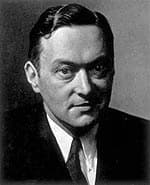
Walter Lippmann
Walter Lippmann was an American intellectual, writer, reporter, and political commentator who gained notoriety for being among the first to introduce the concept of Cold War. Lippmann was twice awarded (1958 and 1962) a Pulitzer Prize for his syndicated newspaper column, "Today and Tomorrow."
29 Books Written

Drift and Mastery, originally published in 1914, is one of the most important and influential documents of the Progressive Movement, a valuable text for understanding the political thought of early twentieth-century America. This paperback edition of Walter Lippmann's classic work includes a revised introduction by William E. Leuchtenburg that places the book in its historical and political contex

The Good Society is a critical text in the history of liberalism. Initially a series of articles published in a variety of Lippmann's favorite magazines, as the whole evolved, it became a frontal assault against totalitarian tendencies within American society. Lippmann took to task those who sought to improve the lot of mankind by undoing the work of their predecessors and by undermining movements

In an era disgusted with politicians and the various instruments of "direct democracy," Walter Lippmann's The Phantom Public remains as relevant as ever. It reveals Lippmann at a time when he was most critical of the ills of American democracy. Antipopulist in sentiment, this volume defends elitism as a serious and distinctive intellectual option, one with considerable precursors in the A
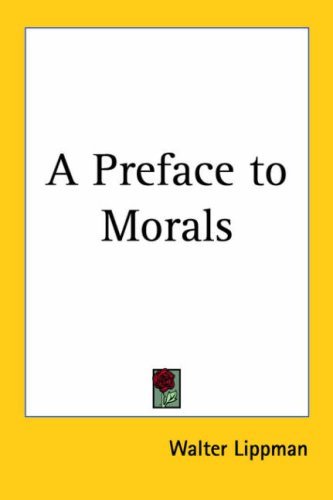
1929. Lippman, a Pulitzer Prize winning political columnist, helped found the liberal New Republic magazine. His writings there influenced Woodrow Wilson, who selected Lippman to help formulate his famous Fourteen Points and develop the concept of the League of Nations. A Preface to Morals endorses liberal democracy. Partial Part I The Dissolution of the Ancestral Order; Part II The Foundations of

In what is widely considered the most influential book ever written by Walter Lippmann, the late journalist and social critic provides a fundamental treatise on the nature of human information and communication. As Michael Curtis indicates in his introduction to this edition. Public Opinion qualifies as a classic by virtue of its systematic brilliance and literary grace. The work is divided into e

Liberty and the News is Walter Lippman's classic account of how the press threatens democracy whenever it has an agenda other than the free flow of ideas. Arguing that there is a necessary connection between liberty and truth, Lippman excoriates the press, claiming that it exists primarily for its own purposes and agendas and only incidentally to promote the honest interplay of facts and ideas. In

The acclaim for Lippmann the political thinker has at times obscured the equally impressive accomplishments of Lippmann the journalist. His output was prodigious, his influence on journalism significant. According to James "He has given a generation of newspapermen a wider vision of their duty." Early Writings provides a unique opportunity to rediscover this journalistic Lippmann and to observe th

Lippmann's famous refutation of the Truman Doctrine.
Book by Lippmann, Walter

American Inquisitors is one of the small gems among Walter Lippmann's larger books. Written in response to the trials of John Scopes and William McAndrew in 1925 and 1927, this volume contains a succinct analysis of a basic problem of democracy: the conflict between intellectual freedom and majority rule. In both cases, the state, acting in the name of popular sovereignty, sought to suppress teach

"Can the United States make foreign commitments without a foreign policy and the force to back it up?"

The Method of Freedom was written at a time of deep anxiety for America and Europe. The worst depression in modem history gripped the world and the rise of dictatorships in Europe and Asia posed a mortal challenge to the essentials of free government. In this volume of a continuing series on the major works of Walter Lippmann, a model for economic recovery and social stability is outlined under a

A great editorial commentator of the twentieth century, Walter Lippmann, was a major contributor to the central periodicals and journals of the age, including the Atlantic Monthly, Foreign Affairs, Harper's, the New Republic, Saturday Review, and Yale Review. Men of Destiny, a set of biographical essays on leading figures of Lippmann's day, is arguably the best single source for understanding the

Please visit www.ArcManor.com for books by other great authors.

Politics. First edition stated. Blue cloth covers rubbed, corners and spine ends bumped, faint glass ring on the front. Interior clean and tight, pages toned.

Transcribed with the Cooperation of The Columbia Broadcasting System, Inc.An Atlantic Monthly Press Book.

This historic book may have numerous typos and missing text. Purchasers can usually download a free scanned copy of the original book (without typos) from the publisher. Not indexed. Not illustrated. 1919 edition. ... APPENDIX II TEXT OF THE PROPOSED CONSTITUTION OF THE LEAGUE OF NATIONS l COVENANT Preamble In order to promote international cooperation and to secure international peace and securit

Born in New York City, Walter Lippmann (1889–1974) was an American journalist. After serving on the editorial staff of the New York World (1921–31), he began writing an extremely influential syndicated column, initially for the New York Herald Tribune (1931–62), later for the Washington Post (1962–67). His column and his numerous books made him renowned as an analyst of temperate detachment and in

There was a time when how to use finger bowls and napkin rings was part of education. In dispensing with archaic manners, we seem to have also dispensed with the common sense sensitivity that among other advantages made possible political discourse without viciousness. Decorum has been jettisoned, often with the excuse that the times are different. The end result has been stress instead of kindnes

The Classic Works of Walter Lippmann
by Walter Lippmann
Public OpinionA Preface to Politics

Letters and the News
by Walter Lippmann
This is a pre-1923 historical reproduction that was curated for quality. Quality assurance was conducted on each of these books in an attempt to remove books with imperfections introduced by the digitization process. Though we have made best efforts - the books may have occasional errors that do not impede the reading experience. We believe this work is culturally important and have elected to bri

Excerpt from The Coming Test With RussiaThis is an uncensored account of a vital and il luminating exchange. It was written down, the first part of it, on the plane ?ying the Lippmanns from Moscow to London and the balance in the English capital. It is a sobering blueprint of the designs of our greatest adversary which we will do well to keep in mind in the tense months ahead.

Today it is assumed that we understand contemporary nationalism and nation-building. Researchers rarely consider the very different traditions from which such state-building emerged. Instead, there is almost too much discussion of the "global village," with its supposed uniformity and inevitable trajectories. We need to view modernity as something other than a single condition with a preordained f

5 1/4"x7 1/2" hardcover book on the Cold War. Publisher-Atlantic Monthly Press/Little, Brown and Company in 1959


The Walter Lippmann Reader: A Preface to Politics; Liberty and the News; Public Opinion; The Phantom Public
by Walter Lippmann
Rating: 3.0 ⭐
Collected in this massive 500+ page omnibus editions are Walter Lippman’s four most important books. These four books are seminal texts in the fields of media studies, political science, and social psychology. The father of modern journalism, Walter Lippmann was a two-time Pulitzer Prize-winner and visionary.A Preface to Politics is most incisive comment on politics to-day is indifference. When me

Public Opinion / A Preface to Politics (Annotated): The Collected Works of Walter Lippmann
by Walter Lippmann
Rating: 3.0 ⭐
Two works by Walter Lippmann in one collection with an active table of contents.Works Public Opinion (1922)."The function of news is to signalize an event, the function of truth is to bring to light the hidden facts, to set them into relation with each other, and make a picture of reality on which men can act"The World Outside and the Pictures in Our Heads