
Walter J. Ong
30 Books Written

Walter J. Ong’s classic work provides a fascinating insight into the social effects of oral, written, printed and electronic technologies, and their impact on philosophical, theological, scientific and literary thought. This thirtieth anniversary edition – coinciding with Ong’s centenary year – reproduces his best-known and most influential book in full and brings it up to date with two new exploratory essays by cultural writer and critic John Hartley. Hartley These illuminating essays contextualize Ong within recent intellectual history, and display his work’s continuing force in the ongoing study of the relationship between literature and the media, as well as that of psychology, education and sociological thought.

The Presence of the Word: Some Prolegomena for Cultural and Religious History
by Walter J. Ong
Rating: 4.1 ⭐
This provocative exploration of the nature and history of the word in some of its social, psychological, literary, phenomenological, and religious dimensions argues that the word is initially aural and in the last analysis always remains sound; it cannot be reduced to any other category. Father Ong contends that sound is essentially an event manifesting power and personal presence, and his descriptive analysis of the development of the media of verbal expression, from their oral sources through the laborious transfer to the visual world and then to contemporary means of electronic communication, shows that the predicament of the human word is the predicament of man himself. Examining the close alliance of the spoken word with the sense of the sacred, particularly in the Hebreo-Christian tradition, he reveals that in a world where presence has penetrated time and space as never before, modern man must find the God who has given himself in the Word which brings man more into the world of sound than of sight.
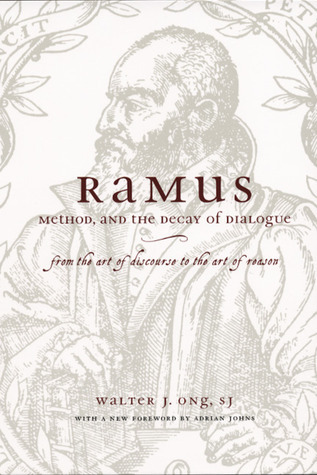
Ramus, Method, and the Decay of Dialogue: From the Art of Discourse to the Art of Reason
by Walter J. Ong
Rating: 4.1 ⭐
Renaissance logician, philosopher, humanist, and teacher, Peter Ramus (1515-72) is best known for his attack on Aristotelian logic, his radical pedagogical theories, and his new interpretation for the canon of rhetoric. His work, published in Latin and translated into many languages, has influenced the study of Renaissance literature, rhetoric, education, logic, and—more recently—media studies.Considered the most important work of Walter Ong's career, Ramus, Method, and the Decay of Dialogue is an elegant review of the history of Ramist scholarship and Ramus's quarrels with Aristotle. A key influence on Marshall McLuhan, with whom Ong enjoys the status of honorary guru among technophiles, this challenging study remains the most detailed account of Ramus's method ever published. Out of print for more than a decade, this book—with a new foreword by Adrian Johns—is a canonical text for enthusiasts of media, Renaissance literature, and intellectual history.

Interfaces of the Word: Studies in the Evolution of Consciousness and Culture
by Walter J. Ong
Rating: 4.2 ⭐
Drawing on a wide range of disciplines―linguistics, phenomenological analysis, cultural anthropology, media studies, and intellectual history―Walter J. Ong offers a reasoned and sophisticated view of human consciousness different in many respects from that of structuralism. The essays in Interfaces of the Word are grouped around the dialectically related themes of change or alienation and growth or integration. Among the subjects Ong covers are the origins of speech in mother tongues; the rise and final erosion of nonvernacular learned languages; and the fictionalizing of audiences that is enforced by writing. Other essays treat the idiom of African talking drums, the ways new media interface with the old, and the various connections between specific literary forms and shifts in media that register in the work of Shakespeare and Milton and in movements such as the New Criticism. Ong also discusses the paradoxically nonliterary character of the Bible and the concerted blurring of fiction and actuality that marked much drama and narrative toward the close of the twentieth century.

What accounts for the popularity of the macho image, the fanaticism of sports enthusiasts, and the perennial appeal of Don Quixote's ineffectual struggles? In Fighting for Life, Walter J. Ong addresses these and related questions, offering insight into the role of competition in human existence. Focusing on the ways in which human life is affected by contest, Ong argues that the male agonistic drive finds an outlet in games as divergent as football and chess. Demonstrating the importance of contest in biological evolution and in the growth of consciousness out of the unconscious, Ong also shows how adversary procedure has affected social, linguistic, and intellectual history. He discusses shifting patterns of contest in such arenas as spectator sports, politics, business, academia, and religion. Human beings' internalization of agonistic drives, he concludes, can foster the deeper discovery of the self and of distinctively human freedom.

Rhetoric, Romance, and Technology: Studies in the Interaction of Expression and Culture
by Walter J. Ong
Rating: 4.6 ⭐
This collection of essays by Walter J. Ong focuses on the complex and dynamic relationship between verbal performance and cultural evolution. By studying the history of rhetoric and related arts from classical antiquity through the age of romanticism to the modern period, Ong both illuminates the past and helps explain late-twentieth-century modes of expression. Elegantly written and wide ranging, Rhetoric, Romance, and Technology traces the evolution of devices used to store, retrieve, and communicate knowledge. Ong discusses diverse topics including memory as art, associationist critical theory, the close relationship between romanticism and technology, and the popular culture of the 1970s. This book also contains essays about Tudor writings in English on rhetoric and literary theory, the study of Latin as a Renaissance puberty rite, Ramism in the classroom and in commerce, Jonathan Swift's notion of the mind, and John Stuart Mill's politics.

Language in all its modes―oral, written, print, electronic―claims the central role in Walter J. Ong’s acclaimed speculations on human culture. After his death, his archives were found to contain unpublished drafts of a final book manuscript that Ong envisioned as a distillation of his life’s work. This first publication of Language as Hermeneutic , reconstructed from Ong’s various drafts by Thomas D. Zlatic and Sara van den Berg, is more than a summation of his thinking. It develops new arguments around issues of cognition, interpretation, and language. Digitization, he writes, is inherent in all forms of "writing," from its early beginnings in clay tablets. As digitization increases in print and now electronic culture, there is a corresponding need to counter the fractioning of digitization with the unitive attempts of hermeneutics, particularly hermeneutics that are modeled on oral rather than written paradigms. In addition to the edited text of Language as Hermeneutic , this volume includes essays on the reconstruction of Ong’s work and its significance within Ong’s intellectual project, as well as a previously unpublished article by Ong, "Time, Digitization, and Dalí's Memory," which further explores language’s role in preserving and enhancing our humanity in the digital age.

This collection puts together the writings of Walter Ong, a scholar who has offered his own observations about voice, orality, speech, literacy, communication and culture. For those new to Ong, the range and accessibility will serve as a suberb introduction to Ong's body of work. Those already familiar with Ong's major publications will find much in this text to supplement and enrich their understanding and direct their future reading.


Critical explorations of literature, contemporary culture and religion.

American Catholic Crossroads: Religious-Secular Encounters in the Modern World
by Walter J. Ong
Rating: 4.0 ⭐

Zawarte w niniejszym wyborze prace Waltera Jacksona Onga nie były dotychczas tłumaczone na język polski. Ong to nowa, personalistyczna oferta w szerokim kręgu zagadnień, jakie nurtują współczesnych. Troska o rozumienie: siebie, drugiego człowieka, relacji międzyludzkich, ich uzależnienia od poznania spraw związanych z komunikacją, tak międzyosobową, jak między twórcą - jego dziełem i odbiorcą, ale jednocześnie diagnoza kłopotów z realizacją tych potrzeb i oczekiwań oraz propozycja drogi wyjścia."Przy pobieżnej, a zwłaszcza wąskiej znajomości prac Onga i zupełnym nieobeznaniu z jego osobą trudno sobie wyobrazić, jak niezwykły to człowiek. Wspominałem o imponującej erudycji, o nienasyconej nigdy ciekawości, wydaje mi się jednak, że na kształt tekstów Onga silnie oddziaływała muzyka. Uwielbiał ją od wczesnej młodości. Nauczył się grać na fortepianie, organach i rogu barytonowym (baritone horn), prowadził chóry. W dorosłym życiu szczególnie przydatna okazała się umiejętność gry na organach. W liście prywatnym z 2001 roku informował mnie, że od ponad 73 lat słucha z uwagą jazzu".ze wstępu Józefa Japoli


Evolution and Cyclicism in Contemporary Poetry
by Walter J. Ong
Oral and Traditional Literatures (Pacific Quarterly Moana)
by Walter J. Ong
Preface by Norman Simms; Literacy and Orality in Our Times, by Walter J. Ong; The New Name, by Carol Rubenstein; Oral Literature and Writing in the South Pacific, by Ruth Finnegan; A.I.M.S.O.F.T.H.E.C.I.A, by Neil R. Grobman; Field Research on Oral Literature and Culture in Serbia, by John Miles Foley; Anonymous Malay Poetry, by Phillip L. Thomas; The Ch-Oral Literature of Sir O.E. Elonge, Anglophone Cameroonian, by Stephen H. Arnold; The Other Maori Belief about Fairies, by Margaret Orbell; and Blowflies, by Talosaga Talovae.
Latin language study as a renaissance puberty rite
by Walter J. Ong
Wit and mystery: A revaluation in mediaeval Latin hymnody
by Walter J. Ong
PMLA
by Walter J. Ong

World as View and World as Event
by Walter J. Ong
14-page offprint from "American Anthropologist" 71/4 (August 1969)

Interfaces of the Word: Studies in the Evolution of Consciousness and Culture by Walter J. Ong
by Walter J. Ong

La lucha por la vida, contestación, sexualidad y conciencia. Versión española de Juan Novella Domingo.
by Walter J. Ong

Oral culture and text culture
by Walter J. Ong
Oral culture and text cultureThe revised version of Oral Culture and Textual Culture is a translation of the 30th anniversary edition of the first edition and adds a lifting of Professor John Hartley of Curtin University, Australia. "Oral culture and character culture" has been steadily attracted attention since its first translation in 1995. This 30th anniversary edition will be the opportunity to revisit the implications and implications of "Oral culture and literary culture" on later scholarship.

Jerry Cotton. Todesspiel mit Mr. High.
by Walter J. Ong

生への闘争―闘争本能・性・意識
by Walter J. Ong
Faith and Contexts: Further Essays 1952 1990
by Walter J. Ong
To learn more about Rowman & Littlefield titles please visit us at www.rowmanlittlefield.com.