
Walker Percy
Walker Percy was an American writer whose interests included philosophy and semiotics. Percy is noted for his philosophical novels set in and around New Orleans; his first, The Moviegoer, won the National Book Award for Fiction. Trained as a physician at Columbia University, Percy decided to become a writer after a bout of tuberculosis. He devoted his literary life to the exploration of "the dislocation of man in the modern age." His work displays a combination of existential questioning, Southern sensibility, and deep Catholic faith. He had a lifelong friendship with author and historian Shelby Foote and spent much of his life in Covington, Louisiana, where he died of prostate cancer in 1990.
30 Books Written

When "The Moviegoer" was first published in 1961, it won the National Book Award and established Walker Percy as one of the supplest and most deftly modulated new voices in Southern literature. In his portrait of a boyish New Orleans stockbroker wavering between ennui and the longing for redemption, Percy managed to combine Bourbon Street elegance with the spiritual urgency of a Russian novel.On the eve of his thirtieth birthday, Binx Bolling is adrift. He occupies himself dallying with his secretaries and going to movies, which provide him with the "treasurable moments" absent from his real life. But one fateful Mardi Gras, Binx embarks on a quest - a harebrained search for authenticity that outrages his family, endangers his fragile cousin Kate, and sends him reeling through the gaudy chaos of the French Quarter. Wry and wrenching, rich in irony and romance, "The Moviegoer" is a genuine American classic.

At his death in 1990, Walker Percy left a considerable legacy of uncollected nonfiction. Assembled in Signposts in a Strange Land, these essays on language, literature, philosophy, religion, psychiatry, morality, and life and letters in the South display the imaginative versatility of an author considered by many to be one the greatest modern American writers.

Dr. Tom More has created a stethoscope of the human spirit. With it, he embarks on an unforgettable odyssey to cure mankind's spiritual flu. This novel confronts both the value of life and its susceptibility to chance and ruin.

Walker Percy's mordantly funny and wholly original contribution to the self-help book craze deals with the Western mind's tendency toward heavy abstraction. This favorite of Percy fans continues to charm and beguile readers of all tastes and backgrounds. Lost in the Cosmos invites us to think about how we communicate with our world.

Lancelot Lamar is a disenchanted lawyer who finds himself confined in a mental asylum with memories that don't seem worth remembering. It all began the day he accidentally discovered he was not the father of his youngest daughter, a discovery which sent Lancelot on modern quest to reverse the degeneration of America. Percy's novel reveals a shining knight for the modern age--a knight not of romance, but of revenge.

Will Barrett is a 25-year-old wanderer from the South living in New York City, detached from his roots and with no plans for the future—until the purchase of a telescope sets off a romance and changes his life forever.Publisher: Spring Arbor/Ingram.

Will Barrett (also the hero of Percy's The Last Gentleman) is a lonely widower suffering from a depression so severe that he decides he doesn't want to continue living. But then he meets Allison, a mental hospital escapee making a new life for herself in a greenhouse. The Second Coming is by turns touching and zany, tragic and comic, as Will sets out in search of God's existence and winds up finding much more.

The 1990s. Euthanasia and quarantines for AIDS have become the norm. But can even this world sanction a substance that "improves" people's behavior and so reduces crime, unemployment and teen pregnancy? A riveting bestseller by the author of The Moviegoer.

The Message in the Bottle: How Queer Man Is, How Queer Language Is, and What One Has to Do with the Other
by Walker Percy
Rating: 4.1 ⭐
In Message in the Bottle, Walker Percy offers insights on such varied yet interconnected subjects as symbolic reasoning, the origins of mankind, Helen Keller, Semioticism, and the incredible Delta Factor. Confronting difficult philosophical questions with a novelist's eye, Percy rewards us again and again with his keen insights into the way that language possesses all of us.

This collection of interviews supplements Conversations with Walker Percy and occasions an additional two dozen pleasurable encounters with Percy. Primarily from the last ten years of Percy’s life, they show how his presence was stimulating thought in much of humanistic America, in literature, linguistic psychology, and philosophy, and in cultural life in general.Although this acclaimed author of The Moviegoer , Lancelot , and Love in the Ruins never overcame his shyness with interviewers, he continued to grant interviews as long as his health permitted. This act of openness illustrates his humility before his ideas and his desire to help others understand them. Although the questions he was asked almost invariably became predictable, he always managed to add an anecdote, an illustration, a topical reference, that would breathe new life into the responses he was making.The interviews in this collection show him at a height when he knew that his illness would not allow him to write any more books, and that the only way to restate his ideas and offer a valediction to the large audience to whom he had always been kind, patient, and appreciative was to speak out. Percy despised the posture of many modern self-proclaimed intellectuals who delight in cloaking ideas in jargon and abstraction. He always tried to express himself clearly and as free of reservations as possible. These interviews reflect that clarity. With this book readers will welcome yet more close encounters with him.


Now in one volume, two novels from the National Book Award winner that follow the life of a Southern man searching for love and connection. In The Last Gentleman, Will Barrett has never felt at peace. After moving from his native South to New York City, Will's most meaningful human connections come through the lens of a telescope in Central Park, from which he views the comings and goings of the eccentric Vaught family. But Will's days as a spectator end when he meets the Vaught patriarch and accepts a job in the Mississippi Delta as caretaker for the family's ailing son, Jamie. Once there, he is confronted not only by his personal demons, but also his growing love for Jamie's sister, Kitty, and a deepening relationship with the Vaught family that will teach him the true meaning of home. And in The Second Coming, now in his late forties, Will Barrett lives a life other men only dream of. Wealthy from a successful career on Wall Street and from the inheritance of his deceased wife's estate, Will is universally admired at the club where he spends his days golfing in the North Carolina sun. But everything begins to unravel when, without warning, Will's golf shots begin landing in the rough, and he is struck with bouts of losing his balance and falling over. Just when Will appears doomed to share the fate of his father--whose suicide has haunted him his whole life--a mental hospital escapee named Allison might prove to be the only one who can save him.From the New York Times-bestselling author of The Moviegoer, these novels have been acclaimed by Time magazine for "irony, understatement, and compassion" and praised by the New York Times as "wonderfully good reading."

A pair of profound dystopian novels from the “brilliantly breathtaking” New York Times–bestselling and National Book Award–winning author of The Moviegoer (The New York Times Book Review). Winner of the National Book Award for The Moviegoer, the “dazzlingly gifted” Southern philosophical author Walker Percy wrote two vividly imagined satirical novels of America’s future featuring deeply flawed psychiatrist and spiritual seeker Tom More (USA Today). Love in the Ruins is “a great adventure . . . so outrageous and so real, one is left speechless” (Chicago Sun-Times), and its sequel The Thanatos Syndrome “shimmers with intelligence and verve” (Newsday). Love in the The great experiment of the American dream has failed. The United States is on the brink of catastrophe. Can an alcoholic, womanizing, lapsed-Catholic psychiatrist really save a society speeding toward inevitable collapse? Dr. Thomas More certainly thinks so. He has invented the lapsometer, a machine capable of diagnosing and curing the country’s spiritual afflictions. If used correctly, the lapsometer could make anxiety, depression, alienation, and racism things of the past. But in the wrong hands, it could rapidly propel the nation into chaos. “A comedy of love against a field of anarchy . . . Percy is easily one of the finest writers we have.” —The New York Times Book Review The Thanatos In Percy’s “ingenious” sequel, Dr. Tom More, fresh out of prison after getting caught selling uppers to truck drivers, returns home to Louisiana, determined to live a simpler life (The New York Times). But when everyone in town starts acting strangely—from losing their sexual inhibitions to speaking only in blunt, truncated sentences—More, with help from his cousin, epidemiologist Lucy Lipscomb, takes it upon himself to investigate. Together, they uncover a government conspiracy poised to rob its citizens of their selves, their free will, and ultimately their humanity. “The Thanatos Syndrome has the ambition and purposefulness to take on the world, to wrestle with its shortcomings, and to celebrate its glories.” —The Washington Post Book World
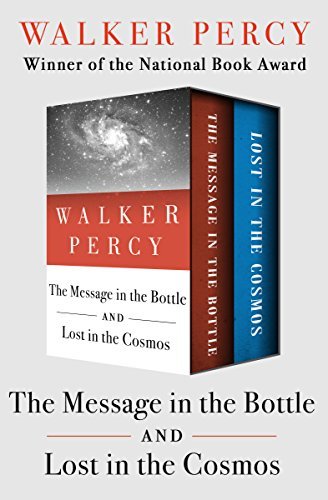
Two fascinating philosophical inquiries from the “dazzlingly gifted” New York Times–bestselling and National Book Award–winning author of The Moviegoer (USA Today). Winner of the National Book Award for The Moviegoer, the Southern writer Walker Percy possessed “an intellectual range and rigor few American novelists can match” (The New York Times Book Review). In these two provocative works, Percy manages to be perceptive and playful as he more directly explores the philosophical foundations of his groundbreaking fiction. The Message in the In these profound and passionate essays that “have a way of quickening the spirit and cleansing the sight,” Percy looks to language to answer the question of who we are as humans (The New Republic). He posits that the act of assigning meaning by naming things makes humans unique. Percy develops a theory of language through the example of Helen Keller being stimulated by the feel of water along with the sign for water, and explores questions such as why other animals don’t talk and why humans in technologically advanced, materially comfortable societies are so sad. “A delight . . . a pleasure to read.” —Larry McMurtry, The Washington Post Book World Lost in the “Charming, whimsical, slyly profound,” Lost in the Cosmos is a one-of-a-kind mix of self-help parody and philosophical speculation (The New York Times). Filled with quizzes, essays, short stories, and diagrams, Percy’s guide is a laugh-out-loud spin on a familiar genre that also pushes readers to serious contemplation of life’s biggest questions, such “Why is it no other species but man gets bored?” and “Explain why Moses was tongue-tied and stagestruck before his fellow Jews but had no trouble talking to God.” “A mock self-help book designed not to help but to provoke; a chapbook to inveigle us into thinking about who we are and how we got into this mess.” —Los Angeles Times Book Review

SYMBOL AND EXISTENCE will prove fascinating to Walker Percy scholars and fans who wish to decipher Percy's authentic philosophical stance. Percy, an existentialist Catholic at his core, was also a scientist seeking an objective paradigm to portray his views. SYMBOL AND EXISTENCE demonstrates that Percy was quite methodical and logical in his thought and provides an entirely new perspective on his scholarship. Much of this book is unique and has never been published before; however, some sections were revised and published as isolated journal articles or book chapters, never presented as the unified whole that Percy intended. The orderly unity of Percy's work has not previously been accessible to scholars and fans. SYMBOL AND EXISTENCE's systematic presentation and its new material offer fresh insight and a more accurate view of Percy's ideas. His early philosophical writings were often revised and significantly modified by outside editorial intent to conform to prevailing intellectual currents of the time. Readers of some published articles with corresponding passages in SYMBOL AND EXISTENCE will be surprised to discover major changes in meaning from Percy's initial writing due to editorial intrusion and loss of context upon their removal from SYMBOL AND EXISTENCE. As the only known systematic representation of Percy's general working theory, SYMBOL AND EXISTENCE gives an important framework for his diverse intellectual background--philosophy and psychology, medicine and anthropology, semiotics and zoology--creating a coherent view of Percy's "radical anthropology."
One of 250 numbered copies signed by Percy on the title page. His thoughts on novel writing.

The Moviegoer & Other Novels 1961-1971 (LOA #380): The Moviegoer / The Last Gentleman / Love in the Ruins
by Walker Percy
Rating: 4.0 ⭐
In 1 volume, 3 classic early works by the Southern physician-turned-novelist who galvanized American literature with stories of spiritual searching amid modern angstIncludes the landmark, National Book Award–winning The Moviegoer , in a fully annotation editionA physician-turned-writer and self-described diagnostician of “the malaise,” Percy plumbed the depths of modern American angst and alienation as few other writers have. Now he joins the Library of America series with a volume collecting his first 3 books.The Moviegoer (1961), winner of the 1962 National Book Award for Fiction, is the story of John Bickerson "Binx" Bolling, a New Orleans stockbroker who finds in movies a resplendent reality that lifts him, for a time, out of the mire of everydayness. Binx is a modern-day pilgrim whose progress unfolds in what editor Paul Elie calls "the first work of what we call contemporary American fiction, the earliest novel to render a set of circumstances and an outlook that still feel recognizably ours."In The Last Gentleman (1966), Percy portrays another troubled, searching young man, this time a southerner living in New York whose intermitent amnesia and odd moments of déjà vu lead him to imagine that the world catastrophe everyone fears has already occurred.A satirical work of speculative fiction, Love in the Ruins (1971) introduces lapsed-Catholic psychiatrist Dr. Thomas More, inventor of the lapsometer, a devise that measures the spiritual sickness of a near-apocalyptic America torn apart by the forces of the far right and left.Rounding out the volume are three short nonfiction pieces by his speech upon accepting the National Book Award, his special message to readers of the Franklin edition of The Moviegoer , and his address to the Publicists’ Association of the National Book Awards concerning Love in the Ruins .
One of 300 copies out 350 total signed by Percy on the limitation page. Designed and printed by Grant Dahlstrom. Essay by Percy. An O instead of Q for Questions on the title page.
1991 BOOK-OF-THE-MONTH CLUB SOFTCOVER

EXCELLENT CLASSIC LITERATURE BOOK, WITH ILLUSTRATIONS.

映画狂時代
by Walker Percy

Mirajul fericirii
by Walker Percy
Povestea de neuitat a unei saptamani ce va schimba definitiv vietile a doi oameni. Aparent, Binx Bolling le are pe la numai 30 de ani este un broker de succes, are bani, masina, iar femeile mor dupa el. Cu toate acestea, viata lui pare lipsita de sens, un sens pe care-l gaseste mergind foarte des la cinema, unde reuseste sa uite traumele provocate de problemele familiale si de experienta razboiului. Romanul este deopotriva o fresca a decaderii Sudului american, dar si un portret viu al New Orleansului. De altfel, punctul culminant al romanului coincide cu o sarbatoare de Mardi Gras. In acelasi timp ironic si romantic, Mirajul fericirii este un roman clasic al literaturii americane.

Novel Writing in an Apocalyptic Time
by Walker Percy
Signed By Walker Percy (Twice - One Signed And Then Another With Inscription ) And Eudora Welty Limited Signed Numbered Edition #172 Of 300. Hardcover Issued Without Dustjacket..

WALKER PERCY. 1916-1990.
by Walker Percy
Symbol as need
by Walker Percy

The Colonial Experience - w/ Dust Jacket!
by Walker Percy
![[Offprint]: Toward a Triadic Theory of Meaning](https://m.media-amazon.com/images/S/compressed.photo.goodreads.com/books/1697714762i/149777186.jpg)
[Offprint]: Toward a Triadic Theory of Meaning
by Walker Percy