
W.H. Auden
Poems, published in such collections as Look, Stranger! (1936) and The Shield of Achilles (1955), established importance of British-American writer and critic Wystan Hugh Auden in 20th-century literature. In and near Birmingham, he developed in a professional middle-class family. He attended English independent schools and studied at Christ church, Oxford. From 1927, Auden and Christopher Isherwood maintained a lasting but intermittent sexual friendship despite briefer but more intense relations with other men. Auden passed a few months in Berlin in 1928 and 1929. He then spent five years from 1930 to 1935, teaching in English schools and then traveled to Iceland and China for books about his journeys. People noted stylistic and technical achievement, engagement with politics, morals, love, and religion, and variety in tone, form and content. He came to wide attention at the age of 23 years in 1930 with his first book, Poems ; The Orators followed in 1932. Three plays in collaboration with Christopher Isherwood in 1935 to 1938 built his reputation in a left-wing politics. People best know this Anglo for love such as "Funeral Blues," for political and social themes, such as "September 1, 1939," for culture and psychology, such as The Age of Anxiety , and for religion, such as For the Time Being and "Horae Canonicae." In 1939, partly to escape a liberal reputation, Auden moved to the United States. Auden and Christopher Isherwood maintained a lasting but intermittent sexual friendship to 1939. In 1939, Auden fell in lust with Chester Kallman and regarded their relation as a marriage. From 1941, Auden taught in universities. This relationship ended in 1941, when Chester Kallman refused to accept the faithful relation that Auden demanded, but the two maintained their friendship. Auden taught in universities through 1945. His work, including the long For the Time Being and The Sea and the Mirror , in the 1940s focused on religious themes. He attained citizenship in 1946. The title of his long The Age of Anxiety , a popular phrase, described the modern era; it won him the Pulitzer Prize in 1947. From 1947, he wintered in New York and summered in Ischia. From 1947, Auden and Chester Kallman lived in the same house or apartment in a non-sexual relation and often collaborated on opera libretti, such as The Rake's Progress for music of Igor Stravinsky until death of Auden. Occasional visiting professorships followed in the 1950s. From 1956, he served as professor at Oxford. He wintered in New York and summered in Ischia through 1957. From 1958, he wintered usually in New York and summered in Kirchstetten, Austria. He served as professor at Oxford to 1961; his popular lectures with students and faculty served as the basis of his prose The Dyer's Hand in 1962. Auden, a prolific prose essayist, reviewed political, psychological and religious subjects, and worked at various times on documentary films, plays, and other forms of performance. Throughout his controversial and influential career, views on his work ranged from sharply dismissive, treating him as a lesser follower of William Butler Yeats and T.S. Eliot, to strongly affirmative, as claim of Joseph Brodsky of his "greatest mind of the twentieth century." He wintered in Oxford in 1972/1973 and summered in Kirchstetten, Austria, until the end of his life. After his death, films, broadcasts, and popular media enabled people to know and ton note much more widely "Funeral Blues," "Musée des Beaux Arts," "Refugee Blues," "The Unknown Citizen," and "September 1, 1939," t
29 Books Written

Between 1927 and his death in 1973, W. H. Auden endowed poetry in the English language with a new face. Or rather, with several faces, since his work ranged from the political to the religious, from the urbane to the pastoral, from the mandarin to the invigoratingly plain-spoken.This collection presents all the poems Auden wished to preserve, in the texts that received his final approval. It includes the full contents of his previous collected editions along with all the later volumes of his shorter poems. Together, these works display the astonishing range of Auden's voice and the breadth of his concerns, his deep knowledge of the traditions he inherited, and his ability to recast those traditions in modern times.

This significantly expanded edition of W. H. Auden’s Selected Poems adds twenty poems to the hundred in the original edition, broadening its focus to better reflect the enormous wealth of form, rhetoric, tone and content in Auden’s work. Newly included are such favorites as “Funeral Blues” and other works that represent Auden’s lighter, comic side, giving a fuller picture of the range of his genius. Also new are brief notes explaining references that may have become obscure to younger generations of readers and a revised introduction that draws on recent additions to knowledge about Auden.As in the original edition, the new Selected Poems makes available the preferred original versions of some thirty poems that Auden revised later in life, making it the best source for enjoying the many facets of Auden’s art in one volume.

Had he been writing now, W.H. Auden might well have penned a poem entitled "Tell me the Truth About Publishing", for the publication of this special, short collection was directly inspired by the runaway success of the 1994 film Four Weddings and a Funeral in which one of Auden's poems was recited. Stretching from October 1932 to June 1948, the poems may have been more revelatory had they been arranged chronologically but commercial demands have placed "Funeral Blues", forevermore known as the poem in the movie, at the end, while "Lullaby", arguably a better poem, is tucked away inside. The period partly coincides with Auden going to America in January 1939 and "Calypso" pulses with the rhythm of a train taking him to his New York rendez-vous at Grand Central. "For there in the middle of that waiting-hall, / Should be standing the one that I love best of all." Many of the poems have the same jolly air and belting rhythm and indeed were written as cabaret songs. "At Last the Secret is Out" must have been tongue-in-cheek considering Auden's sexuality, yet the cover of this slim tome is resolutely heterosexual. But for dipping into Auden's work, this volume serves its purpose. "Funeral Blues" captures the sense of disbelief that the world has the audacity to continue after one has been bereaved. The Cole Porter tone of flippancy and humour--"Put crepe bows round the white necks of the public doves", makes the understated grief all the more poignant. He declares the emblems of romance redundant. "The stars are not wanted now; put out every one." He swings from the grandiose to the mundane and in doing so, sweeps the reader up in the aura of all-emcompassing love. "He was my North, my South, my East and West, / My working week and my Sunday rest.""Lullaby" retains immense mystery and power. Here he evokes the preciousness of one night spent with someone who isn't his. "Let the living creature lie, / Mortal, guilty, but to me, / The entirely beautiful." It leaves much unexplained, yet quite particular, so that it draws one back again and again: "Lay your sleeping head, my love, / Human on my faithless arm..." What an astonishing opener. --Cherry Smyth

The Everyman's Library Pocket Poets hardcover series is popular for its compact size and reasonable price which does not compromise content. Poems: Auden is just another reminder of his exhilarating lyric power and his understanding of love and longing in all their sacred and profane guises. One of English poetry's great 20th century masters, Poems: Auden is the short collection of an exemplary champion of human wisdom in its encounter with the mysteries of experience.

In this volume, W. H. Auden assembled, edited, and arranged the best of his prose writing, including the famous lectures he delivered as Oxford Professor of Poetry. The result is less a formal collection of essays than an extended and linked series of observations—on poetry, art, and the observation of life in general.The Dyer's Hand is a surprisingly personal, intimate view of the author's mind, whose central focus is poetry—Shakespearean poetry in particular—but whose province is the author's whole experience of the twentieth century.

Contains poems about people, places and the intellectual climate of the times. This volume by Auden was published after his departure to America with Christopher Isherwood in January 1939.

As I Walked Out One Evening: Songs, Ballads, Lullabies, Limericks & Other Light Verse
by W.H. Auden
Rating: 4.2 ⭐
W. H. Auden once defined light verse as the kind that is written by poets who are democratically in tune with their audience and whose language is straightforward and close to general speech. Given that definition, the 123 poems in this collection all qualify; they are as accessible as popular songs yet have the wisdom and profundity of the greatest poetry.As I Walked Out One Evening contains some of Auden's most memorable "Now Through the Night's Caressing Grip," " Lay your Sleeping Head, My Love," "Under Which Lyre," and "Funeral Blues." Alongside them are less familiar poems, including seventeen that have never before appeared in book form. Here, among toasts, ballads, limericks, and even a foxtrot, are " The Chimney Sweepers," a jaunty evocation of love, and the hilarious satire "Letter to Lord Byron." By turns lyrical, tender, sardonic, courtly, and risqué, As I Walked Out One Evening is Auden at his most irresistible and affecting.

The first critical edition of a poem that named an eraWhen it was first published in 1947, The Age of Anxiety ―W. H. Auden's last, longest, and most ambitious book-length poem―immediately struck a powerful chord, capturing the imagination of the cultural moment that it diagnosed and named. Beginning as a conversation among four strangers in a barroom on New York's Third Avenue, Auden's analysis of Western culture during the Second World War won the Pulitzer Prize and inspired a symphony by Leonard Bernstein as well as a ballet by Jerome Robbins. Yet reviews of the poem were sharply divided, and today, despite its continuing fame, it is unjustly neglected by readers.This volume―the first annotated, critical edition of the poem―introduces this important work to a new generation of readers by putting it in historical and biographical context and elucidating its difficulties. Alan Jacobs's introduction and thorough annotations help today's readers understand and appreciate the full richness of a poem that contains some of Auden's most powerful and beautiful verse, and that still deserves a central place in the canon of twentieth-century poetry.

W.H. Auden was once described as the Picasso of modern poetry - a tribute to his ceaseless experimentation with form and subject matter. Beginning with Anglo-Saxon poetry and ending with an Horatian expansiveness and conversational sweep, this volume should be essential reading for anyone seriously interested in modern poetry after T.S. Eliot. In his lifetime a controversial, outspoken, yet enigmatic, writer, Auden has gradually come to seem an intimate poet, as we have learned to read him correctly. This volume an introduction to his consummate craftsmanship and his unparalleled originality which made him the master-poet of his generation.

The first critical edition of Auden's only explicitly religious long poemFor the Time Being is a pivotal book in the career of one of the greatest poets of the twentieth century. W. H. Auden had recently moved to America, fallen in love with a young man to whom he considered himself married, rethought his entire poetic and intellectual equipment, and reclaimed the Christian faith of his childhood. Then, in short order, his relationship fell apart and his mother, to whom he was very close, died. In the midst of this period of personal crisis and intellectual remaking, he decided to write a poem about Christmas and to have it set to music by his friend Benjamin Britten. Applying for a Guggenheim grant, Auden explained that he understood the difficulty of writing something vivid and distinctive about that most clichéd of subjects, but welcomed the challenge. In the end, the poem proved too long and complex to be set by Britten, but in it we have a remarkably ambitious and poetically rich attempt to see Christmas in double focus: as a moment in the history of the Roman Empire and of Judaism, and as an ever-new and always contemporary event for the believer. For the Time Being is Auden's only explicitly religious long poem, a technical tour de force, and a revelatory window into the poet's personal and intellectual development. This edition provides the most accurate text of the poem, a detailed introduction by Alan Jacobs that explains its themes and sets the poem in its proper contexts, and thorough annotations of its references and allusions.

This highly amusing and unorthodox travel book resulted from a light-hearted summer journey by the young poets Auden and MacNiece in 1936. Their letters home, in verse and prose, are full of private jokes and irreverent comments about people, politics, literature and ideas. "Letters from Iceland" is one of the most entertaining books in modern literature; from Auden's 'Letter to Lord Byron' and MacNiece's 'Eclogue', to the mischief and fun of their joint 'Last Will and Testament', the book is impossible to resist- a thirties classic.

Written in the midst of World War II after its author emigrated to America, "The Sea and the Mirror" is not merely a great poem but ranks as one of the most profound interpretations of Shakespeare's final play in the twentieth century. As W. H. Auden told friends, it is "really about the Christian conception of art" and it is "my Ars Poetica, in the same way I believe The Tempest to be Shakespeare's." This is the first critical edition. Arthur Kirsch's introduction and notes make the poem newly accessible to readers of Auden, readers of Shakespeare, and all those interested in the relation of life and literature--those two classic themes alluded to in its title.The poem begins in a theater after a performance of The Tempest has ended. It includes a moving speech in verse by Prospero bidding farewell to Ariel, a section in which the supporting characters speak in a dazzling variety of verse forms about their experiences on the island, and an extravagantly inventive section in prose that sees the uncivilized Caliban address the audience on art--an unalloyed example of what Auden's friend Oliver Sachs has called his "wild, extraordinary and demonic imagination."Besides annotating Auden's allusions and sources (in notes after the text), Kirsch provides extensive quotations from his manuscript drafts, permitting the reader to follow the poem's genesis in Auden's imagination. This book, which incorporates for the first time previously ignored corrections that Auden made on the galleys of the first edition, also provides an unusual opportunity to see the effect of one literary genius upon another.

The Shield of Achilles is a poem by W. H. Auden first published in 1952, and the title work of a collection of poems by Auden, published in 1955. It is Auden's response to the detailed description, or ekphrasis, of the shield borne by the hero Achilles in Homer's epic poem the Iliad.The poem is the title work of The Shield of Achilles, a collection of poems in three parts, published in 1955, containing Auden's poems written from around 1951 through 1954. It begins with the sequence "Bucolics", then miscellaneous poems under the heading "In Sunshine and In Shade", then the sequence Horae Canonicae.It won the U.S. National Book Award for Poetry in 1956.
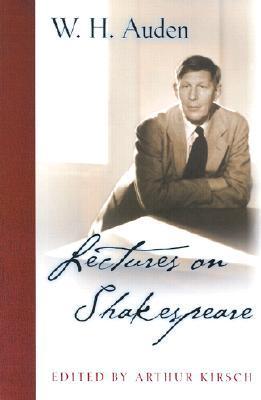
"W. H. Auden, poet and critic, will conduct a course on Shakespeare at the New School for Social Research beginning Wednesday. Mr. Auden has announced that in his course . . . he proposes to read all Shakespeare's plays in chronological order." The New York Times reported this item on September 27, 1946, giving notice of a rare opportunity to hear one of the century's great poets comment on one of the greatest poets of all time. Published here for the first time, these lectures now make Auden's thoughts on Shakespeare available widely.Painstakingly reconstructed by Arthur Kirsch from the notes of students who attended, primarily Alan Ansen, who became Auden's secretary and friend, the lectures afford remarkable insights into Shakespeare's plays as well as the sonnets.A remarkable lecturer, Auden could inspire his listeners to great feats of recall and dictation. Consequently, the poet's unique voice, often down to the precise details of his phrasing, speaks clearly and eloquently throughout this volume. In these lectures, we hear Auden alluding to authors from Homer, Dante, and St. Augustine to Kierkegaard, Ibsen, and T. S. Eliot, drawing upon the full range of European literature and opera, and referring to the day's newspapers and magazines, movies and cartoons. The result is an extended instance of the "live conversation" that Auden believed criticism to be. Notably a conversation between Auden's capacious thought and the work of Shakespeare, these lectures are also a prelude to many ideas developed in Auden's later prose--a prose in which, one critic has remarked, "all the artists of the past are alive and talking among themselves."Reflecting the twentieth-century poet's lifelong engagement with the crowning masterpieces of English literature, these lectures add immeasurably to both our understanding of Auden and our appreciation of Shakespeare.

W. H. Auden (1907-73) came to prominence in the 1930s among a generation of outspoken poets that included his friends Louis MacNeice, Stephen Spender and C. Day Lewis. But he was also an intimate and lyrical poet of great originality, and a master craftsman of some of the most cherished and influential poems of the past century. Other volumes in this series "Betjemen", "Eliot", "Plath", "Hughes" and "Yeats".

Acostumbrado al clima de Nueva York, tan familiarizado con su contaminada niebla, a ti, su inmaculada Hermana, te tenía olvidada por completo, a ti y a cuanto aportas al invierno británico. Ahora, esa impresión nativa vuelve a mí. Enemiga implacable de la prisa, amedrentadora de conductores y de aviones, todo lo veloz, desde luego, te maldecirá, pero cuánto me agrada que hayas sido persuadida a visitar el hechizado campo de Wiltshire a lo largo de toda una semana en estas Navidades, evitando que a alguno le diese por venir aquí donde mi mundo se reduce a esta vieja casa solariega en la que gozamos de la amistad nosotros Jimmy, Tania, Sonia y yo. "Gracias, niebla" de W. H. Auden. W. H. Auden (York, 1907 - Viena, 1973) es, sin duda, uno de los mayores poetas del siglo XX. Tanto en su etapa inglesa, izquierdista y de poemas vigorosos, claros, breves y llenos de encanto, como en una segunda, estadounidense, en la que amplía el poema en extensión y en pensamiento o miras religiosas –dos etapas que tienen en común la elegancia de su técnica y el frecuente sentido del humor–, Auden fue un renovador de la poesía en inglés, a la que aporta versatilidad, lenguaje coloquial y estilo “mandarín”, perplejidad y certeza, naturaleza y reflexión urbana. Thank You, Fog se publicó en 1974, al año siguiente de la muerte de W. H. Auden. El autor ya había fijado el título del libro y su dedicatoria, pero no se trataba aún de un libro concluido. Thank You, Fog contiene los poemas que Auden escribió tras dejar Nueva York en la primavera de 1972 y regresar a su Inglaterra nativa.


Auden's electrifying, enigmatic debut collection, entitled Poems, was published by Faber in 1930. For the second edition (1933) Auden replaced seven of the poems with new poems. The present edition follows the 1933 text.'The rhythmic disjunctions in Auden's lines, the fractured elements of narrative or argument, are wakenings to a new reality, lyric equivalents of the fault Auden intuited in the life of his times ... He arrived at a mode that was stricken with premonitions of an awful thing and was adequate to give expression to those premonitions by strictly poetic means.' Seamus Heaney

Il contratto preparato nell'estate del 1937 da Faber and Faber e da Random House riguardava un generico "libro di viaggio sull'Estremo Oriente" e lasciava alla discrezione di Auden e Isherwood la scelta dell'itinerario e il taglio del resoconto. Ma è certo che la decisione, da parte della strana coppia di reporter, di partire per la Cina - allora in guerra col Giappone non fu delle più ovvie. Di fatto, per quanto in quegli anni l'intelligencija europea frequentasse con una certa assiduità trincee e teatri d'operazioni, nessuno aveva rivolto lo sguardo a quello che - nonostante le dimensioni, la ferocia e le implicazioni che avrebbe avuto per la storia non solo regionale era un conflitto quasi dimenticato. Che Auden e Isherwood ci fanno invece rivivere nel momento stesso in cui accade, con un'immediatezza, una precisione e un'efficacia tanto più sbalorditive se si considera che del Paese in cui soggiornarono dal gennaio al luglio del 1938 i due, per loro stessa ammissione, sapevano molto poco, e soprattutto che la forma da loro adottata un ibrido di prosa, versi e fotografie - era, ed è rimasta, un unicum.

In this series, a contemporary poet advocates a poet of the past or present whom they have particularly admired. By their selection of verses and by the personal and critical reactions they express, the selectors offer intriguing insight into their own work.

One of the modern masters of the extended poem, W. H. Auden has selected for this volume the longer poems he originally published between 1930 and 1947, which are among his most enduring achievements, both for their technical virtuosity and for the emotional and intellectual precision with which he dissects the spiritual illnesses of our times. Collected Longer Poems includes Paid on Both Sides, Letter to Lord Byron, For the Time Being, The Sea and the Mirror, and The Age of Anxiety.With its companion volume, Collected Shorter Poems, published by Random House in 1967, this collection represents all of his past work that Auden wishes to preserve.This edition is set from the first American edition of 1969 and commemorates the seventy-fifth anniversary of Random House.

Owner name on stamp on end page. Slight foxing to edges. Pages are clean and binding is tight.


All of Auden's books of poems from the 1930s, including previously unpublished poems, are augmented by selections from his essays, reviews, film scripts, and stage and radio plays of the same period

"Between 1927 and his death in 1973, W. H. Auden endowed poetry in the English language with a new face. Or rather, with several faces, since his work ranged from the political to the religious, from the urbane to the pastoral, from the mandarin to the invigoratingly plain-spoken. This collection presents all the poems Auden wished to preserve, in the texts that received his final approval. It includes the full contents of his previous collected editions along with all the later volumes of his shorter poems. Together, these works display the astonishing range of Auden's voice and the breadth of his concerns, his deep knowledge of the traditions he inherited, and his ability to recast those traditions in modern times."
The essays in this collection were written as reviews, mainly for The New York Review of Books and The New Yorker, on books by or about Alexander Pope, Vincent van Gogh, Thomas Mann, Virginia Woolf, Oscar Wilde, and A. E. Housman, or as introductions to editions of the classical Greek writers, the Protestant mystics, Shakespeare, Goethe, Kierkegaard, Tennyson, Grimm and Andersen, Poe, G. K. Chesterton, Paul Valéry, and others. Throughout, these prose pieces reveal the same wit and intelligence—as well as the vision—that sparked the brilliance of Auden's poetry.

W.H. Auden is unquestionably one of the most fascinating and influential literary figures of the twentieth century. His formal innovations in poetry and drama have immeasurably affected modern literary consciousness, as have his reactive views about political and literary trends. At the time he wrote The Prolific and the Devourer, Auden was moving away from his vocal Marxism of the 1930s toward a committed Christianity in the 1940s and beyond. The Prolific and the Devourer sheds new light on the personal and public worlds he inhabited, philosophically drawing the line between the position of the artist and that of the politician.The book takes its title and, in part, its form from William Blake's The Marriage of Heaven and Hell. In Auden's interpretation, the Prolific are those who the farmer; the skilled worker; the scientist; the cook; the innkeeper; the doctor; the teacher; the athlete; the artist. The Devourers are the political types who depend on what is already produced for their the "Judges, Policemen, Critics. These are the real Lower Orders, the low, sly lives, whom no decent person should receive in his house." As in Blake, the sections and subsections of Auden's book are unified and propelled by the oracular need to express the key components of human nature.The first section contains a series of aphoristic statements and personal reflections that usher us into the enormous territory to be explored. In the second section, Auden chooses examples from politics, religion, and literature to expound his views on human and historical evolution. The third section examines the characters of the Prolific and the Devourer in relation to Catholic, Protestant, and Romantic traditions and to Socialist and Fascist beliefs. The question and answer form employed in the final section allows Auden to reveal his inner struggle to reach some understanding of God, the supernatural, and pacifism.At a time when spiritual and political values are constantly at odds, with the frequent result of violence, the questions of "being" Auden addresses in this book are highly topical - and his insights, invaluable. The Prolific and the Devourer acts as a tribute to the artistic vocation it describes - remarkable in its visionary breadth and craft.

Lectures delivered at University of Virginia in March, 1949. In these three essays Auden discusses the pre-suppositions of romantic and nineteenth-century, their conceptions of God, society and the heroic individual through an analysis of their treatment of a single theme, the sea.
Only 150 copies of this poem exist. Beginning with a series of seemingly fragmented stanzas on politics, it coalesces into a rumination on the aftermath of a conflict between the "patriots" and the monarchs.Engravings by Laurence Scott