
W.G. Sebald
Winfried Georg Maximilian Sebald was a German writer and academic. His works are largely concerned with the themes of memory, loss of memory, and identity (both personal and collective) and decay (of civilizations, traditions or physical objects). They are, in particular, attempts to reconcile himself with, and deal in literary terms with, the trauma of the Second World War and its effect on the German people. At the time of his death at the age of only 57, he was being cited by many literary critics as one of the greatest living authors, and was tipped as a possible future recipient of the Nobel Prize in Literature.
29 Books Written

Three Book Sebald Set: The Emigrants, The Rings of Saturn, and Vertigo
by W.G. Sebald
Rating: 4.6 ⭐
• 2 recommendations ❤️
The masterworks of W. G. Sebald, now in gorgeous new covers by the famed designer Peter Mendelsund New Directions is delighted to announce beautiful new editions of these three classic Sebald novels, including his two greatest works, The Emigrants and The Rings of Saturn . All three novels are distinguished by their translations, every line of which Sebald himself made pitch-perfect, slaving to carry into English all his essential the shadows, the lambent fallings-back, nineteenth-century Germanic undertones, tragic elegiac notes, and his unique, quiet wit.

Austerlitz, the internationally acclaimed masterpiece, is the story of a man’s search for the answer to his life’s central riddle. A small child when he comes to England on a Kindertransport in the summer of 1939, one Jacques Austerlitz is told nothing of his real family by the Welsh Methodist minister and his wife who raise him. When he is a much older man, the fleeting memories return to him, and obeying an instinct he only dimly understands, he follows their trail back to the world he left behind a half century before. There, faced with the void at the heart of twentieth-century Europe, he struggles to rescue his heritage from oblivion.

The Rings of Saturn — with its curious archive of photographs — records a walking tour along the east coast of England. A few of the things which cross the path and mind of its narrator (who both is and is not Sebald) are lonely eccentrics, Sir Thomas Browne's skull, a matchstick model of the Temple of Jerusalem, recession-hit seaside towns, wooded hills, Joseph Conrad, Rembrandt's "Anatomy Lesson," the natural history of the herring, the massive bombings of WWII, the dowager empress Tzu Hsi, and the silk industry in Norwich.

At first The Emigrants appears simply to document the lives of four Jewish émigrés in the twentieth century. But gradually, as Sebald's precise, almost dreamlike prose begins to draw their stories, the four narrations merge into one overwhelming evocation of exile and loss.Written with a bone-dry sense of humour and a fascination with the oddness of existence The Emigrants is highly original in its heady mix of fact, memory and fiction and photographs.

Vertigo, W. G. Sebald's first novel, never before translated into English, is perhaps his most amazing and certainly his most alarming. Sebald—the acknowledged master of memory's uncanniness—takes the painful pleasures of unknowability to new intensities in Vertigo. Here in their first flowering are the signature elements of Sebald's hugely acclaimed novels The Emigrants and The Rings of Saturn. An unnamed narrator, beset by nervous ailments, is again our guide on a hair-raising journey through the past and across Europe, amid restless literary ghosts—Kafka, Stendhal, Casanova. In four dizzying sections, the narrator plunges the reader into vertigo, into that "swimming of the head," as Webster's defines it: in other words, into that state so unsettling, so fascinating, and so "stunning and strange," as The New York Times Book Review declared about The Emigrants, that it is "like a dream you want to last forever."

W.G. Sebald completed this controversial book before his death in December 2001. On the Natural History of Destruction is his harrowing and precise investigation of one of the least examined silences of our time. In it, the novelist examines the devastation of German cities by Allied bombardment and the reasons for the astonishing absence of this unprecedented trauma from German history and culture. This historical void is in part a repression of things -- such as the death by fire of the city of Hamburg at the hands of the RAF -- too terrible to bear. But rather than record the crises about them, writers sought to retrospectively justify their actions under the Nazis. For Sebald, this is an example of deliberate cultural amnesia. His analysis of its effects in and outside Germany has already provoked angry painful debate. Sebald's novels are rooted in meticulous observation. His essays are novelistic. They include his childhood recollections of the war that spurred his horror at the collective amnesia around him. There are moments of black humor and, throughout, the sensitivity of his intelligence. This book is a study of suffering and forgetting, of the morality hidden in artistic decisions, and of both compromised and genuine heroics.

After Nature, W. G. Sebald’s first literary work, now translated into English by Michael Hamburger, explores the lives of three men connected by their restless questioning of humankind’s place in the natural world. From the efforts of each, “an order arises, in places beautiful and comforting, though more cruel, too, than the previous state of ignorance.” The first figure is the great German Renaissance painter Matthias Grünewald. The second is the Enlightenment botanist-explorer Georg Steller, who accompanied Bering to the Arctic. The third is the author himself, who describes his wanderings amongst the landscapes scarred by the wrecked certainties of previous ages.After Nature introduces many of the themes that W. G. Sebald explored in his subsequent books. A haunting vision of the waxing and waning tides of birth and devastation that lie behind and before us, it confirms the author’s position as one of the most profound and original writers of our time.
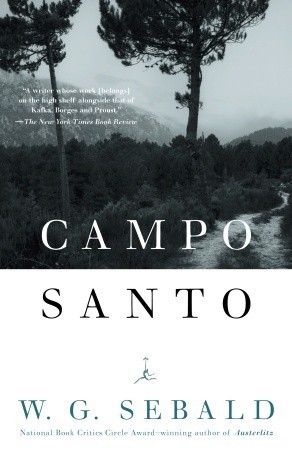
“W. G. Sebald exemplified the best kind of cosmopolitan literary intelligence–humane, digressive, deeply erudite, unassuming and tinged with melancholy. . . . In [Campo Santo] Sebald reveals his distinctive tone, as his winding sentences gradually mingle together curiosity and plangency, learning and self-revelation. . . . [Readers will] be rewarded with unexpected illuminations.”–The Washington Post Book WorldThis final collection of essays by W. G. Sebald offers profound ruminations on many themes common to his work–the power of memory and personal histories, the connections between images in the arts and life, the presence of ghosts in places and artifacts. Some of these pieces pay homage to the Mediterranean island of Corsica, weaving elegiacally between past and present, examining, among other things, the island’s formative effect on its most famous citizen, Napoleon. In others, Sebald examines how the works of Günter Grass and Heinrich Böll reveal “the grave and lasting deformities in the emotional lives” of postwar Germans; how Kafka echoes Sebald’s own interest in spirit presences among mortal beings; and how literature can be an attempt at restitution for the injustices of the real world.Dazzling in its erudition, accessible in its deep emotion, Campo Santo confirms Sebald’s status as one of the great modern writers who divined and expressed the invisible connections that determine our lives.

When W.G. Sebald travelled to Manchester in 1966, he packed in his bags certain literary favourites which would remain central to him throughout the rest of his life and during the years when he was settled in England. In A Place in the Country, he reflects on the six of the figures who shaped him as a person and as a writer, including Jean-Jacques Rousseau, Robert Walser and Jan Peter Tripp.Fusing biography and essay, and finding, as ever, inspiration in place – as when he journeys to the Ile St. Pierre, the tiny, lonely Swiss island where Jean-Jacques Rousseau found solace and inspiration – Sebald lovingly brings his subjects to life in his distinctive, inimitable voice.A Place in the Country is a window into the mind of this much loved and much missed writer.

A publishing landmark—the first major collection of poems by one of the late twentieth century’s literary masters German-born W. G. Sebald is best known as the innovative author of Austerlitz, the prose classic of World War II culpability and conscience that The Guardian called “a new literary form, part hybrid novel, part memoir, part travelogue.” Its publication put Sebald in the company of Nabokov, Calvino, and Borges. Yet Sebald’s brilliance as a poet has been largely unacknowledged—until now. Skillfully translated by Iain Galbraith, the nearly one hundred poems in Across the Land and the Water range from those Sebald wrote as a student in the sixties to those completed right before his untimely death in 2001. Featuring eighty-eight poems published in English for the first time and thirty-three from unpublished manuscripts, this collection also brings together all the verse he placed in books and journals during his lifetime. Here are Sebald’s trademark themes—from nature and history (“Events of war within/a life cracks/across the Order of the World/spreading from Cassiopeia/a diffuse pain reaching into/the upturned leaves on the trees”), to wandering and wondering (“I have even begun/to speak in foreign tongues/roaming like a nomad in my own/town . . .”), to oblivion and memory (“If you knew every cranny/of my heart/you would yet be ignorant/of the pain my happy/memories bring”). Soaring and searing, the poetry of W. G. Sebald is an indelible addition to his superb body of work, and this unique collection is bound to become a classic in its own right.

For a number of years until his death in 2001, W. G. Sebald and the German artist, Jan Peter Tripp exchanged poems and lithographs. Unrecounted is the result of this long artistic friendship a creative dialogue inspired by shared concerns. Sebald's words and Tripp's images speak of moments salvaged from time passing, of our eyes bearing witness, and of memory and remembrance.

W. G. Sebald menehtyi auto-onnettomuudessa vuonna 2001, juuri Austerlitzin ilmestyttyä. Joitakin vuosia aiemmin hän oli aloittanut kirjan Korsikasta, mutta se oli jäänyt syrjään muiden töiden tieltä.Merkintöjä Korsikasta on todennäköisesti tämän kirjan ydin: neljän fragmentaarisen tekstin sikermä muistamisesta ja kuolemasta. Kulttikirjailijalla on ainutlaatuinen kyky yhdistää historiaa ja nykypäivää, viedä lukija huikeille aikamatkoille ja lumota tämä melankolisella viisaudellaan.Sisältää tekstit Pieni retki Ajaccioon (Kleine Exkursion nach Ajaccio), Campo Santo, Alpit merellä (Die Alpen im Meer) ja La cour de l'ancienne école.

Sulle tracce di Robert Walser.Il passeggiatore solitario è apparso per la prima volta nel volume Soggiorno in una casa di campagna .

This work is a collaboration between two artists. It contains 23 short poems by W.G. Sebald, each of them paired with a related image by Tess Jaray. The oblique nature of his poems complements the tension and weightlessness of her works.'A potent, haunting marriage of poetry and art' Richard Cork The Times'Sebald is a rare and elusive species' Anthony Lane, The New Yorker'Jaray has an extraordinary power to purify the way we see things' Patricia Morison, The Daily Telegraph'This isn't art that is about poetry, it's art that is poetry'Charles Darwent, Independent on Sunday

As a German in self-chosen exile from his country of birth, Sebald found a particular affinity with these writers from a neighbouring nation. The traumatic evolution of Austria from vast empire to diminutive Alpine republic, followed by its annexation by Germany, meant that concepts such as ‘home/land’, ‘borderland’ and ‘exile’ occupy a prominent role in its literature, just as they would in Sebald’s own. Through a series of remarkable close readings of texts by Bernhard, Stifter, Kafka, Handke, Roth and more, Sebald charts both the pathologies which so often drove their work and the seismic historical forces which shaped them. This sequence of essays will be a revelation to Sebald’s English-language readers, tracing as they do so many of the themes which animate his own literary writings, to which these essays form a kind of prelude.

Zamieszczone w niniejszym tomie eseje pochodzą z trzech książek W.G. Sebalda: Die Beschreibung des Unglücks (1985), Unheimliche Heimat (1991) i Logis in einem Landhaus (1998). Obiektami dociekań i interpretacji albo bohaterami esejów niemieckiego autora są m.in. Arthur Schnitzler, Franz Kafka, Elias Canetti, Thomas Bernhard, Joseph Roth, Jean Améry, Jean-Jacques Rousseau, Gottfried Keller, Robert Walser, a do grona pisarzy dołącza Jan Peter Tripp, malarz i szkolny kolega Sebalda; osobny szkic został poświęcony fenomenowi pierwszych autorów żydowskich tworzących w języku niemieckim, takich jak Leopold Kompert i Karl Emil Franzos.W pierwszej części tomu Sebald przygląda się głównie literaturze austriackiej, potem przechodzi do omawiania literackich indywidualności Szwajcarii. W swojej pracy korzysta na równi z kompetencji filologa i z licencji eseisty. Jako badacz, jako krytyk i jako pisarz jest bowiem przede wszystkim namiętnym czytelnikiem. Czyta uważnie, z bliska – wybiera z potoku narracji pojedynczą frazę i skupia się na jej szczególnym i złożonym znaczeniu. Porusza się po mapie literatury własnym szlakiem.Opis nieszczęścia to tytuł zapożyczony od pierwszego zbioru esejów pisarza. Formuła celnie uwydatnia to, co autora najbardziej interesuje w literaturze. W przedmowie do książki z 1985 roku Sebald pisał: Ci, którzy obierają zawód pisarza, z reguły nie zaliczają się do ludzi najbardziej niefrasobliwych. Jakże inaczej gotowi byliby wdawać się w niemożliwe zajęcie, polegające na poszukiwaniu prawdy? […] Opis nieszczęścia zawiera w sobie możliwość jego przezwyciężenia.

»Die Gefahr, daß man den Verstand verliert, ist nicht gering.« – Wer war W. G. Sebald?Dieser Band fasst zwanzig Gespräche mit W.G. Sebald zu einer ebenso informativen wie poetischen Bestandsaufnahme zusammen. Viele dieser mit wechselnden Interviewpartnern zwischen 1971 und seinem plötzlichen Tod im Jahr 2001 geführten Gespräche werden hier erstmals gedruckt. Sebald spricht darin über sich selbst und seine Bücher, aber auch über sein ungeschrieben gebliebenes Werk.Dies ist ein zentrales Buch, um Sebalds gesamtes Schreiben zu verstehen. Hier wird nicht nur über Literatur gesprochen, sondern zugleich weitererzählt.

L’origine della musicalità che tutti avvertono in Sebald colta nelle tracce autobiografiche di questa piccola raccolta di prose e di versi: un’infanzia nella Germania postbellica, una giovinezza in cui vanno gemmando temi e Leitmotiv di un’intera opera.

Die Beschreibung des Unglücks. Zur österreichischen Literatur von Stifter bis Handke
by W.G. Sebald
Rating: 4.1 ⭐
In diesen aufschlußreichen sowie brillant formulierten Essays zu Werken von Stifter, Schnitzler, Hofmannsthal und Kafka, von Canetti, Bernhard, Handke, Ernst Herbeck und Gerhard Roth gelingt es dem Schriftsteller und Literaturwissenschaftler Sebald, einige bislang oft wenig beachtete Merkmale österreichischer Literatur ins Blickfeld zu rücken. Im Mittelpunkt seiner Analysen stehen die psychischen Voraussetzungen des Schreibens, insbesondere »das Unglück des schreibenden Subjekts«, mit dem Sebald die eigentümliche Schwermut in der österreichischen Literatur zu erklären versucht. Einfühlsam geht er der Frage nach, inwiefern persönliche Existenznöte, aber auch historische und politische Kalamitäten das Schreiben dieser österreichischen Autoren jeweils beeinflußt haben, und folgert: »Die Beschreibung des Unglücks schließt in sich die Möglichkeit zu seiner Überwindung ein«.

I W.G. Sebalds dikter möter oss ett språkligt landskap vars betydelser är lika oroande som svårfångade. Ofta tar texterna formen av notiser gjorda under vandringar, bilfärder eller tågresor, och de miljöer där jaget rör sig tycks ömsom skrämmande, ömsom lätt humoristiska i sin absurditet. Till hälften dold av dimmor och rök framträder en värld där betraktaren alltid är en främling; där ekon ur Europas traumatiska förflutna blandas med antik mytologi; där Tjechov, Goethe och Kafka trängs med fåglar, elefanter och fabeldjur; och där döden ständigt skymtar på andra sidan vattnet.Sebalds egenartade poesi har länge varit en välbevarad hemlighet i skuggan av hans romaner och berättelser. I Bokstavsspåret samlas ett urval av hans dikter på svenska för första gången. Här kan läsaren följa Sebalds väg från de första publikationerna i tjugoårsåldern till de allra sista texter han lämnade till tryck före sin död.Översättning Axel Englund.

Samlingvolym : Efter naturen / Svindel, känslor / Utvandrade / Saturnus ringar / Austerlitz / Luftkrig och litteratur

Une mise en rsonance de 33 lithographies de Jan Peter Tripp et de pomes courts, proches par leur forme du haku, de W.G. Sebald.




The Complete Works of W.G. Sebald
by W.G. Sebald
EXCELLENT CLASSIC LITERATURE BOOK, WITH ILLUSTRATIONS.

Wandernde Schatten | W G Sebalds Unterwelt
by W.G. Sebald
146p paperback with blue cover, excellent condition, spine not creased, no names or stamps, first edition, hard to find title

鄙の宿
by W.G. Sebald