
Vladimir Nabokov
Russian: Владимир Набоков . Vladimir Vladimirovich Nabokov, also known by the pen name Vladimir Sirin, was a Russian-American novelist. Nabokov wrote his first nine novels in Russian, then rose to international prominence as a master English prose stylist. He also made significant contributions to lepidoptery, and had a big interest in chess problems. Nabokov's Lolita (1955) is frequently cited as his most important novel, and is at any rate his most widely known one, exhibiting the love of intricate wordplay and descriptive detail that characterized all his works. Lolita was ranked fourth in the list of the Modern Library 100 Best Novels; Pale Fire (1962) was ranked 53rd on the same list, and his memoir, Speak, Memory (1951), was listed eighth on the publisher's list of the 20th century's greatest nonfiction. He was also a finalist for the National Book Award for Fiction seven times.
29 Books Written

The most famous and controversial novel from one of the greatest writers of the twentieth century tells the story of Humbert Humbert’s obsessive, devouring, and doomed passion for the nymphet Dolores Haze.Awe and exhilaration—along with heartbreak and mordant wit—abound in Lolita, which tells the story of the aging Humbert Humbert’s obsession for the nymphet Dolores Haze. Lolita is also the story of a hypercivilized European colliding with the cheerful barbarism of postwar America.Most of all, it is a meditation on love—love as outrage and hallucination, madness and transformation.

From the writer who shocked and delighted the world with his novels Lolita, Pale Fire, and Ada, or Ardor, and so many others, comes a magnificent collection of stories. Written between the 1920s and 1950s, these sixty-five tales--eleven of which have been translated into English for the first time--display all the shades of Nabokov's imagination. They range from sprightly fables to bittersweet tales of loss, from claustrophobic exercises in horror to a connoisseur's samplings of the table of human folly. Read as a whole, The Stories of Vladimir Nabokov offers and intoxicating draft of the master's genius, his devious wit, and his ability to turn language into an instrument of ecstasy.The wood-sprite --Russian spoken here --Sounds --Wingstroke --Gods --A matter of chance --The seaport --Revenge --Beneficence --Details of a sunset --The thunderstorm --La veneziana --Bachmann --The dragon --Christmas --A letter that never reached Russia --The fight --The return of Chorb --A guide to Berlin --A nursery tale --Terror --Razor --The passenger --The doorbell --An affair of honor --The Christmas story --The potato elf --The aurelian --A dashing fellow --A bad day --The visit to the museum --A busy man --Terra incognita --The reunion --Lips to lips --Orache --Music --Perfection --The admiralty spire --The Leonardo --In memory of L.I. Shigaev --The circle --A Russian beauty --Breaking the news --Torpid smoke --Recruiting --A slice of life --Spring in Fialta --Cloud, castle, lake --Tyrants destroyed --Lik --Mademoiselle O --Vasiliy Shishkov --Ultima Thule --Solus Rex --The assistant producer --That in aleppo once --A forgotten poet --Time and ebb --Conversation piece, 1945 --Signs and symbols --First love --Scenes from the life of a double monster --The Vane sisters --Lance.

The first novel Nabokov wrote while living in America and the most overtly political novel he ever wrote, Bend Sinister is a modern classic. While it is filled with veiled puns and characteristically delightful wordplay, it is, first and foremost, a haunting and compelling narrative about a civilized man caught in the tyranny of a police state. It is first and foremost a compelling narrative about a civilized man and his child caught up in the tyranny of a police state. Professor Adam Krug, the country's foremost philosopher, offers the only hope of resistance to Paduk, dictator and leader of the Party of the Average Man. In a folly of bureaucratic bungling and ineptitude, the government attempts to co-opt Krug's support in order to validate the new regime.

In Pale Fire Nabokov offers a cornucopia of deceptive pleasures: a 999-line poem by the reclusive genius John Shade; an adoring foreword and commentary by Shade's self-styled Boswell, Dr. Charles Kinbote; a darkly comic novel of suspense, literary idolatry and one-upmanship, and political intrigue.

An older cover sharing this ISBN may be found here.From one of the 20th century's great writers comes one of the finest autobiographies of our time. Speak, Memory, first published in 1951 as Conclusive Evidence and then assiduously revised in 1966, is an elegant and rich evocation of Nabokov’s life and times, even as it offers incisive insights into his major works, including Lolita, Pnin, Despair, The Gift, The Real Life of Sebastian Knight, and The Luhzin Defense.One of the 20th century’s master prose stylists, Vladimir Nabokov was born in St. Petersburg in 1899. He studied French and Russian literature at Trinity College, Cambridge, then lived in Berlin and Paris, where he launched a brilliant literary career. In 1940 he moved to the United States, and achieved renown as a novelist, poet, critic, and translator. He taught literature at Wellesley, Stanford, Cornell, and Harvard. In 1961 he moved to Montreux, Switzerland, where he died in 1977.
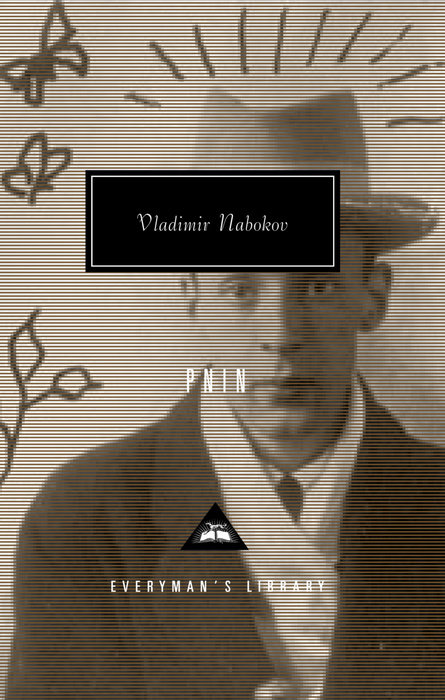
One of the best-loved of Nabokov’s novels, Pnin features his funniest and most heart-rending character. Professor Timofey Pnin is a haplessly disoriented Russian émigré precariously employed on an American college campus in the 1950's. Pnin struggles to maintain his dignity through a series of comic and sad misunderstandings, all the while falling victim both to subtle academic conspiracies and to the manipulations of a deliberately unreliable narrator.Initially an almost grotesquely comic figure, Pnin gradually grows in stature by contrast with those who laugh at him. Whether taking the wrong train to deliver a lecture in a language he has not mastered or throwing a faculty party during which he learns he is losing his job, the gently preposterous hero of this enchanting novel evokes the reader’s deepest protective instinct.Serialized in The New Yorker and published in book form in 1957, Pnin brought Nabokov both his first National Book Award nomination and hitherto unprecedented popularity.
"Once upon a time there lived in Berlin, Germany, a man called Albinus. He was rich, respectable, happy; one day he abandoned his wife for the sake of a youthful mistress; he loved; was not loved; and his life ended in disaster." Thus begins Vladimir Nabokov's Laughter in the Dark; this, the author tells us, is the whole story except that he starts from here, with his characteristic dazzling skill and irony, and brilliantly turns a fable into a chilling, original novel of folly and destruction. Amidst a Weimar-era milieu of silent film stars, artists, and aspirants, Nabokov creates a merciless masterwork as Albinus, an aging critic, falls prey to his own desires, to his teenage mistress, and to Axel Rex, the scheming rival for her affections who finds his greatest joy in the downfall of others. Published first in Russian as Kamera Obskura in 1932, this book appeared in Nabokov's own English translation six years later. This New Directions edition, based on the text as Nabokov revised it in 1960, features a new introduction by Booker Prize-winner John Banville.
An alternative cover edition for this ISBN can be found hereLike Kafka's The Castle, Invitation to a Beheading embodies a vision of a bizarre and irrational world. In an unnamed dream country, the young man Cincinnatus C. is condemned to death by beheading for "gnostical turpitude", an imaginary crime that defies definition. Cincinnatus spends his final days in an absurd jail, where he is visited by chimerical jailers, an executioner who masquerades as a fellow prisoner, and by his in-laws, who lug their furniture with them into his prison cell.

A chilling story of obsession and madness. Luzhin, a distracted, withdrawn boy, takes up chess as a refuge from everyday life. As he rises to the heights of grandmaster, the game of chess gradually supplants the world of reality as he moves inexorably towards madness.
Published two weeks after his seventieth birthday, Ada, or Ardor is one of Nabokov's greatest masterpieces, the glorious culmination of his career as a novelist. It tells a love story troubled by incest. But more: it is also at once a fairy tale, epic, philosophical treatise on the nature of time, parody of the history of the novel, and erotic catalogue. Ada, or Ardor is no less than the superb work of an imagination at white heat.This is the first American edition to include the extensive and ingeniously sardonic appendix by the author, written under the anagrammatic pseudonym Vivian Darkbloom.

Extensively revised by Nabokov in 1965 - thirty years after its original publication -Despair is the wickedly inventive and richly derisive story of Hermann Karlovich, a man who undertakes the perfect crime - his own murder.

Mary is a gripping tale of youth, first love, and nostalgia--Nabokov's first novel. In a Berlin rooming house filled with an assortment of seriocomic Russian émigrés, Lev Ganin, a vigorous young officer poised between his past and his future, relives his first love affair. His memories of Mary are suffused with the freshness of youth and the idyllic ambience of pre-revolutionary Russia. In stark contrast is the decidedly unappealing boarder living in the room next to Ganin's, who, he discovers, is Mary's husband, temporarily separated from her by the Revolution but expecting her imminent arrival from Russia.

Nabokov's fourth novel, The Eye is as much a farcical detective story as it is a profoundly refractive tale about the vicissitudes of identities and appearances. Nabokov's protagonist, Smurov, is a lovelorn, excruciatingly self-conscious Russian émigré living in pre-war Berlin, who takes his own life after being humiliated by a jealous husband, only to suffer even greater indignities in the afterlife.
The Real Life of Sebastian Knight is a perversely magical literary detective story - subtle, intricate, leading to a tantalizing climax - about the mysterious life of a famous writer. Many people knew things about Sebastian Knight as a distinguished novelist, but probably fewer than a dozen knew of the two love affairs that so profoundly influenced his career, the second one in such a disastrous way. After Knight's death, his half brother sets out to penetrate the enigma of his life, starting with a few scanty clues in the novelist's private papers. His search proves to be a story of mystery and intrigue as any of his subject's own novels, as baffling, and, in the end, as uniquely rewarding.

'Of all my novels this bright brute is the gayest', Nabokov wrote of King, Queen, Knave. Comic, sensual and cerebral, it dramatizes an Oedipal love triangle, a tragi-comedy of husband, wife and lover, through Dreyer the rich businessman, his ripe-lipped ad mercenary wife Martha, and their bespectacled nephew Franz. 'If a resolute Freudian manages to slip in' - Nabokov darts a glance to the reader - 'he or she should be warned that a number of cruel traps have been set up here and there'.

The Gift is the last of the novels Nabokov wrote in his native Russian and the crowning achievement of that period in his literary career. It is also his ode to Russian literature, evoking the works of Pushkin, Gogol, and others in the course of its narrative: the story of Fyodor Godunov-Cherdyntsev, an impoverished émigré poet living in Berlin, who dreams of the book he will someday write--a book very much like The Gift itself.

Nabokov described this novella, written in Paris in 1939 but only published twenty years later, as 'the first little throb of Lolita'. The plot is similar: a middle-aged man wedding an unattractive widow in order to indulge his paedophilic obsession with her daughter.However, The Enchanter has an utterly different atmosphere, as time, place and even names remain a mystery. Nabokov transforms his protagonist's attempts to lull his twelve-year-old step-daughter into a state of 'enchantment' into a graceful, chilling fairytale.
"Transparent Things revolves around the four visits of the hero - sullen, gawky Hugh Person - to Switzerland... As a young publisher, Hugh is sent to interview R., falls in love with Armande on the way, wrests her, after multiple humiliations, from a grinning Scandinavian and returns to NY with his bride... Eight years later - following a murder, a period of madness and a brief imprisonment - Hugh makes a lone sentimental journey to wheedle out his past... The several strands of dream, memory, and time [are] set off against the literary theorizing of R. and, more centrally, against the world of observable objects." Martin Amis

Glory is the wryly ironic story of Martin Edelweiss, a twenty-two-year-old Russian émigré of no account, who is in love with a girl who refuses to marry him. "The themes we associate with Nabokov — the romance of emigres, sexual frustration, the nostalgia of youth — shine again, sorrowfully or blithely, but always adding an illuminating dimension to what went before or what comes after." - Kirkus ReviewsConvinced that his life is about to be wasted and hoping to impress his love, Martin embarks on a "perilous, daredevil project"--an illegal attempt to re-enter the Soviet Union, from which he and his mother had fled in 1919. He succeeds--but at a terrible cost.
For two decades, first at Wellesley and then at Cornell, Nabokov introduced undergraduates to the delights of great fiction. Here, collected for the first time, are his famous lectures, which include Mansfield Park, Bleak House, and Ulysses. Edited and with a Foreword by Fredson Bowers; Introduction by John Updike; illustrations.

"For the fourth time in as many years they were confronted with the problem of what birthday present to bring a young man who was incurably deranged in his mind..." Signs and Symbols is a short story centering on the severe mental debility of a young man and on the struggle of his elderly parents to cope with it. It was first published in the May 15, 1948, issue of The New Yorker magazine. Before publishing the story, the editors of the magazine changed the title to "Symbols and Signs." After the story appeared, Nabokov changed the title back to its original wording.Vladimir Nabokov, also known as Vladimir Sirin, was a Russian-American novelist. Nabokov wrote his first nine novels in Russian, then rose to international prominence as a master English prose stylist. He also made significant contributions to lepidoptery (The study and collection of moths & butterflies), and had a big interest in chess problems. Nabokov's Lolita (1955) is frequently cited as his most important novel, and is at any rate his most widely known one, exhibiting the love of intricate wordplay and descriptive detail that characterized all his works.
The author’s observations on the great nineteenth-century Russian writers-Chekhov, Dostoevsky, Gogol, Gorky, Tolstoy, and Turgenev. “This volume... never once fails to instruct and stimulate. This is a great Russian talking of great Russians” (Anthony Burgess). Edited and with an Introduction by Fredson Bowers; illustrations.

Focusing on the central figures of his life--his four wives, his books, and his muse, Dementia--the book leads us to suspect that the fictions Vadim has created as an author have crossed the line between his life's work and his life itself, as the worlds of reality and literary invention grow increasingly indistinguishable.

Nabokov's Dozen (1958) a collection of 13 short stories by Vladimir Nabokov previously published in American magazines. (Nine of them also previously appeared in Nine Stories.)All were later reprinted within The Stories of Vladimir Nabokov. Spring in Fialta --Forgotten poet --First love --Signs and symbols --Assistant producer --Aurelian --Cloud, castle, lake --Conversation piece, 1945 --"That in Aleppo once" --Time and ebb --Scenes from the life of a double monster --Mademoiselle O. --Lance.

When Vladimir Nabokov died in 1977, he left instructions for his heirs to burn the 138 handwritten index cards that made up the rough draft of his final and unfinished novel, "The Original of Laura." But Nabokov's wife, Vera, could not bear to destroy her husband's last work, and when she died, the fate of the manuscript fell to her son. Dmitri Nabokov, now seventy-five the Russian novelist's only surviving heir, and translator of many of his books has wrestled for three decades with the decision of whether to honor his father's wish or preserve for posterity the last piece of writing of one of the greatest writers of the twentieth century. His decision finally to allow publication of the fragmented narrative dark yet playful, preoccupied with mortality affords us one last experience of Nabokov's magnificent creativity, the quintessence of his unparalleled body of work. "Photos of the handwritten index cards accompany the text. They are perforated and can be removed and rearranged, as the author likely did when he was writing the novel. ""

The work of Gogol—one of the very greatest of Russia's literary geniuses—has become fairly well known in America but has seldom been properly understood. There have been many bad, but a few good, translations of his work available in English, and critics have often tended to put labels on him, to make him out "the Russian Dickens" or a forerunner of our own literary champions of the oppressed.In this brilliantly recreative study, Vladimir Nabokov shows us that Gogol's comedy was not Dickensian, but biting and salty, textured throughout by a use of the irrational not duplicated by any other writer; that, in his play The Government Inspector and his great novel Dead Souls , his depiction of the frauds of bureaucracy and the vagaries of Russian serf-owners were not so much intended to work social change as to serve as a framework for portraying the fantasies of the human spirit.Nabokov, whose own uniqueness is known through his novels Lolita and The Real Life of Sebastian Knight brings the uniqueness of Gogol to life—the strange, unhappy, self-deluding man and his singular literary methods and achievements.Nikolai Gogol was originally published by New Direction some years ago, when Edmund Wilson called it "one of the best volumes so far in the interesting series called 'Makers of the Modern Literature'." And B.G. Guerney said in the New Republic, "The creative reader (and student) who wishes to soar on Gogol's own wingéd-steed troika will choose Nabokov as his exhilarating courier."

GUARDIAN BOOKS OF THE YEAR 2014No marriage of a major twentieth-century writer lasted longer than Vladimir Nabokov's. Véra Slonim shared his delight at the enchantment of life's trifles and literature's treasures, and he rated her as having the best and quickest sense of humour of any woman he had met. From their meeting in 1921, Vladimir's letters to his beloved Véra form a narrative arc that tells a forty-six year-long love story, and they are memorable in their entirety. Almost always playful, romantic, and pithy, the letters tell us much about the man and the writer; we see that Vladimir observed everything, from animals, faces, speech, and landscapes with genuine fascination.

In this collection of interviews, articles, and editorials, Vladimir Nabokov ranges over his life, art, education, politics, literature, movies, and modern times, among other subjects. Strong Opinions offers his trenchant, witty, and always engaging views on everything from the Russian Revolution to the correct pronunciation of Lolita.

'The illegible signature of teetering disaster' Three great stories—"The Aurelian", "Signs and Symbols" and "Lance"—the last both a derisive attack on science-fiction and an attempt to imagine the real pain and horror that would accompany space travel.Penguin Modern: fifty new books celebrating the pioneering spirit of the iconic Penguin Modern Classics series, with each one offering a concentrated hit of its contemporary, international flavour. Here are authors ranging from Kathy Acker to James Baldwin, Truman Capote to Stanislaw Lem and George Orwell to Shirley Jackson; essays radical and inspiring; poems moving and disturbing; stories surreal and fabulous; taking us from the deep South to modern Japan, New York's underground scene to the farthest reaches of outer space.