
Victor Serge
Victor Lvovich Kibalchich (В.Л. Кибальчич) was born in exile in 1890 and died in exile in 1947. He is better known as Victor Serge, a Russian revolutionary and Francophone writer. Originally an anarchist, he joined the Bolsheviks five months after arriving in Petrograd in January 1919, and later worked for the newly founded Comintern as a journalist, editor and translator. He was openly critical of the Soviet regime, but remained loyal to the ideals of socialism until his death. After time spent in France, Belgium, Russia and Spain, Serge was forced to live out the rest of his life in Mexico, with no country he could call home. Serge's health had been badly damaged by his periods of imprisonment in France and Russia, but he continued to write until he died of heart attack, in Mexico city on 17 November 1947. Having no nationality, no Mexican cemetery could legally take his body, so he was buried as a 'Spanish Republican.'
29 Books Written

A New York Review Books Original Victor Serge is one of the great men of the 20th century —and one of its great writers too. He was an anarchist, an agitator, a revolutionary, an exile, a historian of his times, as well as a brilliant novelist, and in Memoirs of a Revolutionary he devotes all his passion and genius to describing this extraordinary—and exemplary—career. Serge tells of his upbringing among exiles and conspirators, of his involvement with the notorious Bonnot Gang and his years in prison, of his role in the Russian Revolution, and of the Revolution’s collapse into despotism and terror. Expelled from the Soviet Union, Serge went to Paris, where he evaded the KGB and the Nazis before fleeing to Mexico. Memoirs of a Revolutionary recounts a thrilling life on the front lines of history and includes vivid portraits not only of Trotsky, Lenin, and Stalin but of countless other figures who struggled to remake the world. Peter Sedgwick’s fine translation of Memoirs of a Revolutionary was abridged when first published in 1963. This is the first edition in English to present the entirety of Serge’s book.

Birth of Our Power is an epic novel set in Spain, France, and Russia during the heady revolutionary years 1917–1919. Serge’s tale begins in the spring of 1917, the third year of mass slaughter in the blood-and-rain-soaked trenches of World War I. When the flames of revolution suddenly erupt in Russia and Spain, Europe is “burning at both ends.” Although the Spanish uprising eventually fizzles, in Russia the workers, peasants, and common soldiers are able to take power and hold it. Serge’s “tale of two cities” is constructed from the opposition between Barcelona, the city “we” could not take, and Petrograd, the starving, beleaguered capital of the Russian Revolution besieged by counter-revolutionary Whites. Between the romanticism of radicalized workers awakening to their own power in a sun-drenched Spanish metropolis to the grim reality of workers clinging to power in Russia’s dark, frozen revolutionary outpost. From “victory in defeat” to “defeat in victory.” The novel was composed a decade after the revolution in Leningrad, where Serge was living in semicaptivity because of his declared opposition to Stalin’s dictatorship over the revolution.

Startlingly human and unflinchingly honest, this thinly veiled fictionalized firsthand account of talented political writer Victor Serge’s time in prison is an important addition to the canon of prison writing as well as an unfiltered view of humanity in the early 20th century. Rejecting the opportunity to present political propaganda, Serge’s portrayal of imprisonment is instead an insightful and emotionally wrought tale of repression. The depraving brutality that Serge experienced behind bars is at once a mirror of a society at war and a deeply personal question of purpose. Originally published in 1930 and translated from the French by Richard Greeman in 1977, this reprint makes a fascinating and compelling novel available again with a new introduction by Greeman that situates the work in the context of Serge’s life.

One cold Moscow night, Comrade Tulayev, a high government official, is shot dead in the street, and the search for his killer begins. In this panoramic vision of the Soviet Great Terror, the investigation leads all over the world, netting a whole series of suspects whose only connection is their innocence—at least of the crime of which they stand accused. But The Case of Comrade Tulayev, unquestionably the finest work of fiction ever written about the Stalinist purges, is not just a story of a totalitarian state. Marked by the deep humanity and generous spirit of its author, the legendary anarchist and exile Victor Serge, it is also a classic twentieth-century tale of risk, adventure, and unexpected nobility to sit beside Ernest Hemingway's For Whom the Bell Tolls and André Malraux's Man's Fate.

Unforgiving Years is a thrilling and terrifying journey into the disastrous, blazing core of the twentieth century. Victor Serge’s final work, here translated into English for the first time, is at once the most ambitious, bleakest, and most lyrical of this neglected major writer’s works.The novel is arranged into four sections, like the panels of an immense mural or the movements of a symphony. In the first, D, a lifelong revolutionary who has broken with the Communist Party and expects retribution at any moment, flees through the streets of prewar Paris, haunted by the ghosts of his past and his fears for the future. Part two finds D’s friend and fellow revolutionary Daria caught up in the defense of a besieged Leningrad, the horrors and heroism of which Serge brings to terrifying life. The third part is set in Germany. On a dangerous assignment behind the lines, Daria finds herself in a city destroyed by both Allied bombing and Nazism, where the populace now confronts the prospect of total defeat. The novel closes in Mexico, in a remote and prodigiously beautiful part of the New World where D and Daria are reunited, hoping that they may at last have escaped the grim reckonings of their modern era.A visionary novel, a political novel, a novel of adventure, passion, and ideas, of despair and, against all odds, of hope, Unforgiving Years is a rediscovered masterpiece by the author of The Case of Comrade Tulayev.

1919–1920: St. Petersburg, city of the czars, has fallen to the Revolution. Camped out in the splendid palaces of the former regime, the city’s new masters seek to cement their control, even as the counterrevolutionary White Army regroups. Conquered City, Victor Serge’s most unrelenting narrative, is structured like a detective story, one in which the new political regime tracks down and eliminates its enemies—the spies, speculators, and traitors hidden among the mass of common people. Conquered City is about terror: the Red Terror and the White Terror. But mainly about the Red, the Communists who have dared to pick up the weapons of power—police, guns, jails, spies, treachery—in the doomed gamble that by wielding them righteously, they can put an end to the need for terror, perhaps forever. Conquered City is their tragedy and testament.

Captures the desperation, anguish, and hope of men and women sentenced to deportation in Siberia, in a story set during Hitler's rise in Germany and Stalin's triumph in the Soviet Union

This extraordinary book reveals the many new possibilities released by the worker's revolution of 1917. Serge shows the forces that were to produce the Stalinist dictatorship...but also that this was far from inevitable.

What Every Radical Should Know About State Repression: A Guide for Activists
by Victor Serge
Rating: 4.1 ⭐
“Victor Serge is one of the unsung heroes of a corrupt century.”—Adam Hochschild, author of King Leopold’s Ghost Serge’s exposé of the methods of surveillance and harassment of political activists by the czarist police reads like a spy thriller. But as Dalia Hashad points out in her introduction, this book will have a resonance with political activists today who face a new wave of repression under the Patriot Act and racial profiling in the name of the “war on terror.” Victor Serge was born to Russian émigré parents in 1890. He wrote numerous novels, poems and political essays and was forced into exile for opposing Stalin’s rule. Dalia Hashad is an ACLU organizer in New York for the Campaign Against Racial Profiling.

Last Times, Victor Serge’s epic novel of the fall of France, is based—like much of his fiction—on firsthand experience. The author was an eyewitness to the last days of Paris in June 1940 and joined the chaotic mass exodus south to the unoccupied zone on foot with nothing but his manuscripts. He found himself trapped in Marseille under the Vichy government, a persecuted, stateless Russian, and participated in the early French Resistance before escaping on the last ship to the Americas in 1941.Exiled in Mexico City, Serge poured his recent experience into a fast-moving, gripping novel aimed at an American audience. The book begins in a near-deserted Paris abandoned by the government, the suburbs already noisy with gunfire. Serge’s anti-fascist protagonists join the flood of refugees fleeing south on foot, in cars loaded with household goods, on bikes, pushing carts and prams under the strafing Stukas, and finally make their way to wartime Marseille. Last Times offers a vivid eyewitness account of the city’s criminal underground and no less criminal Vichy authorities, of collaborators and of the growing resistance, of crowds of desperate refugees competing for the last visa and the last berth on the last—hoped-for—ship to the New World.
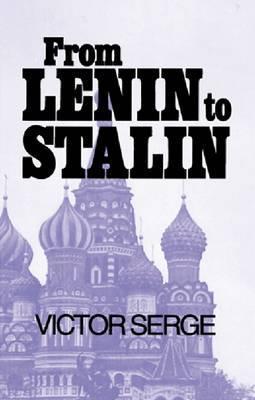
Eyewitness account of the rise of Stalinism.

Upon his arrival in Petrograd in 1919, Victor Serge—the great chronicler of the Russian Revolution—found a society nearly shattered by civil war. In these essays he sketches a portrait of the darkest hours faced by the fledgling revolution, defending the new regime against its critics.

A concise and authentic biography of Leon Trotsky written by his friend and associate in collaboration with Trotsky's widow. Serge had direct access to Trotsky's personal archives.

"Serge searingly evokes the epochal hopes and shattering setbacks of a generation of leftists."BookforumFollowing in the wake of the carnage reaped across Europe by world war, German workers undertook a struggle that would prove decisive in determining the course of the entire twentieth century. In 1923 the fledgling Comintern dispatched Victor Serge, with his peerless journalistic skills, to Berlin to expedite the German Revolution and write these moving reports from the battlefront.Victor Serge is best known as a novelist and for his Memoirs of a Revolutionary. Originally a participant in the anarchist movement, Serge became a committed bolshevik upon arrival in Russia in 1919 and lent his considerable talents to the cause of spreading the revolution across Europe. An eloquent critic of tyranny no matter its form, Serge was a leading member of the Left Opposition in its struggle against Stalin, a cause which ultimately resulted in his exile from Russia.

Victor Serge (1890–1947) played many parts, as he recounted in his indelible Memoirs of a Revolutionary. The son of anti-czarist exiles in Brussels, Serge was a young anarchist in Paris; a syndicalist rebel in Barcelona; a Bolshevik in Petrograd; a Comintern agent in Central Europe; a comrade of Trotsky’s; a friend of writers like Andrei Bely, Boris Pilnyak, and André Breton; a prisoner of Stalin; a dissident Marxist in exile in Mexico . . . A novelist, a literary critic, a political journalist, and a historian of the Russian Revolution, Serge was also a formidable poet. In A Blaze in a Desert: Selected Poems, Victor Serge bears witness to decades of revolutionary upheavals in Europe and the advent of totalitarian rule; many of the poems were written during the “immense shipwreck” of Stalin’s ascendancy. In poems datelined Petrograd, Orenburg, Paris, Marseille, the Caribbean, and Mexico, Serge composed elegies for the fallen who, like him, endured prison, exile, and bitter disappointment in the revolutions of the first half of the twentieth century: Night falls, the boat pulls in, stop singing. Exile relights its captive lampson the shore of time. A Blaze in a Desert comprises Victor Serge’s sole published book of poetry, Resistance (1938), his unpublished manuscript Messages (1946), and his last poem, “Hands” (1947).

An NYRB Classics OriginalVictor Serge’s Notebooks provide an intensely personal account of the last decade of the legendary Franco-Russian writer and revolutionary. Begun after Serge was liberated from Stalin’s Russia, they evoke Popular Front France, the fall of Paris, the “Surrealist Château” in Marseille, and the flight to the New World. They are replete with vivid life portraits (Gide, Breton, Saint-Exupéry, Lévi-Strauss), and moving evocations of fallen revolutionary comrades (Gramsci, Nin, Radek, Trotsky) and of doomed colleagues among the Soviet writers (Fedin, Pilniak, Mandelstam, Gorky).Serge’s Mexican notebooks provide a fascinating account of his exploration of pre-Columbian cultures, his preoccupation with earthquakes and volcanoes, and his sympathetic curiosity for the indigenous peasants. They also portray political and cultural figures in Mexico City, from the exiles’ psychoanalytic circle, to painters like Dr. Atl and Leonora Carrington and poets like Octavio Paz. These writings paint a vivid self-portrait and convey the intense loneliness Serge also felt in these years, cut off as he was from Europe, deprived of a political platform, prey to angina attacks, and anxiously in love with a younger woman.

Anarchists Never Surrender: Essays, Polemics, and Correspondence on Anarchism, 1908–1938
by Victor Serge
Rating: 3.5 ⭐
Anarchists Never Surrender provides a complete picture of Victor Serge’s relationship to anarchism. The volume contains writings going back to his teenage years in Brussels, where he became influenced by the doctrine of individualist anarchism. At the heart of the anthology are key articles written soon after his arrival in Paris in 1909, when he became editor of the newspaper l’anarchie . In these articles Serge develops and debates his own radical thoughts, arguing the futility of mass action and embracing “illegalism.” Serge's involvement with the notorious French group of anarchist armed robbers, the Bonnot Gang, landed him in prison for the first time in 1912. Anarchists Never Surrender includes both his prison correspondence with his anarchist comrade Émile Armand and articles written immediately after his release. The book also includes several articles and letters written by Serge after he had left anarchism behind and joined the Russian Bolsheviks in 1919. Here Serge analyzed anarchism and the ways in which he hoped anarchism would leaven the harshness and dictatorial tendencies of Bolshevism. Included here are writings on anarchist theory and history, Bakunin, the Spanish revolution, and the Kronstadt uprising. Anarchists Never Surrender anthologizes Victor Serge’s previously unavailable texts on anarchism and fleshes out the portrait of this brilliant writer and thinker, a man I.F. Stone called one of the “moral figures of our time.”

Victor Serge, an authentic witness of the political and cultural struggles of the 20th century, wrote these poems of Resistance in Orenburg in Central Asia, where he was sent into exile by Stalin in 1933. He eulogizes close friends and comrades and movingly records and shares the lives of the people he lived among on the steppe, far from the centers of power, intrigue and history. Richard Greeman writes in his introduction that Serge "spoke the truth aloud and perpetuated the spiritual tradition of the Russian revolutionary intelligentsia at the very moment when the voices of his colleagues were forced into silence (so that) this collection of poems, written in deportation on the Ural, represents a unique strand of continuity between a lost generation and what one hopes will be a new beginning, 'with no blank pages,' in Soviet literature." "Victor Serge's Memoirs contain the fiber and metaphor of his novels are replete with the same pulse and rhythm. Even his titles— Birth of Our Power —have a ringing quality. Now, with Resistance , we are given the poems that described and survived the midnight of our century, written with a balanced passion and sobriety—optimism of the will—from the other shore."—Christopher Hitchens, author of Hitch-22 "The poems in this slender volume vividly record his years spent fighting in the Russian Revolution before Serge was exiled in 1933 to central Asia. . . . Serge's biting irony, unlike that found in his Russian contemporaries, conceals an unfailing hope and sensitivity--he does not simply mourn the death of a friend, but records the look and feel of the unbreathing body with a lover's gentleness."— Publishers Weekly Victor Serge (1890-1947), born in Brussels, Belgium, was a Russian revolutionist, writer, translator and journalist. He published his first article in 1908 for Lé Revolté and L'Anarchie , where he later became editor. During his early life, he spent most of his time joining various parties such as the anarchists, communists and Bolsheviks. However, in 1928, he was expelled from the Communist Party and most of his writings began from this point forward. He wrote fiction and non-fiction novels and poems. His most famous and revolutionary book is the non-fiction Memoirs of a Revolutionary

This is one of the most important documentary accounts of the Stalinist system written by the revolutionary novelist and historian Victor Serge. This was his first major work, written just after his harrowing release and expulsion from the Stalinist gulag, where he spent three years as an intransigent oppositionist to the Stalinist regime. Stalin nearly stilled Serge's voice, and in exile he, along with Leon Trotsky, took up the defence of those who were falsely accused and silenced. Twenty years before Krushchev's secret speech about Stalin's crimes, Victor Serge tried to alert the world to what Stalin was doing in the name of socialism in the USSR, to analyse how the Russian Revolution, which had been a beacon of hope for humankind, was in the process of devouring itself. Included in this edition is Serge's never before published (in English) retrospective of the Russian Revolution on its thirtieth birthday, "Thirty Years After the Russian Revolution", Serge's most eloquent summary and analysis of the Stalinist counterrevolution. The introductory essay by Susan Weissman, "Victor Serge: The Forgotten Marsixt", introduces the reader to Serge, evaluating his contribution to current understanding of the former Soviet Union. Susan Weissman also updates Serge's accounts of the fate of various oppositionists with information from the newly opened Soviet archives.
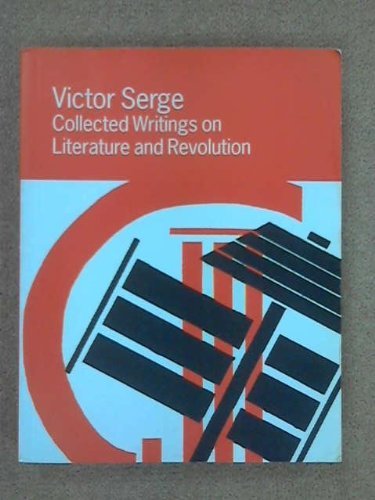
Shipped from UK, please allow 10 to 21 business days for arrival. 1st Edition. Excellent, apperars unopened and unread, good clean tight sound square, no bookplate, inscription or marks of any kind, firmly held, clean crisp corners and edges. In crisp fresh coloured paperback wrapper. 'Gathers togehter for the first time the bulk of Victor Serge's LIterary criticism from the 1920s to thelate 1940s, giving the reader an invaluable account of literary production in a socialist society.'

Affamé de fraternité et de justice sociale, Victor Serge (Bruxelles, 1890-Mexico, 1947) devient, à vingt ans, l'un des fers de lance du mouvement anarchiste français. Injustement condamné à cinq ans de prison et cinq ans d'interdiction de séjour, il rejoint la Révolution russe en janvier 1919. Membre de l'Exécutif de l'Internationale communiste, avocat du bolchevisme en une période cruciale où l'écrasement menace de toutes parts, ce fils d'émigrés anti-tsaristes qui défend corps et âme les acquis d'Octobre 1917 ne tarde pas à dénoncer le sanglant Thermidor orchestré par Staline, Passé à l'opposition incarnée par Trotski, incarcéré, condamné, déporté dans l'Oural, il doit son salut au seul acharnement d'une poignée d'amis français et belges.Expulsé en 1936, déchu de la nationalité soviétique, dépouillé de ses manuscrits, Serge revient à Bruxelles pour y devenir aussitôt la cible d'une féroce campagne de dénigrement répercutée par les fidèles du Komintern. Cet acharnement ne l'empêche pas de rendre compte, jour après jour, des purges et procès qui voient tomber, en URSS, aux côtés de centaines de milliers d'innocents, la vieille garde révolutionnaire. Il dénonce également les attaques de Staline contre anarchistes et partisans du POUM qui se battent en Espagne. En 1937, exaspéré par l'intransigeance de Trotski, il rompt avec le fondateur de la IVe Internationale. Contraint à l'exil par la Seconde Guerre mondiale, il parvient au Mexique. Indigent, esseulé, il y poursuit jusqu'à son dernier souffle son combat pour un renouvellement du socialisme.Écartant la volumineuse œuvre romanesque et critique de Victor Serge, le présent ouvrage offre un témoignage incandescent sur le naufrage politique que fut le bolchevisme. Mais aussi et surtout il retrace la trajectoire d'un écrivain majeur qui sut dire non en écoutant sa seule conscience d'homme.Jil Silberstein.

Paperback. 13,50 / 21.00 cm. in Turkish. 152 p. Translated by Ruhi Baspinar "Bakunin, "Yok edici düsünce, ayni zamanda yaratici düsüncedir" diyordu. Ilk kez 1921'de "Bulletin Communist" tarafindan yayinlanan bu çalisma, dikkatli bir biçimde çesitli eklerle tamamlanmistir. Bir polis mekanizmasinin incelenmesinin, politik formasyonu ne olursa olsun, isçi okuyucunun kafasinda yer etmesi muhtemel olan kuramsal ve pratik sorunlar, iki yeni denemede ele alinmistir. Militan'a ögütler, bütün basitligine karsin, yine de takibe, hafiyelige ve provokasyona karsi isçi savunmasinin önemli kurallarini vermesi bakimindan yararsiz degildir." Illegal çalisma kosullarinda nasil davranmali? Illegal çalismanin püf noktasi nedir) Kitle içinde nasil çalisilir? Polis takibinden nasil sakinilir? Kitap bu sorulara cevap vermektedir. Militan(lar) a basit ama can alici ögütlerden ve notlardan olusmustur. Okurlara sunmaktan mutluluk duyariz. Dorlion Yayinlari

The Serge-Trotsky Papers: Correspondence and Other Writings between Victor Serge and Leon Trotsky
by Victor Serge
Rating: 3.2 ⭐
Leon Trotsky and Victor Serge represent the great and tragic oppositional figures to Stalin's dictatorial grip on the Soviet Union in the late 1920s and 1930s. Written during this period, the letters exchanged between these two friends are published here together with material from both the Trotsky Archive at Harvard and the Serge Archive in Mexico.

Перед тем, как писатель и революционер Виктор Серж был выслан в 1936 г. из СССР, все его рукописи были изъяты. Повесть «Белое море» и стихотворения, составившие эту книгу, ему позднее удалось восстановить по памяти. «Кто ты? Зачем ты? Куда ты? Какая банальщина! Таких вопросов здесь не задают. Здесь «тридцать или пятьдесят километров тундры, двенадцать или пятнадцать дней на санях, какая разница?.. Если мы вдруг исчезнем… допустим, нас сдует ветер и унесёт на Северный полюс — кто это вообще заметит, а?»

Pour un brasier dans un désert: Résistance, messages, mains, destins (Type-type)
by Victor Serge
Rating: 4.7 ⭐
French

Tra quanti parteciparono attivamente alla Rivoluzione russa del 1917, Victor Serge è sicuramente uno degli osservatori più acuti e critici. Scampato alle purghe degli anni trenta, rifugiatosi in Francia, Serge si impegna a lungo nella denuncia del «tradimento» della Rivoluzione operato da Stalin, ma non smette di ragionare anche sui propri errori, o meglio sugli errori dell'intero movimento rivoluzionario russo, di cui anche lui aveva fatto parte. Non rinnega la rivoluzione, ma ne percepisce col tempo i limiti e ne analizza con rigore la storia, mutando il suo pensiero su molti punti. Questo volume propone due momenti centrali dell'analisi di Victor il primo ("La Rivoluzione russa"), del 1938, viene scritto quando Serge è da poco arrivato a Parigi, proveniente dalla prigionia siberiana; il secondo ("Trent'anni dopo la Rivoluzione russa"), viene scritto nel 1947, a pochi mesi dalla morte, nell'esilio di Città del Messico. Come nota David Bidussa nella prefazione, si tratta di due scritti che rappresentano «l'alfa e l'omega» dell'ultima stagione pubblica di Victor Serge. Sopra ogni cosa aleggia il concetto di totalitarismo e il tradimento di un' a trent'anni dai fatti rivoluzionari, degli ideali che avevano animato le piazze non resta niente. Tutto viene messo in discussione e non resta che ripartire su nuove basi, prendendo le distanze dal passato.

" C'était déjà les temps noirs de la disette dans les villes, de famine dans les campagnes, de terreur... " Mer blanche , L'Impasse Saint-Barnabé et L'Hôpital de Leningrad , trois des nouvelles qui composent ce recueil (initialement publié en 1972 aux Éditions François Maspero), évoquent l'atmosphère du début des années 1930 en URSS, quand Staline imposait dans le chaos et par la terreur ses plans déments d'industrialisation et de collectivisation forcée. Dans Mer Blanche , Kirk –; vieux communiste idéaliste heureux de pouvoir encore servir la Révolution en dépit des directives absurdes, des statistiques truquées, des arrestations insensées –; entre dans le néant blanc du grand Nord pour rédiger un rapport sur l'industrialisation d'une pêcherie ; sa vision de l'homme dans la nature est aussi lumineuse, aussi exaltante que le pays de neige qu'il évoque. Le réalisme critique et visionnaire de L'Impasse Saint-Barnabé est proprement balzacien : dans cet appartement collectif, véritable " pension Vauquer " soviétique, chaque locataire vit ses envies, ses haines, ses rêves face à la société en transformation. L'Hôpital de Léningrad , dernier volet de cette trilogie soviétique, est le récit terrifiant d'une visite à l'hôpital psychiatrique délabré où le Guépéou " envoie ses clients quand il n'en peut rien faire d'autre ". Écrite au lendemain de la Seconde Guerre mondiale, la nouvelle Le Séisme évoque des expériences de rêve, de bombardement, de cataclysme géologique et historique à l'ombre d'un volcan naissant qui engloutit un village indio .

“Nessun capo di Stato del nostro secolo ha ordinato tanti supplizi, massacrato con tanta perseveranza, in così gran numero, i suoi compagni di ieri, i suoi collaboratori, i suoi sostenitori, i suoi fratelli. Non uno, per quanto noi sappiamo, nemmeno lo stesso Hitler ha pronunciato una frase simile a quella di ‘Scegliere la vittima, preparare minuziosamente il colpo, saziare una vendetta implacabile e poi andarsene a dormire… Non vi è niente di più dolce nel mondo’.Il ritratto fisico di Stalin si conosce bene. Quella fronte bassa sotto una vigorosa capigliatura, quel viso piuttosto quadrato, carnoso, sul quale si stagliano dei grossi baffi, in cui gli occhi piccoli, privi di luce, danno una impressione di sicurezza niente di più. Egli ha la parola malsicura, l’eloquio monotono, un forte accento georgiano. Si è fatto un abito di una semplicità voluta, una tunica alla maniera militare, col collo montante, stivali… e questa maniera di vestire gli dà l’aspetto di un sottufficiale. Dopo la sua giovinezza, un insieme di inferiorità lo domina. Egli si sente sprovvisto di doti, inferiore a tutti gli uomini di rilievo che egli incontra e per il suo carattere ne è geloso, li invidia e li detesta perché quelli valgono più di lui. L’intrigo lo segue dai suoi primi passi, non si conosce una sua amicizia; ma con una perseveranza terribile egli ha mandato alla morte tutti coloro che aveva conosciuto da una quarantina di anni, seguíto, ascoltato, i compagni della Siberia come quelli del Caucaso, i compagni delle persecuzioni come quelli del potere, tutti, tutti, gli oscuri come gli illustri. Egli ci appare dominato dall’odio del mediocre per tutti coloro che gli sono naturalmente superiori. E il motto di Trotsky ci ritorna alla ‘È la più grande mediocrità del nostro partito’. Questa frase pronunciata verso il 1925, il Georgiano non l’ha mai perdonata”.