
V.S. Naipaul
V. S. Naipaul was a British writer of Indo-Trinidadian descent known for his sharp, often controversial explorations of postcolonial societies, identity, and displacement. His works, which include both fiction and nonfiction, often depict themes of exile, cultural alienation, and the lingering effects of colonialism. He gained early recognition with A House for Mr Biswas, a novel inspired by his father’s struggles in Trinidad. His later works, such as The Mimic Men, In a Free State, and A Bend in the River, cemented his reputation as a masterful and incisive writer. Beyond fiction, his travelogues and essays, including Among the Believers and India: A Million Mutinies Now, reflected his critical perspective on societies in transition. Naipaul received numerous accolades throughout his career, including the Nobel Prize in Literature, awarded for his ability to blend deep observation with literary artistry. While praised for his prose, his often unsparing portrayals of postcolonial nations and controversial statements sparked both admiration and criticism.
30 Books Written

From the Nobel Prize-winning author: an unforgettable comedy of manners inspired by the author's father that has been hailed as one of the twentieth century's finest novels.“A marvelous prose epic that matches the best nineteenth-century novels for richness of comic insight and final, tragic power.” — NewsweekIn his forty-six short years, Mr. Mohun Biswas has been fighting against destiny to achieve some semblance of independence, only to face a lifetime of calamity. Shuttled from one residence to another after the drowning death of his father, for which he is inadvertently responsible, Mr. Biswas yearns for a place he can call home. But when he marries into the domineering Tulsi family on whom he indignantly becomes dependent, Mr. Biswas embarks on an arduous—and endless—struggle to weaken their hold over him and purchase a house of his own.A heartrending, dark yet comedic novel, A House for Mr. Biswas masterfully evokes a man’s quest for autonomy against an emblematic post-colonial canvas.

The Nobel Prize-winning author distills his wide experience of countries and peoples into a moving account of the rites of passage endured by all people and all communities undergoing change or decay. • "Naipaul's finest work." — Chicago Tribune"A subtly incisive self-reckoning." — The Washington Post Book WorldThe story of a writer’s singular journey – from one place to another, and from one state of mind to another. At the midpoint of the century, the narrator leaves the British colony of Trinidad and comes to the ancient countryside of England. And from within the story of this journey – of departure and arrival, alienation and familiarity, home and homelessness – the writer reveals how, cut off from his “first” life in Trinidad, he enters a “second childhood of seeing and learning.”Clearly autobiographical, yet woven through with remarkable invention, The Enigma of Arrival is as rich and complex as any novel we have had from this exceptional writer."The conclusion is both heart-breaking and the only antidote to destruction—of dreams, of reality—is remembering. As eloquently as anyone now writing, Naipaul remembers." — Time"Far and away the most curious novel I've read in a long time, and maybe the most hypnotic book I've ever read." — St. Petersburg Times

'Brilliant and terrifying' - "Observer". I had to be the man who was doing well and more than well, the man whose drab shop concealed some bigger operation that made millions. I had to be the man who had planned it all, who had come to the destroyed town at the bend in the river because he had foreseen the rich future. 'Salim, the narrator, is a young man from an Indian family of traders long resident on the coast of Central Africa. Salim has left the coast to make his way in the interior, there to take on a small trading shop of this and that, sundries, sold to the natives. The place is 'a bend in the river'; it is Africa. The time is post-colonial, the time of Independence. The Europeans have withdrawn or been forced to withdraw and the scene is one of chaos, violent change, warring tribes, ignorance, isolation, poverty and a lack of preparation for the modern world they have entered, or partially assumed as a sort of decoration. It is a story of historical upheaval and social breakdown. Naipaul has fashioned a work of intense imaginative force. It is a haunting creation, rich with incident and human bafflement, played out in an immense detail of landscape rendered with a poignant brilliance' - Elizabeth Hardwick. 'Always a master of fictional landscape, Naipaul here shows, in his variety of human examples and in his search for underlying social causes, a Tolstoyan spirit' - John Updike.

A tender, funny novel written with the verve of Dickens and the passion of Chekhov, set during World War II in a derelict neighborhood in Trinidad’s capital and narrated by an unnamed boy—from the Nobel Prize-winning author.“One of the few contemporary writers of whom we can speak in terms of greatness.” — Newsday“A stranger could drive through Miguel Street and just say ‘Slum!’ because he could see no more.” But to its residents this corner of Trinidad’s capital is a complete world, where everybody is quite different from everybody else. There’s Popo the carpenter, who neglects his livelihood to build “the thing without a name.” There’s Man-man, who goes from running for public office to staging his own crucifixion, and the dreaded Big Foot, the bully with glass tear ducts. There’s the lovely Mrs. Hereira, in thrall to her monstrous husband. This tender, funny early novel is a work of mercurial mood shifts, by turns sweetly melancholy and anarchically funny. It overflows with life on every page.

No writer has rendered our boundariless, post-colonial world more acutely or prophetically than V. S. Naipaul, or given its upheavals such a hauntingly human face. A perfect case in point is this riveting novel, a masterful and stylishly rendered narrative of emigration, dislocation, and dread, accompanied by four supporting narratives. In the beginning it is just a car trip through Africa. Two English people--Bobby, a civil servant with a guilty appetite for African boys, and Linda, a supercilious compound wife -- are driving back to their enclave after a stay in the capital. But in between lies the landscape of an unnamed country whose squalor and ethnic bloodletting suggest Idi Amin's Uganda. And the farther Naipaul's protagonists travel into it, the more they find themselves crossing the line that separates privileged outsiders from horrified victims. Alongside this Conradian tour de force are four incisive portraits of men seeking liberation far from home. By turns funny and terrifying, sorrowful and unsparing, In A Free State is Naipaul at his best.

NATIONAL BESTSELLER • In a narrative that moves with dreamlike swiftness from India to England to Africa, the Nobel Prize-winning author produced his finest novel, a bleakly resonant study of the fraudulent bargains that make up an identity."A masterpiece." — Los Angeles Times Book ReviewThe son of a Brahmin ascetic and his lower-caste wife, Willie Chandran grows up sensing the hollowness at the core of his father's self-denial and vowing to live more authentically. That search takes him to the immigrant and literary bohemias of 1950s London, to a facile and unsatisfying career as a writer, and at last to a decaying Portugese colony in East Africa, where he finds a happiness he will then be compelled to betray. Brilliantly orchestrated, at once elegiac and devastating in its portraits of colonial grandeur and pretension, Half a Life represents the pinnacle of Naipaul's career.

"Among the Believers" is V. S. Naipaul's classic account of his journeys through Iran, Pakistan, Malaysia and Indonesia; 'the believers' are the Muslims he met on those journeys, young men and women battling to regain the original purity of their faith in the hope of restoring order to a chaotic world. It is a uniquely valuable insight into modern Islam, and the comforting simplifications of religious fanaticism. 'The edgy exactitude of Naipaul's writing is both effortlessly classical and yet at the same time brilliantly contemporary, as sharp and lucid as a spear of glass...He is inimitable, truly great and truly deserving of the Nobel' - "Observer".

The Nobel Prize-winning author’s profound reckoning with his ancestral homeland and an extraordinarily perceptive chronicle of his first encounter with India.“Whatever his literary form, Naipaul is a master.” — The New York Review of BooksTraveling from the bureaucratic morass of Bombay to the ethereal beauty of Kashmir, from a sacred ice cave in the Himalayas to an abandoned temple near Madras, Naipaul encounters a dizzying cross-section of browbeaten government workers and imperious servants, a suavely self-serving holy man and a deluded American religious seeker. An Area of Darkness also abounds with Naipaul’s strikingly original responses to India’s paralyzing caste system, its apparently serene acceptance of poverty and squalor, and the conflict between its desire for self-determination and its nostalgia for the British raj. The result may be the most elegant and passionate book ever written about the subcontinent.

A look at India explores the ways different individuals have been affected by the numerous frictions present in Indian society, the contradictions and compromises of religious faith, and more. Reprint. NYT.

"In 1975, at the height of Indira Gandhi’s “Emergency,” V. S. Naipaul returned to India, the country his ancestors had left one hundred years earlier. Out of that journey he produced this concise masterpiece: a vibrant, defiantly unsentimental portrait of a society traumatized by centuries of foreign conquest and immured in a mythic vision of its past.Drawing on novels, news reports, political memoirs, and his own encounters with ordinary Indians–from a supercilious prince to an engineer constructing housing for Bombay’s homeless–Naipaul captures a vast, mysterious, and agonized continent inaccessible to foreigners and barely visible to its own people. He sees both the burgeoning space program and the 5,000 volunteers chanting mantras to purify a defiled temple; the feudal village autocrat and the Naxalite revolutionaries who combined Maoist rhetoric with ritual murder. Relentless in its vision, thrilling in the keenness of its prose, India: A Wounded Civilization is a work of astonishing insight and candor." Back cover comments.

The Mystic Masseur, V S Naipaul's first novel, is the story of the rise and rise of Ganesh, from failed primary school teacher and struggling masseur to author, revered mystic and MBE. It is a journey memorable for its hilarious and bewildering success.

'A Tolstoyan spirit...The so-called third World has produced no more brilliant literary artist' - John Updike, "New Yorker". Born of Indian heritage, raised in the British-dependent Caribbean island of Isabella, and educated in England, forty-year-old Ralph Singh has spent a lifetime struggling against the torment of cultural displacement. Now in exile from his native country, he has taken up residence at a quaint hotel in a London suburb, where he is writing his memoirs in an attempt to impose order on a chaotic existence. His memories lead him to recognize the cultural paradoxes and tainted fantasies of his colonial childhood and later his attempts to fit in at school, his short-lived marriage to an ostenatious white woman. But it is the return of Isabella and his subsequent immersion in the roiling political atmosphere of a newly self-governing nation - every kind of racial fantasy taking wing - that ultimately provide Singh with the necessary insight to discover the crux of his disillusionment. 'Ambitious and successful...Extremely perceptive' - "The Times". 'The sweep of Naipaul's imagination, the brilliant fictional frame that expresses it, are in my view eithout equal today' - "New York Times Book Review".

From the Nobel Prize-winning author comes a novel of exile, displacement, and the agonizing cruelty and pain of colonialism, both for those who rule and those who are their victims.“A brilliant novel in every way.… [It] shimmers with artistic certainty.” — The New York Times Book ReviewSet on a troubled Carribbean island, where “everybody wants to fight his own little war,” where “everyone is a guerrilla,” the novel centers on an Englishman named Roche, once a hero of the South African resistance, who has come to the island – subdued now, almost withdrawn – to work and to help. Soon his English mistress casually nihilistic, bored, quickly enticed – excited – by fantasies of native power and sexuality, and blindly unaware of any possible consequences of her acts. At once Roche and Jane are drawn into fatal connection with a young guerrilla leader named Jimmy Ahmed, a man driven by his own raging fantasies of power, of perverse sensuality, and of the England he half remembers, half sentimentalizes. Against the larger anguish of the world they inhabit, these three act out a drama of death, hideous sexual violence, and political and spiritual impotence that profoundly reflects the ravages history can make on human lives.

Willie Chandran is a man who has allowed one identity after another to be thrust upon him. In his early forties, after a peripatetic life, he succumbs to the encouragement of his sister – and his own listlessness – and joins an underground movement in India. But years of revolutionary campaigns and then prison convince him that the revolution ‘had nothing to do with what we were fighting for’, and he feels himself further than ever ‘from his own history’.When he returns to Britain where, thirty years before, his wanderings began, Willie encounters a country that has turned its back on its past and, like him, has become detached from its own history. He endures the indignities of a culture dissipated by reform and compromise until, in a moment of grotesque revelation – a tour de force of parodic savagery from our most visionary of writers – Willie comes to an understanding that might finally allow him to release his true self.This book is the second volume of Half A Life, but can be read alone.

The Nobel Prize-winning author offers an insightful follow-up to his landmark travelogue Among the Believers : a "brilliant … powerfully observed, stylistically elegant exploration" ( The New York Times ) that’s the result of a five-month journey through Indonesia, Iran, Pakistan, and Malaysia, countries where dreams of Islamic purity clash with economic and political realities. Fourteen years after the publication of his landmark travel narrative Among the Believers , V. S. Naipaul returned to the four non-Arab Islamic countries he reported on so vividly at the time of Ayatollah Khomeini's triumph in Iran. Beyond Belief is the result of his five-month journey in 1995 through lands where descendants of Muslim converts live at odds with indigenous traditions.In extended conversations with a vast number of people—a rare survivor of the martyr brigades of the Iran-Iraq war, a young intellectual training as a Marxist guerilla in Baluchistan, an impoverished elderly couple in Teheran whose dusty Baccarat chandeliers preserve the memory of vanished wealth, and countless others—V. S. Naipaul deliberately effaces himself to let the voices of his subjects come through. Yet the result is a collection of stories that has the author's unmistakable stamp. With its incisive observation and brilliant cultural analysis, Beyond Belief is a startling and revelatory addition to the Naipaul canon.

The Nobel Prize-winning author delivers a Dickensian novel that traces the unlikely career of a failed schoolteacher and village masseur who becomes a revered mystic, a thriving entrepreneur, and the most beloved politician in Trinidad. “No one else … seems able to employ prose fiction so deeply as the very voice of exile.” — The New York Review of BooksIn this slyly funny and lavishly inventive novel—his first—V. S. Naipaul chronicles the ascent of the impecunious village masseur Ganesh Ramsumair. To understand a little better, one has to realize that in the 1940s masseurs were the island’s medical practitioners of choice. As one character observes, “I know the sort of doctors they have in Trinidad. They think nothing of killing two, three people before breakfast.”Ganesh’s journey is variously aided and impeded by a Dickensian cast of rogues and eccentrics. There’s his skeptical wife, Leela, whose schooling has made her excessively, fond. of; marks!; and Leela’s father, Ramlogan, a man of startling mood changes and an ever-ready cutlass. There’s the aunt known as The Great Belcher. There are patients pursued by malign clouds or afflicted with an amorous fascination with bicycles. Witty, tender, filled with the sights, sounds, and smells of Trinidad’s dusty Indian villages, The Mystic Masseur is Naipaul at his most expansive and evocative.

The Nobel Prize-winning author—and "one of literature's great travelers" ( Los Angeles Times )—spans continents and centuries to create what is at once an autobiography and a fictional archaeology of colonialism. "Dickensian … a brilliant new prism through which to view (Naipaul's) life and work."— The New York Times“Most of us know the parents or grandparents we come from. But we go back and back, we go back all of us to the very in our blood and bone and brain we carry the memories of thousands of beings.”So observes the opening narrator of A Way in the World, and it is this conundrum—that the bulk of our inheritance must remain beyond our grasp—which suffuses this extraordinary work of fiction. Returning to the autobiographical mode he so brilliantly explored in The Enigma of Arrival , and writing here in the classic form of linked narrations, Naipaul constructs a story of remarkable resonance and power, remembrance and invention.It is the story of a writer’s lifelong journey towards an understanding of both the simple stuff of inheritance — language, character, family history — and the long interwoven strands of a deeply complicated historical “things barely remembered, things released only by the act of writing.” What he writes — and what his release of memory enables us to see — is a series of extended, illuminated moments in the history of Spanish and British imperialism in the Raleigh’s final, shameful expedition to the New World; Francisco Miranda’s disastrous invasion of South America in the eighteenth century; the more subtle aggressions of the mid-twentieth-century English writer Foster Morris; the transforming and distorting peregrinations of Blair, the black Trinidadian revolutionary. Each episode is viewed through the clarifying lens of the narrator’s own post-colonial experience as a Trinidadian of Indian descent who, during the twilight of the Empire, immigrates to England, reinventing himself in order to escape the very history he is intent upon telling.

From the Nobel Prize-winning author comes a classic of modern travel writing—a deft portrait of Trinidad and the four adjacent Caribbean societies still haunted by the legacies of slavery and colonialism.“Belongs in the same category of travel writing as Lawrence’s books on Italy, Greene’s on West Africa and Pritchett’s on Spain.” — New StatesmanIn 1960 the government of Trinidad invited V. S. Naipaul to revisit his native country and record his impressions. In The Middle Passage, Naipaul watches a Trinidadian movie audience greeting Humphrey Bogart’s appearance with cries of “That is man!” He ventures into a Trinidad slum so insalubrious that the locals call it the Gaza Strip. He follows a racially charged election campaign in British Guiana (now Guyana) and marvels at the Gallic pretension of Martinique society, which maintains the fiction that its roads are extensions of France’s routes nationales. And throughout he relates the ghastly episodes of the region’s colonial past and shows how they continue to inform its language, politics, and values. The result is a work of novelistic vividness and dazzling perspicacity that displays Naipaul at the peak of his powers.
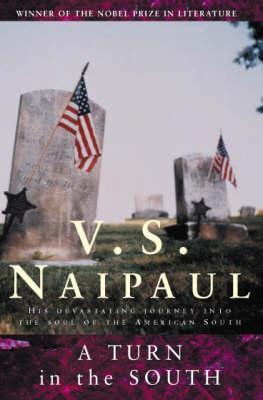
"A Turn in the South" is a reflective journey by V. S. Naipaul in the late 1980s through the American South. Naipaul writes of his encounters with politicians, rednecks, farmers, writers, ordinary men and women, both black and white, with the insight and originality we expect from one of our best travel writers. Fascinating and poetic, this is a remarkable book on race, culture and country. 'Naipaul's writing is supple and fluid, meticulously crafted, adventurous and quick to surprise. And, as usual, there's the freshness and originality of his way of looking at things ...a fine book by a fine man, and one to be read with great a book of style, sagacity and wit' - "Sunday Times". 'A tissue of brilliantly recorded hearsay, of intense listening by a man with a remarkable ear' - "New York Times Review of Books".

Like all of V. S. Naipaul’s “travel” books, The Masque of Africa encompasses a much larger narrative and to judge the effects of belief (in indigenous animisms, the foreign religions of Christianity and Islam, the cults of leaders and mythical history) upon the progress of civilization.From V. S. “For my travel books I travel on a theme. And the theme of The Masque of Africa is African belief. I begin in Uganda, at the center of the continent, do Ghana and Nigeria, the Ivory Coast and Gabon, and end at the bottom of the continent, in South Africa. My theme is belief, not political or economical life; and yet at the bottom of the continent the political realities are so overwhelming that they have to be taken into account.“Perhaps an unspoken aspect of my inquiry was the possibility of the subversion of old Africa by the ways of the outside world. The theme held until I got to the South, when the clash of the two ways of thinking and believing became far too one-sided. The skyscrapers of Johannesburg didn’t rest on sand. The older world of magic felt fragile, but at the same time had an enduring quality. You felt that it would survive any calamity.“I had expected that over the great size of Africa the practices of magic would significantly vary. But they didn’t. The diviners everywhere wanted to ‘throw the bones’ to read the future, and the idea of ‘energy’ remained a constant, to be tapped into by the ritual sacrifice of body parts. In South Africa body parts, mainly of animals, but also of men and women, made a mixture of ‘battle medicine.’ To witness this, to be given some idea of its power, was to be taken far back to the beginning of things.“To reach that beginning was the purpose of my book.”The Masque of Africa is a masterly achievement by one of the world’s keenest observers and one of its greatest writers.

In this book, an old, comically timid and absent-minded man, Surujpat Harbans, runs for office, aided by superstition, bribes, and an aggressive compaign.

The history of Trinidad begins with a delusion: the belief that somewhere nearby on the South American mainland lay El Dorado, the mythical kingdom of gold. In this extraordinary and often gripping book, V. S. Naipaul–himself a native of Trinidad–shows how that delusion drew a small island into the vortex of world events, making it the object of Spanish and English colonial designs and a mecca for treasure-seekers, slave-traders, and revolutionaries.Amid massacres and poisonings, plunder and multinational intrigue, two themes emerge: the grinding down of the Aborigines during the long rivalries of the El Dorado quest and, two hundred years later, the man-made horror of slavery. An accumulation of casual, awful detail takes us as close as we can get to day-to-day life in the slave colony, where, in spite of various titles of nobility, only an opportunistic, near-lawless community exists, always fearful of slave suicide or poison, of African sorcery and revolt. Naipaul tells this labyrinthine story with assurance, withering irony, and lively sympathy. The result is historical writing at its highest level.

Spanning four decades and four continents, this magisterial volume brings together the essential shorter works of reflection and reportage by the Nobel Prize-winning author. “The most splendid writer…. He looks into the mad eye of history and does not blink.” — The Boston GlobeV.S. Naipaul is our most sensitive, literate, and undeceivable observer of the post-colonial world. In these pages, he trains his relentless moral intelligence on societies from India to the United States and sees how each deals with the challenges of modernity and the seductions of both the real and mythical past.Whether he is writing about a string of racial murders in Trinidad; the mad, corrupt reign of Mobutu in Zaire; Argentina under the generals; or Dallas during the 1984 Republican Convention, Naipaul combines intellectual playfulness with sorrow, indignation, and analysis so far-reaching that it approaches prophecy. The Writer and the World reminds us that he is in a class by himself.

I was eleven, no more, when the wish came to me to be a writer; and then very soon it was a settled ambition. But for the young V. S. Naipaul, there was a great distance between the wish and its fulfillment. To become a writer, he would have to find ways of understanding three very different his family's half-remembered Indian homeland, the West Indian colonial society in which he grew up, and the wholly foreign world of the English novels he read.In this essay of literary autobiography, V. S. Naipaul sifts through memories of his childhood in Trinidad, his university days in England, and his earliest attempts at writing, seeking the experiences of life and reading that shaped his imagination and his growth as a writer. He pays particular attention to the traumas of India under its various conquerors and the painful sense of dereliction and loss that shadows writers' attempts to capture the country and its people in prose.Naipaul's profound reflections on the relations between personal or historical experience and literary form, between the novel and the world, reveal how he came to discover both his voice and the subjects of his writing, and how he learned to turn sometimes to fiction, sometimes to the travel narrative, to portray them truthfully. Along the way he offers insights into the novel's prodigious development as a form for depicting and interpreting society in the nineteenth century and its diminishing capacity to do the same in the twentiethÑa task that, in his view, passed to the creative energies of the early cinema.As a child trying to read, I had felt that two worlds separated me from the books that were offered to me at school and in the the childhood world of our remembered India, and the more colonial world of our city. ... What I didn't know, even after I had written my early books of fiction ... was that those two spheres of darkness had become my subject. Fiction, working its mysteries, by indirections finding directions out, had led me to my subject. But it couldn't take me all the way. -V.S. Naipaul, from Reading & Writing

An “extraordinary rich correspondence” ( The New York Times Book Review ) between a seventeen-year-old aspiring writer at Oxford who would go on to become a Nobel Prize winning author and his sacrificing, beloved father. At seventeen, V.S. Naipaul wanted to "follow no other profession" but writing. Awarded a scholarship by the Trinidadian government, he set out to attend Oxford, where he encountered a vastly different world from the one he yearned to leave behind. Separated from his family by continents, and grappling with depression, financial strain, loneliness, and dislocation, "Vido" bridged the distance with a faithful correspondence that began shortly before the young man's two-week journey to England and ended soon after his father's death four years later.Here, for the first time, we have the opportunity to read this profoundly moving correspondence, which illuminates with unalloyed candor the relationship between a sacrificing father and his determined son as they encourage each other to persevere with their writing. For though his father's literary aspirations would go unrealized, Naipaul's triumphant career would ultimately vindicate his beloved mentor's legacy.

V. S. Naipaul has always faced the challenges of "fitting one civilization to another." In A Writer's People, he takes us into this process of creative and intellectual assimilation, which has shaped both his writing and his life.Naipaul discusses the writers to whom he was exposed early on—Derek Walcott, Gustave Flaubert, and his father, among them—and his first encounters with literary culture. He illuminates the ways in which the writings of Gandhi, Nehru, and other Indian writers both reveal and conceal the authors themselves and their nation. And he brings the same scrutiny to bear on his own life: his early years in Trinidad; the empty spaces in his family history; his ever-evolving reactions to the more complicated India he would encounter for the first time at age thirty.

Mr Stone likes to be known as Head Librarian with Excal, and dislikes the prospect of retirement. After a brief acquaintanceship with Mrs Springer, he marries her to defend himself against idleness and solitude. Then a foolproof plan strikes him, to introduce the order of the Knights Companion.


Michael X in Trinidad, Peronism in Argentina, the cult of Kingship in Mobutu's Zaire - the author brings his novelist's questioning to bear upon the "half-made" societies, those still suffering from the profound deprivations of colonialism and prey to corruption.

Questo testo, inedito per l’Italia, è uno degli ultimi scritti da V.S. Naipaul - ed è anche uno dei più diretti e personali. È apparso per la prima volta sul «New Yorker» del 6 gennaio 2020.