
Uta Hagen
15 Books Written

Legendary actress and teacher Uta Hagen knew that an actor's finest work was often achieved for love rather than for money. She lived this philosophy alongside her husband, Herbert Berghof, at HB Studio, their acting school in New York. It was there that they created a workplace and spiritual home for actors such as Robert DeNiro, Jack Lemmon, Anne Bancroft, and Bette Midler.Respect for Acting is Hagen's blueprint for the actor, her design for "enlightened stage acting." This classic book has helped generations of actors hone their craft, and its advice is as useful now as it was when it was first published. Hagen draws on her own struggle with the techniques of acting as well as her decades of teaching experience to break down the areas in which actors can work and search for realities in themselves that serve the character and the play. This approach helps actors to be specific in their actions in order to communicate an artistic statement. Hagen's instructions and examples also guide the aspiring actor through practical problems such as "How do I talk to the audience?" and "How do I stay fresh in a long run?"Part One, "The Actor," deals with the actor's concept of him or herself, as well as techniques that set an actor in motion physically, verbally, and emotionally.Part Two, "The Object Exercises," offers specific and detailed work for the actor, covering a broad range of problems and circumstances, from making an entrance to using the Fourth Wall.Part Three, "The Play and the Role," covers how to approach the play and identify with the character the actor will undertake. It also shares practical thoughts and answers the questions young actors ask most.Uta Hagen's influence endures in many of today's most compelling stage and screen performances. Informative and inspiring, Respect for Acting will bring her timeless techniques to actors and audiences for years to come.

Theoretically, the actor ought to be more sound in mind and body than other people, since he learns to understand the psychological problems of human beings when putting his own passions, his loves, fears, and rages to work in the service of the characters he plays. He will learn to face himself, to hide nothing from himself -- and to do so takes an insatiable curiosity about the human condition.from the PrologueUta Hagen, one of the world's most renowned stage actresses, has also taught acting for more than forty years at the HB Studio in New York. Her first book, Respect for Acting, published in 1973, is still in print and has sold more than 150,000 copies. In her new book, A Challenge for the Actor, she greatly expands her thinking about acting in a work that brings the full flowering of her artistry, both as an actor and as a teacher. She raises the issue of the actor's goals and examines the specifics of the actor's techniques. She goes on to consider the actor's relationship to the physical and psychological senses. There is a brilliantly conceived section on the animation of the body and mind, of listening and talking, and the concept of expectation.But perhaps the most useful sections in this book are the exercises that Uta Hagen has created and elaborated to help the actor learn his craft. The exercises deal with developing the actor's physical destination in a role; making changes in the self serviceable in the creation of a character; recreating physical sensations; bringing the outdoors on stage; finding occupation while waiting; talking to oneself and the audience; and employing historical imagination.The scope and range of Uta Hagen here is extraordinary. Her years of acting and teaching have made her as finely seasoned an artist as the theatre has produced.


Uta Hagen, one of the great ladies of the American theatre has written a deeply personal memoir of her life, from her childhood in Germany to the present. Sources is Miss Hagen's lyrical account of the special ways love of nature is intertwined with love of art in her life, providing a rare glimpse of the off-stage life of an actress. Originally published in 1983, this book is republished in 2019 with a foreword by Uta's daughter, Leticia Ferrer, and her grand-daughter Teresa Teuscher to whom Uta dedicated the book.

The twisted story of 12-year-old twins whose devotion to one another is played out in a macabre game of murder.

Das Kleine Schauspieler-Handbuch von Uta Hagen enthält alles, was junge Schauspieler über ihre Kunst wissen sollten.« Los Angeles TimesUta Hagen (* 12. Juni 1919 in Göttingen; † 14. Januar 2004 in New York) studierte Dramaturgie in London und wurde als deutsch-amerikanische Bühnenschauspielerin und Schauspiellehrerin berühmt. Für ihre Leistungen erhielt sie zweimal den Tony Award und 1999 einen zusätzlichen für ihr Lebenswerk. Sie spielte in über zwanzig Broadway-Produktionen mit, unter anderem in Klassikern wie Othello, Key Largo, Endstation Sehnsucht, Come Back, Die heilige Johanna und Wer hat Angst vor Virginia Woolf?. Zu ihren Filmauftritten zählt »Boys from Brazil« (1978), in dem sie neben Laurence Olivier, Gregory Peck und Lilli Palmer spielte.Neben ihrer Arbeit als Schauspielerin lehrte sie viele Jahre an der HB-Schauspielschule. Geraldine Page, Fritz Weaver, Jason Robards, Jack Lemmon, Steve McQueen, Liza Minnelli, Whoopi Goldberg, Jack Lemmon, Robert De Niro und Al Pacino sind nur einige bekannte Namen ihrer ehemaligen Schauspielschüler. Bei diesem Buch wurde sie von Haskel Frankel, Theaterkritiker des National Observer, unterstützt.

The Studio Story by Uta Hagen and Report to the Austrian Academy by Herbert Berghof
by Uta Hagen
Rating: 4.8 ⭐
Herbert Berghof began his studio in New York in1945. Uta Hagen joined him in 1947. Together, they trained generations of actors as the Studio grew from rented space on 26th Street to today's three buildings at 120 Bank Street in the West Village. Uta wrote The Studio Story (and re-wrote it) as the Studio and HB Playwrights Foundation grew and expanded.Edith Meeks, Executive & Artistic Director of HB Studio has provided a foreword. In it she writes, “The personal and professional stories of Herbert Berghof and Uta Hagen are inextricably intertwined with the story of HB, their the haven they created for theater artists to pursue their own ideas and methods.”The publication of this book is a gift from Uta’s daughter Letty Ferrer and her grand-daughter, Teresa Teuscher, in honor of the Centennial of Uta’s birth.


A atriz e professora Uta Hagen pede "respeito pela interpretação" - uma referência explícita, no título original desta obra, "ao fato de que todo leigo se considera um crítico capaz". O debate sobre a ética é uma marca do discurso da autora, que ressalta: o ator deve buscar o autoconhecimento e lutar pelo valor da arte. Hagen tampouco ignora aqui os problemas cotidianos vividos pelo profissional do teatro - a batalha dos testes de elenco, as pressões de produção, os jogos de poder. Uta Hagen pro põe, com bastante clareza, exercícios eficientes, que nasceram das questões humanas e técnicas que vivenciou na prática. Uma obra para atores e profissionais da interpretação de todos os níveis.

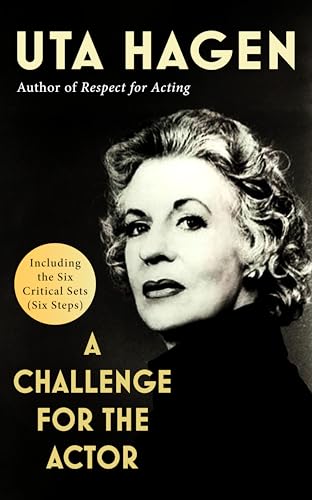
"I held onto this book for dear life throughout my twenties, and still thumb through it when I need a tune up. If I lose my car keys and I’m frantically turning my house upside down trying to find them I look up at the heavens and hope she’s having a good laugh." - Amanda Peet"I was extraordinarily privileged to work with Uta Hagen in Circle in the Square’s production of George Bernard Shaw’s play, You Never Can Tell. She was committed to revealing the truth and we are the beneficiaries of her brilliant observations." - Victor Garber"CHALLENGE FOR THE ACTOR, written by one of the most important actors of the 20th Century, is a remarkable source of practical principles on how to be a human being in your work and to not just “act." Uta's purpose for this book is to clarify and update the articulation of her technique as stated in RESPECT FOR ACTING. In "Chapter 8" of this book particularly, she provides a self-empowering approach to acting that is an invaluable resource for achieving the art of acting for stage, film, and television at its highest level." - Ted Brunetti"Uta Hagen changed my life. She changed the lives of thousands and thousands of other people as well. To have Uta’s books and to be able to look through them at the drop of a hat keeps me going and keeps me inspired to keep going." - Austin Pendleton"Uta Hagen’s A CHALLENGE FOR THE ACTOR is simply the bible for any acting student serious about their craft. Even as a professional I refer to it time and again for the basics. It is a touchstone." - Laila Robins“'Cynicism leads to mental illness and insanity.' Words of warning Uta Hagen spoke often to her students. Here in lies the difference between Ms. Hagen’s classic RESPECT FOR ACTING and its companion A CHALLENGE FOR THE ACTOR. She meets head on the soul killing demon that threatens the art and craft of all actors, cynicism. The challenge is to remain curious, caring, innocent, disciplined, educated, and life-loving amid dark times. To have the courage to fight the forces of apathy and disbelief in order to serve with all one’s heart the profession that one loves.” - Victor SlezakUta Hagen, one of the world's most renowned stage actresses, also taught acting for more than 40 years at the HB Studio in New York. Her first book, Respect for Acting, published in 1973, remains a best seller in print. In this edition of her second classic book, A Challenge for the Actor, she greatly expands her thinking about acting in a work that brings the full flowering of her artistry, both as an actor and as a teacher. She raises the issue of the actor's goals and examines the specifics of the actor's techniques. She goes on to consider the actor's relationship to the physical and psychological senses. There is a brilliantly conceived section on the animation of the body and mind, of listening and talking, and the concept of expectation.But perhaps the most useful are the exercises that Uta Hagen has created and elaborated to help the actor learn his craft. The exercises deal with developing the actor's physical destination in a role; making changes in the self serviceable in the creation of a character; recreating physical sensations; bringing the outdoors on stage; finding occupation while waiting; talking to oneself and the audience; and employing historical imagination.The scope and range of Uta Hagen here is extraordinary.

Respect for Acting: Library Edition
by Uta Hagen
