
University of Chicago Press
24 Books Written
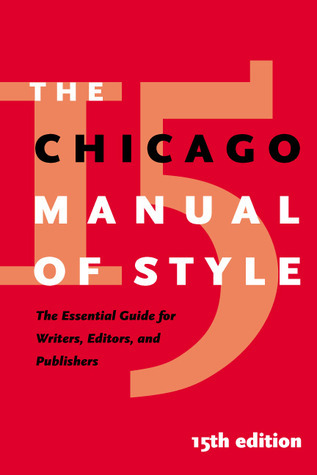
The 15th edition of The Chicago Manual of Style has been superseded by the 17th edition. In the 1890s, a proofreader at the University of Chicago Press prepared a single sheet of typographic fundamentals intended as a guide for the University community. That sheet grew into a pamphlet, and the pamphlet grew into a book—the first edition of the Manual of Style, published in 1906. Now in its fifteenth edition, The Chicago Manual of Style—the essential reference for authors, editors, proofreaders, indexers, copywriters, designers, and publishers in any field—is more comprehensive and easier to use than ever before.Those who work with words know how dramatically publishing has changed in the past decade, with technology now informing and influencing every stage of the writing and publishing process. In creating the fifteenth edition of the Manual, Chicago's renowned editorial staff drew on direct experience of these changes, as well as on the recommendations of the Manual's first advisory board, composed of a distinguished group of scholars, authors, and professionals from a wide range of publishing and business environments.Every aspect of coverage has been examined and brought up to date—from publishing formats to editorial style and method, from documentation of electronic sources to book design and production, and everything in between. In addition to books, the Manual now also treats journals and electronic publications. All chapters are written for the electronic age, with advice on how to prepare and edit manuscripts online, handle copyright and permissions issues raised by technology, use new methods of preparing mathematical copy, and cite electronic and online sources.A new chapter covers American English grammar and usage, outlining the grammatical structure of English, showing how to put words and phrases together to achieve clarity, and identifying common errors. The two chapters on documentation have been reorganized and updated: the first now describes the two main systems preferred by Chicago, and the second discusses specific elements and subject matter, with examples of both systems. Coverage of design and manufacturing has been streamlined to reflect what writers and editors need to know about current procedures. And, to make it easier to search for information, each numbered paragraph throughout the Manual is now introduced by a descriptive heading.Clear, concise, and replete with commonsense advice, The Chicago Manual of Style, fifteenth edition, offers the wisdom of a hundred years of editorial practice while including a wealth of new topics and updated perspectives. For anyone who works with words, whether on a page or computer screen, this continues to be the one reference book you simply must have.What's new in the Fifteenth Edition:* Updated material throughout to reflect current style, technology, and professional practice* Scope expanded to include journals and electronic publications* Comprehensive new chapter on American English grammar and usage by Bryan A. Garner (author of A Dictionary of Modern American Usage)* Updated and rewritten chapter on preparing mathematical copy* Reorganized and updated chapters on documentation, including guidance on citing electronic sources* Streamlined coverage of current design and production processes, with a glossary of key terms* Descriptive headings on all numbered paragraphs for ease of reference* New diagrams of the editing and production processes for both books and journals, keyed to chapter discussions* New, expanded Web site with special tools and features for Manual users at www.chicagomanualofstyle.org.
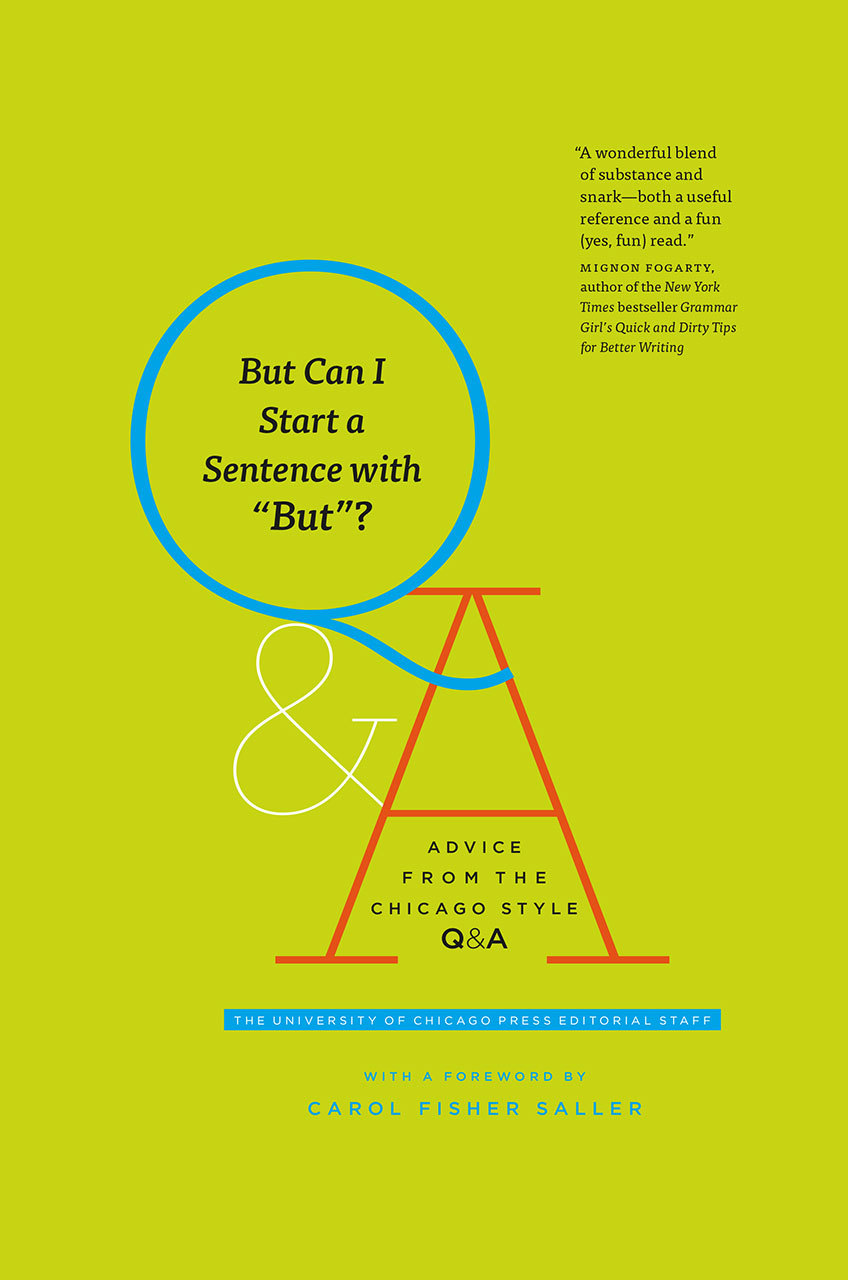
But Can I Start a Sentence with "But"?: Advice from the Chicago Style Q&A
by University of Chicago Press
Rating: 4.3 ⭐
Q. Is it “happy medium” or “happy median”? My author “We would all be much better served as stewards of finite public funds if we could find that happy median where trust reigns supreme.” Thanks!A. The idiom is “happy medium,” but I like the image of commuters taking refuge from road rage on the happy median.Q. How do I write a title of a song in the body of the work (caps, bold, underline, italics, etc.)? The Zombies’ “She’s Not There” looped in his head.A. Noooo! Now that song is looping in my head (“but it’s too late to say you’re sorry . . .”). Use quotation marks. Thanks a lot. Every month, tens of thousands of self-declared word nerds converge upon a single The Chicago Manual of Style Online 's Q&A. There the Manual ’s editors open the mailbag and tackle readers’ questions on topics ranging from abbreviation to word division to how to reform that coworker who still insists on two spaces between sentences. Champions of common sense, the editors offer smart, direct, and occasionally tongue-in-cheek responses that have guided writers and settled arguments for more than fifteen years.But Can I Start a Sentence with “But”? brings together the best of the Chicago Style Q&A . Curated from years of entries, it features some of the most popular—and hotly debated—rulings and also recovers old favorites long buried in the archives.Questions touch on myriad matters of editorial style—capitalization, punctuation, alphabetizing, special characters—as well as grammar, usage, and beyond (“How do I spell out the sound of a scream?”). A foreword by Carol Fisher Saller, the Q&A’s longtime editor, takes readers through the history of the Q&A and addresses its reputation for mischief. (“It’s not that we set out to be cheeky,” she writes.)Taken together, the questions and answers offer insights into some of the most common issues that face anyone who works with words. They’re also a comforting reminder that even the best writer or editor needs a little help—and humor—sometimes.

For nearly one hundred years, The Chicago Manual of Style has been the authoritative reference for writers, editors, and publishers. Now in its fifteenth edition, the Manual has been thoroughly revised and updated. The chapter on indexing presented here has been reorganized, streamlined, and revised for the electronic age. It provides examples and recommendations on style and method for professionals, authors, and others who prepare indexes for published works.
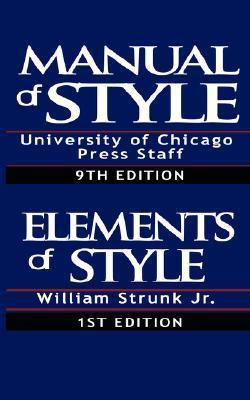
This is the 1927 edition of "Manual of Style: Containing Typographical Rules Governing the Publications of the University of Chicago Press together with Specimens of Types Used at the University of Chicago Press."The Chicago Manual of Style by University of Chicago Press Staff (Editor) - 9th EditionCountless publishing professionals have learned the details of their business from this classic guide for publishers, editors and writers. In the 1890s, a proofreader at the University of Chicago Press prepared a single sheet of typographic fundamentals intended as a guide for the University community. That sheet grew into a pamphlet, and the pamphlet grew into a book.Clear, concise, and replete with commonsense advice, The Chicago Manual of Style offers the wisdom of a hundred years of editorial practice while including a wealth of new topics and updated perspectives. For anyone who works with words, whether on a page or computer screen, this continues to be the one reference book you simply must have.The Elements of Style by William Strunk, Jr. - 1st EditionAsserting that one must first know the rules to break them, this classic reference book is a must-have for any student and conscientious writer. Intended for use in which the practice of composition is combined with the study of literature, it gives in brief space the prinicipal requirements of plain English style and concentrates attention on the rules of usage and principles of composition most commonly violated.


This hardcover book is a child’s first mathematical reference book. It contains explanations of key mathematical content, along with directions to the Everyday Mathematics games.
In the 1890s, a proofreader at the University of Chicago Press prepared a single sheet of typographic fundamentals intended as a guide for the University community. That sheet grew into a pamphlet. The pamphlet grew into a book. The 1st edition of the Manual of Style published in 1906. Now The Chicago Manual of Style is the essential reference for authors, editors, proofreaders, indexers, copywriters, designers & publishers in any field.

Excellent condition. Proceeds go to local chapter of the American Cancer Society.

Book HardcoverPublication 6/30/2007 354

These books provide extra cumulative practice on basic facts, computation, word problems, mental math, and estimation skills.Book PaperbackPublication 5/1/2002Reading Age 10 and Up

Up-to-date, concise, and easy to use, the Science and Technology Encyclopedia is a reliable resource for a wide general readership-from high school students to undergraduates to all those with an interest in the comprehensive array of scientific fields it covers.It includes:*More than 6,500 authoritative A-Z entries covering earth and life sciences (including natural history, physics, chemistry, medicine, information technology, and other disciplines)*Biographical entries for more than 850 famous scientists, detailing their careers and achievements*Over 20,000 cross-references*More than 250 detailed illustrations, including schematic diagrams, representational natural history artwork, and technical cutaway diagrams

THE UNIVERSITY OF CHICAGO Walking Guide to the Celebrating the University's Centennial Year 1991 - 1992.

The Temple of Khonsu. Volume 1: Scenes of King Herihor in the Court
by University of Chicago Press
Rating: 4.0 ⭐
The present stately folio with its accompanying text (translating all the texts in the plates) is the first-fruits of 45 years of intermittent work by the redoubtable Chicago team, alongside their work at Medinet Habu and elsewhere in Karnak. In production and fidelity it worthily upholds the extremely high standards in recording and publishing ancient Egyptian monuments so justly associated with the Chicago epigraphic survey. The Preface (signed by Dr. Wente) contains distinctly more than the expected history of the project and acknowledgments. It incorporates also a valuable summary of some of the more significant results accruing from the full record of Herihor's work in the forecourt of the temple of Khons. As for scope, the present volume contains a record of all wall-surfaces inside that court, other than Herihor's stela and the two great doorways (with later decor), and of all the decorated columns but not the architraves. From a review by K. A. Kitchen in Bibliotheca Orientalis 38 (1981) 301-02].

Requirements for Certification of Teachers, Counselors, Librarians, Administrators for Elementary Schools, Secondary Schools, Junior Colleges 1989-90
by University of Chicago Press
Rating: 4.0 ⭐

When you think of modern architecture, you think of Chicago, the birthplace of the skyscraper, the cradle of twentieth-century American design, and the home of enduring works by such iconic figures as Louis Sullivan, Ludwig Mies van der Rohe, and Frank Lloyd Wright. Idealized through tourism and celebrated in the groves of academe, the city's majestic skyline and landmark buildings remain a living testament to the modern movement.In Chicago Architecture , Charles Waldheim and Katerina Ruedi Ray revise and offer alternatives to the archetypal story of modern architecture in Chicago. They and an esteemed group of contributors assert that the mythic status of Chicago architecture has distorted our understanding of the historical circumstances in which it was realized. This searching volume illuminates the importance of photographs, books, magazines, and other media in the cultivation of an international audience for Chicago architecture; it explores the pivotal role of real estate developers, finance and insurance sectors, and speculative capital markets in the development of the city itself; and, perhaps most notably, it examines a wide variety of overlooked architectural works and their creators—individuals who did not fit into the dominant modernist narrative.Offering new insights on Chicago public housing and O'Hare International Airport, on the Columbian Exposition and Marina City, on the city's grid system and the place of women architects in the story of Chicago modernism, and on the subjective experience of living inside Chicago's most well-known buildings, Chicago Architecture is a work of enormous scope and vision—a book as heady and towering as the skyline it considers.

Chicago guide to preparing electronic manuscripts : for authors and publishers.
by University of Chicago Press
Rating: 4.0 ⭐
This guide to preparing manuscripts on computer offers authors and publishers practical assistance on how to use authors' disks or tapes for typesetting. When the thirteenth edition of The Chicago Manual of Style was published in 1982, the impact of personal computers on the publishing process had just begun to be felt. This new book supplements information in the Chicago Manual by covering the rapidly changing subject of electronic manuscripts. Since the early 1980s more and more authors have been producing manuscripts on computers and expecting their publishers to make use of the electronic version. For a number of reasons, including the proliferation of incompatible machines and software, however, publishers have not always found it easy to work with electronic manuscripts. The University of Chicago Press has been doing so since 1981, and in this book passes on the results of six years' experience with preparing such manuscripts and converting them to type.

The Wobbling Pivot (pp. 134-149) Jonathan Z. Smith


Transitions Mathematics
Author-title Catalog of the Chinese Collection
by University of Chicago Press
History of Civilization Selected Readings Topic 2 the Greek Polis
by University of Chicago Press
History book