
Ulysses S. Grant
Ulysses Simpson Grant, originally Hiram Ulysses Grant, in Civil War victoriously campaigned at Vicksburg from 1862 to 1863, and, made commander in chief of the Army in 1864, accepted the surrender of Robert Edward Lee, general, at Appomattox in 1865; widespread graft and corruption marred his two-term presidency, the eighteenth of the United States, from 1869 to 1877. Robert Edward Lee surrendered to Ulysses Simpson Grant at Appomattox in 1865. Robert Edward Lee, Confederate general, surrendered to Ulysses Simpson Grant, Union general, at the hamlet of Appomattox Court House on 9 April 1865 to end effectively the Civil War. The son of an Appalachian tanner of Ohio, Ulysses Simpson Grant of America entered the military academy at 17 years of age in 1839. The academy graduated him in 1843. In 1846, three years afterward, Grant served as a lieutenant in the Mexican War under Winfield Scott and Zachary Taylor. The conflict concluded in 1848. Grant abruptly resigned in 1854. After struggling through the succeeding years as a real estate agent, a laborer, and a county engineer, Grant decided to join the northern effort. Abraham Lincoln appointed Grant to brigadier of volunteers in 1861; he in 1862 claimed the first major capture of fort Henry and fort Donelson in Tennessee. A Confederate attack at the battle of Shiloh surprised him, who emerged, but the severe casualties prompted a public outcry. Following many long initial setbacks and his rescue of the besieged at Chattanooga, however, Grant subsequently established his reputation as most aggression and success to Lincoln. Named lieutenant in 1864, Grant implemented a coordinated strategy of simultaneous attacks, aimed at destroying ability of economy to sustain forces of the south. He mounted a successful attrition against his Confederate opponents to courthouse in 1865. After Andrew Jackson, four decades earlier, people elected duly popular Grant as a Republican in 1868 and re-elected him in 1872 as the first to serve fully. Grant signed and enforced congressional rights legislation to lead Reconstruction. Grant built a powerful, patronage-based Republican Party in the south and strained relations between the north and former Confederates. Sometimes, nepotism produced scandal of his Administration; people coined the neologism to describe his politics. Grant left office in 1877 and embarked upon a two-year world tour. Unsuccessful in winning the nomination for a third in 1880, left destitute by a fraudulent investor, and near the brink of death, Grant wrote his Memoirs, which were enormously successful among veterans, the public, and critics. However, in 1884, Grant learned that he was suffering from terminal throat cancer and, two days after completing his writing, he died at the age of 63. Historians typically rank Grant in the lowest quartile for his tolerance, but in recent years his reputation has improved among some scholars impressed by his support for rights for African Americans.
30 Books Written

The Personal Memoirs of Ulysses S. Grant: The Complete Annotated Edition
by Ulysses S. Grant
Rating: 4.5 ⭐
• 4 recommendations ❤️
President Ulysses S. Grant (1822-1885) was one of the most esteemed individuals of the nineteenth century. His two-volume memoirs, sold door-to-door by former Union soldiers, have never gone out of print and were once as ubiquitous in American households as the Bible. Mark Twain, Gertrude Stein, Matthew Arnold, Henry James, and Edmund Wilson hailed these works as great literature, and Presidents Bill Clinton and George W. Bush both credit Grant with influencing their own writing. Yet a judiciously annotated clarifying edition of these memoirs has never been produced until now.The Personal Memoirs of Ulysses S. Grant is the first comprehensively annotated edition of Grant's memoirs, fully representing the great military leader's thoughts on his life and times through the end of the Civil War and his invaluable perspective on battlefield decision making. An introduction contextualizes Grant's life and significance, and lucid editorial commentary allows the president's voice and narrative to shine through. With annotations compiled by the editors of the Ulysses S. Grant Association's Presidential Library, this definitive edition enriches our understanding of the antebellum era, the Mexican War, and the Civil War. Grant provides insight into how rigorously these events tested America's democratic institutions and the cohesion of its social order.The Personal Memoirs of Ulysses S. Grant preserves and extends a work of profound political, historical, and literary significance and serves as the gateway for modern readers of all backgrounds to an American classic.
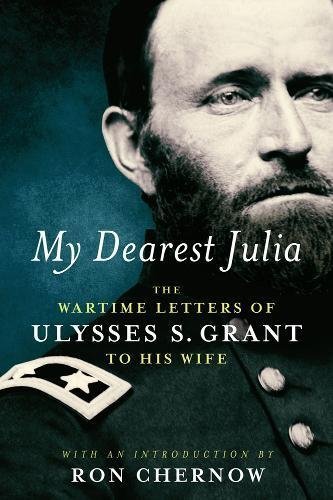
My Dearest Julia: The Wartime Letters of Ulysses S. Grant to His Wife
by Ulysses S. Grant
Rating: 4.1 ⭐
The Civil War’s greatest general as you’ve never seen him A revealing collection of letters written by Ulysses S. Grant to his wife, Julia, perfect for American history buffs.Grant’s intimate reflections on the War in Mexico and the Civil War “[show] his remarkable evolution from an insecure young soldier to a capable, self-confident general” (Ron Chernow).Ulysses S. Grant is justly celebrated as the author of one of the finest military autobiographies ever written, yet many readers of his Personal Memoirs are unaware that during his army years Grant wrote hundreds of intimate and revealing letters to his wife, Julia Dent Grant. Presented with an introduction by acclaimed biographer Ron Chernow, My Dearest Julia collects more than eighty of these letters, beginning with their engagement in 1844 and ending with the Union victory in 1865. They record Grant's first experience under fire in Mexico (“There is no great sport in having bullets flying about one in every direction but I find they have less horror when among them than when in anticipation”), the aching homesickness that led him to resign from the peacetime army, and his rapid rise to high command during the Civil War. Often written in haste, sometimes within the sound of gunfire, his wartime letters vividly capture the immediacy and uncertainty of the conflict. Grant initially hoped for an early conclusion to the fighting, but then came to accept that the war would have no easy end. “The world has never seen so bloody or so protracted a battle as the one being fought,” he wrote from Spotsylvania in 1864, “and I hope never will again.”

Twenty years after Appomattox, the Civil War’s greatest general fought his last campaign against death and time. Stricken by cancer as his family faced financial ruin, Ulysses S. Grant wrote his Personal Memoirs to secure their future, and in doing so won for himself a unique place in American letters. Acclaimed by readers as diverse as Mark Twain, Matthew Arnold, Gertrude Stein, and Edmund Wilson, the Personal Memoirs demonstrates the intelligence, intense determination, and laconic modesty that made Grant the Union’s foremost commander. This Library of America volume also includes 174 letters written by Grant from 1839 to 1865. Many of them are to his wife, Julia, and offer an intimate view of their affectionate and enduring marriage; others, addressed to fellow generals, government officials, and his congressional patron Elihu B. Washburne, provide a fascinating contemporary perspective on the events that would later figure in the Memoirs.Grant’s autobiography is devoted almost entirely to his life as a soldier: his years at West Point, his service in the peacetime army, and his education in war during conflicts foreign and domestic. Grant considered the Mexican War “one of the most unjust ever waged by a stronger against a weaker nation” and thought that the Civil War was our punishment for it; but his retrospective disapproval did not prevent him from becoming enchanted by Mexico or from learning about his own capacity for leadership amid the confusion and carnage of battle.His account of the Civil War combines a lucid treatment of its political causes and its military actions, along with the story of his own growing strength as a commander. At the end of an inconsequential advance in Missouri in 1861 he realized that his opponent “had been as much afraid of me as I had been of him.” Fort Donelson and Shiloh taught him to seize the initiative, while his success in living off the land during the Vicksburg campaign inspired William T. Sherman to undertake his marches through the interior of the South.By 1864 Grant knew that the rebellion could be suppressed only by maintaining relentless pressure against its armies and methodically destroying its resources. As the Union’s final general-in-chief, he acted with the resolve that had eluded his predecessors, directing battles whose drawn-out ferocity had no precedent in Western warfare. His narrative of the war’s final year culminates in his meeting with Lee at Appomattox, a scene of quiet pride, sadness, and humanity.Grant’s writing is spare, telling, and quick, superbly evocative of the imperatives of decision, motion, and action that govern those who try to shape the course of war. Grant wrote about the most destructive war in American history with a clarity and directness unequaled in our literature.

This book was converted from its physical edition to the digital format by a community of volunteers. You may find it for free on the web. Purchase of the Kindle edition includes wireless delivery.

After three deadly years of fighting, President Abraham Lincoln had seen a little progress in the West against the Confederacy, but in the main theater of operations, Virginia, the lines were almost exactly where they had been when the American Civil War started. The war was at a stalemate with northern public support rapidly fading. Then, Lincoln summoned General Ulysses S. Grant, victor of the Vicksburg campaign, to come East. In little over a year, America's most catastrophic armed conflict ended, the Union was preserved, and slavery was abolished. This book details how these triumphs were achieved and in the telling earned international acclaim as a superb example of an English-language personal chronicle. About the AuthorUlysses S. Grant remains one of the giants in American history, revered and respected by his contemporaries, but viewed ever after as one of the country's most controversial figures. He graduated from West Point in 1843 and went on to have a successful military career before becoming the 18th President of the United States for two terms. These grand accomplishments stand in stark contrast with his failures. He became an alcoholic, a failed businessman, and the administration during his presidency is regarded as one of the most corrupt in U.S. history. While other prominent Americans look to publishing their recollections as a crowning event undertaken in the leisure of retirement, Grant had to write his 1885 memoir as a means to pay his debts and support his family.

In his own captivating words, General Ulysses S. Grant describes the Wilderness Campaign, the almost anti-climactic surrender of General Robert E. Lee at Appomattox, and the assassination of President Abraham Lincoln. His depiction of the most crucial and hardest-fought battles of the Civil War, the near-disasters, and the bloody triumphs reveals a highly intelligent, profound, thinking man. Grant wrote his memoirs as he lay dying of cancer and completed the manuscript only a week before his death.

The Memoirs of General Ulysses Simpson Grant, Part 1libreka classics – These are classics of literary history, reissued and made available to a wide audience.Immerse yourself in well-known and popular titles!

The generalship and presidency of Ulysses S. Grant has undergone a re-evaluation in recent years, with historians viewing both more favorably than in the past. Here in his own words is Grant in retirement, on a trip around the world, discussing the men and events of his incredible careers with John Russell Young of the "New York Herald."Young was invited to make the two year tour with the Grants. He records the former president talking about everything from politics to people he'd known. But the best of the conversations are on the men and battles of the Civil War.Grant provides his thoughts on Lincoln, Sherman, Sheridan, Lee, Thomas, Longstreet and more. He discusses the siege of Vicksburg, the Battle of Shiloh, and the surrender at Appomattox.This is not the Grant of his highly-regarded autobiography. He is more relaxed, more casual, and talks more of people than events. This is a Ulysses S. Grant you probably haven't seen before.John Russell Young later distinguished himself as United States minister to China.Every memoir of the American Civil War provides us with another view of the catastrophe that changed the country forever.For the first time, this long out-of-print volume is available as an affordable, well-formatted book for e-readers and smartphones.Be sure to LOOK INSIDE by clicking the cover above or download a sample.

The Civil War — the bloodiest, most dramatic moment in this nation's history — also produced some of the country's greatest literature. Blood reflects the violent hatred, love, patriotism, and heroism this conflict generated through the vivid stories of the men and women who were there. This collection includes Ulysses S. Grant (via the rumored pen of Mark Twain) recounting the taking of Vicksburg; Theodore Lyman watching Grant come into his own on his first drive toward Richmond; George Templeton Strong describing the horror of the New York Draft Riots; and plantation owner Mary Chestnut's report on the final days before the fall of Atlanta. Also included are firsthand accounts ranging from Pickett's Charge to Sherman's March, from Lee's Virginia campaigns to the heroism of African American foot soldiers, as well as excerpts from some of the most notable fiction on the subject.

This book was converted from its physical edition to the digital format by a community of volunteers. You may find it for free on the web. Purchase of the Kindle edition includes wireless delivery.

This book was converted from its physical edition to the digital format by a community of volunteers. You may find it for free on the web. Purchase of the Kindle edition includes wireless delivery.

This book was converted from its physical edition to the digital format by a community of volunteers. You may find it for free on the web. Purchase of the Kindle edition includes wireless delivery.

This book was converted from its physical edition to the digital format by a community of volunteers. You may find it for free on the web. Purchase of the Kindle edition includes wireless delivery.

Personal Memoirs of Ulysses S. Grant, and, Recollections and Letters Robert E. Lee
by Ulysses S. Grant
Rating: 4.3 ⭐
More than one hundred fifty years after General Robert E. Lee surrendered to General Ulysses S. Grant at Appomattox Courthouse, the writings of these two remarkable men continue to spark interest in the Civil War. Grant's Personal Memoirs and Lee's Recollections and Letters remain not only decisive histories of the Civil War and its military leaders, but also fundamental texts for understanding the character of the United States and her heroes.

For the 150th anniversary of the Civil War, The Library of America re-issues the memoirs of Ulysses S. Grant and William Tecumseh Sherman in a handsome, newly designed case. An ailing Grant wrote his Personal Memoirs to secure his family's future. In doing so, the Civil War's greatest general won himself a unique place in American letters. John Keegan has called it "perhaps the most revelatory autobiography of high command to exist in any language." The Library of America's edition of Grant's Memoirs includes 175 of his letters to Lincoln, Sherman, and his wife, Julia, among others. Hailed as a prophet of modern war and condemned as a harbinger of modern barbarism, William T. Sherman is the most controversial general of the Civil War. "War is cruelty, and you cannot refine it," he wrote in fury to the Confederate mayor of Atlanta, and his memoir is filled with dozens of such wartime exchanges and a fascinating account of the famous march through Georgia and the Carolinas.LIBRARY OF AMERICA is an independent nonprofit cultural organization founded in 1979 to preserve our nation’s literary heritage by publishing, and keeping permanently in print, America’s best and most significant writing. The Library of America series includes more than 300 volumes to date, authoritative editions that average 1,000 pages in length, feature cloth covers, sewn bindings, and ribbon markers, and are printed on premium acid-free paper that will last for centuries.

Letters of Ulysses S. Grant to His Father and His Youngest Sister, 1857-78
by Ulysses S. Grant
Rating: 3.4 ⭐
This book was converted from its physical edition to the digital format by a community of volunteers. You may find it for free on the web. Purchase of the Kindle edition includes wireless delivery.

A reprint of Ulysses S. Grant's memoir with a forward written by David hardin

Las memorias del general más famoso de la Guerra de Secesión americana (1861-1865) tuvieron en Ulysses S. Grant a su principal protagonista, un alumno de la mítica academia militar de West Point que alcanzaría las más altas cotas de prestigio como soldado y posteriormente como político al llegar a ser el 18º Presidente de los EEUU. Una figura destacadísima para una gran parte de la ciudadanía norteamericana y para la historia de los Estados Unidos de América en su conjunto. Un hombre con sus fortalezas y sus debilidades transcritas sobre el papel en estas extraordinarias memorias. En esta inicial publicación se abarcará sus primeros años de andadura, desde su nacimiento hasta la parte dedicada a la guerra de México (1846-1848), que será el eje central de la misma. Posteriormente la editorial HRM ediciones publicará dos volúmenes adicionales en la cual la Guerra de Secesión será la gran protagonista.

Unabridged on 7 compact disc (nine hours), read by Peter Johnson. The Personal Memoirs of U.S. Grant, Part The Wilderness Campaign; Surrender at Appomattox. About the Ulysses Simpson Grant was the eighteenth President of the United States. He was an American general and gained international fame as the leading Union General. It was due to his efforts that the Unionists gained their early victories.

*Illustrated *Includes Table of Contents After the American Civil War began in April 1861, Ulysses S. Grant made a meteoric rise to the top of the Union war effort. Illinois. On April 6, 1862 a determined full-force attack from the Confederate Army took place at the Battle of Shiloh; the objective was to destroy the entire Western Union offensive once for all. Over 44,699 Confederate troops led by Albert Sidney Johnston and P.G.T. Beauregard, vigorously attacked five divisions of Grant’s army bivouacked nine miles south at Pittsburgh Landing. Aware of the impending Confederate attack, Union troops sounded the alarm and readied for battle, however, no defensive entrenchment works had been made. The Confederates struck hard and repulsed the Union Army towards the Tennessee River. Grant and Maj. General William T. Sherman were able to rally the troops and make a stand. After receiving reinforcement troops from Maj. Gen. Don Carlos Buell and Maj. Gen. Lew Wallace’s missing division, Grant succeeded in stabilizing the Army of the Tennessee. Confederate General Johnson was killed in the battle on the first day of fighting, and on the second day, Grant launched a costly counter-offensive and pursuit that forced the Confederate Army, now under P.G.T. Beauregard, to retreat to Corinth. The battle was the costliest in the Civil War up until this time, having 23,746 combined Union and Confederate casualties. The carnage at Shiloh demonstrated to both Confederates and Unionists that the Civil War was both very serious and extremely costly. Shiloh was the first battle in the American Civil War with tremendous casualties and Grant received much criticism for keeping the Union Army bivouacked rather than entrenched. As a result, Grant’s superior Maj. Gen Henry Halleck demoted him to second-in-command of a newly formed 120,000-strong Union Army. Grant was ready to resign from command when Maj. Gen. Sherman talked him into remaining in Halleck’s army. Grant would go on to restore his reputation and become the North’s greatest war hero, eventually coming to command all armies and force Lee’s surrender at Appomattox, ending the war for all intents and purposes. After the war, he would write what is considered the best personal memoirs of the war as well. He also wrote an account of the Battle of Shiloh that was eventually published in the well known Battles & Leaders series. This edition of Battles & Leaders of the Civil The Battle of Shiloh is specially formatted with a Table of Contents and pictures of Shiloh’s important commanders.

General U.S. Grant's Writings (Complete and Unabridged Including His Personal Memoirs, State of the Union Address and Letters of Ulysses S. Grant to H
by Ulysses S. Grant
Rating: 3.9 ⭐
Ulysses S. Grant (1822 - 1885) was the 18th President of the United States (1869-1877) immediately after he had fought in thw Civil War as a General, defeating the Confederate military. As President he led the Radical Republicans who attempted to remove all trace of Confederate nationalism and slavery. President Grant effectively destroyed the Ku Klux Klan in 1871. President Grant was a champion of African American equality and civil rights. This Collection of General Grant's writings include his complete and unabridged Personal Memoirs, State of the Union Address and Letters of Ulysses S. Grant to His Father and His Youngest Sister, 1857-78.

This book was converted from its physical edition to the digital format by a community of volunteers. You may find it for free on the web. Purchase of the Kindle edition includes wireless delivery.

This book was converted from its physical edition to the digital format by a community of volunteers. You may find it for free on the web. Purchase of the Kindle edition includes wireless delivery.

9hrs 37minsCovering the pivotal years 1861-1864, General Ulysses S. Grant leads us in his own words from Fort Sumter to his appointment as commander of all the armies of the North. Grant remembers his experiences with the key players of the day, takes us onto the battlefields, and recounts the twists and turns of fate. Grant was a failed peacetime soldier, failed farmer, failed woodcutter, failed bill collector, and 38-year-old clerk in a harness store in the spring of 1861. By 1864, he was directing all the Union forces.

Surrender at Appomattox: First-hand Accounts of Robert E. Lee's Surrender to Ulysses S. Grant
by Ulysses S. Grant
Rating: 3.3 ⭐
On the 12th of April, 1865, the Army of Northern Virginia marched to the field in front of Appomattox Court-House, stacked their arms, folded their colors, and walked empty handed to find their distant, blighted homes. These are detailed and moving first-hand accounts from a number of historically prominent witnesses to Robert E. Lee's surrender of the Army of Northern Virginia at Appomattox. Accounts Major-General Wesley Merritt, USAMajor-General John Gibbon, USAColonel Charles Marshall, Aide-de-camp and Military Secretary to General R. E. Lee, CSABrigadier-General E. P. Alexander, CSALt. General James Longstreet, CSAGeneral Phil Sheridan, USALt. General Ulysses S. Grant, USAAlso included is "the famous telegram," which informed President Lincoln of Lee's surrender.A must have for any Civil War buff!The table of contents is linked to each chapter. The book was carefully formatted for optimal navigation on all electronic readers as well as mobile devices with a small display.

Quotations from Ulysses S. Grant, eighteenth President of the United States and General-in-Chief of the Union forces during the Civil War.

Personal Memoirs Of U.S. Grant: FREE Crime And Punishment By Fyodor Dostoevsky, 100% Formatted, Illustrated - JBS Classics, All Volumes
by Ulysses S. Grant
Rating: 4.8 ⭐
This eBook of 'Personal Memoirs Of U.S. Grant' by Ulysses S. Grant has been tested on below parameters across ALL devices (including Kindle, Android, iBook, Cloud Readers etc.). It works 100% perfectly as required. 1) Active Table of Contents.Footnotes & Endnotes. 2) Word Wise – Enabled. 3) Illustrations & Tables (if any) are available with ZOOM feature on double-click. Among the autobiographies of great military figures, Ulysses S. Grant's is certainly one of the finest, and it is unarguably the most notable literary achievement of any American a lucid, compelling, and brutally honest chronicle of triumph and failure.General Grant's personal memoirs are a must read for all Civil War buffs and those even remotely interested in history.This book, which includes both Volume I and II.The reader is given a (very) short review of his early childhood, life at West Point, and early Army life. The next one hundred pages are dedicated to the Mexican War followed by his resignation from the military and civilian life in Illinois. The remainder of Volume I and all of Volume II extensively deal with the war between the states. Volume I (written before Grant realized he was critically ill) is rich in detail of the various military campaigns and his ascension through the military ranks. Volume II hurls the reader into the conflict, reads rapidly, and is rife with Grant's personal observations and insights. This second volume picks up where the first left off

The complete Personal Memoirs of ulysses s grant, and Letters of Ulysses S. Grant to His Father and His Youngest Sister, 1857-78 by Grant.

Ulysses S. Grant led the Union in their operations against Vicksburg. This is his history of the campaign, taken from Battles and Leaders of the Civil War.

Ulysses S. Grant: Memoirs and Selected Letters : Personal Memoirs of U.S. Grant / Selected Letters, 1839-1865
by Ulysses S. Grant
Rating: 3.0 ⭐
Very RARE edition!! UNIQUE offer!! Don’t wait to be OWNER of this special piece of HISTORY!!!