
Tom Wolfe
Wolfe was educated at Washington and Lee Universities and also at Yale, where he received a PhD in American studies. Tom Wolfe spent his early days as a Washington Post beat reporter, where his free-association, onomatopoetic style would later become the trademark of New Journalism. In books such as The Electric Koolaid Acid Test, The Right Stuff, and The Bonfire of the Vanities, Wolfe delves into the inner workings of the mind, writing about the unconscious decisions people make in their lives. His attention to eccentricities of human behavior and language and to questions of social status are considered unparalleled in the American literary canon. He is one of the founders of the New Journalism movement of the 1960s and 1970s. Tom Wolfe is also famous for coining and defining the term fiction-absolute . http://us.macmillan.com/author/tomwolfe
29 Books Written

Tom Wolfe began The Right Stuff at a time when it was unfashionable to contemplate American heroism. Nixon had left the White House in disgrace, the nation was reeling from the catastrophe of Vietnam, and in 1979--the year the book appeared--Americans were being held hostage by Iranian militants. Yet it was exactly the anachronistic courage of his subjects that captivated Wolfe. In his foreword, he notes that as late as 1970, almost one in four career Navy pilots died in accidents. "The Right Stuff," he explains, "became a story of why men were willing--willing?--delighted!--to take on such odds in this, an era literary people had long since characterized as the age of the anti-hero." Wolfe's roots in New Journalism were intertwined with the nonfiction novel that Truman Capote had pioneered with In Cold Blood. As Capote did, Wolfe tells his story from a limited omniscient perspective, dropping into the lives of his "characters" as each in turn becomes a major player in the space program. After an opening chapter on the terror of being a test pilot's wife, the story cuts back to the late 1940s, when Americans were first attempting to break the sound barrier. Test pilots, we discover, are people who live fast lives with dangerous machines, not all of them airborne. Chuck Yeager was certainly among the fastest, and his determination to push through Mach 1--a feat that some had predicted would cause the destruction of any aircraft--makes him the book's guiding spirit. Yet soon the focus shifts to the seven initial astronauts. Wolfe traces Alan Shepard's suborbital flight and Gus Grissom's embarrassing panic on the high seas (making the controversial claim that Grissom flooded his Liberty capsule by blowing the escape hatch too soon). The author also produces an admiring portrait of John Glenn's apple-pie heroism and selfless dedication. By the time Wolfe concludes with a return to Yeager and his late-career exploits, the narrative's epic proportions and literary merits are secure. Certainly The Right Stuff is the best, the funniest, and the most vivid book ever written about America's manned space program. --Patrick O'Kelley

They say if you remember the '60s, you weren't there. But, fortunately, Tom Wolfe was there, notebook in hand, politely declining LSD while Ken Kesey and his Merry Pranksters fomented revolution, turning America on to a dangerously playful way of thinking as their Day-Glo conveyance, Further, made the most influential bus ride since Rosa Parks's. By taking On the Road's hero Neal Cassady as his driver on the cross-country revival tour and drawing on his own training as a magician, Kesey made Further into a bully pulpit, and linked the beat epoch with hippiedom. Paul McCartney's Many Years from Now cites Kesey as a key influence on his trippy Magical Mystery Tour film. Kesey temporarily renounced his literary magic for the cause of "tootling the multitudes"--making a spectacle of himself--and Prankster Robert Stone had to flee Kesey's wild party to get his life's work done. But in those years, Kesey's life was his work, and Wolfe infinitely multiplied the multitudes who got tootled by writing this major literary-journalistic monument to a resonant pop-culture moment.Kesey's theatrical metamorphosis from the distinguished author of One Flew over the Cuckoo's Nest to the abominable shaman of the "Acid Test" soirees that launched The Grateful Dead required Wolfe's Day-Glo prose account to endure (though Kesey's own musings in Demon Box are no slouch either). Even now, Wolfe's book gives what Wolfe clearly got from Kesey: a contact high.

The setting is Atlanta, Georgia — a racially mixed, late-century boomtown full of fresh wealth and wily politicians. The protagonist is Charles Croker, once a college football star, now a late-middle-aged Atlanta conglomerate king whose outsize ego has at last hit up against reality. Charlie has a 29,000 acre quail-shooting plantation, a young and demanding second wife, and a half-empty office complex with a staggering load of debt.Meanwhile, Conrad Hensley, idealistic young father of two, is laid off from his job at the Croker Global Foods warehouse near Oakland and finds himself spiraling into the lower depths of the American legal system.And back in Atlanta, when star Georgia Tech running back Fareek “the Canon” Fanon, a homegrown product of the city’s slums, is accused of date-raping the daughter of a pillar of the white establishment, upscale black lawyer Roger White II is asked to represent Fanon and help keep the city’s delicate racial balance from blowing sky-high.Networks of illegal Asian immigrants crisscrossing the continent, daily life behind bars, shady real estate syndicates — Wolfe shows us contemporary America with all the verve, wit, and insight that have made him our most admired novelist. Charlie Croker’s deliverance from his tribulations provides an unforgettable denouement to the most widely awaited, hilarious and telling novel America has seen in ages — Tom Wolfe’s most outstanding achievement to date.

Alternate cover edition of ISBN 9780553381344.The Bonfire of the Vanities is a 1987 satirical novel by Tom Wolfe. The story is a drama about ambition, racism, social class, politics, and greed in 1980s New York City, and centers on three main characters: WASP bond trader Sherman McCoy, Jewish assistant district attorney Larry Kramer, and British expatriate journalist Peter Fallow.The novel was originally conceived as a serial in the style of Charles Dickens' writings: It ran in 27 installments in Rolling Stone starting in 1984. Wolfe heavily revised it before it was published in book form. The novel was a bestseller and a phenomenal success, even in comparison with Wolfe's other books. It has often been called the quintessential novel of the 1980s.

Tom Wolfe, the master social novelist of our time, the spot-on chronicler of all things contemporary and cultural, presents a sensational new novel about life, love, and learning--or the lack of it--amid today's American colleges.Our story unfolds at fictional Dupont University: those Olympian halls of scholarship housing the cream of America's youth, the roseate Gothic spires and manicured lawns suffused with tradition . . . Or so it appears to beautiful, brilliant Charlotte Simmons, a sheltered freshman from North Carolina. But Charlotte soon learns, to her mounting dismay, that for the upper-crust coeds of Dupont, sex, cool, and kegs trump academic achievement every time.As Charlotte encounters the paragons of Dupont's privileged elite--her roommate, Beverly, a Groton-educated Brahmin in lusty pursuit of lacrosse players; Jojo Johanssen, the only white starting player on Dupont's godlike basketball team, whose position is threatened by a hotshot black freshman from the projects; the Young Turk of Saint Ray fraternity, Hoyt Thorpe, whose heady sense of entitlement and social domination is clinched by his accidental brawl with a bodyguard for the governor of California; and Adam Geller, one of the Millennial Mutants who run the university's "independent" newspaper and who consider themselves the last bastion of intellectual endeavor on the sex-crazed, jock-obsessed campus--she is seduced by the heady glamour of acceptance, betraying both her values and upbringing before she grasps the power of being different--and the exotic allure of her own innocence.With his trademark satirical wit and famously sharp eye for telling detail, Wolfe's I Am Charlotte Simmons draws on extensive observations at campuses across the country to immortalize the early-21st-century college-going experience.

Based on the same sort of detailed, on-scene, high-energy reporting that powered Tom Wolfe's previous bestselling novels, Back to Blood is another brilliant, spot-on, scrupulous, and often hilarious reckoning with our times.As a police launch speeds across Miami's Biscayne Bay - with officer Nestor Camacho on board - Tom Wolfe is off and running. Into the feverous landscape of the city, he introduces the Cuban mayor, the black police chief, a wanna-go-muckraking young journalist and his Yale-marinated editor; an Anglo sex-addiction psychiatrist and his Latina nurse by day, loin lock by night - until lately, the love of Nestor's life; a refined, and oh-so-light-skinned young woman from Haiti and her Creole-spouting, black-gang-banger-stylin' little brother; a billionaire porn addict, crack dealers in the 'hoods, "de-skilled" conceptual artists at the Miami Art Basel Fair, "spectators" at the annual Biscayne Bay regatta looking only for that night's orgy, yenta-heavy ex-New Yorkers at an "Active Adult" condo, and a nest of shady Russians.

The author derails the great American myth of modern art in a scathing, witty, uncompromising critique of American art from the 1950s through the 1970s. Reprint.

Tom Wolfe, "America's most skillful satirist" (The Atlantic Monthly), examines the strange saga of American architecture in this sequel to The Painted Word.

Two hilarious essays by the author of The Right Stuff show the white liberal establishment confronting the new subculture, with humorous and unexpected results. Reprint.

The author's first book, a unique collection of essays about 1960s lifestyles, peels the lid off the egalitarian subculture of the era. Reprint.

The maestro storyteller and reporter provocatively argues that what we think we know about speech and human evolution is wrong.Tom Wolfe, whose legend began in journalism, takes us on an eye-opening journey that is sure to arouse widespread debate. The Kingdom of Speech is a captivating, paradigm-shifting argument that speech—not evolution—is responsible for humanity's complex societies and achievements.From Alfred Russel Wallace, the Englishman who beat Darwin to the theory of natural selection but later renounced it, and through the controversial work of modern-day anthropologist Daniel Everett, who defies the current wisdom that language is hard-wired in humans, Wolfe examines the solemn, long-faced, laugh-out-loud zig-zags of Darwinism, old and Neo, and finds it irrelevant here in the Kingdom of Speech.

In Hooking Up , Tom Wolfe ranges from coast to coast observing 'the lurid carnival actually taking place in the mightiest country on earth in the year 2000.' From teenage sexual manners and mores to fundamental changes in the way human beings now regard themselves thanks to the hot new fields of genetics and neuroscience; from his legendary profile of William Shawn, editor of The New Yorker (first published in 1965), to a remarkable portrait of Bob Noyce, the man who invented Silicon Valley, Tom Wolfe the master of reportage and satire returns in vintage form.

Looking for new forms of status and power, the author travels from La Jolla to London in search of the 1960s subculture's wildest heroes. Reprint.

Comments on the evolution of the New Journalism and presents representative writings by Gay Talese, Truman Capote, Norman Mailer, and others

Mauve Gloves & Madmen, Clutter & Vine: And Other Stories, Sketches, and Essays
by Tom Wolfe
Rating: 3.6 ⭐
"When are the 1970s going to begin?" ran the joke during the Presidential campaign of 1976. With his own patented combination of serious journalism and dazzling comedy, Tom Wolfe met the question head-on in these rollicking essays -- and even provided the 1970s with its "The Me Decade."

The Electric Kool-aid Acid Test/The Kandy Kolored Tangerine Flake Streamline Baby/Radical Chic & Mau Mauing the Flak Catchers
by Tom Wolfe
Rating: 4.0 ⭐
This edition was specially created in 1990 for Quality Paperback Books by arrangement with Farrar, Straus & Giroux, Inc.

Bantam Doubleday Dell Audio, Compact Disk, $24.95/$34.95(Can), ISBN: 0-553-45568-0He's been called the inventor of the New Journalism--and possessor of the age's most distinctive prose style. Now in this original novella, serialized to critical acclaim in Rolling Stone magazine in December 1996, Tom Wolfe, author of the bestseller The Bonfire of the Vanities, turns his penetrating eye and devastating wit to the world of TV news...As the producer of a prime-time TV newsmagazine, Irv Durtscher fancies himself the Federico Fellini of television journalism. For who else can draw 50 million viewers, satisfy the network's gluttony for profits, and advance the cause of social justice? The only problem is that no one else recognizes Irv's genius. Instead, all the accolades go to the blonde bombshell anchor who won't give balding, near-sighted Irv the time of day. But suddenly Irv has a chance to break the most sensational story of his career--one that will surely catapult him into the national spotlight and into Madame Bombshell's heart. For months the wheels of justice have ground to a halt as three soldiers from Fort Bragg have categorically denied that they savagely beat and murdered a member of their company because he was gay. Now, Irv Durtscher, self-proclaimed soul of a soulless industry, is poised to expose the truth. With a fortune in surveillance equipment, he has infiltrated a bar near Fort Bragg, in the hopes that the unwitting soldiers will hang themselves on videotape. What he gets is pure dynamite. But Irv's story won't be complete until he arranges to ambush the three young toughs and show them the footage. What happens when one of New York's mediaelite confronts the Lords of Testosterone?...not what you think. Ambush at Fort Bragg is classic Wolfe--a blistering send-up of one man's drive for fame and glory and the lengths to which the media will go to showcase their version of the truth. This is Wolfe at his very best--timely, relevant, and right on the money about many aspects of 90s America: the media, the military, the South, discrimination, and homophobia.A graduate of Yale University and the Columbia School of Theatre Arts, Edward Norton's film credits include Everyone Says I Love You, The People Vs. Larry Flynt and Primal Fear, for which he received an Oscar nomination.Not available in any book format, Ambush at Fort Bragg has been published by BDD Audio on cassette and CD.

Gathers selections from Wolfe's previous essay collections about American culture, the Vietnam War, art and architecture, and the space program

Wolfe focuses on the changing mores and social landscape of the 1980s, with drawings from two decades as a graphic artist. Reprint.

Este volumen reúne dos títulos del autor que levantaron en su día una gran polvareda y que ahora presentamos con un prólogo de Oscar Tusquets Blanca. En La palabra pintada, Wolfe describe el curso errático de la historia social del arte moderno y afirma que se ha convertido en una parodia de sí mismo: tan literario, académico y manierista como la pintura contra la que se había rebelado. El arte moderno se puso de moda y los peritos y expertos cedieron su lugar a le beau monde y los críticos. Greenberg, Rosenberg, Steinberg: éstos quedarán en la Historia del Arte –argumenta Wolfe– y no los pintores, llámense Pollock, De Kooning, Lichtenstein... ¿Quién teme al Bauhaus feroz? es una operación similar en el ámbito de la arquitectura, a partir del fin de la Primera Guerra Mundial y la aspiración del Bauhaus, cuyos integrantes suscribían la famosa consigna de Gropius: «empezar de cero». Tan crucial como «empezar de cero» era acabar con la arquitectura «burguesa», por lo que estos marxistas sueñan con edificar un mundo riguroso y abstracto. Expulsados de Alemania por el nazismo, se refugian en los Estados Unidos. Así, en la Babilonia del capitalismo, se produce la paradoja de una atemorizada obediencia a los cánones de una arquitectura desnuda, fría y abstracta, que prohíben el lujo y hasta el optimismo.«La palabra pintada es una obra maestra» (The Washington Post).«¿Quién teme al Bauhaus feroz? es una brillante alta comedia sobre grandes cantidades de dinero, modales y la gran manipulación del gusto público» (Publishers Weekly).

A single volume contains two New York Times best-sellers by a popular contemporary author, The Right Stuff and Bonfire of the Vanities, both of which have been made into major motion pictures.

In questo saggio, pubblicato per la prima volta sulla «New York Review» nell’agosto del 1976, Tom Wolfe coniò un’espressione che sarebbe entrata nel gergo storico e piscoantropologico: il «Decennio dell’Io». Gli anni cioè in cui i privilegi di una certa aristocrazia si espansero fino a raggiungere la maggioranza delle persone, e in cui la missione intrinseca alla cosiddetta tradizione cavalleresca» – dedicare la propria esistenza alla cura di sé, della propria immagine, delle proprie ambizioni e via dicendo – divenne improvvisamente prerogativa di ognuno. Nuove sette, religioni, affabulatori d’ogni sorta, tutti si lanciarono a capofitto nel nuovo grande eccitantissimo tema: Io… Io… Io… Un soggetto cui nessuno avrebbe più dovuto rinunciare, un dolce orrore alla mercé di tutti. Nessuno escluso.

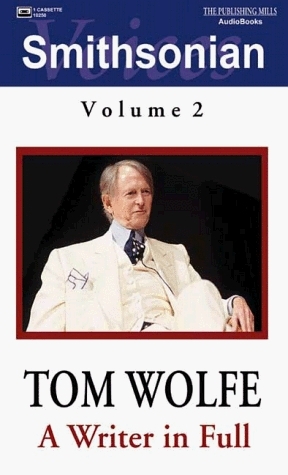
The celebrated author of the bestsellers, A MAN IN FULL, THE RIGHT STUFF, and BONFIRE OF THE VANITIES discusses his unique approach to writing during a lecture at The Smithsonian Institution. Approximate length: 90 minutes; 1 cassette.

том второйОт издателя В романе по-журналистски точно воспроизводится картина жизни современного Нью-Йорка: умело выстроенная интрига заставляет читателя с интересом наблюдать, как сколачивается капитал и строится политическая карьера героев, как жизнь одних с легкостью приносится в жертву амбициозным устремлениям других, но кто-то сгорает в кострах амбиций, а кто-то возрождается из пепла, словно Феникс.

For over a hundred years the story of Alice and her adventures has enchanted children of all ages. One of those who has been captivated by its charm is Tom Wolfe, and now he brings the characters to life through his carving. And more he shares his fascination with his readers. While many illustrators have brought their own imagination to Lewis Carroll's characters over the years, Tom goes back to the drawings of Sir John Tenniel for his inspiration. Of course he adds his own interpretation, giving them a unique personality that Carroll would have appreciated. As usual, Tom leads the carver through the project with easy to follow, step-by-step instructions, illustrated in full color photographs. This is a great book for the beginner and intermediate carvers, but the patterns and guidance Tom provides will be valued by all.


The Right Stuff / The Bonfire of the Vanities / The Electric Kool-Aid Acid Test
by Tom Wolfe
Rating: 4.8 ⭐
Tom wolfe collection 3 books set includes titles in this set :- the right stuff, the bonfire of the vanities, the electric kool-aid acid test. Description:- The Right Stuff What is it, I wondered, that makes a man willing to sit on top of an enormous Roman Candle, such as a Redstone, Atlas, Titan, or Saturn rocket, and wait for someone to light the fuse? I decided on the simplest approach possible. I would ask a few of the astronauts and find out... The Bonfire of the Vanities Sherman McCoy is a WASP, bond trader and self-appointed 'Master of the Universe'. He has a fashionable wife, a Park Avenue apartment and a Southern mistress. His spectacular fall begins the moment he is involved in a hit-and-run accident in the Bronx. Prosecutors, newspaper hacks, politicians and clergy close in on him, determined to bring him down. The Electric Kool-Aid Acid Test I looked around and people's faces were distorted...lights were flashing everywhere...the screen at the end of the room had three or four different films on it at once, and the strobe light was flashing faster than it had been...the band was playing but I couldn't hear the music...people were dancing...someone came up to me and I shut my eyes and with a machine he projected images on the back of my eye-lids...I sought out a person I trusted and he laughed and told me that the Kool-Aid had been spiked and that I was beginning my first LSD experience...