
Toby Lester
I'm a journalist, an editor, and an independent scholar. Most recently, I'm the author of Da Vinci's Ghost (2012), about Leonardo da Vinci's Vitruvian Man, and The Fourth Part of the World (2009), about the map that gave America its name. I'm also a longtime contributor to The Atlantic, for whom I've written extensively, on such topics as the reconstruction of ancient Greek music, the revisionist study of the Qur'an, and the attempt to change alphabets in Azerbaijan. Between 1995 and 2005 I worked for The Atlantic in a number of different editorial capacities—as a staff editor, as the executive editor of the Web site, as a senior editor, and as a managing editor. During those years I also served briefly as the editor of Country Journal and the executive editor of DoubleTake. My writing has appeared in not only The Atlantic but also Smithsonian, The Boston Globe, The American Scholar, The Wilson Quarterly, BBC News Magazine, and the London Times, as well as a number of anthologies, including the lead chapter of the recent New Literary History of America. Prior to 1995, I worked in international relief and development: monitoring intifada-related activity in the West Bank, as a refugee-affairs officer for the United Nations; helping establish programs in eastern Europe and the former Soviet Union, as a Peace Corps country desk officer; and teaching English in a mountain school, as a Peace Corps volunteer in Yemen. I graduated from the University of Virginia in 1987 with degrees in English and French, and now live in the Boston area with my wife and three daughters. I come from a family of writers. My father, James Lester, was a member of the first successful American Everest expedition, and is the author of Too Marvelous for Words (1994), the only biography of the jazz pianist Art Tatum. My mother, Valerie Lester, is the author of, among other works, Fasten Your Seat Belts: History and Heroism in the Pan Am Cabin (1995), and Phiz: The Man Who Drew Dickens (2004)—a biography of her great-great grandfather, Hablot Knight Browne, who was Charles Dickens’s principal illustrator. And my sister, Alison Lester, is the author of Locked Out (2007), a collection of short stories about expatriate life.
4 Books Written
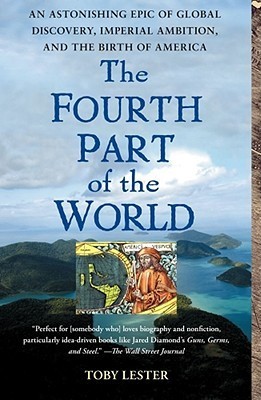
The Fourth Part of the World: An Astonishing Epic of Global Discovery, Imperial Ambition, and the Birth of America
by Toby Lester
Rating: 4.2 ⭐
• 2 recommendations ❤️
“Old maps lead you to strange and unexpected places, and none does so more ineluctably than the subject of this the giant, beguiling Waldseemüller world map of 1507.” So begins this remarkable story of the map that gave America its name.For millennia Europeans believed that the world consisted of three Europe, Africa, and Asia. They drew the three continents in countless shapes and sizes on their maps, but occasionally they hinted at the existence of a "fourth part of the world," a mysterious, inaccessible place, separated from the rest by a vast expanse of ocean. It was a land of myth—until 1507, that is, when Martin Waldseemüller and Matthias Ringmann, two obscure scholars working in the mountains of eastern France, made it real. Columbus had died the year before convinced that he had sailed to Asia, but Waldseemüller and Ringmann, after reading about the Atlantic discoveries of Columbus’s contemporary Amerigo Vespucci, came to a startling Vespucci had reached the fourth part of the world. To celebrate his achievement, Waldseemüller and Ringmann printed a huge map, for the first time showing the New World surrounded by water and distinct from Asia, and in Vespucci’s honor they gave this New World a America.The Fourth Part of the World is the story behind that map, a thrilling saga of geographical and intellectual exploration, full of outsize thinkers and voyages. Taking a kaleidoscopic approach, Toby Lester traces the origins of our modern worldview. His narrative sweeps across continents and centuries, zeroing in on different portions of the map to reveal strands of ancient legend, Biblical prophecy, classical learning, medieval exploration, imperial ambitions, and more. In Lester’s telling the map comes Marco Polo and the early Christian missionaries trek across Central Asia and China; Europe’s early humanists travel to monastic libraries to recover ancient texts; Portuguese merchants round up the first West African slaves; Christopher Columbus and Amerigo Vespucci make their epic voyages of discovery; and finally, vitally, Nicholas Copernicus makes an appearance, deducing from the new geography shown on the Waldseemüller map that the earth could not lie at the center of the cosmos. The map literally altered humanity’s worldview.One thousand copies of the map were printed, yet only one remains. Discovered accidentally in 1901 in the library of a German castle it was bought in 2003 for the unprecedented sum of $10 million by the Library of Congress, where it is now on permanent public display. Lavishly illustrated with rare maps and diagrams, The Fourth Part of the World is the story of that the dazzling story of the geographical and intellectual journeys that have helped us decipher our world.

Da Vinci's Ghost: Genius, Obsession, and How Leonardo Created the World in His Own Image
by Toby Lester
Rating: 3.6 ⭐
Toby Lester—the award-winning author of The Fourth Part of the World, celebrated by Simon Winchester as “a rare and masterly talent”—takes on one of the great untold stories in the history of ideas: the genesis of Leonardo da Vinci’s Vitruvian Man.Everybody knows the picture: a man, meticulously rendered by Leonardo da Vinci, standing with arms and legs outstretched in a circle and a square. Deployed today to celebrate subjects as various as the grandeur of art, the beauty of the human form, and the universality of the human spirit, the drawing turns up just about everywhere: in books, on coffee cups, on corporate logos, even on spacecraft. It has, in short, become the world’s most famous cultural icon—and yet almost nobody knows about the epic intellectual journeys that led to its creation. In this modest drawing that would one day paper the world, da Vinci attempted nothing less than to calibrate the harmonies of the universe and understand the central role man played in the cosmos.Journalist and storyteller Toby Lester brings Vitruvian Man to life, resurrecting the ghost of an unknown Leonardo. Populated by a colorful cast of characters, including Brunelleschi of the famous Dome, Da Vinci’s Ghost opens up a surprising window onto the artist and philosopher himself and the tumultuous intellectual and cultural transformations he bridged. With sparkling prose and a rich variety of original illustrations, Lester captures the brief but momentous time in the history of western thought when the Middle Ages gave way to the Renaissance, art and science and philosophy converged as one, and all seemed to hold out the promise that a single human mind, if properly harnessed, could grasp the nature of everything.


Die Symmetrie der Welt
by Toby Lester
Jeder kennt dieses ein Mann, sorgfältig gezeichnet, die Arme und Beine ausgebreitet, steht in einem Kreis und einem Quadrat, die Körperteile befinden sich in einem idealen Verhältnis zueinander. Das Bild steht nicht nur für die Schönheit des menschlichen Körpers, sondern auch für die Universalität der Kunstund des menschlichen Geistes. Toby Lester spannt den Bogen vom ersten vorchristlichen Jahrhundert, in dem der römische Architekt Vitruv seine Theorie des wohlgeformten Menschen vorlegte, über das Mittelalter und Hildegard von Bingens Vorstellungen von der Rolle des Menschen im Mikrokosmos bis in die Tage Leonardos, als die Künstler, Baumeister undPhilosophen der Renaissance ihr Verhältnis zur Welt neu definierten. Lester zeigt, wie Kunst, Naturwissenschaften undPhilosophie an der Wende zum 15. Jahrhundert zu einer Einheit verschmolzen und Leonardo zu einer Darstellung inspirierten, die den Menschen in das Zentrum rückt - und die uns bis heute fasziniert.