
Timothy Snyder
Timothy Snyder is Housum Professor of History at Yale University and a permanent fellow at the Institute for Human Sciences. He received his doctorate from the University of Oxford in 1997, where he was a British Marshall Scholar. He has held fellowships in Paris, Vienna, and Warsaw, and an Academy Scholarship at Harvard. His most recent book is Black Earth: The Holocaust as History and Warning, published in September 2015 by Crown Books. He is author also of Bloodlands: Europe Between Hitler and Stalin (2010), a history of Nazi and Soviet mass killing on the lands between Berlin and Moscow. A New York Times bestseller and a book of the year according to The Atlantic, The Independent, The Financial Times, the Telegraph, and the New Statesman, it has won twelve awards including the Emerson Prize in the Humanities, a Literature Award from the American Academy of Arts and Letters, the Leipzig Award for European Understanding, and the Hannah Arendt Prize in Political Thought. His other award-winning publications include Nationalism, Marxism, and Modern Central Europe: A Biography of Kazimierz Kelles-Krauz (1998); The Reconstruction of Nations: Poland, Ukraine, Lithuania, Belarus, 1569-1999 (2003); Sketches from a Secret War: A Polish Artist's Mission to Liberate Soviet Ukraine (2005); The Red Prince: The Secret Lives of A Habsburg Archduke (2008), and Bloodlands: Europe Between Hitler and Stalin (2010). Snyder helped Tony Judt to compose a thematic history of political ideas and intellectuals in politics, Thinking the Twentieth Century (2012). He is also the co-editor of Stalin and Europe: Terror, War, Domination and Wall Around the West: State Power and Immigration Controls in Europe and North America (2001). Snyder was the recipient of an inaugural Andrew Carnegie Fellowship in 2015. He is a member of the Committee on Conscience of the United States Holocaust Memorial Museum and sits on the advisory council of the Yivo Institute for Jewish Research Research. He teaches undergraduate and graduate courses in modern East European political history.
28 Books Written

From the author of the international bestseller On Tyranny , the definitive history of Hitler’s and Stalin’s politics of mass killing, explaining why Ukraine has been at the center of Western history for the last century. Americans call the Second World War “the Good War.” But before it even began, America’s ally Stalin had killed millions of his own citizens—and kept killing them during and after the war. Before Hitler was defeated, he had murdered six million Jews and nearly as many other Europeans. At war’s end, German and Soviet killing sites fell behind the Iron Curtain, leaving the history of mass killing in darkness. Assiduously researched, deeply humane, and utterly definitive, Bloodlands is a new kind of European history, presenting the mass murders committed by the Nazi and Stalinist regimes as two aspects of a single story. With a new afterword addressing the relevance of these events to the contemporary decline of democracy, Bloodlands is required reading for anyone seeking to understand the central tragedy of modern history and its meaning today.
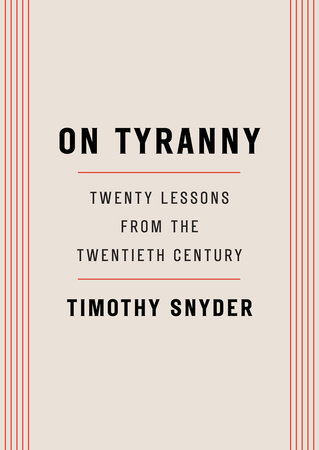
A historian of fascism offers a guide for surviving and resisting America’s turn towards authoritarianism.On November 9th, millions of Americans woke up to the impossible: the election of Donald Trump as president. Against all predictions, one of the most-disliked presidential candidates in history had swept the electoral college, elevating a man with open contempt for democratic norms and institutions to the height of power.Timothy Snyder is one of the most celebrated historians of the Holocaust. In his books Bloodlands and Black Earth, he has carefully dissected the events and values that enabled the rise of Hitler and Stalin and the execution of their catastrophic policies. With Twenty Lessons, Snyder draws from the darkest hours of the twentieth century to provide hope for the twenty-first. As he writes, “Americans are no wiser than the Europeans who saw democracy yield to fascism, Nazism and communism. Our one advantage is that we might learn from their experience.”Twenty Lessons is a call to arms and a guide to resistance, with invaluable ideas for how we can preserve our freedoms in the uncertain years to come.

NEW YORK TIMES BESTSELLER - From the author of On Tyranny comes a stunning new chronicle of the rise of authoritarianism from Russia to Europe and America."A brilliant analysis of our time."--Karl Ove Knausgaard, The New YorkerWith the end of the Cold War, the victory of liberal democracy seemed final. Observers declared the end of history, confident in a peaceful, globalized future. This faith was misplaced. Authoritarianism returned to Russia, as Putin found fascist ideas that could be used to justify rule by the wealthy. In the 2010s, it has spread from east to west, aided by Russian warfare in Ukraine and cyberwar in Europe and the United States.Russia found allies among nationalists, oligarchs, and radicals everywhere, and its drive to dissolve Western institutions, states, and values found resonance within the West itself. The rise of populism, the British vote against the EU, and the election of Donald Trump were all Russian goals, but their achievement reveals the vulnerability of Western societies.In this forceful and unsparing work of contemporary history, based on vast research as well as personal reporting, Snyder goes beyond the headlines to expose the true nature of the threat to democracy and law. To understand the challenge is to see, and perhaps renew, the fundamental political virtues offered by tradition and demanded by the future. By revealing the stark choices before us--between equality or oligarchy, individuality or totality, truth and falsehood--Snyder restores our understanding of the basis of our way of life, offering a way forward in a time of terrible uncertainty.
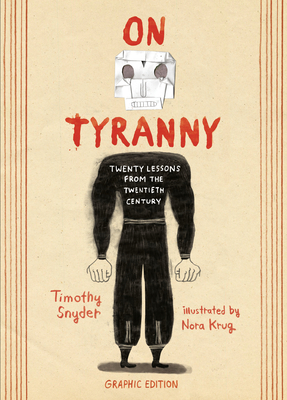
On Tyranny: Twenty Lessons from the Twentieth Century - Graphic Edition
by Timothy Snyder
Rating: 4.5 ⭐
A graphic edition of historian Timothy Snyder's bestselling book of lessons for surviving and resisting America's arc toward authoritarianism, featuring the visual storytelling talents of renowned illustrator Nora Krug.Timothy Snyder's New York Times bestseller On Tyranny uses the darkest moments in twentieth-century history, from Nazism to Communism, to teach twenty lessons on resisting modern-day authoritarianism. Among the twenty include a warning to be aware of how symbols used today could affect tomorrow; an urgent reminder to research everything for yourself and to the fullest extent; a point to use personalized and individualized speech rather than cliched phrases for the sake of mass appeal; and more.In this graphic edition, Nora Krug draws from her highly inventive art style in Belonging--at once a graphic memoir, collage-style scrapbook, historical narrative, and trove of memories--to breathe new life, color, and power into Snyder's riveting historical references, turning a quick-read pocket guide of lessons into a visually striking rumination. In a time of great uncertainty and instability, this edition of On Tyranny emphasizes the importance of being active, conscious, and deliberate participants in resistance.

A brilliant, haunting, and profoundly original portrait of the defining tragedy of our time. In this epic history of extermination and survival, Timothy Snyder presents a new explanation of the great atrocity of the twentieth century, and reveals the risks that we face in the twenty-first. Based on new sources from eastern Europe and forgotten testimonies from Jewish survivors, Black Earth recounts the mass murder of the Jews as an event that is still close to us, more comprehensible than we would like to think, and thus all the more terrifying.The Holocaust began in a dark but accessible place, in Hitler's mind, with the thought that the elimination of Jews would restore balance to the planet and allow Germans to win the resources they desperately needed. Such a worldview could be realized only if Germany destroyed other states, so Hitler's aim was a colonial war in Europe itself. In the zones of statelessness, almost all Jews died. A few people, the righteous few, aided them, without support from institutions. Much of the new research in this book is devoted to understanding these extraordinary individuals. The almost insurmountable difficulties they faced only confirm the dangers of state destruction and ecological panic. These men and women should be emulated, but in similar circumstances few of us would do so. By overlooking the lessons of the Holocaust, Snyder concludes, we have misunderstood modernity and endangered the future. The early twenty-first century is coming to resemble the early twentieth, as growing preoccupations with food and water accompany ideological challenges to global order. Our world is closer to Hitler's than we like to admit, and saving it requires us to see the Holocaust as it was -- and ourselves as we are. Groundbreaking, authoritative, and utterly absorbing, Black Earth reveals a Holocaust that is not only history but warning.

A brilliant exploration of freedom—what it is, how it’s been misunderstood, and why it’s our only chance for survival—by the acclaimed Yale historian and author of the #1 New York Times bestseller On TyrannyTimothy Snyder has been called “the leading interpreter of our dark times.” As a historian, he has given us startling reinterpretations of political collapse and mass killing. As a public intellectual, he has turned that knowledge toward counsel and prediction, working against authoritarianism here and abroad. His book On Tyranny has inspired millions around the world to fight for freedom. Now, in this tour de force of political philosophy, he helps us see exactly what we’re fighting for.Freedom is the great American commitment, but as Snyder argues, we have lost sight of what it means—and this is leading us into crisis. Too many of us look at freedom as the absence of state We think we're free if we can do and say as we please, and protect ourselves from government overreach. But true freedom isn’t so much freedom from as freedom to—the freedom to thrive, to take risks for futures we choose by working together. Freedom is the value that makes all other values possible.On Freedom takes us on a thrilling intellectual journey. Drawing on the work of philosophers and political dissidents, conversations with contemporary thinkers, and his own experiences coming of age in a time of American exceptionalism, Snyder identifies the practices and attitudes—the habits of mind—that will allow us to design a government in which we and future generations can flourish. We come to appreciate the importance of traditions (championed by the right) but also the role of institutions (the purview of the left). Intimate yet ambitious, this book helps forge a new consensus rooted in a politics of abundance, generosity, and grace.

On December 29, 2019, historian Timothy Snyder fell gravely ill. Unable to stand, barely able to think, he waited for hours in an emergency room before being correctly diagnosed and rushed into surgery. Over the next few days, as he clung to life and the first light of a new year came through his window, he found himself reflecting on the fragility of health, not recognized in America as a human right but without which all rights and freedoms have no meaning.And that was before the pandemic. We have since watched American hospitals, long understaffed and undersupplied, buckling under waves of coronavirus patients. The federal government made matters worse through willful ignorance, misinformation, and profiteering. Our system of commercial medicine failed the ultimate test, and thousands of Americans died.In this eye-opening cri de coeur, Snyder traces the societal forces that led us here and outlines the lessons we must learn to survive. In examining some of the darkest moments of recent history and of his own life, Snyder finds glimmers of hope and principles that could lead us out of our current malaise. Only by enshrining healthcare as a human right, elevating the authority of doctors and medical knowledge, and planning for our children's future can we create an America where everyone is truly free.

The Reconstruction of Nations: Poland, Ukraine, Lithuania, Belarus, 1569 - 1999
by Timothy Snyder
Rating: 4.3 ⭐
Timothy Snyder traces the emergence of four rival modern nationalist ideologies from common medieval notions of citizenship. He presents the ideological innovations and ethnic cleansings that abetted the spread of modern nationalism but also examines recent statesmanship that has allowed national interests to be channeled toward peace.“A work of profound scholarship and considerable importance.”—Timothy Garton Ash, St. Antony’s College, University of Oxford“Timothy Snyder’s style is a welcome reminder that history writing can be—indeed, ought to be—a literary pursuit.”—Charles King, Times Literary Supplement“A brilliant and fascinating analysis of the subtleties, complexities, and paradoxes of the evolution of nations in Eastern Europe. It has major implications for all of us who want to understand the processes of state collapse and nation-building in the world.”—Samuel P. Huntington, Harvard Academy for International and Area Studies“Snyder’s ultimate query in this fresh and stimulating look at the path to nationhood is how the bitter experiences along the way, including the bitterest—ethnic cleansing—are to be overcome.”—Robert Legvold, Foreign Affairs

Wilhelm Von Habsburg wore the uniform of the Austrian officer, the court regalia of a Habsburg archduke, the simple suit of a Parisian exile, the collar of the Order of the Golden Fleece, and, every so often, a dress. He could handle a saber, a pistol, a rudder, or a golf club; he handled women by necessity and men for pleasure. He spoke the Italian of his archduchess mother, the German of his archduke father, the English of his British royal friends, the Polish of the country his father wished to rule, and the Ukrainian of the land Wilhelm wished to rule himself. In this exhilarating narrative history, prize-winning historian Timothy D. Snyder offers an indelible portrait of an aristocrat whose life personifies the wrenching upheavals of the first half of the twentieth century, as the rule of empire gave way to the new politics of nationalism. Coming of age during the First World War, Wilhelm repudiated his family to fight alongside Ukrainian peasants in hopes that he would become their king. When this dream collapsed he became, by turns, an ally of German imperialists, a notorious French lover, an angry Austrian monarchist, a calm opponent of Hitler, and a British spy against Stalin. Played out in Europe's glittering capitals and bloody battlefields, in extravagant ski resorts and dank prison cells, The Red Prince captures an extraordinary moment in the history of Europe, in which the old order of the past was giving way to an undefined future-and in which everything, including identity itself, seemed up for grabs.

Sketches from a Secret War: A Polish Artist s Mission to Liberate Soviet Ukraine
by Timothy Snyder
Rating: 4.1 ⭐
The forgotten protagonist of this true account aspired to be a cubist painter in his native Kyïv. In a Europe remade by the First World War, his talents led him to different roles—intelligence operative, powerful statesman, underground activist, lifelong conspirator. Henryk Józewski directed Polish intelligence in Ukraine, governed the borderland region of Volhynia in the interwar years, worked in the anti-Nazi and anti-Soviet underground during the Second World War, and conspired against Poland’s Stalinists until his arrest in 1953. His personal story, important in its own right, sheds new light on the foundations of Soviet power and on the ideals of those who resisted it. By following the arc of Józewski’s life, this book demonstrates that his tolerant policies toward Ukrainians in Volhynia were part of Poland’s plans to roll back the communist threat.The book mines archival materials, many available only since the fall of communism, to rescue Józewski, his Polish milieu, and his Ukrainian dream from oblivion. An epilogue connects his legacy to the disintegration of the Soviet Union and the democratic revolution in Ukraine in 2004.

Nationalism, Marxism, and Modern Central Europe: A Biography of Kazimierz Kelles-Krauz (1872-1905)
by Timothy Snyder
Rating: 3.9 ⭐
Timothy Snyder presents the often overlooked life and thought of Kazimierz Kelles-Krauz, an important Polish intellectual at the beginning of this century, and thereby opens a new path in the understanding of modern nationalism and twentieth-century socialism. During his brief life in Poland, Paris, and Vienna, Kelles-Krauz influenced or infuriated most of the leaders of the various socialist movements of Central Europe and France. His central ideas ultimately were not accepted by the socialist mainstream at the time of his death. However, ninety years later, we see that his theories anticipated late twentieth-century thought on the importance of nationalism as a social force and the parameters of socialism in political theory and praxis. Kelles-Krauz was one of the only theoreticians of his age to advocate Jewish and Ukrainian national rights as being equivalent to, for example, Polish national rights, and he correctly foresaw the struggle for national sovereignty as being central to future events in Europe.


У новій книзі Тімоті Снайдера зібрано його статті та публічні виступи, оприлюднені з грудня 2013 по серпень 2014 року. Вперше опубліковано повний текст лекції Снайдера в Києво-Могилянській академії та подальшої дискусії. З текстів Снайдера витворюється картина сучасних українських подій в контексті європейської історії.

Kniha textů amerického historika a laureáta sedmnácté Ceny VIZE 97 pro rok 2016, který ji získal za nadčasovou reflexi historických událostí moderních dějin. Autor je profesorem na Yaleově univerzitě, kde se věnuje dějinám střední a východní Evropy. V knize naleznete eseje, které jsou autorovou reakcí a doplnění bestselleru Krvavé země. Tématem knihy jsou netradiční úvahy o holocaustu, na téma Stalin a Hitler, fašismus, historický vývoj Ukrajiny a obecnější stati o paměti, kolektivní paměti a paměti suverenity. Dále je kniha doprovozena životopisem, autorovým doslovem a soupisem všech jeho publikací.

On Tyranny, Bloodlands, The Road to Unfreedom 3 Books Collection Set By Timothy Snyder
by Timothy Snyder
Rating: 4.6 ⭐
Please Note That The Following Individual Books As Per Original ISBN and Cover Image In this Listing shall be Dispatched On Tyranny, Bloodlands, The Road to Unfreedom 3 Books Collection Set By Timothy On The Founding Fathers tried to protect us from the threat they knew, the tyranny that overcame ancient democracy. Today, our political order faces new threats, not unlike the totalitarianism of the twentieth century. We are no wiser than the Europeans who saw democracy yield to fascism, Nazism, or communism. Our one advantage is that we might learn from their experience.Americans call the Second World War “the Good War.” But before it even began, America’s ally Stalin had killed millions of his own citizens—and kept killing them during and after the war. Before Hitler was defeated, he had murdered six million Jews and nearly as many other Europeans. At war’s end, German and Soviet killing sites fell behind the Iron Curtain, leaving the history of mass killing in darkness.The Road to With the end of the Cold War, the victory of liberal democracy seemed final. Observers declared the end of history, confident in a peaceful, globalized future. This faith was misplaced. Authoritarianism returned to Russia, as Vladimir Putin found fascist ideas that could be used to justify rule by the wealthy. In the 2010s, it has spread from east to west, aided by Russian warfare in Ukraine and cyberwar in Europe and the United States.

Ebook podejmujący jeden z trudniejszych tematów w historii Polski XX w. Amerykański historyk ukazuje wielorakość przyczyn dramatycznych zajść 1943 r. Jego „Wołyń...” to kolejny ważny głos w dyskusji na temat stosunków polsko-ukraińskich. To lektura obowiązkowa przed i po obejrzeniu filmu Wojtka Smarzowskiego.Wojciech Smarzowski mówiąc o swoim filmie "Wołyń", podkreśla, że nie jest historykiem, zrobił film o miłości w czasach potwornych i liczy na to, że historycy wezmą ten temat na warsztat. Wybitny uczony amerykański Timothy Snyder w opracowaniu Wołyń 1943. Polsko-ukraińskie czystki etniczne w przystępny sposób ukazuje wielorakość przyczyn dramatycznych zajść 1943 roku, co pozwala osadzić wstrząsający obraz Smarzowskiego w głębszej i szerszej perspektywie historycznej. Lektura obowiązkowa przed i po obejrzeniu filmu.

Und wie elektrische Schafe träumen wir: Humanität, Sexualität, Digitalität (Passagen Thema)
by Timothy Snyder
Rating: 3.0 ⭐
Digitale Wesen beuten unsere Tendenz zur Selbstüberschätzung aus, fördern unsere falschen Überzeugungen, instrumentalisieren unsere sexuellen Ängste, reduzieren uns auf isolierte Tiere. Timothy Snyder diskutiert die Gefahren, die aus der digitalen Welt erwachsen.Der Historiker Timothy Snyder nimmt den 1950 entwickelten Turing-Test des englischen Mathematikers und Logikers Alan Turing und eine etwa zeitgleich erschienene Kurzgeschichte von Isaac Asimov zum Ausganspunkt, um verschiedenen Konstellationen der Interaktion zwischen menschlichen und digitalen Wesen nachzugehen. Unweigerlich ergeben sich daraus Problemstellungen betreffend Ethik, Freiheit und Wahrheit. Und es stellt sich die grundlegende Frage: Was heißt es, Mensch zu sein? Snyders Zeitdiagnose fällt dabei düsterer aus als die dystopischen Visionen der Science-Fiction-Literatur. Es gibt in unserer Zeit, so der Autor, bereits Ansätze einer digitalen Tyrannei, die sich durch eine systematische Negation der Wahrheit auszeichnet. Sein Fazit: Ohne Festhalten an der Wahrheit und an Fakten lassen sich weder Freiheit noch Demokratie bewahren.

Hva er den historiske bakgrunnen for krigen i Ukraina? Hvordan inngår invasjonen i Putins politiske planer? Og hvor går veien videre?I Veien til ufrihet (2018) leverte den amerikanske historikeren Timothy Snyder en rystende fremstilling av Vladimir Putins ideologiske prosjekt, og hans taktikk for å undergrave frie valg og demokratiske institusjoner i USA og Europa. Snyders spådommer har siden vist seg å være skremmende riktige. Denne boka samler kapitlene om Ukraina fra Veien til ufrihet i tillegg til et par nyere tekster fra Snyder, og gir et unikt rammeverk for å forstå både den brutale invasjonen, Putin-regimets politiske tenkning, og den ukrainske frihetskampen.

Wat is vrijheid? Waarom is onze vrijheid in gevaar? En waarom is vrijheid onze enige kans om te overleven? Vrijheid is de kern van onze westerse wereld, het hart van onze democratie, maar we zijn uit het oog verloren wat het betekent, met crisis als resultaat. Te veel mensen beschouwen vrijheid als de afwezigheid van staatsmacht. We denken dat we vrij zijn als we kunnen doen en zeggen wat we willen en zo min mogelijk worden gehinderd door de overheid. Maar echte vrijheid is niet zozeer vrijheid van als wel vrijheid om - om te gedijen, om dingen op het spel te zetten voor een toekomst die we samen kiezen en waar we samen aan werken. Vrijheid is de waarde die alle andere waarden mogelijk maakt. Op basis van het werk van filosofen en politieke dissidenten, gesprekken met hedendaagse denkers, zijn eigen ervaringen en reportages uit onder meer Oekraïne, waar hij president Zelensky sprak, beschrijft Snyder wat er nodig is voor een toekomst waarin wij en de generaties na ons kunnen floreren. Daarbij heeft hij zowel oog voor het belang van tradities (die door rechts worden verdedigd) als voor de rol van de instituties (de prioriteit van links). Over vrijheid is het even briljante als urgente, hoogst actuele nieuwe boek van de beroemde historicus en auteur van onder andere de bestsellers Bloedlanden en Over tirannie.

Ihre Unabhängigkeit war den Ukrainern 1991 zugefallen, erkämpft haben sie sie erst auf dem Maidan. Sie stürzten ihr korruptes Regime, doch nur, um sich mit einem weitaus mächtigeren Gegner konfrontiert zu sehen, der mit allen Mitteln versucht, ihnen die neu gewonnene Chance zu nehmen.Im Moment der tiefsten Krise der Europäischen Union werden wir Zeugen einer Bewegung, die Werte einfordert, die wir selbst mehr und mehr aus den Augen verloren haben.

Integration and Disintegration: Europe, Ukraine, and the World
by Timothy Snyder

So viel Anfang war nie
by Timothy Snyder

Shine!
by Timothy Snyder
The text celebrates the glow of friendship as it "shines" in the warmth of the "great sun." Choirs will delight in the power of this stunning piece, which is harmonically colorful and tuneful. / Educational Octavo / TTBB, a cappella / Concert, General

Timothy Snyder 3 Books Collection Set
by Timothy Snyder
Please Note That The Following Individual Books As Per Original ISBN and Cover Image In this Listing shall be Dispatched Timothy Snyder 3 Books Collection On In the twentieth century, European democracies collapsed into fascism, Nazism and communism. These were movements in which a leader or a party claimed to give voice to the people, promised to protect them from global existential threats, and rejected reason in favour of myth. European history shows us that societies can break, democracies can fall, ethics can collapse, and ordinary people can find themselves in unimaginable circumstances. The Road to In this visionary work of contemporary history, Timothy Snyder shows how Russia works within the West to destroy the West; by supporting the far right in Europe, invading Ukraine in 2014, and waging a cyberwar during the 2016 presidential campaign and the EU referendum. Nowhere is this more obvious than in the creation of Donald Trump, an American failure deployed as a Russian weapon. But this threat presents an opportunity to better understand the pillars of our freedoms and face the choices that will determine the equality or oligarchy, individualism or totalitarianism, truth or lies. Our America has not measured up well. Tens of thousands are dead for no reason. America is supposed to be about freedom, yet illness and fear make its citizens less free. After all, freedom is meaningless if we are too ill to think about our right to happiness or too weak to pursue it. So, if a government is making its people unhealthy it is also making them unfree.On December 29, 2019, Timothy Snyder fell gravely ill..
Timothy Snyder Collection 3 Books Set
by Timothy Snyder
Please Note That The Following Individual Books As Per Original ISBN and Cover Image In this Listing shall be Dispatched Timothy Snyder Collection 3 Books Set (On Tyranny, The Road to Unfreedom, Bloodlands): On In the twentieth century, European democracies collapsed into fascism, Nazism and communism. These were movements in which a leader or a party claimed to give voice to the people, promised to protect them from global existential threats, and rejected reason in favour of myth. European history shows us that societies can break, democracies can fall, ethics can collapse, and ordinary people can find themselves in unimaginable circumstances. The Road to In this visionary work of contemporary history, Timothy Snyder shows how Russia works within the West to destroy the West; by supporting the far right in Europe, invading Ukraine in 2014, and waging a cyberwar during the 2016 presidential campaign and the EU referendum. Nowhere is this more obvious than in the creation of Donald Trump, an American failure deployed as a Russian weapon. But this threat presents an opportunity to better understand the pillars of our freedoms and face the choices that will determine the equality or oligarchy, individualism or totalitarianism, truth or lies. In the middle of Europe, in the middle of the twentieth century, the Nazi and Soviet regimes murdered fourteen million people in the bloodlands between Berlin and Moscow. In a twelve-year-period, in these killing fields - today's Ukraine, Belarus, Poland, Western Russia and the eastern Baltic coast - an average of more than one million citizens were slaughtered every year, as a result of deliberate policies unrelated to combat.

O wolności. Przewodnik po świecie, który można ocalić
by Timothy Snyder
Suwerenność – nieprzewidywalność – mobilność – fakty – solidarność Snyder wraca w wielkiej formie. Rozpatrując historię, współczesność i przyszłość – od nazistowskich Niemiec, przez ZSRR, po Amerykę Trumpa i Rosję Putina – buduje mapę myślenia o wolności. Nie jako braku ograniczeń, lecz jako zrywie do działania, ćwiczeniu bliskości społecznej i pielęgnowaniu życia w prawdzie. Suwerenność, nieprzewidywalność, mobilność, fakty i solidarność – to pięć filarów refleksji Snydera. Są one nie tylko filozoficznymi kategoriami, ale także konkretnymi narzędziami ułatwiającymi zrozumienie współczesnych zagrożeń i odzyskiwanie sprawczości.. Co to znaczy być suwerenną osobą? Czemu przewidywalność oznacza zniewolenie? Kto przeciera nam szlaki, a komu przecieramy szlaki my? Fakty oznaczają życie w prawdzie, a solidarność łagodzi trudną logikę życia. Wolność nie istnieje w oderwaniu od innych. O wolności to śmiała intelektualna i moralna propozycja, jak odzyskać sprawczość w epoce dezinformacji, dryfu w stronę autorytaryzmu i obywatelskiego zmęczenia. To książka o odpowiedzialności – i głęboko humanistyczna wizja przyszłości. „Timothy Snyder to jeden z najbardziej oryginalnych i przenikliwych współczesnych myślicieli zajmujących się historią Europy, amerykańską polityką, a teraz także wolnością. Każdy, komu zależy na tej ostatniej – kto rozważa, czym wolność jest i czego trzeba, by ją ocalić – powinien przeczytać tę książkę”. – Anne Applebaum Tł Bartłomiej Pietrzyk