
Tim Kreider
Tim Kreider is an essayist and cartoonist. His comic "The Pain--When Will It End?" ran in the Baltimore City Paper for 12 years and was collected in three books by Fantagraphics. His first collection of essays, "We Learn Nothing," was published by Free Press in 2012. He has written for The New York Times, The Men's Journal, Nerve.com, The Comics Journal, and Film Quarterly. He is at work on a new collection for Simon & Schuster, "I Wrote This Book Because I Love You." He lives in an Undisclosed Location on the Chesapeake Bay.
11 Books Written

* A People Top 10 Book of 2018 *The New York Times essayist and author of We Learn Nothing , Tim Kreider trains his singular power of observation on his (often befuddling) relationships with women.Psychologists have told him he’s a psychologist. Philosophers have told him he’s a philosopher. Religious groups have invited him to speak. He had a cult following as a cartoonist. But, above all else, Tim Kreider is an essayist—one whose deft prose, uncanny observations, dark humor, and emotional vulnerability have earned him deserved comparisons to David Sedaris, Sarah Vowell, and the late David Foster Wallace (who was himself a fan of Kreider’s humor).“Beautifully written, with just enough humor to balance his spikiness” ( Booklist ), I Wrote This Book Because I Love You focuses Tim’s unique perception and wit on his relationships with women—romantic, platonic, and the murky in-between. He talks about his difficulty finding lasting love and seeks to understand his commitment issues by tracking down the John Hopkins psychologist who tested him for a groundbreaking study on attachment when he was a toddler. He talks about his valued female friendships, one of which landed him on a circus train bound for Mexico. He talks about his time teaching young women at an upstate New York college, and the profound lessons they wound up teaching him. And in a hugely popular essay that originally appeared in The New York Times , he talks about his nineteen-year-old cat, wondering if it’s the most enduring relationship he’ll ever have.“In a style reminiscent of Orwell, E.B. White and David Sedaris” ( The New York Times Book Review ), each of these pieces is “heartbreaking, brutal, and hilarious” (Judd Apatow), and collectively they cement Kreider’s place among the best essayists working today.
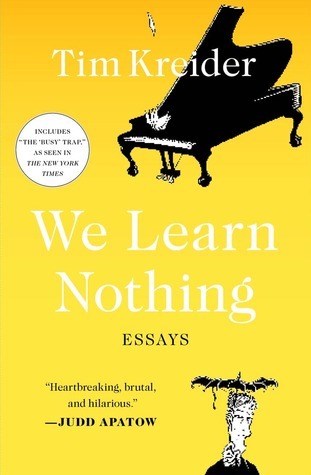
“Kreider locates the right simile and the pith of situations as he carefully catalogues humanity’s inventive and manifold ways of failing” (Publishers Weekly, starred review).In We Learn Nothing, satirical cartoonist Tim Kreider turns his funny, brutally honest eye to the dark truths of the human condition, asking big questions about human-sized problems: What if you survive a brush with death and it doesn’t change you? Why do we fall in love with people we don’t even like? How do you react when someone you’ve known for years unexpectedly changes genders? With a perfect combination of humor and pathos, these essays, peppered with Kreider’s signature cartoons, leave us with newfound wisdom and a unique prism through which to examine our own chaotic journeys through life. These are the conversations you have only with best friends or total strangers, late at night over drinks, near closing time. This edition also includes the sensationally popular essay “The Busy Trap,” as seen in the New York Times.

Twilight of the Assholes
by Tim Kreider
Tim Kreider refuses to let the Bush administration off easy. Tim Kreider’s first cartoon collection, The Pain—When Will It End? was one of the few bastions of sanity throughout the awful aberration in American history known as the Bush Administration. The end of his second volume of political cartoons, Why Do They Kill Me? , saw its author in despair over the 2004 election. In this new volume, Twilight of the Assholes , as reality gets ever bleaker, Kreider’s humor becomes increasingly apocalyptic, deranged, and hilarious. He juxtaposes the Biblical Christ with His blonde, flag-draped, machine-gun-toting American incarnation in “Jesus vs. Jeezus,” proposes a third political party that represents Americans’ real values in “The Sex Party,” draws the dead Saddam Hussein as a mischievous invisible imp still causing trouble, and envisions the officials of the Bush administration getting their comeuppance in the grisly fashion of Dick Tracy villains. And he finds two cartoons’ worth of “Reasons to Look Forward to the Next Terrorist Attack.” Also included is his infamous entry into Iran’s Holocaust cartoon contest, “Silver Linings of the Holocaust.”Kreider mocks not only the evil and hapless Bush but the fecklessness of progressives, the imbecile bigotry of radical Islam, and, most of all, the dumb bovine complacency of the American voter. His art has become even more dense with gags and his writing (most recently featured in the New York Times ) has never been more astute and devastating. Twilight of the Assholes is an hysterical chronicle of the end of the Era of Darkness, and, believe it or not, a heartening document of one man’s loss and tentative restoration of faith in democracy. Black-and-white cartoons and illustration throughout

SOCIAL SATIRE IN A MISANTHROPIC AND EXISTENTIAL VEIN, IN THE GRAND TRADITIONS OF KLIBAN AND STEADMAN Tim Kreider's cartoons, previously seen only in the Baltimore City Paper, have attracted a cult following for their razor-sharp intelligence and unprecedented viciousness. His manic, spontaneous line, and his eye for facial expression, gesture, and detail make his cartoons more than one-shot gags. His humor is both crudite and puerile, as personally revealing as a drunken blackout and as politically trenchant as a lone gunman. Kreider's work has been likened to the foul result of inbreeding between Ralph Steadman and B. Kliban. The wide range of subject matter in this collection, from religion and politics to Nietzsche and pie, from sex and violence to the sheer pointlessness of it all, can only be suggested by a sampling of titles: "Breakfast for the Devil, " "The Four Press Secretaries of the Apocalypse, " "Learn German While Drunk, " and "I'm Sorry I'm So Horrible." (The collection also includes the unspeakable "Graveyard Shift at the Pussy Juice Factory.") Kreider's vision of the human condition is of a man distracted from the vast starship hovering over his city by a glimpse of a pretty girl's ass; his version of the existential abyss is a cruddy laundromat with old magazines spilled on the plastic chairs and the word "FAGOT" scratched on a dryer; and the only hope or joy he finds in this life is in jigglin' dem monster juggs or setting a monkey's ass on fire. You may be ashamed to laugh, but laugh you will.

Tim Kreider’s first cartoon collection, The Pain—When Will It End? was oneof the few bastions of sanity throughout the awful aberration in American historyknown as the Bush Administration. The end of his second volume of politicalcartoons, Why Do They Kill Me?, saw its author in despair over the 2004election. In this new volume, Twilight of the Assholes, as reality gets ever bleaker,Kreider’s humor becomes increasingly apocalyptic, deranged, and hilarious.He juxtaposes the Biblical Christ with His blonde, flag-draped, machine-gun-totingAmerican incarnation in “Jesus vs. Jeezus,” proposes a third politicalparty that represents Americans’ real values in “The Sex Party,” draws the deadSaddam Hussein as a mischievous invisible imp still causing trouble, and envisionsthe officials of the Bush administration getting their comeuppance in the grisly fashion of Dick Tracy villains. Andhe finds two cartoons’ worth of “Reasons to Look Forward to the Next Terrorist Attack.” Also included is his infamousentry into Iran’s Holocaust cartoon contest, “Silver Linings of the Holocaust.”Kreider mocks not only the evil and hapless Bush but the fecklessness of progressives, the imbecile bigotry of radicalIslam, and, most of all, the dumb bovine complacency of the American voter. His art has become even more dense withgags and his writing (most recently featured in the New York Times) has never been more astute and devastating. Twilightof the Assholes is an hysterical chronicle of the end of the Era of Darkness, and, believe it or not, a heartening documentof one man’s loss and tentative restoration of faith in democracy.

by Tim KreiderCynical, astute, blackly hilarious, and deeply biased, these cartoons are neither the superficial, obvious jibes that appear in your daily paper's editorial section nor the didactic left-wing rants syndicated in your local alternative weekly; they are the artistic equivalent of hollow-point bullets fired from a high-powered rifle with a laser sight directly into the brain of the Bush administration.

2000 by the Regents of the University of California. Reprinted from "Film Quarterly" Vol. 53, no. 3, by permission of the University of California Press.

Les gens lucides sont toujours seuls
by Tim Kreider
Tim Kreider a longtemps vu Ken comme un mentor et comme le plus brillant de ses amis. Engagé, entier et intransigeant, c’était le genre de type qui arrivait à entraîner les autres dans son élan intellectuel. Et puis un sujet est venu prendre toute la place : le pic pétrolier, et la catastrophe planétaire qu’il allait entraîner.“Ça faisait quelques années déjà qu’avec Ken, je me sentais un peu comme quand on essaie de rester proche d’un ami qui s’est marié avec une folle ou converti sur le chemin de Damas (Ken aurait sans doute beaucoup à dire sur ces analogies) : le genre de situation qui vous oblige à prendre acte du fait que quelque chose qui vous laisse complètement indifférent (dans le meilleur des cas) est maintenant une part essentielle de la vie de votre ami, lequel de son côté attend de vous un enthousiasme à la mesure du sien. ” — Tim Kreider

On croit connaître les gens
by Tim Kreider
Il y a quelques années Jim Boylan, l’un des meilleurs amis de Tim Kreider, lui a annoncé qu’il était une femme née dans le corps d’un homme.“Pour que j’aie envie d’écrire sur un truc, il faut que j’aie trouvé le moyen de le rendre que ça ne parle pas juste de moi, mais aussi de vous. Le texte que j’ai écrit sur mon amie Jenny Boylan qui est transsexuelle, ne parle pas de ce que c’est que de changer de sexe, mais de ce que c’est que d’appartenir à un sexe, et de pourquoi nous nous comportons de manières si différentes avec les hommes et avec les femmes” — Tim Kreider