
Tim Flannery
Tim Flannery is one of Australia's leading thinkers and writers. An internationally acclaimed scientist, explorer and conservationist, he has published more than 130 peer-reviewed scientific papers and many books. His books include the landmark works The Future Eaters and The Weather Makers, which has been translated into more than 20 languages and in 2006 won the NSW Premiers Literary Prizes for Best Critical Writing and Book of the Year. He received a Centenary of Federation Medal for his services to Australian science and in 2002 delivered the Australia Day address. In 2005 he was named Australian Humanist of the Year, and in 2007 honoured as Australian of the Year. He spent a year teaching at Harvard, and is a founding member of the Wentworth Group of Concerned Scientists, a director of the Australian Wildlife Conservancy, and the National Geographic Society's representative in Australasia. He serves on the board of WWF International (London and Gland) and on the sustainability advisory councils of Siemens (Munich) and Tata Power (Mumbai). In 2007 he co-founded and was appointed Chair of the Copenhagen Climate Council, a coalition of community, business, and political leaders who came together to confront climate change. Tim Flannery is currently Professor of Science at Maquarie University, Sydney.
28 Books Written

The Weather Makers: How Man Is Changing the Climate and What It Means for Life on Earth
by Tim Flannery
Rating: 3.9 ⭐
• 2 recommendations ❤️
An international best seller embraced and endorsed by policy makers, scientists, writers and energy industry executives from around the world, Tim Flannery’s The Weather Makers contributed in bringing the topic of global warming to national prominence. For the first time, a scientist provided an accessible and comprehensive account of the history, current status, and future impact of climate change, writing what has been acclaimed by reviewers everywhere as the definitive book on global warming.With one out of every five living things on this planet committed to extinction by the levels of greenhouse gases that will accumulate in the next few decades, we are reaching a global climatic tipping point. The Weather Makers is both an urgent warning and a call to arms, outlining the history of climate change, how it will unfold over the next century, and what we can do to prevent a cataclysmic future. Originally somewhat of a global warming skeptic, Tim Flannery spent several years researching the topic and offers a connect-the-dots approach for a reading public who has received patchy or misleading information on the subject. Pulling on his expertise as a scientist to discuss climate change from a historical perspective, Flannery also explains how climate change is interconnected across the planet.This edition includes an new afterword by the author.

The Eternal Frontier: An Ecological History of North America and Its Peoples
by Tim Flannery
Rating: 4.1 ⭐
• 2 recommendations ❤️
In The Eternal Frontier, world-renowned scientist and historian Tim Flannery tells the unforgettable story of the geological and biological evolution of the North American continent, from the time of the asteroid strike that ended the age of dinosaurs 65 million years ago, to the present day. Flannery describes the development of North America's deciduous forests and other flora, and tracks the immigration and emigration of various animals to and from Europe, Asia, and South America, showing how plant and animal species have either adapted or become extinct. The story takes in the massive changes wrought by the ice ages and the coming of the Indians, and continues right up to the present, covering the deforestation of the Northeast, the decimation of the buffalo, and other facets of the enormous impact of frontier settlement and the development of the industrial might of the United States. Natural history on a monumental scale, The Eternal Frontier contains an enormous wealth of fascinating scientific details, and Flannery's accessible and dynamic writing makes the book a delight to read. This is science writing at its very best -- a riveting page-turner that is simultaneously an accessible and scholarly trove of incredible information that is already being hailed by critics as a classic. "Tim Flannery's account ... will fascinate Americans and non-Americans alike." -- Jared Diamond, author of Guns, Germs, and Steel "No one before Flannery ... has been brave enough to tackle the whole pageant of North America." -- David Quammen, the New York Times Book Review "Tim Flannery's book will forever change your perspective on the North American continent ... Exhilarating." -- John Terborgh, The New York Review of Books "Full of engaging and attention-catching information about North America's geology, climate, and paleontology." -- Patricia Nelson Limerick, the Washington Post Book World "Natural history par excellence." -- Kirkus Reviews (starred review) "This gutsy Aussie may have read our landscape and ecological history with greater clarity than any native son." -- David A. Burney, Natural History "A fascinating, current, and insightful look at our familiar history from a larger perspective." -- David Bezanson, Austin-American Statesman "The scope of [Flannery's] story is huge, and his research exhaustive." -- Lauren Gravitz, The Christian Science Monitor

From internationally bestselling author and celebrated scientist Tim Flannery, a history of Europe unlike any before: an ecological account of the land itself and the forces shaping life on it. In Europe: A Natural History, world-renowned scientist, explorer, and conservationist Tim Flannery applies the eloquent interdisciplinary approach he used in his ecological histories of Australia and North America to the story of Europe. He begins 100 million years ago, when the continents of Asia, North America, and Africa interacted to create an island archipelago that would later become the Europe we know today. It was on these ancient tropical lands that the first distinctly European organisms evolved. Flannery teaches us about Europe's midwife toad, which has endured since the continent's beginning, while elephants, crocodiles, and giant sharks have come and gone. He explores the monumental changes wrought by the devastating comet strike and shows how rapid atmospheric shifts transformed the European archipelago into a single landmass during the Eocene.As the story moves through millions of years of evolutionary history, Flannery eventually turns to our own species, describing the immense impact humans had on the continent's flora and fauna--within 30,000 years of our arrival in Europe, the woolly rhino, the cave bear, and the giant elk, among others, would disappear completely. The story continues right up to the present, as Flannery describes Europe's leading role in wildlife restoration, and then looks ahead to ponder the continent's future: with advancements in gene editing technology, European scientists are working to recreate some of the continent's lost creatures, such as the great ox of Europe's primeval forests and even the woolly mammoth.Written with Flannery's characteristic combination of elegant prose and scientific expertise, Europe: A Natural History narrates the dramatic natural history and dynamic evolution of one of the most influential places on Earth.

The Future Eaters: An Ecological History of the Australasian Lands and People
by Tim Flannery
Rating: 4.2 ⭐
In this illustrated ecological history, acclaimed scientist and historian Flannery follows the environment of the islands through the age of dinosaurs to the age of mammals and the arrival of humans, to the European colonizers and industrial society. Penetrating, gripping, and provocative, this book combines natural history, anthropology, and ecology on an epic scale. Illustrations.

We stand at a crossroads, where comprehension of our place in nature—of our true abilities and of our history—is supremely important. We have formed a global civilisation of unprecedented might, driven forward by the power of our minds—a civilisation which is transforming our Earth. We are masters of technology, and of comprehension, but it's what we believe that may, from now on, determine our fate.Tim Flannery's first major book since The Weather Makers charts the history of life on our planet. Here on Earth, which draws its points of departure from Darwin and Wallace, Lovelock and Dawkins, is an extraordinary exploration of evolution and sustainability. Our success as a species has had disastrous effects on many of the Earth's ecosystems and could lead to our downfall. But equally, Flannery argues, we are now equipped as never before to explore our true relationship with the planet on which our biological, economic and cultural futures depend. Here on Earth is not just a dazzling account of life on our planet. It will change the way you live.

Flannery travels to the unexplored regions of New Guinea in search of species that science has yet to discover or classify. He finds many -- from a community of giant cave bats that were supposedly extinct to the elusive black-and-white tree-kangaroo -- and along the way has a wealth of unforgettable adventures. Flannery scales cliffs, descends into caverns, and cheats death, both from disease and at the hands of the local cannibals, who wish to take revenge on his "clan" of wildlife scientists. He eventually befriends the tribespeople, who become companions in his quest and whose contributions to his research prove invaluable. In New Guinea pidgin, throwim way leg means to take the first step of a long journey. The journey in this book is a wild ride full of natural wonders and Flannery's trademark wit, a tour de force of travelogue, anthropology, and natural history.
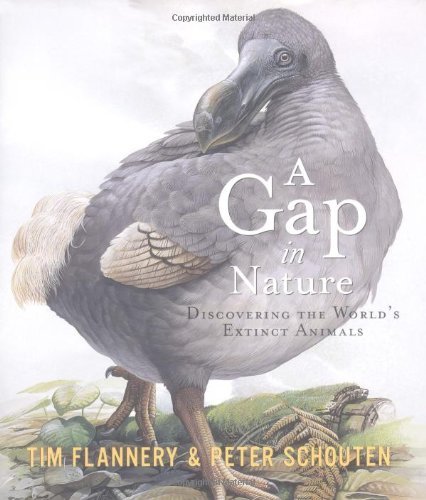
"Since humanity first wandered from its African birthplace over fifty millennia ago, it has radically altered the environment everywhere it has settled, often at the cost of the creatures that ruled the wild before its arrival. As our prehistoric ancestors spread throughout the globe, they began the most deadly epoch the planet's fauna have experienced since the demise of the dinosaurs. And following the dawn of the age of exploration five hundred years ago, the rate of extinction has accelerated ever more rapidly." In A Gap in Nature, scientist and historian Tim Flannery, in collaboration with internationally acclaimed wildlife artist Peter Schouten, catalogues 103 creatures that have vanished from the face of the earth since Columbus first set foot in the New World. From the colorful Carolina parakeet to the gigantic Steller's sea cow, Flannery evocatively tells the story of each animal and its habitat, how it lived and how it succumbed to its terrible destiny. Accompanying every entry is a beautifully rendered color representation by Schouten, who has devoted years of his life to this project. His portraits - life size in their original form - are exquisitely reproduced in this extraordinary book and include animals from every continent: American passenger pigeons, Tasmanian thylacines, Mauritian dodos, African bluebucks, and dozens more.

Big Meg: The Story of the Largest and Most Mysterious Predator that Ever Lived
by Tim Flannery
Rating: 3.8 ⭐
Internationally bestselling author and renowned scientist Tim Flannery and his daughter, scientist Emma Flannery, delivers an informative-yet-intimate portrait of the megalodon, an extinct shark and the largest predator of all timeWhen Tim Flannery was a boy he found a fossilized tooth of the giant shark megalodon at a beach near his home in Australia. This remarkable find—the tooth was large enough to cover his palm—sparked an interest in paleontology that was to inform his life’s work and a lifelong quest to uncover the secrets of the great shark Otodus megalodon .Tim passed on his love of the natural world and interest in the fossil record to his daughter, Emma, a scientist and writer. And now, together, they have written a fascinating account of this ancient marine creature.Big Meg charts the evolution of megalodon, its super-predator status for about fifteen million years and its decline and extinction. It delves into the fossil record to answer questions about its behavior and role in shaping marine ecosystems as well as its impact on the human psyche. It contains stories of the scientist and amateur fossil hunters who have scoured the seas, and land, for fossil remains, drawn to the beauty and mystique of the great shark, sometimes meeting their death in the process.Deemed “in the league of the all-time great explorers” by David Attenborough, Tim Flannery has come together with Emma Flannery to spin a story of the great natural history of our planet as enthralling as the fossil record itself.
A decade ago, Tim Flannery’s #1 international bestseller, The Weather Makers , was one of the first books to break the topic of climate change out into the general conversation. Today, Earth’s climate system is fast approaching a crisis. Political leadership has not kept up, and public engagement with the issue of climate change has declined. Opinion is divided between technological optimists and pessimists who feel that catastrophe is inevitable. The publication of this new book is timed for the lead-up to the Climate Change Conference in Paris in December 2015, which aims to achieve a legally binding and universal agreement on climate from all the nations in the world. This book anticipates and will influence the debates.Time is running out, but catastrophe is not inevitable. Around the world people are now living with the consequences of an altered climate—with intensified and more frequent storms, wildfires, droughts and floods. For some it’s already a question of survival. Drawing on the latest science, Flannery gives a snapshot of the trouble we are in and more crucially, proposes a new way forward, including rapidly progressing clean technologies and a “third way” of soft geo-engineering. Tim Flannery, with his inimitable style, makes this urgent issue compelling and accessible. This is a must-read for anyone interested in our global future.

Every young person who cares about preserving the planet needs to know what’s inside this book — and follow the authors’ call to action. (Age 14 and up)First published for an adult readership, THE WEATHER MAKERS received critical kudos for its solid science and powerful message. Now this accessible new edition speaks directly to young adults, offering a clear look at the history of climate change, how it will unfold over the nextcentury, and what we can do to prevent a cataclysmic future. Here is an immediate and hard-hitting look backward — and forward — in climate history, bolstered by models and projections of current data. It includes interviews with people whose livelihoods have been directly affected by climate change, as well as individuals who make new technology and renewable resources a part of daily life. Newly featured are twenty-five practical tips that give readers the tools for living a greener lifestyle — at home, in school, in the community, and ultimately, on Earth.Back matter includes source notes, a bibliography, and an index.

A fabulous account of hunting, trapping and recording mammal species in the Pacific Islands. Twenty-five years ago, a zoologist from the Australian Museum in Sydney set off to research the mammals of the Pacific Islands. Starting with a survey of one of the most inaccessible islands in Melanesia that young scientist found himself ghost-whispering, snake wrestling, quadoi hunting and plunging waist-deep into a sludge of maggot-infested faeces in search of a small bat that turned out not to be earth-shatteringly interesting. Now one of Australias greatest scientists, Tim Flannery looks back on his ground-breaking fieldwork. With accounts of discovering, naming and sometimes eating animal species new to science, and stories of historic expeditions and colourful local customs, he takes us on an enthralling journey through some of the most diverse and spectacular environments on Earth.

Chasing Kangaroos: A Continent, a Scientist, and a Search for the World's Most Extraordinary Creature
by Tim Flannery
Rating: 3.5 ⭐
In his most personal book yet, Tim Flannery, the internationally acclaimed author of The Weather Makers , draws on three decades of travel, research, and field work to craft a love letter to his native land and one of its most unique and beloved inhabitants: the kangaroo. Crisscrossing the continent, Flannery shows us how the destiny of this extraordinary creature is inseparable from the environment that created it. Along the way he uses encounters with ancient aboriginal cultures and eccentric fossil hunters, farmers and scientists, kangaroo advocates and kangaroo hunters, to explore how Australia’s deserts and rainforests have shaped human responses to the continent -- and how kangaroos have evolved to handle the resulting challenges. Ultimately, Chasing Kangaroos is a smart yet utterly readable synthesis of memoir, travel, natural history, and evolutionary science -- and further proof of Flannery’s “offhand interdisciplinary brilliance” ( Entertainment Weekly ).

mergencies test governments, organisations and individuals. Although Australia’s prompt, science-led response to COVID-19 has not been perfect, it has saved tens of thousands of lives. But for decades, governments have ignored, ridiculed or understated the advice of scientists on the climate emergency.Now, in the wake of the megafires of 2020, a time of reckoning has arrived. In The Climate Cure renowned climate scientist Tim Flannery takes aim at those responsible for the campaign of obfuscation and denial that has already cost so many Australian lives and held back action on climate change.Flannery demands a new approach, based on the nation’s response to COVID-19, that will lead to effective government policies. The Climate Cure is an action plan for our future. We face a fork in the road, and must decide now between catastrophe and survival.

Sunlight and Seaweed: An Argument for How to Feed, Power and Clean Up the World
by Tim Flannery
Rating: 4.0 ⭐
Acclaimed scientist Tim Flannery investigates exciting new technologies currently being developed to address our most pressing environmental threats in a book that presents a positive future for us and our planet.Climate change, food production and toxic pollution present huge challenges, but, as Flannery shows, we already have innovative, practical and inspiring solutions.Solar energy has, until now, been limited to supplying power only when the sun is shining. But new technology using concentrated sunlight to provide intense heat energy that can be effectively stored overcomes this problem, providing clean renewable power around the clock. Further, the large amounts of power produced can be used to tackle the issue of feeding the world’s growing population—by enabling energy-intense methods of purifying polluted land for agricultural production.Drawing carbon out of the atmosphere is an essential component in limiting climate change. Flannery explores the potential of kelp, a fast-growing sea algae, to be used on a large scale to convert carbon from the air to a non-gaseous form, reducing levels of atmospheric carbon.With accessible and engaging explanations of the fascinating science behind these technologies, as well as accounts of the systems already in operation around the world, Sunlight and Seaweed is an enlightening and uplifting view of the future.

Now or Never: Why We Must Act Now to End Climate Change and Create a Sustainable Future
by Tim Flannery
Rating: 3.5 ⭐
In Now or Never, the internationally acclaimed author of The Weather Makers returns to the subject of climate change with a book that is at once a forceful call to action and a deeply (and often surprisingly) pragmatic roadmap toward sustainability. Utilizing the most up-to-the-minute data available, Tim Flannery offers a guided tour of the environmental challenges we face and their potential solutions in both the big picture and in specific detail. He explores everything from techniques for storing the carbon that dead plants release into the earth to the fragile balancing act between energy demands and food supply in India and China, from carbon-trading schemes in South America to a recent collaboration between a Danish wind-energy company and an automobile manufacturer that may produce a viable electric car and end the reign of big oil. Now or Never is a powerful, thought-provoking, and essential book about the most urgent issue of our time. It burns with Flannery’s characteristic mix of passion, scientific precision, and “offhand interdisciplinary brilliance” (Entertainment Weekly).

It's 1932, and the Venus Island fetish, a ceremonial mask surrounded by thirty-two human skulls, now resides in a museum in Sydney. But young anthropologist Archie Meek, recently returned from an extended field trip to Venus Island, has noticed a strange discoloration of some of the skulls of the fetish. Has someone been tampering with the primitive artifact? Is there a link between the mysterious disappearance of Cecil Polkinghorne, curator of archaeology, and the fetish? And how did Eric Sopwith, retired mollusks expert, die in the museum's storeroom?The Mystery of the Venus Island Fetish is a delightfully risque caper, full of eccentric characters, intrigue and adventure.

In twenty short books, Penguin brings you the classics of the environmental movement.Taking us on an extraordinary journey into the past and around the globe, from coral reefs to the North Pole, deserts to rainforests, Tim Flannery's A Warning from the Golden Toad tells the story of the earth's climate, and how we have changed it.Over the past 75 years, a new canon has emerged. As life on Earth has become irrevocably altered by humans, visionary thinkers around the world have raised their voices to defend the planet, and affirm our place at the heart of its restoration. Their words have endured through the decades, becoming the classics of a movement. Together, these books show the richness of environmental thought, and point the way to a fairer, saner, greener world.

Astonishing Animals: Extraordinary Creatures and the Fantastic Worlds They Inhabit
by Tim Flannery
Rating: 4.3 ⭐
Sumptuous birds of paradise, amazing soft shell turtles, frogs that look like tomatoes, and terrifying fish (including the deep-water angler fish from Finding Nemo) are just some of the extraordinary creatures that can be found in Tim Flannery and Peter Schouten’s new book Astonishing Animals.Superbly illustrated in lifelike full color paintings, Astonishing Animals details ninety of the world’s most amazing animals from around the world. In this book you will find the Hairy Seadevil, the spectacular Sulawesi Naked Bat, and in the depths of the limestone caves in Slovenia, the Olm, a pink, four-legged, sightless salamander that lives for a hundred years. In fascinating vignettes, Flannery offers the true evolutionary tale of how each of these bizarre creatures came to look the way they do. Alongside each historical account is a stunning hand painted color reproduction (life-size in the original painting) by Schouten.Filled with purple-faced apes, jagged toothed dolphins, antlered lizards, Astonishing Animals is a remarkable collection of the world’s most incredible creatures and the stories behind their remarkable survival into a modern age.

Australia is home to many animals and plants found nowhere else on earth, making Australians caretakers of a unique heritage in a land that tolerates few mistakes. Yet, in After the Future, Tim Flannery shows that this country is now on the brink of a new wave of extinctions, which threatens to leave our national parks as “marsupial ghost towns.” Why are species becoming extinct despite the tens of millions of dollars being spent to protect nature? And what more should be done?In this passionate and illuminating essay, Flannery tells the story of the human impact on the continent. He revisits his Future Eaters hypothesis, discussing how firestick farming helped to shape the ecology and preserve native fauna. He looks at the way recent governments, in tandem with an indifferent populace and a rabid libertarian right, have let environmental knowledge and commitments erode. Finally, he describes new approaches to wildlife conservation and argues that Australia must take the lead on these. This is an essay that rings the alarm on behalf of the natural world, and asks us to think again about protection of its irreplaceable riches.“Such is the depth of public ignorance about Australia’s extinction crisis that most people are unaware that it is occurring, while those who do know of it commonly believe that our national parks and reserves are safe places for threatened species. In fact the second extinction wave is now in full swing, and it’s emptying our national parks and wildlife reserves as ruthlessly as other landscapes.”—Tim Flannery, After the Future

Terra Australis Matthew Flinders' Great Adventures in the Circumnavigation of Australia
by Tim Flannery
Rating: 3.8 ⭐
Matthew Flinders is the man who gave Australia its name.A Voyage to Terra Australis, first published in two volumes in 1814, is his masterwork in which he vividly describes his voyages to map the great island continent between 1796 and 1803.Brilliantly edited and introduced by Tim Flannery, this version includes the journey Flinders made with George Bass to prove that Tasmania is an island, his herculean voyage in the Investigator circumnavigating Australia and his account of the wreck of the Porpoise. Flinders writes about his meetings with Aborigines, his encounters with French explorers and Macassan fishing fleets, and about the unforgettable wilderness of Australia.

In The Birth of Sydney, scientist and historian Tim Flannery blends the writings of Australian explorers, settlers, leaders, journalists and visitors to construct a compelling narrative history of the great metropolis - from its founding as a remote penal colony of the British Empire in 1788 to its emergence as a vital trading power in the nineteenth century. Together, their voices and experiences create an unforgettable panoramic portrait of the early life of the majestic harbor city.

The Birth of Melbourne is a spectacular anthology of contemporary writings giving a vivid insight into the history of Melbourne. In 1835 John Batman sailed up the Yarra and was astonished by the beauty of the land. It was a temperate Kakadu, teeming with wildlife and with soils rich enough to spawn pastoral empires. With the discovery of gold, the city was transformed almost overnight into 'marvellous Melbourne'. And yet, as Tim Flannery writes, the price paid was environmental ruin and the tragic loss of societies that had flourished on Port Phillip Bay for millennia. The Birth of Melbourne includes voices that range from tribal elders to Chinese immigrants, from governors to criminals. Among many others, John Pascoe Fawkner, Georgiana McCrae, J. B. Were, Ned Kelly, Marcus Clarke, Anthony Trollope and Rudyard Kipling contribute to this biography of our most surprising city. 'For me, a story is always more vivid when I can marry it to a particular place…I recommend this book to anyone with an affection for Melbourne and a lively interest in its past.' Martin Flanagan, Age
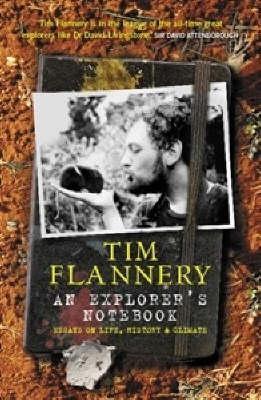
The Weather Makers catapulted Tim Flannery’s name into global consciousness; now he is known as one of the world’s foremost experts on climate change. But he didn’t just come into his knowledge and interest overnight. With its selection of exhilarating essays and articles written over the past 25 years, An Explorer’s Notebook charts the evolution of a young scientist doing fieldwork in remote locations to the major thinker who has changed the way we all view our actions in the face of global warming.��� Flannery writes about his journeys in the jungles of New Guinea and Irian Jaya, about the extraordinary people he met and the species he discovered. He writes about matters as wideranging as love, insects, population, water and the stresses we put on the environment. He explores how we can predict our own future by understanding the profound history of life on Earth. He also chronicles the recent seismic shift in the world’s attitude toward climate change, noting the deep impact felt by all of us. He writes on a wide variety of topics, from the huge increase in the number of accidental falls experienced by Winnipeg pedestrians each winter to the huge decrease in traditional circumcisions in the African Samburun tribe—a decrease that is devastating the tribe’s social order.��� For the millions who read The Weather Makers and for those interested in wildlife or the environment—and in wonderful storytelling— An Explorer’s Notebook is a must-read book.“Canadians are avid readers, and serious books can influence the course of their politics. Just prior to my arrival in early 2006, a new government had been elected. . . . At the time my tour started, Canada was chairing Kyoto’s Council of Parties for some crucial meetings, and the Harper government seemed hell-bent on destroying the entire process. Everywhere I spoke, the audiences were huge—typically around 1,000—and they showed deep embarrassment at Harper’s approach to Kyoto.”—From An Explorer’s Notebook

Are zombie jellyfish real?Do frogs like opera?What’s it like to wrestle a python?Tim Flannery has the answers. Introducing some of the most spectacular and unusual creatures on Earth, from water to sky and the forests and deserts in between, he offers in- depth and often bizarre facts on extraordinary animals that live in each habitat while incorporating concepts of climate change, evolution, conservation, and taxonomy. Did you know that lions once roamed North America, or that albatrosses sleep-fly? Have you ever heard a piranha bark, or ever wondered how the sloth got its name?

Tim Flannery is one of the world’s great thinkers, environmental scientists and writers. Sir David Attenborough once described him as being ‘in the league of the all-time great explorers like Dr David Livingstone.’ This definitive collection of his work brings together thirty years of essays, speeches and occasional writing on palaeontology, mammology, environmental science and history, including the science of climate change and the challenges and opportunities we face in addressing this issue, so critical for all of us. Tim Flannery is a paleontologist, explorer and conservationist, a leading writer on climate change, and the 2007 Australian of the Year. His books include the award-winning international bestseller The Weather Makers, Here on Earth and Atmosphere of Hope. He is currently chief councillor of the Climate Council. ‘This man is a national treasure, and we should heed his every word.’ Sunday Telegraph ‘Flannery is a writer who sneezes at political correctness and charges into the densely land-mined territory of the biological determinants of human behaviour.’ Washington Post ‘Flannery synthesises a vast range of scientific studies and a decent selection of historical and cultural writings, leavening those with his own forceful ideas.’ New York Times Book Review

En 2002, le village de Trachilos en Crète fut le théâtre d’une émouvante découverte : des empreintes de pas quasi humaines, imprimées dans des roches datant du Miocène – la preuve que de grands singes bipèdes évoluèrent en Europe, bien avant l’arrivée d’Homo erectus il y a près de 2 millions d’années !Qu’il s’agisse ou non de nos ancêtres, ces primates consacrent le statut exceptionnel de notre « supercontinent », une terre de métissage au carrefour de l’Asie, de l’Afrique et de l’Amérique du Nord. Une terre de tous les changements, soumise à une intense activité géologique, à de profonds bouleversements climatiques, mais aussi à la pression de l’homme… Voici enfin l’histoire au temps long – de 100 millions d’années à nos jours – de tous ceux qui l’habitèrent : sa flore, sa faune, sans oublier nos lointains cousins humains.Un formidable récit, visuel et documenté, où se croisent pêle-mêle récifs coralliens, mangroves, steppes glacées, ammonites, ptérodactyles, tortues, rhinocéros, tritons, mammouths et autres Néandertaliens…

Deep Dive into Deep Sea: Exploring the Most Mysterious Levels of the Ocean
by Tim Flannery
Rating: 4.3 ⭐
Internationally renowned author and scientist Tim Flannery explores the most remote and mysterious levels of Earth’s oceans. Who is the giant squid’s mortal enemy? Can you see ghosts in the deep sea? What in the world is a headless chicken monster? Tim Flannery has the answers. In this informed and accessible book, he takes readers on a journey into the darkest depths of this unchartered realm to learn about the incredible creatures living there. Divided into sections that focus on the various depths of the ocean, readers can navigate their way through the sea while being guided by anecdotes from Tim’s own personal experiences. From hairy sea devils and goblin sharks to entire ecosystems within whale carcasses, he uncovers fascinating and bizarre facts about this enchanting place and the slippery, scaly, and strange creatures that live there. Packed with vibrant illustrations and snappy engaging text, Deep Dive into Deep Sea will enthrall, enlighten, and capture the imaginations and passions of young oceanographers.

Yaklaşık 100 milyon yıl önce, üç büyük kıtanın –Asya, Kuzey Amerika ve Afrika– hareketleri sonucu büyük, tropik bir takımada meydana geldi. Bu takımada, daha sonra Avrupa’yı oluşturacaktı. O dönemden beri Avrupa durmak bilmeyen değişimlere sahne oldu ve farklı kökenlerden sayısız türe ev sahipliği yaptı.Milyonlarca yıl boyunca çok sayıda bitki ve hayvan türü Avrupa’ya göç etti ve burada kıtanın kendisiyle eşzamanlı olarak evrimleşti. İlk mercan resifleri Avrupa’da oluştu; yünlü gergedanlar, mamutlar ve Yeryüzü’nün gelmiş geçmiş en iri filleri Avrupa’da yaşadı; insan türünün geçirdiği önemli gelişmelerin çoğu Avrupa’da meydana geldi. Tim Flannery, çığır açan bu eserinde Avrupa’nın kökenine gidiyor ve kıtanın, Yeryüzü’nün geri kalanı için neden büyük önem taşıdığını araştırıyor. Doğa bilimlerinde kaydedilen ilerlemeler ışığında, Avrupa’nın hem geçmişte hem de günümüzde nasıl küresel değişimin başını çektiğini açıklarken; yaklaşık kırk bin yıl önce Avrupa’ya geldiğinden beri insanlığın da kıtanın hem faunasında hem de florasında nasıl büyük bir etkiye sahip olduğunu gözler önüne seriyor. Doğa tarihiyle kültür tarihini harmanlayan Köken’de nereden geldiğimizin ve kim olduğumuzun hikâyesini keyifle okuyacaksınız.