
Thomas Szasz
Thomas Stephen Szasz (pronounced /sas/; born April 15, 1920 in Budapest, Hungary) was a psychiatrist and academic. He was Professor Emeritus of Psychiatry at the State University of New York Health Science Center in Syracuse, New York. He was a prominent figure in the antipsychiatry movement, a well-known social critic of the moral and scientific foundations of psychiatry, and of the social control aims of medicine in modern society, as well as of scientism. He is well known for his books, The Myth of Mental Illness (1960) and The Manufacture of Madness: A Comparative Study of the Inquisition and the Mental Health Movement which set out some of the arguments with which he is most associated.
28 Books Written

The Myth of Mental Illness – Foundations of a Theory of Personal Conduct
by Thomas Szasz
Rating: 3.7 ⭐
• 2 recommendations ❤️
A classic work that has revolutionized thinking throughout the Western world about the nature of the psychiatric profession and the moral implications of its practices. "Bold and often brilliant."--Science

s/t: A Comparative Study of the Inquisition & the Mental Health MovementIn this seminal work, Dr. Szasz examines the similarities between the Inquisition and institutional psychiatry. His purpose is to show "that the belief in mental illness and the social actions to which it leads have the same moral implications and political consequences as had the belief in witchcraft and the social actions to which it led."

For more than half a century, Thomas Szasz has devoted much of his career to a radical critique of psychiatry. His latest work, The Science of Lies, is a culmination of his life’s to portray the integral role of deception in the history and practice of psychiatry. Szasz argues that the diagnosis and treatment of mental illness stands in the same relationship to the diagnosis and treatment of bodily illness that the forgery of a painting does to the original masterpiece. Art historians and the legal system seek to distinguish forgeries from originals. Those concerned with medicine, on the other hand—physicians, patients, politicians, health insurance providers, and legal professionals—take the opposite stance when faced with the challenge of distinguishing everyday problems in living from bodily diseases, systematically authenticating nondiseases as diseases. The boundary between disease and nondisease—genuine and imitation, truth and falsehood—thus becomes arbitrary and uncertain. There is neither glory nor profit in correctly demarcating what counts as medical illness and medical healing from what does not. Individuals and families wishing to protect themselves from medically and politically authenticated charlatanry are left to their own intellectual and moral resources to make critical decisions about human dilemmas miscategorized as “mental diseases” and about medicalized responses misidentified as “psychiatric treatments.” Delivering his sophisticated analysis in lucid prose and with a sharp wit, Szasz continues to engage and challenge readers of all backgrounds.

s/t: Mental Healing as Religion, Rhetoric & Repression

.In Our Right to Drugs, Thomas Szasz shows that our present drug war started at the beginning of this century, when the American government first assumed the task of protecting people from patent medicines. By the end of World War I, however, the free market in drugs was but a dim memory, if that. Instead of dwelling on the familiar impracticality or unfairness of our drug laws, Szasz demonstrates the deleterious effects of prescription laws which place people under lifelong medical tutelage. The result is that most Americans today prefer a coercive and corrupt command drug economy to a free market in drugs.Throughout the book, Szasz stresses the consequences of the fateful transformation of the central aim of American drug prohibitions from protecting us from being fooled by misbranded drugs to protecting us from harming ourselves by self-medication--defined as drug abuse. And he reminds us that the choice between self-control and state coercion applies to all areas of our lives, drugs being but one of the theaters in which this perennial play may be staged. A free society, Szasz emphasizes, cannot endure if its citizens reject the values of self-discipline and personal responsibility and if the state treats adults as if they were naughty children. In a no-holds-barred examination of the implementation of the War on Drugs, Szasz shows that under the guise of protecting the vulnerable members of our society--especially children, blacks, and the sick--our government has persecuted and injured them. Leading politicians persuade parents to denounce their children, and encourage children to betray their parents and friends--behavior that subverts family loyalties and destroys basic human decency. And instead of protecting blacks and Hispanics from dangerous drugs, this holy war has allowed us to persecute them, not as racists but as therapists--working selflessly to bring about a drug-free America. Last but not least, to millions of sick Americans, the War on Drugs has meant being deprived of the medicines they want-- because the drugs are illegal, unapproved here though approved abroad, or require a prescription a physician may be afraid to provide. The bizarre upshot of our drug policy is that many Americans now believe they have a right to die, which they will do anyway, while few believe they have a right to drugs, even though that does not mean they have to take any. Often jolting, always stimulating, Our Right to Drugs is likely to have the same explosive effect on our ideas about drugs and drug laws as, more than thirty years ago, The Myth of Mental Illness had on our ideas about insanity and psychiatry.

Ceremonial Chemistry: The Ritual Persecution of Drugs, Addicts and Pushers
by Thomas Szasz
Rating: 4.3 ⭐
s/t: The Ritual Persecution of Drugs, Addicts & PushersThomas Szasz suggests that governments have overstepped their bounds in labeling and prohibiting certain drugs as "dangerous" substances and incarcerating drug "addicts" in order to cure them. Szasz asserts that such policies scapegoat illegal drugs and the persons who use and sell them, and discourage the breaking of drug habits by pathologizing drug use as "addiction." Reaers will find in Szasz's arguments a cogent and committed response to a worldwide debate.

This volume contains the earliest essays, going back more than 30 years, in which the author staked out his position on 'the nature, scope, methods & values of psychiatry.'PrefacePreface to the 1st EditionAcknowledgmentsThe myth of mental illnessThe mental health ethic The rhetoric of rejectionMental health as ideologyWhat psychiatry can & cannot doBootlegging humanistic values through psychiatryThe insanity plea & the insanity verdictInvoluntary mental hospitalization: a crime against humanityMental health services in the schoolPsychiatry, the state & the university: the problem of the professional identity of academic psychiatryPsychiatric classification as a strategy of personal constraintWhither psychiatry?Index

This collection of impassioned essays, published between 1973 and 2006, chronicles Thomas Szasz’s long campaign against the orthodoxies of “pharmacracy,” that is, the alliance of medicine and the state. From “Diagnoses Are Not Diseases” to “The Existential Identity Thief,” “Fatal Temptation,” and “Killing as Therapy,” the book delves into the complex evolution of medicalization, concluding with “ The New Despotism.” In practice, society must draw a line between what counts as medical practice and what does not. Where it draws that line goes far in defining the kinds of laws its citizens live under, the kinds of medical care they receive, and the kinds of lives they are allowed to live.

From one of the most renowned and controversial thinkers in behavioral science, here is a critical examination of the way both science and society define insanity. Attacking the universally accepted psychiatric doctrines that blur the distinction between literal and metaphoric diseases, Szasz argues that insanity is not an objectively definable or identifiable condition and presents a more fully-rounded account of the insanity concept, showing how it relates to and differs from three closely allied ideas--social deviance, bodily illness and the sick role. Reveals why it is truly impossible to understand psychiatric problems without first distinguishing an abnormal biological condition--like diabetes--from the sick role. Destined to become a classic, this is an important addition to the author's already impressive body of work.

15 years & 12 books after The Myth of Mental Illness, the Wm Buckley of social relations continues his elegant & passionate assault on psychiatry, this time zeroing in on the most vulnerable syndrome in the medical library. "Schizophrenia is not a disease," Szasz insists, only a name that fake doctors (psychiatrists) give to misbehavers who annoy their families & misfits who can't "endure life with decency & dignity." This anti-Freudian no lesion-no illness formula is familiar, but genetic approaches to the subject--& all the recent, impressive statistics--are also rejected. Even R.D. Laing & the "anti-psychiatrists" (who've stolen much of Szasz' thunder) draw ridicule--for their idealization of insanity & for attempts to treat, however benignly, "so-called" schizophrenics. The undeniable problems with the schizophrenia diagnosis--vagueness, lack of etiology, institutional abuse--receive repeated emphasis, along with nightmarish reports of (primarily Soviet) political persecution masquerading as psychiatry. Disturbing stuff, but Szasz drowns the valid controversies in hyperbole ("the greatest scientific scandal of our scientific age") & tests our patience with labored analogies: therapy as slavery or arranged marriage, schizophrenia as the psychiatric faith's Eucharist. As always, the Szasz attack is relentlessly abstract (no case histories or current asylum data) & short on compassion, yet imbued with an odd eloquence that perhaps only tunnel-vision can achieve.--Kirkus

If, as the Old Testament tells us, the First or Original Sin was the knowledge of good and evil, then the knowledge of clear speech was the “Second Sin,” At Babel, God punished man for this transgression with the Divine Confusion, and we have been misleading each other ever since. Dr. Thomas Szasz believes that it is this confusion of language that has produced much of the inhumanity, intolerance, and outright stupidity which today affect everything from our politics to our sex lives. This is Dr. Szasz’s effort to dispel some of this confusion. It is a collection of penetrating, fresh, and often humorous thoughts, ranging from sex and the family to drugs, schizophrenia, and psychiatry. For example, Dr. Szasz points out that when a person acts as if he were speaking to God we say he is praying, but when he acts as if God were speaking to him we say he has “schizophrenia” — and we look to medical science to “cure” him of his “mental illness.” Other excerpts from the Second Formerly, Americans charges with murder were considered innocent until proven guilty; now they are considered insane until proven sane. the primary sexual activity of mankind. In the nineteenth century, it was a disease; in the twentieth, it is a cure. Treating addiction to heroin with methadone is like treating addiction to Scotch with Bourbon.

Fatal Freedom is an eloquent defense of every individual’s right to choose F a voluntary death. By maintaining statutes that determine that voluntary death is not legal, Thomas Szasz believes that our society is forfeiting one of its basic freedoms and causing the psychiatric medical establishment to treat individuals in a manner that is disturbingly inhumane. Society’s penchant for defining behavior it terms objectionable as a disease has created a psychiatric establishment that exerts far too much influence over how and when we choose to die. In a compelling argument that clearly and intelligently addresses one of the most significant ethical issues of our time, Szasz compares suicide to other practices that historically began as sins, became crimes, and now arc seen as mental illnesses.

In Western thought, suicide has evolved from sin to sin–and–crime, to crime, to mental illness, and to semilegal act. A legal act is one we are free to think and speak about and plan and perform, without penalty by agents of the state.While dying voluntarily is ostensibly legal, suicide attempts and even suicidal thoughts are routinely punished by incarceration in a psychiatric institution. Although many people believe the prevention of suicide is one of the duties the modern state owes its citizens, Szasz argues that suicide is a basic human right and that the lengths to which the medical industry goes to prevent it represent a deprivation of that right.Drawing on his general theory of the myth of mental illness, Szasz makes a compelling case that the voluntary termination of one’s own life is the result of a decision, not a disease. He presents an in-depth examination and critique of contemporary anti–suicide policies, which are based on the notion that voluntary death is a mental health problem, and systematically lays out the dehumanizing consequences of psychiatrizing suicide prevention.If suicide be deemed a problem, it is not a medical problem. Managing it as if it were a disease, or the result of a disease, will succeed only in debasing medicine and corrupting the law. Pretending to be the pride of medicine, psychiatry is its shame.
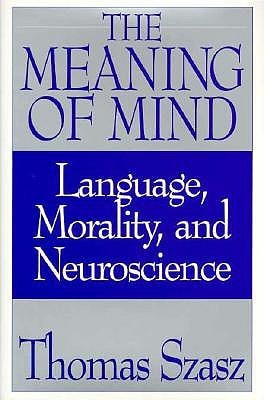
In this brilliantly original and highly accessible work, Thomas Szasz demonstrates the futility of analyzing the mind as a collection of brain functions. Instead of trying to unravel the riddle of a mythical entity called the mind, Szasz suggests that our task should be to understand and judge persons always as moral agents responsible for their own actions, not as victims of brain chemistry. This is Szasz's most ambitious work to date. In his best-selling book, The Myth of Mental Illness , he took psychiatry to task for misconstruing human conflict and coping as mental illness. In Our Right to Drugs , he exposed the irrationality and political opportunism that fuels the Drug War. In The Meaning of Mind , he warns that we misconstrue the dialogue within as a problem of consciousness and neuroscience, and do so at our own peril.In The Meaning of Mind , Thomas Szasz argues that only as a verb does the word mind mean something in the real world, namely, attending or heeding. Minding is the ability to pay attention and adapt to one's environment by using language to communicate with others and oneself. Viewing the mind as a potentially infinite variety of self-conversations is the key that unlocks many of the mysteries we associate with this concept. Modern neuroscience is a misdirected effort to explain mind in terms of brain functions. The claims and conclusions of the diverse academics and scientists who engage in this enterprise undermine the concepts of moral agency and personal responsibility. Szasz shows that the cognitive function of speech is to enable us to talk not only to others but to ourselves (in short, to be our own interlocutor), and that the view that mind is brain―embraced by both the scientific community and the popular press―is not an empirical finding but a rhetorical ruse concealing humanity's unceasing struggle to control persons by controlling the vocabulary. The discourse of brain-mind, unlike the discourse of man as moral agent, protects people from the dilemmas intrinsic to holding themselves responsible for their own actions and holding others responsible for theirs. Because we live in an age blessed by the fruits of materialist science, reductionist explanations of the relationship between brain and mind are more popular today than ever, making this book an indispensible addition to the seemingly recondite debate about, simply, who we are.

In recent decades, American medicine has become increasingly politicized and politics has become increasingly medicalized. Behaviors previously seen as virtuous or wicked, wise or unwise are now dealt with as healthy or sick--unwanted behaviors to be controlled as if they were health issues. The modern penchant for transforming human problems into diseases and judicial sanctions into treatments, replacing the rule of law with the rule of medical discretion, leads to the creation of a type of government social critic Thomas Szasz calls pharmacracy.Medicalizing troublesome behaviors and social problems is tempting to voters and politicians it panders to the people by promising to satisfy their needs for dependence on medical authority and offers easy self-aggrandizement to politicians as the dispensers of more and better health care. Thus, the people gain a convenient scapegoat, enabling them to avoid personal responsibility for their behavior. The government gains a rationale for endless and politically expedient wars against social problems defined as public health emergencies. The health care system gains prestige, funding, and bureaucratic power that only an alliance with the political system can provide.However, Szasz warns, the creeping substitution of pharmacracy for democracy--private medical concerns increasingly perceived as requiring a political response--inexorably erodes personal freedom and dignity. Medicine and Politics in America is a clear and convincing presentation of this hidden danger, all too often ignored in our health care debates and avoided in our political contests.

This is a new collection of biting aphorisms and provocative meditations by the master iconoclast of our age. Of The Untamed Tongue Szasz "I have tried, in the tradition of Voltaire's Philosophical Dictionary , to present a satirical overview of the current state of the 'human comedy' — with special emphasis on psychiatry, therapy, and related follies."The entries in this heretical 'dictionary' are arranged under such headings as ethics, liberty, love, money, politics, psychiatry, psychotherapy, punishment, religion, sex, social relations, and suicide. They all reveal Szasz at his courageous and outrageous best, as he takes on the government's futile and murderous 'war on drugs', exposes the hypocrisies of psychotherapy and the atrocities of psychiatry, and defends the individual's most sacred right — the right to suicide.

s/t: The Political-philosophical Foundations of Medical Ethics

Cruel Compassion is the capstone of Thomas Szasz's critique of psychiatric practices. Reexamining psychiatric interventions from a cultural-historical and political-economic perspective, Szasz demonstrates that the main problem that faces mental health policy makers today is adult dependency. Millions of Americans, diagnosed as mentally ill, are drugged and confined by doctors for noncriminal conduct, go legally unpunished for the crimes they commit, and are supported by the state—not because they are sick, but because they are unproductive and unwanted. Obsessed with the twin beliefs that misbehavior is a medical disorder and that the duty of the state is to protect adults from themselves, we have replaced criminal-punitive sentences with civil-therapeutic 'programs.' The result is the relentless loss of individual liberty, erosion of personal responsibility, and destruction of the security of persons and property—symptoms of the transformation of a Constitutional Republic into a Therapeutic State, unconstrained by the rule of law. Szasz shows convincingly that not until we separate therapy from coercion—much as the founders separated theology from coercion—shall we be able to get a handle on our seemingly intractable psychiatric and social problems. No contemporary thinker has done more than Thomas Szasz to expose the myths and misconceptions surrounding insanity and the practice of psychiatry. Now, in Cruel Compassion, he gives us a sobering look at some of our most cherished notions about our humane treatment of society's unwanted, and perhaps more importantly, about ourselves as a compassionate and democratic people.

s/t: An Inquiry into the Social Uses of Mental Health Practices

More than fifty years ago, Thomas Szasz showed that the concept of mental illness—a disease of the mind—is an oxymoron, a metaphor, a myth. Disease, in the medical sense, affects only the body. He also demonstrated that civil commitment and the insanity defense, the paradigmatic practices of psychiatry, are incompatible with the political values of personal responsibility and individual liberty. The psychiatric establishment’s rejection of Szasz’s critique posed no danger to his work: its defense of coercions and excuses as "therapy" supported his argument regarding the metaphorical nature of mental illness and the transparent immorality of brutal psychiatric control masquerading as humane medical care.In the late 1960s, the launching of the so-called antipsychiatry movement vitiated Szasz’s effort to present a precisely formulated conceptual and political critique of the medical identity of psychiatry and of psychiatric coercions and excuses. Led by the Scottish psychiatrist R. D. Laing, the antipsychiatrists used the term to attract attention to themselves and deflect attention from what they did, which included coercions and excuses based on psychiatric principles and power.For this reason, Szasz rejected, and continues to reject, psychiatry and antipsychiatry with equal vigor. Subsuming his work under the rubric of antipsychiatry betrays and negates it just as surely and effectively as subsuming it under the rubric of psychiatry. In Antipsychiatry: Quackery Squared, Szasz powerfully argues that his writings belong to neither psychiatry nor antipsychiatry. They stem from conceptual analysis, social-political criticism, and common sense.

In this book Szasz argues that Virginia Woolf was a victim neither of mental illness, nor psychiatry, nor her husband -- three ways she is regularly portrayed. He finds her to be an intelligent and self-assertive person, a moral agent who used mental illness, psychiatry, and her husband to fashion for herself a life of her own choosing. This is not to impute to Virginia Woolf some sort of limitless freedom of the will, nor is it to deny that the cultural and social milieu in which she grew up and lived had a profound impact on her psyche and her sense of the life choices open to her. It is only to remind us of the primacy of Virginia Woolf as an active, goal-directed, moral agent, responsible equally for her madness-badness and her genius-creativity.

s/t: The Theory & Method of Autonomous Psychotherapy

Aphorisms about marriage, love, sex, ethics, freedom, punishment, religion, psychiatry, mental illness, and other topics illuminate contradictions characterizing contemporary attitudes and the consequences of literalizing metaphors. Bibliogs

Understanding the history of psychiatry requires an accurate view of its function and purpose. In this provocative new study, Szasz challenges conventional beliefs about psychiatry. He asserts that, in fact, psychiatrists are not concerned with the diagnosis and treatment of bona fide illnesses. Psychiatric tradition, social expectation, and the law make it clear that coercion is the profession's determining characteristic. Psychiatrists may "diagnose" or "treat" people without their consent or even against their clearly expressed wishes, and these involuntary psychiatric interventions are as different as are sexual relations between consenting adults and the sexual violence we call "rape." But the point is not merely the difference between coerced and consensual psychiatry, but to contrast them. The term "psychiatry" ought to be applied to one or the other, but not both. As long as psychiatrists and society refuse to recognize this, there can be no real psychiatric historiography. The coercive character of psychiatry was more apparent in the past than it is now. Then, insanity was synonymous with unfitness for liberty. Toward the end of the nineteenth century, a new type of psychiatric relationship developed, when people experiencing so-called "nervous symptoms," sought help. This led to a distinction between two kinds of mental neuroses and psychoses. Persons who complained about their own behavior were classified as neurotic, whereas persons about whose behavior others complained were classified as psychotic. The legal, medical, psychiatric, and social denial of this simple distinction and its far-reaching implications undergirds the house of cards that is modern psychiatry. Coercion as Cure is the most important book by Szasz since his landmark The Myth of Mental Illness.

Re-examining psychiatric interventions from a cultural-historical and political-economic perspective, Szasz demonstrates that the main problem that faces mental health policymakers today is adult dependency. Millions of Americans, diagnosed as mentally ill, are drugged and confined by doctors for non-criminal conduct, go legally unpunished for the crimes they commit, and are supported by the state - not because they are sick, but because they are unproductive and unwanted. Obsessed with the twin beliefs that misbehaviour is a medical disorder and that the duty of the state is to protect adults from themselves, we have replaced criminal-punitive sentences with civil-therapeutic programmes. The result is the relentless loss of individual liberty and erosion of personal responsibility - symptoms of the transformation of a Constitutional Republic into a Therapeutic State, unconstrained by the rule of law.

Thomas Szasz has been challenging the very existence of "mental illness" for over twenty-five years. His advocacy of freedom of choice and the abolition of involuntary psychiatry has made him America's most controversial psychiatrist.The Therapeutic State is a unique collection of topical essays about what the author calls "one of the grandest illusions of our age, mental illness, and the quixotic crusade against it." Pivoting his analysis on news-making events, Szasz exposes the fallacies of our present penchant for interpreting the behavior of "sane" persons as goal-directed and therefore sensible, and the behavior of "insane" persons as caused by a "mental illness" and therefore senseless. In a series of diverse short pieces, originally published in newspapers and magazines, the author shows us that individual liberty and responsibility are indivisible, and that we cannot protect ourselves against coercive psychiatry's threats to liberty so long as we persist in using psychiatric ideas and interventions to evade responsibility.Szasz's recommendation is simple but So-called mental patients should be treated like other people - as no more subject to loss of liberty or entitled to excuses from responsibility than anyone else. Psychiatrists should be treated like other professionals - having no more power to inculpate innocent persons or to expurgate guilty ones than, say, accountants or architects. In short, our aim should be to disarm psychiatrists, much as the Founding Fathers disarmed priests. Nothing less can free us from the "benefits" and "harms" of the Therapeutic State.

Dr. Szasz presents four case histories which highlight his contention that pretrial psychiatric examination and subsequent `hospitalization' are travesties `on justice and healing which ought to be repudiated by both the legal and medical professions."

In this work Dr. Szasz dispels popular and scientific confusion about what pain and pleasure actually are. Demonstrating the doubtful value of such distinctions as “real” and Imagined” pain, or “physical” and “intellectual” pleasure, he analyses the basic concepts-psychological, philosophical, and sociological-involved in bodily feelings and discusses how these feelings are communicated. Some of the subjects discussed in Pain and Pleasure self-mutilation, sexual satisfaction, “hysterical anesthesia,” false pregnancy, laughter, homosexuality, and dream analysis.