
Thomas Nagel
Thomas Nagel is an American philosopher, currently University Professor and Professor of Philosophy and Law at New York University, where he has taught since 1980. His main areas of philosophical interest are philosophy of mind, political philosophy and ethics. He is well-known for his critique of reductionist accounts of the mind in his essay "What Is it Like to Be a Bat?" (1974), and for his contributions to deontological and liberal moral and political theory in The Possibility of Altruism (1970) and subsequent writings. Thomas Nagel was born to a Jewish family in Belgrade, Yugoslavia (now Serbia). He received a BA from Cornell University in 1958, a BPhil from Oxford University in 1960, and a PhD from Harvard University in 1963 under the supervision of John Rawls. Before settling in New York, Nagel taught briefly at the University of California, Berkeley (from 1963 to 1966) and at Princeton University (from 1966 to 1980), where he trained many well-known philosophers including Susan Wolf, Shelly Kagan, and Samuel Scheffler, who is now his colleague at NYU. In 2006, he was made a member of the American Philosophical Society. Nagel is a Fellow of the American Academy of Arts and Sciences and a Corresponding Fellow of the British Academy, and has held fellowships from the Guggenheim Foundation, the National Science Foundation, and the National Endowment for the Humanities. In 2008, he was awarded a Rolf Schock Prize for his work in philosophy, the Balzan prize, and the honorary degree of Doctor of Letters from Oxford University.
30 Books Written

If there is such a thing as reason, it has to be universal. Reason must reflect objective principles whose validity is independent of our point of view--principles that anyone with enough intelligence ought to be able to recognize as correct. But this generality of reason is what relativists and subjectivists deny in ever-increasing numbers. And such subjectivism is not just an inconsequential intellectual flourish or badge of theoretical chic. It is exploited to deflect argument and to belittle the pretensions of the arguments of others. The continuing spread of this relativistic way of thinking threatens to make public discourse increasingly difficult and to exacerbate the deep divisions of our society. In The Last Word , Thomas Nagel, one of the most influential philosophers writing in English, presents a sustained defense of reason against the attacks of subjectivism, delivering systematic rebuttals of relativistic claims with respect to language, logic, science, and ethics.He shows that the last word in disputes about the objective validity of any form of thought must lie in some unqualified thoughts about how things are--thoughts that we cannot regard from outside as mere psychological dispositions.

Thomas Nagel's Mortal Questions explores some fundamental issues concerning the meaning, nature and value of human life. Questions about our attitudes to death, sexual behaviour, social inequality, war and political power are shown to lead to more obviously philosophical problems about personal identity, consciousness, freedom, and value. This original and illuminating book aims at a form of understanding that is both theoretical and personal in its lively engagement with what are literally issues of life and death.

Mind & Cosmos: Why the Materialist Neo-Darwinian Conception of Nature is Almost Certainly False
by Thomas Nagel
Rating: 3.6 ⭐
• 1 recommendation ❤️
العقل والنظام الكوني : يُخرجه (مركز تبصير مترجما إلى العربية تعاونا مع مطبعة جامعة أكسفورد، وهو من تأليف الفيلسوف الأمريكي توماس ناجل، لما سيأتي بيانه، وما قدمنا على هذه الخطوة مع علمنا بتوجهات وأيدلوجية المؤلف إلا من بابة وشهد شاهد من أهلها ففي الكتاب كلام واضح من كاتب وصف نفسه بين طيات الكتاب بأنه (ملحد) صراحة ودون موازية، ومع ذلك تجد في الكتاب نقدا للمادية الداروينية وخرافة نشأة الحياة والكائنات الحية المعقدة ذات الوعي والإرادة والتفكير العلمي النقدي، والتي تدرك بدورها وجود القيمة والأخلاق، من خلال محض التطور الدارويني. وذلك دون وجود تفسيرات واضحة من المادية الداروينية الحديثة توضح كيف نشأت كل هذه الصفات للكائن الحي من محض تفاعلات كيميائية صدقية في ظل وسط علمي يعلم جيدا أنها - أي : الداروينية الحديثة لم تجب أصلا عن سؤال نشأة الحياة المحضة في الكائنات أحادية الخلية !! في هذا الكتاب ترى الخيرة بادية في جميع صفحاته، نقدًا شديد اللهجة للمادية وبيان عوارها، ومع ذلك تجد أيضا من المؤلف رفضا للمنهج الألوهي بحجة أنه يبحث فقط عن منهج علمي تجربي فتجد المؤلف يصرح قائلا: حيث إنه من غير المعقول للوهلة الأولى أن تكون الحياة كما نعرفها - نتيجة سلسلة من الحوادث المادية مصحوبة بالية الانتخاب الطبيعي. ليعلم المسلم حقيقة الأمر من أفواه معتنقيه لا من مرتزقة الداروينية ومروجها.

Human beings have the unique ability to view the world in a detached way: We can think about the world in terms that transcend our own experience or interest, and consider the world from a vantage point that is, in Nagel's words, "nowhere in particular." At the same time, each of us is a particular person in a particular place, each with his own "personal" view of the world, a view that we can recognize as just one aspect of the whole. How do we reconcile these two standpoints--intellectually, morally, and practically? To what extent are they irreconcilable and to what extent can they be integrated? Thomas Nagel's ambitious and lively book tackles this fundamental issue, arguing that our divided nature is the root of a whole range of philosophical problems, touching, as it does, every aspect of human life. He deals with its manifestations in such fields of philosophy as: the mind-body problem, personal identity, knowledge and skepticism, thought and reality, free will, ethics, the relation between moral and other values, the meaning of life, and death. Excessive objectification has been a malady of recent analytic philosophy, claims Nagel, it has led to implausible forms of reductionism in the philosophy of mind and elsewhere. The solution is not to inhibit the objectifying impulse, but to insist that it learn to live alongside the internal perspectives that cannot be either discarded or objectified. Reconciliation between the two standpoints, in the end, is not always possible.

In this cogent and accessible introduction to philosophy, the distinguished author of Mortal Questions and The View From Nowhere sets forth the central problems of philosophical inquiry for the beginning student. Arguing that the best way to learn about philosophy is to think about its questions directly, Thomas Nagel considers possible solutions to nine problems--knowledge of the world beyond our minds, knowledge of other minds, the mind-body problem, free will, the basis of morality, right and wrong, the nature of death, the meaning of life, and the meaning of words. Although he states his own opinions clearly, Nagel leaves these fundamental questions open, allowing students to entertain other solutions and encouraging them to think for themselves.

What we see, what we understand, is never free from the peculiar “conscious” perception that isolates us in our specificity of individuals and human beings. So for everyone, bats included. Hence, starting from a simple and apparently naive question, a whole wide panorama of great philosophical questions opens up, which in an irresistible crescendo leads the thinker from the problem of the subject-world and mind-body relationship to a question on the possibilities and limits of science and an objective knowledge in general, up to the perspective of a language to come that allows us to open a gap between the many dead ends in which we seem destined.

Just as there are rational requirements on thought, there are rational requirements on action. This book defends a conception of ethics, and a related conception of human nature, according to which altruism is included among the basic rational requirements on desire and action.

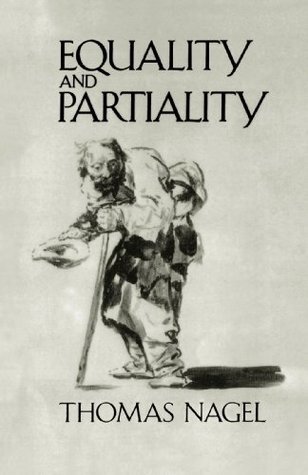
Derived from Thomas Nagel's Locke Lectures, Equality and Partiality proposes a nonutopian account of political legitimacy, based on the need to accommodate both personal and impersonal motives in any credible moral theory, and therefore in any political theory with a moral foundation. Within each individual, Nagel believes, there is a division between two standpoints, the personal and the impersonal. Without the impersonal standpoint, there would be no morality, only the clash, compromise, and occasional convergence of individual perspectives. It is because a human being does not occupy only his own point of view that each of us is susceptible to the claims of others through private and public morality. Political systems, to be legitimate, must achieve an integration of these two standpoints within the individual. These ideas are applied to specific problems such as social and economic inequality, toleration, international justice, and the public support of culture. Nagelpoints to the problem of balancing equality and partiality as the most important issue with which political theorists are now faced.

Thomas Nagel is widely recognized as one of the top American philosophers working today. Reflecting the diversity of his many philosophical preoccupations, this volume is a collection of his most recent critical essays and reviews.The first section, Public and Private, focuses on the notion of privacy in the context of social and political issues, such as the impeachment of President Clinton. The second section, Right and Wrong, discusses moral, political and legal theory, and includes pieces on John Rawls, G.A. Cohen, and T.M. Scanlon, among others. The final section, Mind and Reality, features discussions of Richard Rorty, Donald Davidson, and the Sokal hoax, and closes with a substantial new essay on the mind-body problem. Written with characteristic rigor, these pieces reveal the intellectual passion underlying the incisive analysis for which Nagel is known.

Over the past twenty-five years, Thomas Nagel has played a major role in the philosophico-biological debate on subjectivity and consciousness. This extensive collection of published essays and reviews offers Nagel's opinionated views on the philosophy of mind, epistemology, and political philosophy, as well as on fellow philosophers like Freud, Wittgenstein, Rawls, Dennett, Chomsky, Searle, Nozick, Dworkin, and MacIntyre.

This volume collects recent essays and reviews by Thomas Nagel in three subject areas. The first section, including the title essay, is concerned with religious belief and some of the philosophical questions connected with it, such as the relation between religion and evolutionary theory, the question of why there is something rather than nothing, and the significance for human life of our place in the cosmos. It includes a defense of the relevance of religion to science education. The second section concerns the interpretation of liberal political theory, especially in an international context. A substantial essay argues that the principles of distributive justice that apply within individual nation-states do not apply to the world as a whole. The third section discusses the distinctive contributions of four philosophers to our understanding of what it is to be human--the form of human consciousness and the source of human values.

This volume presents two closely related essays by Thomas ?Gut Feelings and Moral Knowledge? and ?Moral Reality and Moral Progress.? Both essays are concerned with moral epistemology and our means of access to moral truth; both are concerned with moral realism and with the resistance to subjectivist and reductionist accounts of morality; and both are concerned with the historical development of moral knowledge. The second essay also proposes an account of the historical development of moral truth, according to which it does not share the timelessness of scientific truth. This is because moral truth must be based on reasons that are accessible to the individuals to whom they apply, and such accessibility depends on historical developments. The result is that only some advances in moral knowledge are discoveries of what has been true all along.


Ο καλύτερος τρόπος για να ανακαλύψουμε τι είναι η φιλοσοφία είναι να φιλοσοφήσουμε οι ίδιοι. Αυτή είναι η κατευθυντήρια γραμμή της σκέψης του Τόμας Νάγκελ και ο κύριος λόγος που τον ώθησε στη συγγραφή αυτής της σύντομης αλλά περιεκτικής εισαγωγής στη φιλοσοφία. Τα φιλοσοφικά προβλήματα θεωρούνται γενικά δυσνόητα, αφηρημένα και απόμακρα από την καθημερινή μας ζωή. Το βιβλίο αυτό επιχειρεί, αντίθετα, να δείξει πως τα φιλοσοφικά ερωτήματα είναι αυτά που κάθε σκεπτόμενος άνθρωπος θέτει κάποια στιγμή στον εαυτό του, όταν προσπαθεί να κατανοήσει το σκοπό και το νόημα της ζωής του μέσα στον κόσμο, την επικοινωνία του με τους συνανθρώπους του, τις αιτίες και τις συνέπειες της συμπεριφοράς του μέσα στην κοινωνία.

This book collects Thomas Nagel's recent philosophical reflections on topics of fundamental ethics, moral psychology, science and religion, death, the holocaust, and the metaphysics of mind. Among the figures discussed are Peter Singer, Alvin Plantinga, Christine Korsgaard, Tony Judt, Elizabeth Anscombe, Philippa Foot, Iris Murdoch, T. M. Scanlon, Ronald Dworkin, Samuel Scheffler, Daniel Kahneman, Jonathan Haidt, Joshua Greene, and Daniel Dennett. Nagel consistently defends a realist interpretation of moral truth and resists reductive attempts to subsume ethics to psychology and evolutionary theory. He also defends a pluralistic conception of the content of morality as opposed to utilitarianism, one that includes deontological elements such as rights and special responsibilities. A realist outlook also informs his discussion of metaphysical and epistemological questions.The book closes with tributes to a number of people Nagel has known over the course of his career. The essays are all addressed to a general audience, and should appeal not only to philosophers but to anyone interested in current attempts to understand human life, human values, and how we fit into the world.


L'impresa di dare forma a un ideale comprensibile di giustizia globale è strettamente connessa a due questioni la relazione fra giustizia e sovranità e l'ampiezza e i limiti dell'eguaglianza, intesa come una naturale richiesta di giustizia. Se guardiamo allo sviluppo storico delle concezioni di giustizia e di legittimità dello Stato-nazione, sembra che di solito la sovranità abbia preceduto la legittimità e mai -come sarebbe più ovvio aspettarsi - viceversa. Persino nel caso più famoso di creazione di una federazione democratica, l'illegittimità precedette la legittimità: la fondazione degli Stati Uniti dipese dalla tutela della schiavitù, senza la quale non si sarebbe mai raggiunta l'unanimità fra le tredici ex-colonie. Regimi ingiusti e palesemente illegittimi costituiscono insomma i precursori necessari del progresso verso la legittimità e la democrazia, perché creano il potere centralizzato che si può a quel punto contestare, e forse volgere in altre direzioni senza distruggerlo. "È improbabile che assisteremo alla diffusione di una giustizia globale nel lungo periodo, a meno di non creare prima istituzioni sovranazionali forti che non mirano alla giustizia, ma perseguono piuttosto interessi comuni e riflettono le diseguaglianze nel potere di contrattazione fra gli Stati ora esistenti." Il punto è capire se tutto questo può essere fatto di comune accordo, e non con l'imposizione violenta.


In this book, effective computational methods to facilitate those pivotal simulations using open-source software are introduced and discussed with a special focus on the coupled thermo-mechanical behavior of the rock salt. A cohesive coverage of applying geotechnical modeling to the subsurface storage of hydrogen produced from renewable energy sources is accompanied by specific, reproducible example simulations to provide the reader with direct access to this fascinating and important field. Energy carriers such as natural gas, hydrogen, oil, and even compressed air can be stored in subsurface geological formations such as depleted oil or gas reservoirs, aquifers, and caverns in salt rock. Many challenges have arisen in the design, safety and environmental impact assessment of such systems, not the least of which is that large-scale experimentation is not a feasible option. Therefore, simulation techniques are central to the design and risk assessment of these and similar geotechnical facilities.


Essay aus dem Jahr 2004 im Fachbereich Philosophie - Philosophie des 20. Jahrhunderts / Gegenwart, Note: 1,0, Europa-Universität Viadrina Frankfurt (Oder), Sprache: Deutsch, Abstract: Ein Essay zu Thomas Nagels Text: "Wie es ist eine Fledermaus zu sein." Eine Abhandlung über das Wesen menschlichen Bewusstseins. Im Schlussteil seiner Atomlehre lässt Demokrit Verstand und Sinne gegeneinander antreten. „Scheinbar ist Farbe, scheinbar Süße, scheinbar Bitterkeit - wirklich nur Atome und leerer Raum!”, deklamiert zunächst der Verstand, woraufhin die Sinne entgegnen: „Du armer Verstand, von uns nimmst du die Beweisstücke und willst uns besiegen? Dein Sieg ist dein Fall!” Es deutet sich hier an, was Philosophen wie Descartes, Leibniz bis weit in die Neuzeit bewegen sollte: das „Leib-Seele-Problem“: Wie kann es sein, dass rein physikalische Reize mich als Menschen in einen emotionalen Zustand von Genuss, Schmerz oder Freude versetzen können? Ist dies dann echt oder nur Farce, eine Art „Sinnestäuschung“? Wie also ist die Natur Zustände beschaffen: Körperlich? Mental? Oder auch anders ausgedrückt: Was ist, was bedeutet menschliches Bewusstsein?

Eine Abhandlung über Gleichheit und Parteilichkeit ist das Hauptwerk Thomas Nagels zur politischen Philosophie. Hervorgegangen aus seinen 1990 in Oxford gehaltenen Locke Lectures erkundet Nagel in diesem dichten Traktat den Konflikt zwischen individueller Freiheit und gesellschaftlicher Gleichheit – zwischen dem Einzelnen und dem Kollektiv. Dieser Konflikt, den er als das Grundproblem der politischen Philosophie bezeichnet, lässt sich nicht auf Systemebene lösen, denn er hat seinen Ursprung darin, dass schon jede Person zwei Standpunkte einzunehmen in der Lage den persönlichen und den überpersönlichen. Diesem unhintergehbaren Dualismus Rechnung zu tragen, ist die Aufgabe jeder politischen Lehre, die die Frage beantworten »Wie sollen wir in einer Gesellschaft miteinander leben?« Ein Klassiker.

LE POINT DE VUE DE NULLE PART
by Thomas Nagel

Uma Breve Introdução A Filosofia
by Thomas Nagel
Libro usado en buenas condiciones, por su antiguedad podria contener señales normales de uso

O čemu je zapravo reč: vrlo kratak uvod u filozofiju
by Thomas Nagel

Zahnriemengetriebe
by Thomas Nagel

Vesnice intrebari
by Thomas Nagel
Vesnice intrebari exploreaza cateva probleme fundamentale cu privire la intelesul, natura si valoarea vietii umane. Se arata cum intrebarile referitoare la atitudinile noastre fata de moarte, comportament sexual, inechitate sociala, razboi ori putere politica se constituie in concepte filosofice despre identitatea personala, constiinta, libertate si valoare. Thomas Nagel scrie cu acea claritate si precizie a stilului pe care filosofii le-au admirat intotdeauna. Daca cineva poate sa captiveze prin scris cititorul, atunci acela este Thomas Nagel, cu aceasta carte. New Statesman O minunata realizare. Putini filosofi prefesionisti au scris atat de precis si placut despre probleme atat de diverse, dificile si serioase. P. F. Strawson, The New York Review of Books