
Thomas M. Nichols
Dr. Thomas M. Nichols is a professor of National Security Affairs at the U.S. Naval War College and an adjunct professor in the Harvard Extension School. He also taught at Dartmouth College, Georgetown University (where he earned his PhD), and other schools and lecture programs. He is currently a Senior Associate of the Carnegie Council on Ethics and International Affairs, and a Fellow of the International History Institute at Boston University. He has also been a Fellow of the International Security Program and the Project on Managing the Atom at the Belfer Center for Science and International Affairs at the John F. Kennedy School of Government at Harvard University. In his Washington days, Professor Nichols was a fellow at the Center for Strategic and International Studies, a consultant to the U.S. government, and a research analyst for private industry. Later, he served as personal staff for foreign and defense affairs to the late U.S. Senator John Heinz of Pennsylvania
18 Books Written
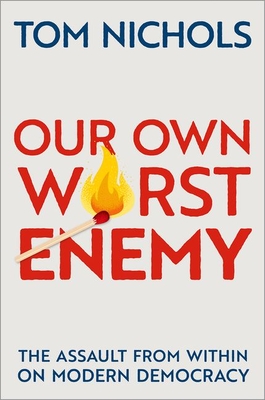
Our Own Worst Enemy: The Assault from within on Modern Democracy
by Thomas M. Nichols
Rating: 4.1 ⭐
• 2 recommendations ❤️
A contrarian yet highly engaging account of the spread of illiberal and anti-democratic sentiment throughout our culture that places responsibility on the citizens themselves.Over the past three decades, citizens of democracies who claim to value freedom, tolerance, and the rule of law have increasingly embraced illiberal politicians and platforms. Democracy is in trouble--but who is really to blame?In Our Own Worst Enemy, Tom Nichols challenges the current depictions of the rise of illiberal and anti-democratic movements in the United States and elsewhere as the result of the deprivations of globalization or the malign decisions of elites. Rather, he places the blame for the rise ofilliberalism on the people themselves. Nichols traces the illiberalism of the 21st century to the growth of unchecked narcissism, rising standards of living, global peace, and a resistance to change. Ordinary citizens, laden with grievances, have joined forces with political entrepreneurs who thriveon the creation of rage rather than on the encouragement of civic virtue and democratic cooperation. While it will be difficult, Nichols argues that we need to defend democracy by resurrecting the virtues of altruism, compromise, stoicism, and cooperation--and by recognizing how good we've actuallyhad it in the modern world.Trenchant, contrarian, and highly engaging, Our Own Worst Enemy reframes the debate about how democracies have ended up in this dire state of affairs and what to do about it.

The Death of Expertise: The Campaign against Established Knowledge and Why it Matters
by Thomas M. Nichols
Rating: 4.0 ⭐
• 2 recommendations ❤️
Technology and increasing levels of education have exposed people to more information than ever before. These societal gains, however, have also helped fuel a surge in narcissistic and misguided intellectual egalitarianism that has crippled informed debates on any number of issues. Today, everyone knows everything: with only a quick trip through WebMD or Wikipedia, average citizens believe themselves to be on an equal intellectual footing with doctors and diplomats. All voices, even the most ridiculous, demand to be taken with equal seriousness, and any claim to the contrary is dismissed as undemocratic elitism.Tom Nichols' The Death of Expertise shows how this rejection of experts has occurred: the openness of the internet, the emergence of a customer satisfaction model in higher education, and the transformation of the news industry into a 24-hour entertainment machine, among other reasons. Paradoxically, the increasingly democratic dissemination of information, rather than producing an educated public, has instead created an army of ill-informed and angry citizens who denounce intellectual achievement. When ordinary citizens believe that no one knows more than anyone else, democratic institutions themselves are in danger of falling either to populism or to technocracy or, in the worst case, a combination of both. An update to the 2017breakout hit, the paperback edition of The Death of Expertise provides a new foreword to cover the alarming exacerbation of these trends in the aftermath of Donald Trump's election. Judging from events on the ground since it first published, The Death of Expertise issues a warning about the stability and survival of modern democracy in the Information Age that is even more important today.

In an age of new threats to international security, the old rules of war are rapidly being discarded. The great powers are moving toward norms less restrictive of intervention, preemption, and preventive war. This evolution is taking place not only in the United States but also in many of the world's most powerful nations, including Russia, France, and Japan, among others. As centuries of tradition and law are overturned, will preventive warfare push the world into chaos?Eve of Destruction is a provocative contribution to a growing international debate over the acceptance of preventive military action. In the first work to identify the trends that have led to a coming age of preventive war, Thomas M. Nichols uses historical analysis as well as interviews with military officials from around the world to trace the anticipatory use of force from the early 1990s—when the international community responded to a string of humanitarian crises in Somalia, Bosnia, and Kosovo—to today's current and potential actions against rogue states and terrorists. He makes a case for a bold reform of U.S. foreign policy, and of the United Nations Security Council itself, in order to avert outright anarchy.

For more than forty years, the United States has maintained a public commitment to nuclear disarmament, and every president from Ronald Reagan to Barack Obama has gradually reduced the size of America's nuclear forces. Yet even now, over two decades after the end of the Cold War, the United States maintains a huge nuclear arsenal on high alert and ready for war. The Americans, like the Russians, the Chinese, and other major nuclear powers, continue to retain a deep faith in the political and military value of nuclear force, and this belief remains enshrined at the center of U.S. defense policy regardless of the radical changes that have taken place in international politics.In "No Use," national security scholar Thomas M. Nichols offers a lucid, accessible reexamination of the role of nuclear weapons and their prominence in U.S. security strategy. Nichols explains why strategies built for the Cold War have survived into the twenty-first century, and he illustrates how America's nearly unshakable belief in the utility of nuclear arms has hindered U.S. and international attempts to slow the nuclear programs of volatile regimes in North Korea and Iran. From a solid historical foundation, Nichols makes the compelling argument that to end the danger of worldwide nuclear holocaust, the United States must take the lead in abandoning unrealistic threats of nuclear force and then create a new and more stable approach to deterrence for the twenty-first century.

What is the role that tactical or non-strategic nuclear weapons (NSNWs) play in NATO defense policy and strategy? This book examines the key issues surrounding this question as the Alliance seeks to redefine itself in the 21st century and meet the requirements in the Defense and Deterrence Policy Review.

The Sacred Cause: Civil-Military Conflict over Soviet National Security, 1917-1992
by Thomas M. Nichols
Rating: 3.8 ⭐
To the officers of the USSR Armed Forces, the defense of the Soviet Union was, in the words of a Soviet general, a "sacred cause." What was the nature of Soviet civil-military relations, and what have the new militaries inherited from the Soviet experience? In this book Thomas M. Nichols examines the struggles over national security policy between military officers and political leaders in the USSR, and shows that the Soviet civil-military relationship has a long history of conflict rather than cooperation. Nichols disputes the longstanding Western belief in Party-Army amity. He argues that Party control over the Soviet armed forces has been tenuous since Stalin's death; the relationship was inherently unstable and conflictual, growing in intensity because of Gorbachev and his approach to domestic and foreign policy reforms. The source of this instability lay in the creation of the Soviet Armed Forces as a Marxist military, and Nichols maintains that this privileged and highly ideological institution found itself in frequent conflict with a Party that had of necessity to take an increasingly pragmatic approach to international politics. Movement toward a politically isolated and professionalized military, he shows, was continuously subverted by civilian leaders who sought to control military issues through political intrusions into doctrine and strategy. He concludes that the new leaders of the post-Soviet republics have inherited a group of military organizations that continue to resist the abandonment both of their ideological foundations and of their cohesion as a multinational military - a situation he believes may prove to be one of the greatest threats to the emerging post-Soviet democracies.

At the dawn of the 21st century, it should be evident that the Cold War of 1945-1991 was but the first of its kind. Nichols urges the reader to consider previous resolutions before another such conflict arises. He asserts that the Cold War was essentially a clash of ideologies tempered by the ever-present threat of nuclear annihilation. Victory for the West came quietly, without the final and utterly destructive war often envisioned.Undoubtedly, the end of the Cold War was a signal victory for the West, and for the United States in particular. Yet Nichols reminds that enemies of the ideals of democracy, capitalism, and liberty abound and will lash out against western states that hold true to them. When this occurs, it will be imperative for the West to remember key lessons taken from the Cold War. Nichols argues that conflicts driven by dissonant ideologies differ from wars fought over resources and territory, and must therefore be fought differently.

The Russian Presidency: Society and Politics in the Second Russian Republic
by Thomas M. Nichols
Rating: 4.5 ⭐
Why has Russian democracy apparently survived and even strengthened under a presidential system, when so many other presidential regimes have decayed into authoritarian rule? And what are the origins of presidential power in modern Russia? Thomas M. Nichols argues that the answer lies in the relationship between political institutions and where society, and consequently politics, is fractious and divided, structural safeguards inherent in presidentialism actually serve to strengthen democratic behavior. The Russian presidency is not the cause of social turmoil in Russia, but rather a successful response to it. This book's emphasis on the social origins of Russian politics explains not only the unexpected survival of Russian democracy, but encourages a reconsideration of the relationship between institutions, social conditions, and democracy.


This work has been selected by scholars as being culturally important, and is part of the knowledge base of civilization as we know it. This work was reproduced from the original artifact, and remains as true to the original work as possible. Therefore, you will see the original copyright references, library stamps (as most of these works have been housed in our most important libraries around the world), and other notations in the work. This work is in the public domain in the United States of America, and possibly other nations. Within the United States, you may freely copy and distribute this work, as no entity (individual or corporate) has a copyright on the body of the work. As a reproduction of a historical artifact, this work may contain missing or blurred pages, poor pictures, errant marks, etc. Scholars believe, and we concur, that this work is important enough to be preserved, reproduced, and made generally available to the public. We appreciate your support of the preservation process, and thank you for being an important part of keeping this knowledge alive and relevant.

Having trouble unraveling the myriad of choices that confront us everyday? This book, A Matter of Choice, explores those elements that can liberate and empower or confine us. For â Choices that have purpose â Choices made for us by people or circumstances â Choosing to be indifferent â Choosing to be willfully ignorant â Choosing God â What about luck? â Tools for making wise choices The power of one's choice is significant if not the most empowering realization we will ever have. What is striking about our free will, or the power to affect the affairs of our life, is the tremendous responsibility attached to that gift and the humbling effect it should place on us. If we wanted a wish granted at the start of our life, and had the wisdom to ask, it would probably include free will or the freedom to make our own choices. And, indeed that is what God has granted us. The idea of the power of choice and one's freedom to choose is one of God's greatest gifts to mankind. If God let all creation have freewill, then that gift is bestowed upon all of us. If freedom of choice is sacred to Him and He will not interfere with it, then it should be sacred to us and instill in us the gravity of proper choices. (Taken from the introduction).

Supramundane Facts In The Life Of Rev. Jesse Babcock Ferguson, A. M., LL. D. - Including Twenty Years' Observation Of Preternatural Phenomena
by Thomas M. Nichols
Rating: 5.0 ⭐
Many of the earliest books, particularly those dating back to the 1900s and before, are now extremely scarce and increasingly expensive. We are republishing these classic works in affordable, high quality, modern editions, using the original text and artwork.

'What's in a Name?' a Popular Explanation of Ordinary Christian-Names of Men and Women
by Thomas M. Nichols
Rating: 5.0 ⭐
This work has been selected by scholars as being culturally important, and is part of the knowledge base of civilization as we know it. This work was reproduced from the original artifact, and remains as true to the original work as possible. Therefore, you will see the original copyright references, library stamps (as most of these works have been housed in our most important libraries around the world), and other notations in the work.This work is in the public domain in the United States of America, and possibly other nations. Within the United States, you may freely copy and distribute this work, as no entity (individual or corporate) has a copyright on the body of the work.As a reproduction of a historical artifact, this work may contain missing or blurred pages, poor pictures, errant marks, etc. Scholars believe, and we concur, that this work is important enough to be preserved, reproduced, and made generally available to the public. We appreciate your support of the preservation process, and thank you for being an important part of keeping this knowledge alive and relevant.

This work has been selected by scholars as being culturally important, and is part of the knowledge base of civilization as we know it. This work was reproduced from the original artifact, and remains as true to the original work as possible. Therefore, you will see the original copyright references, library stamps (as most of these works have been housed in our most important libraries around the world), and other notations in the work.This work is in the public domain in the United States of America, and possibly other nations. Within the United States, you may freely copy and distribute this work, as no entity (individual or corporate) has a copyright on the body of the work.As a reproduction of a historical artifact, this work may contain missing or blurred pages, poor pictures, errant marks, etc. Scholars believe, and we concur, that this work is important enough to be preserved, reproduced, and made generally available to the public. We appreciate your support of the preservation process, and thank you for being an important part of keeping this knowledge alive and relevant.

Jacopo Tintoretto was the most prolific painter working in Venice in the later 16th century. Though his early career was marked by the struggle to achieve recognition, in his mature years he worked extensively on decorations for the Doge's Palace and for the meeting-house of the Scuola Grande di S Rocco. In addition to his religious and mythological works, Jacopo also painted many portraits of prominent Venetians. His swift, abbreviated style was, however, never wholly accepted by the leading aristocratic families that dominated Venetian cultural life and, despite a long and busy career, Jacopo Tintoretto apparently never became rich. This fully illustrated Grove Art Essentials title introduces Tintoretto's life and work, the development of his style, and his critical reception, and it includes an extensive bibliography to jumpstart further study of this remarkable Renaissance painter.
Just war, not prevention.: An article from: Ethics & International Affairs
by Thomas M. Nichols
Rating: 5.0 ⭐

First Presbyterian Church Of New Brunswick, N.j.: A Historical Discourse
by Thomas M. Nichols
This work has been selected by scholars as being culturally important, and is part of the knowledge base of civilization as we know it. This work was reproduced from the original artifact, and remains as true to the original work as possible. Therefore, you will see the original copyright references, library stamps (as most of these works have been housed in our most important libraries around the world), and other notations in the work. This work is in the public domain in the United States of America, and possibly other nations. Within the United States, you may freely copy and distribute this work, as no entity (individual or corporate) has a copyright on the body of the work. As a reproduction of a historical artifact, this work may contain missing or blurred pages, poor pictures, errant marks, etc. Scholars believe, and we concur, that this work is important enough to be preserved, reproduced, and made generally available to the public. We appreciate your support of the preservation process, and thank you for being an important part of keeping this knowledge alive and relevant.
A Handy-Book of the British Museum, for Every-Day Readers. By T. Nichols ... 1870 [Leather Bound]
by Thomas M. Nichols
Leather Binding on Spine and Corners with Golden leaf printing on spine. This book is printed in black & white, Sewing binding for longer life, where the book block is actually sewn (smythe sewn/section sewn) with thread before binding which results in a more durable type of binding. Reprinted in 2022 with the help of original edition published long back 1870. As this book is reprinted from a very old book, there could be some missing or flawed pages. If it is multi vo Resized as per current standards. We expect that you will understand our compulsion with such books. 492 A handy-book of the British Museum, for every-day readers. By T. Nichols ... 1870 Nichols, Thomas M.