
Thomas E. Woods Jr.
Thomas Ernest Woods Jr. is an American author, podcast host, and libertarian commentator who is currently a senior fellow at the Mises Institute. A proponent of the Austrian School of economics, Woods hosts a daily podcast, The Tom Woods Show, and formerly co-hosted the weekly podcast Contra Krugman. Woods' The Politically Incorrect Guide to American History in 2004 interpreted U.S. history through a paleoconservative and, as described by some writers, pro-Confederate lens. This, and his 2009 book Meltdown on the financial crisis of 2007–2008, became New York Times bestsellers. His subsequent writing has focused on promoting libertarianism and libertarian leaning political figures such as former Congressman and presidential candidate Ron Paul. Woods also teaches homeschooling courses on Western civilization and government called The Liberty Homeschooler as part of the Ron Paul Curriculum. In 1994, Woods was a founding member of the League of the South, but he no longer associates with it.
28 Books Written

In Meltdown, the free-market answer to the Fed-created economic crisis, New York Times bestselling author Thomas E. Woods, Jr., explains what led up to the current economic crisis, who's really to blame, and why government bailouts won't work.

Real Dissent: A Libertarian Sets Fire to the Index Card of Allowable Opinion
by Thomas E. Woods Jr.
Rating: 4.2 ⭐
WITH A FOREWORD BY RON PAULNothing makes traditional left and right kiss and make up faster than when they're faced with an articulate libertarian. Avert your eyes from this dangerous extremist, citizen! Government is composed of wise public servants who innocently pursue the common good! In Real Dissent, Tom Woods demolishes some of the toughest critics of libertarianism in his trademark way. In doing so he strays beyond what he calls the index card of allowable opinion, the narrow range within which the media and political classes permit debate to take place in America.Should 40% or 35% of our income be taxed? That's the kind of debate the New York Times prefers. Should our income be taxed at all? Now that's out of bounds, citizen!In foreign policy, Americans are permitted to choose between bombing a despised country or starving its people to death. You favor peace? Why, you must be an "extremist"!On the Federal Reserve, the debate is over which policy the Fed should pursue. But what if the Fed is itself the problem? No answer, because the question isn't raised.Real Dissent is organized into ten War and PropagandaPart Capitalism and Anti-CapitalismPart Libertarianism Attacked, and My RepliesPart Ron Paul and Forbidden TruthsPart End the FedPart History and LibertyPart When Libertarians Go Wrong [on people who don't quite get their own philosophy]Part Books You May Have MissedPart Talking Selected Tom Woods Show InterviewsPart Back to How I Evaded the Gatekeepers of Approved OpinionThe index card of allowable opinion forces Americans into narrow and pointless debates, and closes off discussion of plausible and humane alternatives. For the sake of American liberty, it’s time we set that thing on fire.This book is a match.PRAISE FOR TOM “During my presidential campaigns, Tom Woods wrote some of the most effective replies to some of my unkindest critics.... "Real Dissent is great fun to read, but also filled with useful debating points that will come in handy as you make the case for the free society with friends and family. Over the years I have worked together closely with Tom, one of the libertarian movement’s brightest and most prolific scholars, and I am delighted to commend his new book to you. You will enjoy it, and profit from it.”Ron Paul, former U.S. Congressman“The smartest guy in the room.”Judge Andrew P. Napolitano, Senior Judicial Analyst, FOX News“Tom Woods is one of my dearest allies in the struggle against wrong-headed and dangerous economic policy.”Peter Schiff“Tom Woods has written some great stuff over the years, and he's contributed to the education of a lot of people, including myself.”David Stockman, director of the Office of Management and Budget, 1981-1985About the AuthorThomas E. Woods Jr. is a senior fellow of the Ludwig von Mises Institute and host of The Tom Woods Show, a Monday-through-Friday podcast (at TomWoodsRadio.com). He has appeared on CNBC, FOX News, MSNBC, C-SPAN, FOX Business, Bloomberg Television, and many other outlets, and has been a guest on hundreds of radio programs.Tom is the New York Times betselling author of 12 books, including Meltdown (on the financial crisis) and The Politically Incorrect Guide to American History. His book The Church and the Market won the $50,000 first prize in the Templeton Enterprise Awards for 2006.

Ask a college student today what he knows about the Catholic Church and his answer might come down to one word: "corruption." But that one word should be "civilization." Western civilization has given us the miracles of modern science, the wealth of free-market economics, the security of the rule of law, a unique sense of human rights and freedom, charity as a virtue, splendid art and music, a philosophy grounded in reason, and innumerable other gifts that we take for granted as the wealthiest and most powerful civilization in history. But what is the ultimate source of these gifts? Bestselling author and professor Thomas E. Woods, Jr. provides the long neglected answer: the Catholic Church. Woods’s story goes far beyond the familiar tale of monks copying manuscripts and preserving the wisdom of classical antiquity. In How the Catholic Church Built Western Civilization, you’ll learn: · Why modern science was born in the Catholic Church · How Catholic priests developed the idea of free-market economics five hundred years before Adam Smith · How the Catholic Church invented the university · Why what you know about the Galileo affair is wrong · How Western law grew out of Church canon law · How the Church humanized the West by insisting on the sacredness of all human life No institution has done more to shape Western civilization than the two-thousand-year-old Catholic Church—and in ways that many of us have forgotten or never known. How the Catholic Church Built Western Civilization is essential reading for recovering this lost truth.

“The problem in America isn’t so much what people don’t know; the problem is what people think they know that just ain’t so.” —Thomas E. WoodsMost Americans trust that their history professors and high school teachers will give students honest and accurate information. The Politically Incorrect Guide to American History makes it quite clear that liberal professors have misinformed our children for generations.Professor Thomas E. Woods, Jr. takes on the most controversial moments of American history and exposes how history books are merely a series of clichés drafted by academics who are heavily biased against God, democracy, patriotism, capitalism and most American family values.Woods reveals the truth behind many of today's prominent myths.... The First Amendment prohibits school prayer The New Deal created great prosperity What the Supreme Court says, goesFrom the real American “revolutionaries” to the reality of labor unions, The Politically Incorrect Guide to American History is all you need for the truth about America—objective and unvarnished.
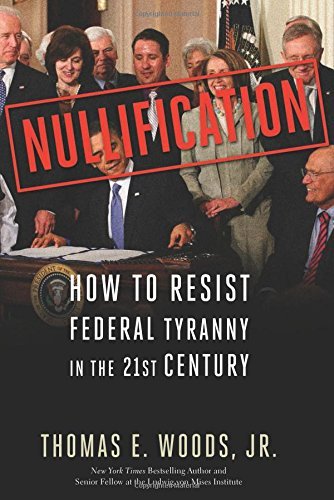
Citizens across the country are fed up with the politicians in Washington telling us how to live our lives—and then sticking us with the bill. But what can we do? Actually, we can just say “no.” As New York Times bestselling author Thomas E. Woods, Jr., explains, “nullification” allows states to reject unconstitutional federal laws. For many tea partiers nationwide, nullification is rapidly becoming the only way to stop an over-reaching government drunk on power. From privacy to national healthcare, Woods shows how this growing and popular movement is sweeping across America and empowering states to take action against Obama’s socialist policies and big-government agenda.

Guess what? The Indians didn’t save the Pilgrims from starvation by teaching them to grow corn. Thomas Jefferson thought states’ rights—an idea reviled today—were even more important than the Constitution’s checks and balances. The “Wild” West was more peaceful and a lot safer than most modern cities. And the biggest scandal of the Clinton years didn’t involve an intern in a blue dress.Surprised? Don’t be. In America, where history is riddled with misrepresentations, misunderstandings, and flat-out lies about the people and events that have shaped the nation, there’s the history you know and then there’s the truth.In 33 Questions About American History You’re Not Supposed to Ask , Thomas E. Woods Jr., the New York Times bestselling author of The Politically Incorrect Guide to American History , sets the record straight with a provocative look at the hidden truths about our nation’s history—the ones that have been buried because they’re too politically incorrect to discuss. Woods draws on real scholarship—as opposed to the myths, platitudes, and slogans so many other “history” books are based on—to ask and answer tough questions about American history, - Did the Founding Fathers support immigration?- Was the Civil War all about slavery?- Did the Framers really look to the American Indians as the model for the U.S. political system?- Was the U.S. Constitution meant to be a “living, breathing” document—and does it grant the federal government wide latitude to operateas it pleases?- Did Bill Clinton actually stop a genocide, as we’re told?You’d never know it from the history that’s been handed down to us, but the answer to all those questions is no.Woods’s eye-opening exploration reveals how much has been whitewashed from the historical record, overlooked, and skewed beyond recognition. More informative than your last U.S. history class, 33 Questions About American History You’re Not Supposed to Ask will have you wondering just how much about your nation’s past you haven’t been told.

Rollback: Repealing Big Government Before the Coming Fiscal Collapse
by Thomas E. Woods Jr.
Rating: 4.3 ⭐
In his blockbuster new book, Rollback, New York Times bestselling author Thomas E. Woods, Jr. offers the first critical analysis of the 2010 mid-term elections and answer the #1 question on conservatives’ minds: How do we roll back the liberal policies and big government programs that Obama/Pelosi/Reid rushed through Congress before the mid-terms? From getting rid of wasteful and inefficient federal agencies to abolishing the income tax to repealing health care reform and all of Obama’s "green” policies, Woods outlines a bold plan for dramatically overhauling the government and restoring our Founding Fathers vision for America.

Who Killed the Constitution?: The Fate of American Liberty from World War I to George W. Bush
by Thomas E. Woods Jr.
Rating: 4.1 ⭐
“Let no more be heard of confidence in man, but bind him down from mischief by the chains of the Constitution.”—Thomas JeffersonThe United States Constitution—the bedrock of our country, the foundation of our federal republic—is . . . dead. You won’t hear that from the politicians who endlessly pay lip service to the Constitution. It’s the dirty little secret that bestselling authors Thomas E. Woods Jr. and Kevin R. C. Gutzman expose in this provocative new book. The fact is that government officials—Democrats and Republicans, presidents, judges, and congresses alike—long ago rejected the idea that the Constitution possesses a fixed meaning limiting the U.S. government’s power. In case you’ve forgotten, this idea was not a minor aspect of the Constitution; it was the document’s very purpose. Woods and Gutzman round up the suspects responsible for the death of the government the Founding Fathers designed. Going right to the scenes of the crimes, they dissect twelve of the most egregious assaults on the Constitution—some virtually unknown. In chronicling this “dirty dozen,” the authors show that the attacks began long before presidents declared preemptive wars, congresses built pork-barrel bridges to nowhere, and Supreme Court justices began to behave as our supreme legislators. In Who Killed the Constitution? Woods and Gutzman• REVEAL the federal government’s “great gold robbery”—the flagrant assault on the Constitution you never heard about in history class• DESTROY the phony case for presidential war power• EXPOSE how the federal government has actively discriminated to end . . . discrimination• TEAR DOWN the “wall of separation” between church and state—an invention that completely contradicts what the Constitution says• DARE to touch the “third rail of American jurisprudence,” Brown v. Board of Education—showing why a government decision that seems “right” isn’t necessarily constitutionalNever shying away from controversy, Woods and Gutzman reveal an unsettling but unavoidable truth: now that the federal government has broken free of the Constitution’s chains, government officials are restrained by little more than their sense of what they can get away with.Who Killed the Constitution? is a rallying cry for Americans outraged by government run amok and a warning to take heed before we lose the liberties we are truly entitled to.

Diary of a Psychosis: How Public Health Disgraced Itself During COVID Mania
by Thomas E. Woods Jr.
Rating: 4.5 ⭐
FOREWORD BY JAY BHATTACHARYA, MD, PHDYou remember the some locations did better than others on Covid because those places followed the rules, and others foolishly ignored them. Covid spread was your fault, you science hater!There is precisely zero evidence behind any aspect of this morality play, which is demolished by this book.Diary of a Psychosis is different from all other books on it traces the development of the government response as it happened, bit by bit, and subjects it to relentless did any of it do any good?It thereby preserves some of the crucial day-to-day details that other chronicles have forgotten. And it's those little details of the bizarre behavior of those years that, presented together, preserve for the reader the full horror of the madness of those dark days.The more people know the information in this book, the harder it will be for the ruling classes to do this to us again.

The Church and the Market: A Catholic Defense of the Free Economy
by Thomas E. Woods Jr.
Rating: 4.3 ⭐
In The Church and the Market: A Catholic Defense of the Free Economy, Thomas E. Woods Jr. makes a vigorous argument in favor of the market economy from a Catholic perspective. Filling a lapse in the debate on the role of religious thought in economic theory, Woods's uncompromising position, informed by the history of Catholic economic thought, shows that the long-seen contradiction between Catholic faith and support for the market economy does not exist. With attention to detail on almost all aspects of the free market, from the Federal Reserve System and inflation to antitrust legislation and labor issues, this book provides essential background for anyone interested in balancing issues of social conscience with modern economic principles.

Here's what's inside this FREE book by New York Times bestselling author Tom Woods:- Bernie's arguments on trade, inequality, the minimum wage, and more -- answered.- Why "capitalism" isn't the problem with American health care.- Why we certainly don't want to be like Sweden or Denmark.- The hard numbers on renewable energy (they're not pretty). And much more!

New York Times bestselling author and historian Thomas E. Woods and guests from his daily podcast respond to such common objections to libertarianism as "What would the poor do without government schools?", "How can you favor legalizing drugs?", "Wouldn’t banks be unstable in a free market?", and "Why don’t you want to ban sweatshops?"

Examines what is now called the Extraordinary Form of the Mass (the old Latin Mass) in light of Pope Benedict XVI's motu proprio allowing any priest to say it and any parishioner to request and attend it. Looks at what happened to the old Mass after Vatican II, why the Novus Ordo was so divisive and what led the Pope to issue his motu proprio.

Your Facebook Friends Are Wrong About the Lockdown: A Non-Hysteric's Guide to COVID-19
by Thomas E. Woods Jr.
Rating: 4.1 ⭐
"You just want people to die!"That's the intellectually stimulating response you get when you question the wisdom of shutting society down.In fact, the consequences of the lockdowns are so devastating and far-reaching that all decent and humane people must reject the whole strategy.In this free eBook, New York Times bestselling author Tom Woods sets the record straight, and leaves the case for the lockdowns in tatters.source: WrongAboutLockdown.com===If you prefer to resume living a normal life, or not see everything you’ve spent decades building destroyed in a matter of months, or want your children not to waste away in a world of computer screens and “virtual playdates,” you must want to kill people’s grandmothers. This is how discourse is actually being carried on in the United States right now.Then I noticed that good news from around the world was greeted almost angrily. I have never seen anything like this. It’s as if some people need the virus to be an apocalyptic problem. Like most people, I am all for taking reasonable precautions and keeping an eye on the virus. And we can discuss which methods more effectively preserve biological life. But is mere biological life worth living? This is not a question the “experts” are qualified to answer. If people’s hopes, dreams, and aspirations are all dashed for an indefinite period of time, which purveyors of the present strategy almost flippantly propose, is that really living? “Probably no large gatherings for a long time,” we’ve been told. How long? And what are “large gatherings”? Oh, just concerts, theater, lectures, church, sporting events, the arts in general – pretty much everything that makes life worth living. The kind of “life” all this portends has a pulse, yes, but no soul.

The Church Confronts Modernity: Catholic Intellectuals and the Progressive Era
by Thomas E. Woods Jr.
Rating: 4.0 ⭐
As the twentieth century opened, American intellectuals grew increasingly sympathetic to Pragmatism and empirical methods in the social sciences. The Progressive program as a whole―in the form of Pragmatism, education, modern sociology, and nationalism―seemed to be in agreement on one everything was in flux. The dogma and "absolute truth" of the Church were archaisms, unsuited to modern American citizenship and at odds with the new public philosophy being forged by such intellectuals as John Dewey, William James, and the New Republic magazine. Catholics saw this new public philosophy as at least partly an attack on them.Focusing on the Catholic intellectual critique of modernity during the period immediately before and after the turn of the twentieth century, this provocative and original book examines how the Catholic Church attempted to retain its identity in an age of pluralism. It shows a Church fundamentally united on major issues―quite unlike the present-day Catholic Church, which has been the site of a low-intensity civil war since the close of the Second Vatican Council in 1965. Defenders of the faith opposed James, Dewey, and other representatives of Pragmatism as it played out in ethics, education, and nationalism. Their goals were to found an economic and political philosophy based on natural law, to appropriate what good they could find in Progressivism to the benefit of the Church, and to make America a Catholic country.The Church Confronts Modernity explores how the decidedly nonpluralistic institution of Christianity responded to an increasingly pluralistic intellectual environment. In a culture whose chief value was pluralism, they insisted on the uniqueness of the Church and the need for making value judgments based on what they considered a sound philosophy of humanity. In neither capitulating to the new creed nor retreating into a self-righteous isolation, American Catholic intellectuals thus laid the groundwork for a half-century of intellectual vitality.

Troubled by rampant injustice and inequality, many conscientious Christians advocate radical economic reforms. Distributism, a program that traces its popularity to Catholic writers Hilaire Belloc and G.K. Chesterton, promotes the widespread ownership of property by tempering the market with guilds or similar associations.

Our Enemy, The Fed: Fact and Fiction About the Federal Reserve and the U.S. Economy
by Thomas E. Woods Jr.
Rating: 4.3 ⭐
Your Facebook friends think "capitalism" and "greed" caused the 2008 crisis.Not a word about the Federal Reserve.When you bring it up, they either have no idea what you're talking about, or they plead: "Why, these are our wise economic planners, citizen!"But when these wise economic planners go wrong -- as in 2008 -- the free market, rather than the planners themselves, gets the blame.Criticize the Fed, and you get told: the Fed has stabilized the economy! Why, you don't want panics like we had in the 19th century, do you?This free eBook by New York Times bestselling author Tom Woods (Ph.D., Columbia University) turns this argument on its head. If it's genuine prosperity we want, then the Fed is the villain, not our savior.
This is a free e-book. It has interesting information about a complex important topic.

Public schooling is as close to the official religion of the United States as any institution is ever likely to be. And if you are reading this eBook, you are likely a heretic.Education Without the State brings together some of the conversations I’ve had about education on the Tom Woods Show, my weekday podcast. Five days a week I cover some aspect of libertarianism. That gives me a treasure trove of material on which I can draw to assemble eBooks like this one.

I send out a daily email called The Tom Woods Letter. This book is a collection of the juiciest issues.I'm a libertarian, of course, and for a long time I directed the bulk of my criticism at neoconservatives. Sure, I well understood the problems of the left, but I thought they were almost too obvious to dwell on. The neocons were more insidious, and in my view weren't subject to nearly enough scrutiny.Over the past year or so, though, with the growth in SJW (Social Justice Warrior) activity, I've been vividly reminded of the evils of the left. Nearly all of what you read in this book, therefore, is directed at leftism.The left's moral priorities completely baffle me. They're far angrier at someone who holds politically incorrect views than they are at someone who launches an unnecessary war. And for all their pretensions to being antiwar, they seem more committed to making sure transgender folks can become fighter pilots. It's weird.

5 Paths to an Online Income: Specific Advice From my Years of Experience
by Thomas E. Woods Jr.
Rating: 4.0 ⭐
CURIOUS ABOUT ONLINE EARNING OPPORTUNITIES BUT DON'T KNOW WHERE TO START?Look over my shoulder as I show you how I've been doing it for yearsForget the get-rich-quick schemes. There are far too many legitimate and effective ways to earn money online for anyone to waste time with the scammers.5 Paths to an Online Income, my free eBook, shows you step by step the exact things I've done to make a comfortable living for my family online, with all the freedom and flexibility that entails. If you've followed me over the years, you know I do in fact do all the things in this book. And now I'm showing you how.Too many eBooks about online earning offer little more than vague generalities. This one takes you step by step through specifics, including:- How to make money as an affiliate (earning commissions from selling other people's products) -- this one is huge - How to be a successful freelancer online - How to self-publish a book - How to earn money blogging -- yes, it can be done - How to start -- and monetize -- a podcast

In 2009 I published Meltdown, which was essentially the first book on the financial crisis to be published by anyone. I wrote it because I could already see the conventional wisdom beginning to ossify: why, the economy blew up in 2008 because of capitalism run amok! This is as wrong as wrong can be, yet it has reached the status of something "everyone knows." The 2008 crisis has passed into history, but it remains important for us to study and understand. As F. A. Hayek observed, if we don't get history right, then we'll get the present dreadfully wrong.In Meltdown I placed a great deal of emphasis on the role of the Federal Reserve System in causing the housing bubble and the subsequent bust. This eBook, which is focused on the more specific question of whether "deregulation caused the crisis, spends less time on the Fed, so for that aspect of the question I refer the reader to Meltdown.Now on to the myth busting.

Start Your Blog Or Website Today: Resources for People Too Busy to Learn Programming or Design
by Thomas E. Woods Jr.
Rating: 4.0 ⭐
I'll bet some of you have been meaning to start a website or blog, but you haven't gotten around to it. I've been saying virtually everyone should have a blog -- there's no better way to improve as a writer than to practice writing short pieces for an audience. What's more, you can get your opinions out there, or establish yourself as an authority on something, or just pursue your labor of love.Well, I've prepared a short, free eBook that can get you past the thinking-about-it stage and into the getting-it-done stage. It's called "Start Your Blog or Website Today: Resources for People Too Busy to Learn Programming or Design."In this FREE eBook, you'll learn:- how to get your brand new blog up and running in just five minutes- how to start your website without learning design or programming- ways I've earned money online - how to get people coming back to your site again and again - how I created a free eBook to maximize signups to my list - how I'm able to tell an audience, "Text LIBERTY to 33444 to get my free eBook and weekly letter" -discount codes to help you save money along the way and much more

Some people (foolishly, of course) claim that war "helps the economy." We've done a good job demolishing that one.What most people don't realize is that the military state, and its constant preparations for war, is also a drag on the economy -- in ways you've probably never thought of.In this free eBook, New York Times bestselling author Tom Woods explains precisely how the Pentagon deforms the economy and makes us poorer.

Profesor Thomas E. Woods Jr jest historykiem, wykładowcą prestiżowych uczelni amerykańskich, znanym promotorem idei wolnego rynku i swobód obywatelskich. Jego teksty naukowe i publicystyczne ukazują się w najważniejszych amerykańskich pismach, m.in.: "American Historicial Review", "Christian Science Monitor", "Investorss Business Daily", "The Freeman", "Independent Review" oraz "The American Conservative". Publikował również w "Catholic Social Science Review", a przez 11 lat współredagował "The Latin Mass Magazine", stając się jednym z niekwestionowanych przywódców ruchu Tradycji Katolickiej w USA. W 2006 roku zdobył prestiżową Nagrodę Templetona (Templeton Enterprise Awards), za swoją książkę pt. "Kościół a wolny rynek. Katolicka obrona wolnej gospodarki". W niniejszym tomie, wydanym specjalnie z okazji wizyty Profesora w Polsce - na zaproszenie Fundacji PAFERE - ukazuje się obszerny wybór jego publicystyki.
