
Thomas E. Ricks
Thomas Edwin "Tom" Ricks (born September 25, 1955) is an American journalist who writes on defense topics. He is a Pulitzer Prize-winning former reporter for the Wall Street Journal and Washington Post. He writes a blog at ForeignPolicy.com and is a member of the Center for a New American Security, a defense policy think tank. He lectures widely to the military and is a member of Harvard University's Senior Advisory Council on the Project on U.S. Civil-Military Relations. He has reported on military activities in Somalia, Haiti, Korea, Bosnia, Kosovo, Macedonia, Kuwait, Turkey, Afghanistan, and Iraq. Ricks is author of five books: the bestselling Fiasco: The American Military Adventure In Iraq (2006), its follow-up The Gamble: General David Petraeus and the American Military Adventure in Iraq, 2006-2008 (2009), The Generals: American Military Command from World War II to Today (2012), the novel A Soldier's Duty (2001), and Making the Corps (1997) (from wikipedia)
16 Books Written

Waging a Good War: A Military History of the Civil Rights Movement, 1954-1968
by Thomas E. Ricks
Rating: 4.5 ⭐
• 2 recommendations ❤️
#1 New York Times bestselling author and Pulitzer Prize winner Thomas E. Ricks offers a new take on the Civil Rights Movement, stressing its unexpected use of military strategy and its lessons for nonviolent resistance around the world.“Ricks does a tremendous job of putting the reader inside the hearts and souls of the young men and women who risked so much to change America . . . Riveting.” ―Charles Kaiser, The GuardianIn Waging a Good War , the bestselling author Thomas E. Ricks offers a fresh perspective on America’s greatest moral revolution―the civil rights movement of the 1950s and 1960s―and its legacy today. While the Movement has become synonymous with Martin Luther King, Jr.’s ethos of nonviolence, Ricks, a Pulitzer Prize–winning war reporter, draws on his deep knowledge of tactics and strategy to advance a surprising but revelatory idea: the greatest victories for Black Americans of the past century were won not by idealism alone, but by paying attention to recruiting, training, discipline, and organization―the hallmarks of any successful military campaign.An engaging storyteller, Ricks deftly narrates the Movement’s triumphs and defeats. He follows King and other key figures from Montgomery to Memphis, demonstrating that Gandhian nonviolence was a philosophy of active, not passive, resistance―involving the bold and sustained confrontation of the Movement’s adversaries, both on the ground and in the court of public opinion. While bringing legends such as Fannie Lou Hamer and John Lewis into new focus, Ricks also highlights lesser-known figures who played critical roles in fashioning nonviolence into an effective tool―the activists James Lawson, James Bevel, Diane Nash, and Septima Clark foremost among them. He also offers a new understanding of the Movement’s later difficulties as internal disputes and white backlash intensified. Rich with fresh interpretations of familiar events and overlooked aspects of America’s civil rights struggle, Waging a Good War is an indispensable addition to the literature of racial justice and social change―and one that offers vital lessons for our own time.

This is the Story of The American Military Adventure in Iraq. The Heart of the story Fiasco has to tell, which has never been told before, is that of a Military occupation whose leaders failed to see a blooming insurgency for what it was and as a result lead their soldiers in such a way that the insurgency became inevitable.

From #1 New York Times bestselling author Thomas E. Ricks, a dual biography of Winston Churchill and George Orwell, whose farsighted vision and inspired action preserved democracy from the threats of authoritarianism, from the left and right alike.Both George Orwell and Winston Churchill came close to death in the mid-1930s—Orwell shot in the neck in a trench line in the Spanish Civil War, and Churchill struck by a car in New York City. If they'd died then, history would scarcely remember them. At the time, Churchill was a politician on the outs, his loyalty to his class and party suspect. Orwell was a mildly successful novelist, to put it generously. No one would have predicted that by the end of the 20th century they would be considered two of the most important people in British history for having the vision and courage to campaign tirelessly, in words and deeds, against the totalitarian threat from both the left and the right. In a crucial moment, they responded first by seeking the facts of the matter, seeing through the lies and obfuscations, and then acting on their beliefs. Together, to an extent not sufficiently appreciated, they kept the West's compass set toward freedom as its due north.It's not easy to recall now how lonely a position both men once occupied. By the late 1930s, democracy was discredited in many circles and authoritarian rulers were everywhere in the ascent. There were some who decried the scourge of communism, but saw in Hitler and Mussolini men we could do business with, if not in fact saviors. And there were others who saw the Nazi and fascist threat as malign but tended to view communism as the path to salvation. Churchill and Orwell, on the other hand, had the foresight to see clearly that the issue was human freedom—that whatever its coloration, a government that denied its people basic freedoms was a totalitarian menace and had to be resisted.In the end, Churchill and Orwell proved their age's necessary men. The glorious climax of Churchill and Orwell is the work they both did in the decade of the 1940s to triumph over freedom's enemies. And though Churchill played the larger role in the defeat of Hitler and the Axis, Orwell's reckoning with the menace of authoritarian rule in Animal Farm and 1984 would define the stakes of the Cold War for its 50-year course and continues to give inspiration to fighters for freedom to this day. Taken together, in Thomas E. Ricks' masterful hands, their lives are a beautiful testament to the power of moral conviction and to the courage it can take to stay true to it, through thick and thin.
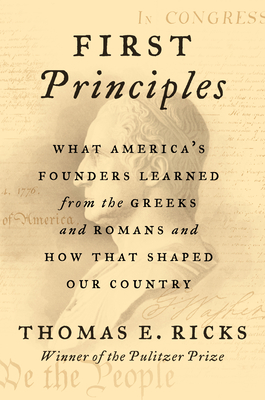
First Principles: What America's Founders Learned from the Greeks and Romans and How That Shaped Our Country
by Thomas E. Ricks
Rating: 4.0 ⭐
New York Times BestsellerEditors' Choice —New York Times Book Review"Ricks knocks it out of the park with this jewel of a book. On every page I learned something new. Read it every night if you want to restore your faith in our country." —James Mattis, General, U.S. Marines (ret.) & 26th Secretary of Defense The Pulitzer Prize-winning journalist and #1 New York Times bestselling author offers a revelatory new book about the founding fathers, examining their educations and, in particular, their devotion to the ancient Greek and Roman classics—and how that influence would shape their ideals and the new American nation.On the morning after the 2016 presidential election, Thomas Ricks awoke with a few questions on his mind: What kind of nation did we now have? Is it what was designed or intended by the nation’s founders? Trying to get as close to the source as he could, Ricks decided to go back and read the philosophy and literature that shaped the founders’ thinking, and the letters they wrote to each other debating these crucial works—among them the Iliad, Plutarch’s Lives, and the works of Xenophon, Epicurus, Aristotle, Cato, and Cicero. For though much attention has been paid the influence of English political philosophers, like John Locke, closer to their own era, the founders were far more immersed in the literature of the ancient world.The first four American presidents came to their classical knowledge differently. Washington absorbed it mainly from the elite culture of his day; Adams from the laws and rhetoric of Rome; Jefferson immersed himself in classical philosophy, especially Epicureanism; and Madison, both a groundbreaking researcher and a deft politician, spent years studying the ancient world like a political scientist. Each of their experiences, and distinctive learning, played an essential role in the formation of the United States. In examining how and what they studied, looking at them in the unusual light of the classical world, Ricks is able to draw arresting and fresh portraits of men we thought we knew.First Principles follows these four members of the Revolutionary generation from their youths to their adult lives, as they grappled with questions of independence, and forming and keeping a new nation. In doing so, Ricks interprets not only the effect of the ancient world on each man, and how that shaped our constitution and government, but offers startling new insights into these legendary leaders.

From the #1 bestselling author of Fiasco and The Gamble , an epic history of the decline of American military leadership from World War II to IraqHistory has been kind to the American generals of World War II—Marshall, Eisenhower, Patton, and Bradley—and less kind to the generals of the wars that followed. In The Generals , Thomas E. Ricks sets out to explain why that is. In part it is the story of a widening gulf between performance and accountability. During the Second World War, scores of American generals were relieved of command simply for not being good enough. Today, as one American colonel said bitterly during the Iraq War, “As matters stand now, a private who loses a rifle suffers far greater consequences than a general who loses a war.” In The Generals we meet great leaders and suspect ones, generals who rose to the occasion and those who failed themselves and their soldiers. Marshall and Eisenhower cast long shadows over this story, as does the less familiar Marine General O. P. Smith, whose fighting retreat from the Chinese onslaught into Korea in the winter of 1950 snatched a kind of victory from the jaws of annihilation.But Korea also showed the first signs of an army leadership culture that neither punished mediocrity nor particularly rewarded daring. In the Vietnam War, the problem grew worse until, finally, American military leadership bottomed out. The My Lai massacre, Ricks shows us, is the emblematic event of this dark chapter of our history. In the wake of Vietnam a battle for the soul of the U.S. Army was waged with impressive success. It became a transformed institution, reinvigorated from the bottom up. But if the body was highly toned, its head still suffered from familiar problems, resulting in tactically savvy but strategically obtuse leadership that would win battles but end wars badly from the first Iraq War of 1990 through to the present.Ricks has made a close study of America’s military leaders for three decades, and in his hands this story resounds with larger meaning: about the transmission of values, about strategic thinking, and about the difference between an organization that learns and one that fails.
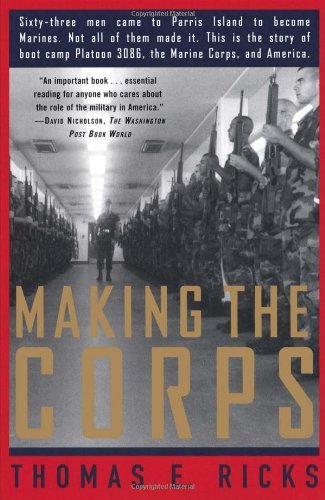
The bestselling, compelling insider’s account of the Marine Corps from the lives of the men of Platoon 3086—their training at Parris Island, their fierce camaraderie, and the unique code of honor that defines them.The United States Marine Corps, with its proud tradition of excellence in combat, its hallowed rituals, and its unbending code of honor, is part of the fabric of American myth. Making the Corps visits the front lines of boot camp in Parris Island, South Carolina. Here, old values are stripped away and new Marine Corps values are forged. Bestselling author Thomas E. Ricks follows these men from their hometowns, through boot camp, and into their first year as Marines. As three fierce drill instructors fight a battle for the hearts and minds of this unforgettable group of young men, a larger picture emerges, brilliantly painted, of the growing gulf that divides the military from the rest of America.
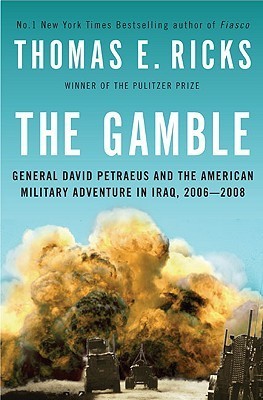
The Gamble: General David Petraeus and the American Military Adventure in Iraq, 2006-2008
by Thomas E. Ricks
Rating: 4.0 ⭐
The Gamble tells the gripping story of how, in the Iraq War's darkest hour, an unlikely collection of dissident generals, scholars and foreign experts pulled the country back from the edge of the abyss and saved countless lives. This was 'the surge', and at its helm was General David Petraeus, now acknowledged as one of the greatest military tacticians in US history. Based on unprecedented access to the entire chain of army command - at the top and fighting on the ground - this is the definitive account of one of America's biggest ever military gambles, and what it means for the future of Iraq.

An FBI agent finds himself in the insular world of a fishing village on the Maine coast where the rules are different—sometimes lethally so.After his wife and two children are killed in a car crash, Ryan Tapia starts a new life in Maine. But his first case there is a puzzling oddball—the corpse of a fisherman washes up on federal land, while the man’s boat drifts into waters that are part of an Indian reservation. Ryan quickly learns the nuances of Maine life as he delves into two illicit coastal hard drugs and rare fish. Many of the locals are happy to see that particular fisherman dead. What’s more, they are not shy about noting that Ryan must have screwed up pretty badly to be posted to such a remote location as Bangor, Maine. Undaunted, Ryan works to understand the unforgiving way of life on Liberty Island, where people live by an older, harsher code. Adrift on a sailboat one day, he encounters a man from the Malpense tribe, living as a hermit on a remote island, who witnessed something that fateful day. In his riveting crime debut, New York Times bestselling author Thomas E. Ricks turns his literary talents to land he knows deeply, from working in the Maine woods and trapping lobsters year-round. Everyone Knows But You is a rich and dynamic crime novel that brings a unique part of America to vivid, thrilling life.
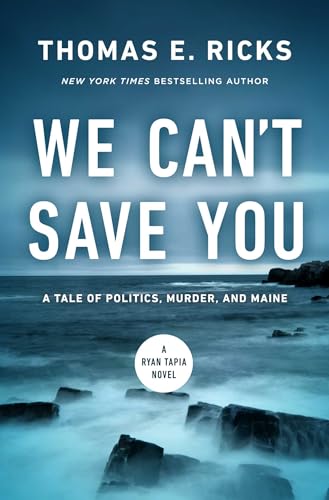
Thomas E. Ricks, author of five New York Times bestsellers, combines his deep knowledge of Maine with his years of experience covering U.S. military operations to craft a powerful tale of politics and mayhem in this riveting crime novel. When a group of young Native Americans launches a series of protests against climate change and its effects on the waters and woods of Maine, veteran FBI agent Ryan Tapia, is assigned to monitor the movement. The protestors, who become determined to split away from American society, are led by “Peeled Paul” Soco, an Malpense hermit who played a key role in one of Tapia's previous investigations. When the marchers begin making camps on the lawns of luxurious summer mansions along the Maine coast, they win national media attention—and the wrath of a reactionary president. Tapia soon finds himself torn. He wants to do right by Soco and the protestors, but his bosses at the Bureau are eager to please a president itching to crack down on them. Growing increasingly sympathetic to the protestors and their cause, he tells them about a possible refuge—a secret CIA base hidden away in the depths of the Maine woods on the Canadian border. Enraged by the protestor's actions, the White House sends a U.S. Army unit to track down the protestors on their stealth march through the evergreen forests. Meanwhile, Tapia’s bosses, vexed and embarrassed, fire him and threaten arrest. Undaunted, Tapia snowmobiles through the wilderness on a wintry night to warn the Indian protestors of the impending attack. Building to a dizzying, wind-whipped climax, We Can't Save You establishes Ryan Tapia as one of the most compelling and nuanced investigators in crime fiction.

From one of America’s most esteemed military correspondents and the author of Making the Corps comes a “briskly paced, engrossing tale” ( Los Angeles Times ) about a brutal brushfire war in Afghanistan that sets off a titanic struggle for the soul of the twenty-first-century American military.

In this timely supplement to his 2009 New York Times bestseller The Gamble, Thomas E. Ricks reveals how the Iraq war has changed and how the national conversation has shifted since the time of writing. This Penguin eSpecial offers new insights into the difficulties likely to confront the United States in Iraq in the coming year, from our most trusted expert on the conflict there.

The History and Success of American Generals
by Thomas E. Ricks
The Nimitz Lecture series hosts a wide array of distinguished and nationally recognized public figures who are scholars, professional military persons, or government officials--either foreign or domestic--for a series of lectures on national security affairs. This volume examines why U.S. generals were more successful in World War II than in Korea, Vietnam, or Afganhistan and looks specifically at General O.P. Smith as a case study.

Circle and Square
by Thomas E. Ricks
Two shapes, who are friends, struggle with their relationship--until new shapes show up and want to be their friends, too!

Harleys in the Chrome Group
by Thomas E. Ricks
This is a great book of motorcycles,chrome, and people who ride and love them. This little book has the cyles with all the "Toys"

GAMBLE THE AIR EXP
by Thomas E. Ricks

Big Money, Small Town: A Ryan Tapia Novel
by Thomas E. Ricks
In this gripping and dynamic thriller, former FBI agent Ryan Tapia finds himself ensnared in the complex interplay of power, politics, environmental degradation, and resistance at a cobalt mine in Maine.While building his career as a private investigator in the Maine countryside, Ryan Tapia takes the case of Dr. Ed Healey, a local physician suffering from an acute case of cobalt poisoning. A mine has recently opened in Pushaw county, extracting the valuable minerals needed for batteries in electronic devices and electric cars. But a deadly “Fan” of poison is seeping out . . . But there are dark legacies in Pushaw that go back to the Salem witch trials and the community on nearby Witch Island, where the Thornfoot family is turning the tables and exploiting the vagaries of modern life for their own ends. On the cusp of finding his personal happiness once more, Tapia is caught in the middle of this vortex of manipulation and money, desperation and deceit. Neighbors turn on one another and the people of Pushaw risk becoming as deadly to one another as the industrial poison simmering beneath the surface. In Big Money, Small Town, Thomas Ricks has crafted a nuanced and enthralling novel that challenges our understandings of money and influence in every facet of modern life.