
Thomas Cathcart
Thomas Cathcart and Daniel Klein wrote the bestselling Plato and a Platypus Walk into a Bar: Understanding Philosophy Through Jokes, which will be translated into more than a dozen languages. Not bad for a couple of philosophy majors from Harvard who tried on various careers after graduation. Tom worked with street gangs in Chicago, doctors at Blue Cross and Blue Shield, and dropped in and out of divinity schools. Dan has written jokes for various comedians, including Flip Wilson and Lily Tomlin. Tom lives on Cape Cod with his wife. Dan lives in the Berkshires with his wife. Together, they are also authors of the politically incorrect book of daily affirmations Macho Meditations."
11 Books Written

Plato and a Platypus Walk Into a Bar: Understanding Philosophy Through Jokes
by Thomas Cathcart
Rating: 3.8 ⭐
• 2 recommendations ❤️
Here's a lively, hilarious, not-so-reverent crash course through the great philosophical traditions, schools, concepts, and thinkers. Its Philosophy 101 for everyone who knows not to take all this heavy stuff too seriously. Some of the Big Ideas are Existentialism (what do Hegel and Bette Midler have in common?), Philosophy of Language (how to express what its like being stranded on a desert island with Halle Berry), Feminist Philosophy (why, in the end, a man is always a man), and much more. Finallyit all makes sense!
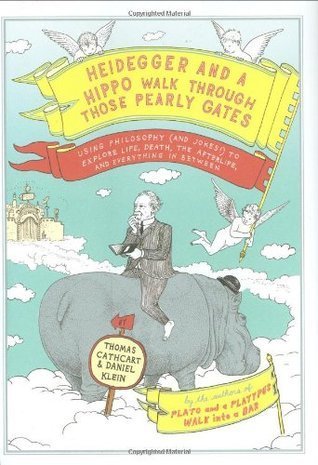
Heidegger and a Hippo Walk Through Those Pearly Gates: Using Philosophy (and Jokes!) to Explore Life, Death, the Afterlife, and Everything in Between
by Thomas Cathcart
Rating: 3.6 ⭐
From the authors of the bestselling Plato and a Platypus Walk into a Bar , an uproarious new book on the meaning of death (and life, too)The new book by the bestselling authors of Plato and a Platypus Walk Into a Bar is a hilarious take on the philosophy, theology, and psychology of mortality and immortality. That is, Death. The authors pry open the coffin lid on this one, looking at the Big D and also its prequel, Life, and its sequel, the Hereafter. Philosophers such as Schopenhauer, Nietzsche, Camus, and Sartre have been wrestling with the meaning of death for as long as they have been wrestling with the meaning of life. Fortunately, humorists have been keeping pace with the major thinkers by creating gags about dying. Death’s funny that way—it gets everybody’s attention.Death has gotten a bad rap. It’s time to take a closer look at what the Deep Thinkers have to say on the subject, and there are no better guides than Cathcart and Klein.
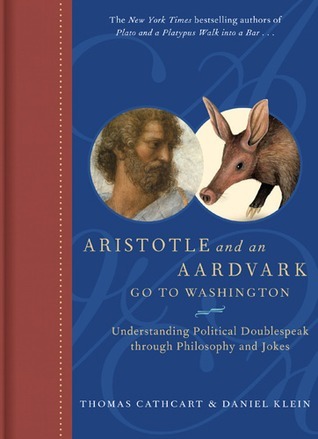
Thomas Cathcart and Daniel Klein, authors of the national bestseller Plato and a Platypus Walk into a Bar, aren’t falling for any election year claptrap—and they don’t want their readers to either! In Aristotle and an Aardvark Go to Washington, our two favorite philosopher-comedians return just in time to save us from the double-speak, flim-flam, and alternate reality of politics in America.Deploying jokes and cartoon as well as the occasional insight from Aristotle and his peers, Cathcart and Klein explain what politicos are up to when they state: “The absence of evidence is not the evidence of absence.” (Donald Rumsfeld), “It depends on what the meaning of the word ‘is’ is.” (Bill Clinton), or even, “We hold these truths to be self-evident…” (Thomas Jefferson, et al).Drawing from the pronouncements of everyone from Caesar to Condoleeza Rice, Genghis Kahn to Hillary Clinton, and Adolf Hitler to Al Sharpton. Cathcart and Klein help us learn to identify tricks such as “The Texas Sharpshooter Fallacy” (non causa pro causa) and the “The Fallacy Fallacy” (argumentum and logicam). Aristotle and an Aardvark is for anyone who ever felt like the politicos and pundits were speaking Greek. At least Cathcart and Klein provide the Latin name for it (raudatio publica)!
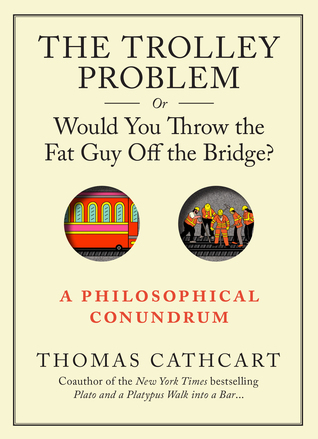
The Trolley Problem, or Would You Throw the Fat Guy Off the Bridge?: A Philosophical Conundrum
by Thomas Cathcart
Rating: 3.8 ⭐
A trolley is careering out of control. Up ahead are five workers; on a spur to the right stands a lone individual. You, a bystander, happen to be standing next to a switch that could divert the trolley, which would save the five, but sacrifice the one—do you pull it? Or say you’re watching from an overpass. The only way to save the workers is to drop a heavy object in the trolley’s path. And you’re standing next to a really fat man…. This ethical conundrum—based on British philosopher Philippa Foot’s 1967 thought experiment—has inspired decades of lively argument around the world. Now Thomas Cathcart, coauthor of the New York Times bestseller Plato and a Platypus Walk into a Bar , brings his sharp intelligence, quirky humor, and gift for popularizing serious ideas to “the trolley problem.” Framing the issue as a possible crime that is to be tried in the Court of Public Opinion, Cathcart explores philosophy and ethics, intuition and logic. Along the way he makes connections to the Utilitarianism of Jeremy Bentham, Kant’s limits of reason, St. Thomas Aquinas’s fascinating Principle of Double Effect, and more. Read with an open mind, this provocative book will challenge your deepest held notions of right and wrong. Would you divert the trolley? Kill one to save five? Would you throw the fat man off the bridge?
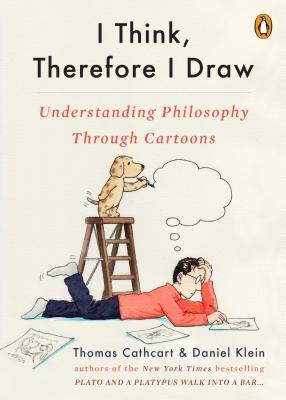
A hilarious new exploration of philosophy through cartoons from the duo who brought you the New York Times bestselling Plato and a Platypus Walk Into A Bar...Thomas Cathcart and Daniel Klien have been thinking deep thoughts and writing jokes for decades, and now they are here to help us understand Philosophy through cartoons, and cartoons through Philosophy. Covering topics as diverse as religion, gender, knowledge, morality, and the meaning of life (or the lack thereof), I Think, Therefore I Draw gives a thorough introduction to all of the major debates in philosophy through history and the present. And since they explain with the help of a selection of some of the smartest cartoonists working today, you'll breeze through these weighty topics as you guffaw and slap your knee.Cathcart and Klein's Plato and a Platypus Walk into a Bar... and Heidegger and a Hippo Walk Through Those Pearly Gates have been a favorite of philosophers and non-philosophers alike for years. Packed with dozens of witty cartoons and loaded with profound philosophical insight, I Think, Therefore I Draw will delight readers and leave them enlightened.

“Two books, one box, and the Meaning of Life. What more do you want?” Take a tour de farce through philosophy and politics with the New York Times bestseller Plato and a Platypus Walk Into a Bar and the hilarious election-year follow-up Aristotle and an Aardvark Go To Washington . Now presented in a special value hardcover boxed set!

There Is No God and Mary Is His Mother: Rediscovering Religionless Christianity
by Thomas Cathcart
Rating: 3.2 ⭐
Is the Western world really post-Christian, or does Christianity simply need a reinterpretation? What did Dietrich Bonhoeffer mean by "religionless Christianity"? Is it passé? Or was it perhaps ahead of its time? In an era of dramatically increased religious pluralism and the emergence of large numbers of people identifying as "spiritual but not religious," so-called "religionless Christianity" can speak to those who find both biblicism and "belief-based" religion irrelevant. In this personal, witty, and timely book, New York Times bestselling author Thomas Cathcart takes readers on a journey into belief and unbelief and leads them through to the other side. Drawing from deep philosophical and theological wells, There Is No God and Mary Is His Mother demonstrates the meaningfulness of being a Christian in a secular age. Cathcart shows that, even absent traditional theological formulas and doctrines, Christianity can be a credible, meaningful, and practical means of negotiating worldly existence and experience. For Christians, There Is No God and Mary Is His Mother offers encouragement. For ex-Christians, it presents a different way of being a Christian than the one they've rejected. For atheists, it shows how Christianity can be an ally in affirming the here and now. Religionless Christianity is possible and desirable wherever and whenever it awakens personal and social transformation.

An uproariously funny daily inspirational guide for manly men. Ralph and Reggie—two regular, blue-collar buds from Boston—offer one-a-day mcnuggets of affirmation, inspiration, manly wisdom and earth-shaking epiphanies from the end of the bar on the inner issues that truly matter—everything from sex to sports to sex to imported vs. domestic to sex to the meaning of life.

MEDIA MADE MAGAZINE-Movers and Shakers Special Edition V2 Issue 5
by Thomas Cathcart

Aristotle and an Aardvark Go to Washington
by Thomas Cathcart

Art Direction + Editorial Design (Abrams Studio) by Thomas Cathcart (1-Oct-2007) Paperback
by Thomas Cathcart