
Theodore Roosevelt
Theodore Roosevelt, Jr., also known as T.R., and to the public (but never to friends and family) as Teddy, was the twenty-sixth President of the United States, and a leader of the Republican Party and of the Progressive Movement. He fathered Alice Roosevelt Longworth, a daughter. He became the youngest President in United States history at the age of 42. He served in many roles including Governor of New York, historian, naturalist, explorer, author, and soldier (posthumously awarded the Medal of Honor in 2001 for his role at the Battle of San Juan Hill in the Spanish-American War). Roosevelt is most famous for his personality: his energy, his vast range of interests and achievements, his model of masculinity, and his "cowboy" persona.
35 Books Written

By the 26th President of the United States, popularly known as T.R. or Teddy. He was also a widely respected historian, naturalist and explorer of the Amazon Basin; his 35 books include works on outdoor life, natural history, U.S. Western and political history, an autobiography and a host of other topics.

In 1898, as the Spanish-American War was escalating, Theodore Roosevelt assembled an improbable regiment of Ivy Leaguers, cowboys, Native Americans, African-Americans, and Western Territory land speculators. This group of men, which became known as the Rough Riders, trained for four weeks in the Texas desert and then set sail for Cuba. Over the course of the summer, Roosevelt's Rough Riders fought valiantly, and sometimes recklessly, in the Cuban foothills, incurring casualties at a far greater rate than the Spanish.Roosevelt kept a detailed diary from the time he left Washington until his triumphant return from Cuba later that year. The Rough Riders was published to instant acclaim in 1899. Robust in its style and mesmerizing in its account of battle, it is exhilarating, illuminating, and utterly essential reading for every armchair historian and at-home general.The books in the Modern Library War series have been chosen by series editor Caleb Carr according to the significance of their subject matter, their contribution to the field of military history, and their literary merit.

Teddy Roosevelt lived a full and accomplished life and shared many of his beliefs in this book, in which he tells how to live life to its most productive and fullest.

After losing his bid for the United States Presidency as a third party candidate, Theodore Roosevelt decided to take on the most dangerous adventure left on earth. He and his son, Kermit, accepted Candido Mariano da Silva Rondon's invitation to help him plot the course of the River of Doubt. The River of Doubt could just as easily have been named the River of Death. The river's rapids turned out to be much more ferocious than expected, cannibalistic natives dogged the group through most of the journey, and Murphy was their constant companion. The expedition lost men, supplies, and canoes. At one point, Roosevelt contracted a flesh-eating bacteria and became so weak that he urged his son to leave him behind to die. Ultimately Teddy and Kermit emerged from the wilderness triumphantly. Here is their story in Theodore Roosevelt's own words.

The Naval War of 1812 is a historical non-fiction book written by Theodore Roosevelt, the 26th President of the United States. The book was first published in 1882 and provides a detailed account of the naval battles and events that took place during the War of 1812 between the United States and Great Britain.The book is divided into three parts, each one covering a different aspect of the war. The first part covers the background and causes of the war, including the issues of impressment and trade restrictions. The second part focuses on the naval battles that took place on the Great Lakes and the Atlantic Ocean, including the famous battles of Lake Erie and the USS Constitution's victory over HMS Guerriere. The third and final part of the book covers the end of the war and its aftermath, including the Treaty of Ghent and the impact of the war on American naval power.Throughout the book, Roosevelt provides detailed descriptions of the ships, commanders, and tactics used in each battle. He also offers his own analysis and opinions on the strategies employed by both sides. The book is considered a classic work on the subject and is still widely read and studied today.Overall, The Naval War of 1812 is a comprehensive and informative account of the naval aspect of the War of 1812, written by one of America's most famous presidents and historians.Chesapeake Bay became the principal scene of their operations; it was there that their main body collected, and their greatest efforts were made. In it a number of line-of-battle ships, frigates, sloops, and cutters had been collected, and early in the season Admiral Sir John Warren and Rear Admiral Cockburn arrived to take command. The latter made numerous descents on the coast, and frequently came into contact with the local militia, who generally fled after a couple of volleys. These expeditions did not accomplish much, beyond burning the houses and driving off the live-stock of the farmers along shore, and destroying a few small towns--one of them, Hampton, being sacked with revolting brutality.This scarce antiquarian book is a facsimile reprint of the old original and may contain some imperfections such as library marks and notations. Because we believe this work is culturally important, we have made it available as part of our commitment for protecting, preserving, and promoting the world's literature in affordable, high quality, modern editions, that are true to their original work.

African Game Trails: An Account of the African Wanderings of an American Hunter-Naturalist
by Theodore Roosevelt
Rating: 4.0 ⭐
The twenty-sixth president of the United States was also a world-renowned hunter, conservationist, soldier, and scholar. African Game Trails includes stories about President Theodore Roosevelt adventures throughout East Africa, Belgian Congo, Mombassa, Khartoum, and more.In 1908 Teddy took a long safari holiday in East Africa with his son Kermit. His account of this adventure is as remarkably fresh today as it was when these adventures on the veldt were first published. Roosevelt describes the excitement of the chase, the people he met (including such famous hunters as Cunninghame and Selous), and flora and fauna he collected in the name of science. Long out of print, this classic is one of the preeminent examples of Africana, and belongs on every collector's shelf.Travelling the world to hunt and kill dozens of animals including Lions, Rhinos, Giraffes, Leopards, Buffalo, Hippos and Elephants. This fascinating story about Teddy Roosevelt's hunting adventures are not for the squeamish or the politically correct as it includes heart-pounding stories.
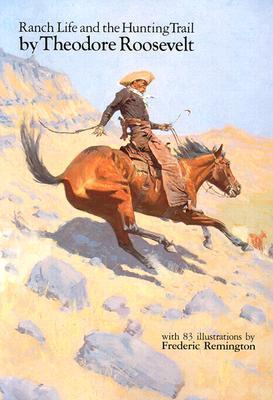
No American president has been closer to the working life of the West than Theodore Roosevelt. From 1884 to 1886 he built up his ranch on the Little Missouri in Dakota Territory, accepting the inevitable toil and hardships. He met the unique characters of the Bad Lands—mountain men, degenerate buffalo hunters, Indians, and cowboys—and observed their changes as the West became more populated. Ranch Life and the Hunting Trail describes Roosevelt's routine labor and extraordinary adventures, including a stint as a deputy sheriff pursuing three horse thieves through the cold of winter. Whether recounting stories of cowboy fights or describing his hunting of elk, antelope, and bear, the book expresses his lifelong delight in physical hardihood and tests of nerve.

Darling Ethel: Of course you remember the story of the little prairie girl. I always associate it with you. Well, again and again on this trip we would pass through prairie villages-bleak and lonely-with all the people in from miles about to see me. Among them were dozens of young girls, often pretty, and as far as I could see much more happy than the heroine of the story. One of them shook hands with me, and then, after much whispering, said: "We want to shake hands with the guard " The "guard" proved to be Roly, who was very swell in his uniform, and whom they evidently thought much more attractive than the President...-from "Prairie Girls"Remembered today for his expansive personality and grand sense of adventure, Theodore Roosevelt--politician and soldier, naturalist and historian--was also a devoted, doting father and husband. This beautiful selection of the letters he wrote to his children over the courses of their lives, as well as a few written to other correspondents about the children, reveal a man deeply in love with his family and with the joys of fatherhood. The tales of Christmases at the White House and whistle-stop tours through the American countryside offer a cozy glimpse into one of the greatest American presidencies... and Roosevelt's tenderness with his sons and daughters--as he treats them as friends, confidantes, and equals--creates a warm and intimate portrait of one of the great American characters.Also available from Cosimo Classics: Roosevelt's A Book-Lover's Holidays in the Open, America and the World War, Through the Brazilian Wilderness and Papers on Natural History, Ranch Life and the Hunting Trail, The Strenuous Life: Essays and Addresses, and Historic Towns: New YorkOF INTEREST TO: Roosevelt fans, readers of autobiography, students of the American presidencyAmerican icon THEODORE ROOSEVELT (1858-1919) was 26th President of the United States, serving from 1901 to 1909, and the first American to win a Nobel Prize, in 1906, when he was awarded the Peace Prize for mediating the Russo-Japanese War. He is the author of 35 books.

Written during his days as a ranchman in the Dakota Bad Lands, these two wilderness tales by Theodore Roosevelt endure today as part of the classic folklore of the West. The narratives provide vivid portraits of the land as well as the people and animals that inhabited it, underscoring Roosevelt's abiding concerns as a naturalist.Originally published in 1885, Hunting Trips of a Ranchman chronicles Roosevelt's adventures tracking a twelve-hundred-pound grizzly bear in the pine forests of the Bighorn Mountains. Yet some of the best sections are those in which Roosevelt muses on the beauty of the Bad Lands and the simple pleasures of ranch life. The British Spectator said the book "could claim an honorable place on the same shelf as Walton's Compleat Angler ." The Wilderness Hunter , which came out in 1893, remains perhaps the most detailed account of the grizzly bear ever recorded. Introduction by Stephen E. Ambrose.

Many of the earliest books, particularly those dating back to the 1900s and before, are now extremely scarce and increasingly expensive. We are republishing these classic works in affordable, high quality, modern editions, using the original text and artwork.

Captures the thrill of the chase as Theodore Roosevelt recounts his North-American hunting adventures.


"Citizenship in a Republic" is the title of a speech delivered by President Theodore Roosevelt, at the Sorbonne in Paris, France on April 23, 1910. It popularized the phrase "The Man in the Arena", as a person who is heavily involved in a situation that requires courage, skill, or tenacity, as opposed to someone sitting on the side-lines and watching: “It is not the critic who counts; not the man who points out how the strong man stumbles, or where the doer of deeds could have done them better. The credit belongs to the man who is actually in the arena, whose face is marred by dust and sweat and blood; who strives valiantly; who errs, who comes short again and again, because there is no effort without error and shortcoming; but who does actually strive to do the deeds …” Presidents John F. Kennedy an Richard Nixon quoted from "The Man in the Arena" in their speeches.

By the time he was twenty-five the future president of the United States was already a published author. From The Naval War of 1812 through his four-volume Winning of the West, Teddy Roosevelt proved himself a master historian...but one must not make the mistake of labeling him a stodgy academic.The future president was also a great outdoorsman, with such works as Ranch Life and the Hunting Trail and African Game Trails capturing his rough and ready lifestyle.Theodore Roosevelt was part Francis Parkman, part Lowell Thomas, and one hundred percent spirit of America and master of the printed page.The Man in the Arena collects self-contained excerpts from some of his greatest works, including such revealing memoirs as The Rough Riders, the Autobiography, and Through the Brazilian Wilderness, in an effort to capture the many aspects of a great American who was indeed larger than life and his own best "Boswell."

Hunting Trips of a Ranchman: Sketches of Sport on the Northern Cattle Plains
by Theodore Roosevelt
Rating: 4.2 ⭐
Theodore Roosevelt was one of most remarkable presidents to have ever lived. From stalking wild geese to hunting elks to protecting the camp from a grizzly bear, this book documents his life out in the plains and mountains of the Midwest. Never one to shy away from an adventure, Roosevelt’s record of life as a ranchman and hunter has endured today as part of the classic folklore of the West. This book focuses on Roosevelt’s life as a hunter in the American frontier where he had gone to overcome the grief of losing his mother and wife in 1884. Vivid descriptions of the scenery, flora and fauna as well as people that populated the frontier abound within this book that covers Roosevelt’s life throughout 1885. It is on these plains that Roosevelt began to understand the true American spirit and allowed him to forge his life as a politician. “Could claim an honourable place on the same shelf as Walton’s Compleat Angler." The Spectator “Part memoir, part travelogue, part nature essay, and part sociological study … a peculiarly comprehensive documentary of life on the Plains, encompassing wildlife survey, cowboy culture, geographical study, and environmental exigency.” Love of the Land, Zachary Michael Jack Hunting Trips of a Ranchman provides a fascinating insight into the early life of one of the United States’ most interesting presidents. Theodore Roosevelt was an American statesman, author, explore, soldier, naturalist and reformer who served as the 26th President of the United States. He died in 1919.

The Winning of the West, Volume One: From the Alleghanies to the Mississippi, 1769-1776
by Theodore Roosevelt
Rating: 4.1 ⭐
First part of what was considered Roosevelt's most important book. The narrative traced the origin of a new "race" of Americans to frontier conditions in the 18th century.

This unprecedented volume brings together 367 letters written by Theodore Roosevelt between 1881 and 1919. Also included are four speeches, best known by the phrases they introduced into the language: "The Strenuous Life" (1899); "The Big Stick" (1901); "The Man in the Arena" (1910); and "The New Nationalism" (1910).

• The complete four-volume set of American President Theodore Roosevelt’s The Winning of The West (Presidential Edition) is bound together in this Kindle edition. The 1,000-plus page book includes: Volume One From the Alleghanies to the Mississippi, 1769-1776 Volume Two From the Alleghanies to the Mississippi, 1777-1783 Volume Three The founding of the Trans=Alleghany Commonwealths 1784-1790 Volume Four Louisiana and the Northwest, 1791-1807 About The Author Theodore "T.R." Roosevelt, Jr. (1858 –1919) was an American politician, author, naturalist, soldier, explorer, and historian who served as the 26th President of the United States. He was a leader of the Republican Party (GOP) and founder of the Progressive Party insurgency of 1912. He is known for his exuberant personality, range of interests and achievements, and his leadership of the Progressive Movement, as well as his "cowboy" persona and robust masculinity. Born into a wealthy family in New York City, Roosevelt was a sickly child who suffered from asthma. To overcome his physical weakness, he embraced a strenuous life. He was home-schooled and became an eager student of nature. He attended Harvard College where he studied biology, boxed, and developed an interest in naval affairs. He quickly entered politics, determined to become a member of the ruling class. In 1881 he was elected to the New York State Assembly, where he became a leader of the reform faction of the GOP. His book The Naval War of 1812 (1882) established him as a learned historian and writer. When his first wife Alice died two days after giving birth in February 1884 (and his mother died the same day in the same house), he was heartbroken and in despair; Roosevelt temporarily left politics and became a cattle rancher in the Dakotas. When blizzards destroyed his herd, he returned to New York City politics, running and losing a race for mayor. In the 1890s he took vigorous charge of the city police as New York City Police Commissioner. He was the GOP nominee for Vice President with William McKinley, campaigning successfully against radicalism and for prosperity, national honor, imperialism (regarding the Philippines), high tariffs and the gold standard. Roosevelt became President after McKinley was assassinated in 1901. He was inaugurated at age 42, the youngest person to become president.

The Winning of the West, Volume 2: From the Alleghanies to the Mississippi, 1777-1783
by Theodore Roosevelt
Rating: 4.2 ⭐
After political defeats and the loss of half his capital in a ranching venture in North Dakota, Theodore Roosevelt began writing his ambitious history of the conquest of the American West in 1888. He projected a sweeping drama, well documented and filled with Americans fighting Indian confederacies north and south while dealing with the machinations of the British, French, and Spanish and their sympathizers. Roosevelt wanted to show how backwoodsmen such as Daniel Boone and Simon Kenton, followed by hardy pioneer settlers, gave the United States eventual claim to land west of the Alleghanies. Heroism and treachery among both the whites and the Indians can be seen in his rapidly shifting story of a people on the move. By force and by treaty the new nation was established in the East, and when the explorers and settlers pushed against the Mississippi, everything west of the river was considered part of that nation. Roosevelt's second volume further illustrates his contention that no regular army could have prevailed in the border fighting, only toughened individual frontiersmen. Here Boone is seen again, as well as George Rogers Clark, the conqueror of the Illinois country. Roosevelt shows how the American Revolution helped the newly independent peoples take over the West.

President, environmentalist, big game hunter, war hero, trust buster, father of the modern American navy, builder of the Panama Canal, Nobel Peace Prize winner‚Äö Teddy Roosevelt remains a commanding and intriguing figure of American history. This handsome book includes approximately 100 of the most memorable quotes of this prolific writer and orator.

Reformer, rancher, conservationist, hunter, historian, police commissioner, soldier, the youngest man ever to serve as president of the United States--no other American public figure has led as vigorous and varied a life as Theodore Roosevelt. This volume brings together two fascinating autobiographical works. The Rough Riders (1899) is the story of the 1st U.S. Volunteer Cavalry, the regiment Roosevelt led to enduring fame during the Spanish-American War. With his characteristic elan Roosevelt recounts how "these grim hunters of the mountains, these wild rough riders of the plains," endured the heat, hunger, rain, mud, and malaria of the Cuban campaign to charge triumphantly up the San Juan Heights during the Battle of Santiago. In An Autobiography (1913), Roosevelt describes his life in politics and the emergence of his progressive ideas. Surveying his career as a state legislator, civil service reformer, New York City police commissioner, assistant secretary of the navy, governor, and president, Roosevelt writes of his battles against corruption, his role in establishing America as a world power, his passionate commitment to conservation, and his growing conviction that only a strong national government and an energetic presidency could protect the public against the rapacious greed of modern corporations.

The Winning of the West, Volume 4: Louisiana and the Northwest, 1791-1807
by Theodore Roosevelt
Rating: 4.0 ⭐
This book was converted from its physical edition to the digital format by a community of volunteers. You may find it for free on the web. Purchase of the Kindle edition includes wireless delivery.

The Winning of the West, Volume 3: The Founding of the Trans-Alleghany Commonwealths, 1784-1790
by Theodore Roosevelt
Rating: 4.2 ⭐
The material used herein is that mentioned in the preface to the first volume, save that I have also drawn freely on the Draper Manuscripts, in the Library of the State Historical Society of Wisconsin, at Madison. For the privilege of examining these valuable manuscripts I am indebted to the generous courtesy of the State Librarian, Mr. Reuben Gold Thwaites; I take this opportunity of extending to him my hearty thanks.

Stories of hunting big game in the West and notes about animals pursued and observed.

This is a reproduction of a book published before 1923. This book may have occasional imperfections such as missing or blurred pages, poor pictures, errant marks, etc. that were either part of the original artifact, or were introduced by the scanning process. We believe this work is culturally important, and despite the imperfections, have elected to bring it back into print as part of our continuing commitment to the preservation of printed works worldwide. We appreciate your understanding of the imperfections in the preservation process, and hope you enjoy this valuable book.

This book is a biography by Theodore Roosevelt about the English 'Lord Protector', Oliver Cromwell. Within this text, Roosevelt explains how Cromwell's rise to power was the first modern struggle for social, religious, and political freedom. Firstly he analyses the increasingly incompetent and tyrannical actions of the Stuart kings. Then, Roosevelt explores the Long Parliament and how Charles I's despotism forced the Members of Parliament to revolt. He then studies Charles's executed and, Finally, Roosevelt examines Cromwell's capacity as a soldier and leader in the Scotch and Irish campaigns. This biography examines a fascinating character who was pivotal in period of English history that has influenced the development of England as a world power. Roosevelt writes with a passion and wit alien to the work of many current historians, making this book an enjoyable must-read for students of history. This book is republished with a new biography of the author.

Unless we are thorough going Americans and unless our patriotism is part of the very fiber of our being, we can neither serve God nor take our own part. Fear God and Take Your Own Part is a collection of articles Theodore Roosevelt wrote, largely for Metropolitan Magazine, some six years after he left the presidency. The title is another way of saying that a nation must have the power and will for self-sacrifice as well as the power and will for self-protection. In the book, Roosevelt, who also wrote extensively on the outdoors, vigorously sets forth the "principles of true Americanism" that still reverberate throughout the nation today. THEODORE ROOSEVELT (1858-1919) was a heroic figure who served as the 26th president of the United States. During his eight years in office, he steered the United States more actively into world politics. Teddy "Rough Riders" Roosevelt was also a military leader, a prosecutor, a naturalist, and a prolific writer.

Theodore Roosevelt on Bravery: Lessons from the Most Courageous Leader of the Twentieth Century
by Theodore Roosevelt
Rating: 4.1 ⭐
Teddy Roosevelt is the only president in history to deliver a ninety-minute speech directly after being shot in the chest. He’s a Nobel Prize recipient, a Harvard graduate, and he was the youngest President in history to be inaugurated into office. Roosevelt’s force took America by storm in the early twentieth century, and he is regarded as one of the finest leaders ever to take office.His wisdom even earned him a spot in Mount Rushmore, which has immortalized him along with George Washington, Thomas Jefferson, and Abraham Lincoln.As a sickly child, Roosevelt was home-schooled his entire life until enrolling at Harvard University, where he studied biology. A year after graduating, he began his political career as the New York City police commissioner, and later as a member of the New York State Assembly, where he led the reform division of the GOP. In the time since his presidency, Roosevelt’s bravery has inspired generations of Americans.“A man who is good enough to shed his blood for the country is good enough to be given a square deal afterwards.”Skyhorse Publishing, as well as our Arcade imprint, are proud to publish a broad range of books for readers interested in history--books about World War II, the Third Reich, Hitler and his henchmen, the JFK assassination, conspiracies, the American Civil War, the American Revolution, gladiators, Vikings, ancient Rome, medieval times, the old West, and much more. While not every title we publish becomes a New York Times bestseller or a national bestseller, we are committed to books on subjects that are sometimes overlooked and to authors whose work might not otherwise find a home.

Book by Roosevelt, Theodore, Roosevelt, Kermit

Gathers selections from speeches and essays

Rare history sample in great condition!!

The Hunting and Exploring Adventures of Theodore Roosevelt ; Told in His Own Words
by Theodore Roosevelt
Rating: 3.3 ⭐
Most of all Theodore Roosevelt is remember for his exuberance, and never did he display more enthusiasm than in his love for the outdoors. Throughout his life, he was a keen observer of nature, and an indefatigable hunter. He was also, to quote Times magazine, "the liveliest writer who ever held the presidency". This combination makes "The Hunting and Exploring Adventure of Theodore Roosevelt" - told in his own words taken from the best of his writings - classic among books on the outdoors. The front flap description.
The Letters of Theodore Roosevelt, The Years of Preparation: Vol. 1, 1868-1898. Vol. 2, 1898-1900
by Theodore Roosevelt
Rating: 3.0 ⭐
The Letters of Theodore Roosevelt: Volume IV, The Square Deal, 1903-1905
by Theodore Roosevelt
The Letters of Theodore Roosevelt constitute a major contribution to the field of American history and literature. At the same time, they present an autobiography of matchless candor and vitality. They are at once a mine of information for the historian, a case study in astute and vigorous political leadership, and a delight to the general reader. All the letters needed to reveal Roosevelt's thought and action in his public and private life are included, with appropriate editorial comment; and each is printed in its entirety.In the letters of 1901–1905, Roosevelt consolidates his position as President and party leader, settles the coal strike, deals with the politics of the Panama Canal, expands the Navy, extends the sphere of American interests abroad, achieves the Presidency in his own right, and works with the Russians and the Japanese to make the Peace in Portsmouth.

The Hunting and Exploring Adventures of Theodore Roosevelt: Told in His Own Words
by Theodore Roosevelt
Learn about T. Roosevelt's adventures told by himself