
Theodor W. Adorno
Theodor Wiesengrund Adorno was one of the most important philosophers and social critics in Germany after World War II. Although less well known among anglophone philosophers than his contemporary Hans-Georg Gadamer, Adorno had even greater influence on scholars and intellectuals in postwar Germany. In the 1960s he was the most prominent challenger to both Sir Karl Popper's philosophy of science and Martin Heidegger's philosophy of existence. Jürgen Habermas, Germany's foremost social philosopher after 1970, was Adorno's student and assistant. The scope of Adorno's influence stems from the interdisciplinary character of his research and of the Frankfurt School to which he belonged. It also stems from the thoroughness with which he examined Western philosophical traditions, especially from Kant onward, and the radicalness to his critique of contemporary Western society. He was a seminal social philosopher and a leading member of the first generation of Critical Theory. Unreliable translations hampered the initial reception of Adorno's published work in English speaking countries. Since the 1990s, however, better translations have appeared, along with newly translated lectures and other posthumous works that are still being published. These materials not only facilitate an emerging assessment of his work in epistemology and ethics but also strengthen an already advanced reception of his work in aesthetics and cultural theory.
30 Books Written

Minima Moralia: Reflections on a Damaged Life
by Theodor W. Adorno
Rating: 4.0 ⭐
• 2 recommendations ❤️
Adorno's literary and philosophical masterpiece, built from aphorisms and reflections.A reflection on everyday existence in the 'sphere of consumption of late Capitalism', this work is Adorno's literary and philosophical masterpiece. Built from aphorisms and reflections, he shifts in register from personal experience to the most general theoretical problems.

The creation of the Frankfurt School of critical theory in the 1920s saw the birth of some of the most exciting and challenging writings of the twentieth century. It is out of this background that the great critic Theodor Adorno emerged. His finest essays are collected here, offering the reader unparalleled insights into Adorno's thoughts on culture. He argued that the culture industry commodified and standardized all art. In turn this suffocated individuality and destroyed critical thinking. At the time, Adorno was accused of everything from overreaction to deranged hysteria by his many detractors. In today's world, where even the least cynical of consumers is aware of the influence of the media, Adorno's work takes on a more immediate significance. The Culture Industry is an unrivalled indictment of the banality of mass culture.

Perhaps the most important aesthetics of the twentieth century appears here newly translated, in English that is for the first time faithful to the intricately demanding language of the original German. The culmination of a lifetime of aesthetic investigation, Aesthetic Theory is Theodor W. Adorno's magnum opus, the clarifying lens through which the whole of his work is best viewed, providing a framework within which his other major writings cohere.

No other country and no other period has produced a tradition of major aesthetic debate to compare with that which unfolded in German culture from the 1930s to the 1950s. In Aesthetics and Politics the key texts of the great Marxist controversies over literature and art during these years are assembled in a single volume. They do not form a disparate collection but a continuous, interlinked debate between thinkers who have become giants of twentieth-century intellectual history.Discussing expressionism / Ernst BlochRealism in the balance / Georg LukacsAgainst Georg Luckacs / Bertolt BrechtConversations with Brecht / Walter BenjaminLetters to Walter Benjamin / Theodor AdornoReply / Walter BenjaminReconciliation under duress ; Commitment / Theodor AdornoReflections in conclusion / Fredric Jameson
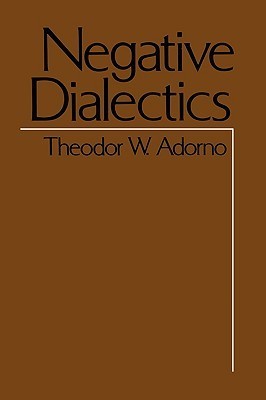
The major work and Adorno's culminating achievement. Negative Dialectics is a critique of the philosophies of Kant, Hegel, and Heidegger, and a visionary elaboration of the author's own vision of dialectics.

Am 6. April 1967 hielt Theodor W. Adorno auf Einladung des Verbands Sozialistischer Studenten Österreichs an der Wiener Universität einen Vortrag, der aus heutiger Sicht nicht nur von historischem Interesse ist. Vor dem Hintergrund des Aufstiegs der NPD, die bereits in den ersten beiden Jahren nach ihrer Gründung im November 1964 erstaunliche Wahlerfolge einfahren konnte, analysiert Adorno Ziele, Mittel und Taktiken des neuen Rechtsradikalismus dieser Zeit, kontrastiert ihn mit dem »alten« Nazi-Faschismus und fragt insbesondere nach den Gründen für den Zuspruch, den rechtsextreme Bewegungen damals – 20 Jahre nach Kriegsende – bei Teilen der bundesdeutschen Bevölkerung fanden.Vieles hat sich seitdem geändert, manches aber ist gleich geblieben oder heute, 50 Jahre später, wieder da. Und so liest sich Aspekte des neuen Rechtsradikalismus wie eine Flaschenpost an die Zukunft, deren Wert für unsere Gegenwart Volker Weiß in seinem Nachwort herausarbeitet.

Theodor Adorno was no stranger to controversy. In 'The Jargon of Authenticity' he gives full expression to his hostility to the language employed by certain existentialist thinkers such as Martin Heidegger.

Bringing together the findings of psychoanalysis and social science, this book grew out of an urgent commitment to study the origins of anti-Semitism in the aftermath of Hitler's Germany. First published in 1951, it was greeted as a monumental study blazing new trails in the investigation of prejudice. As offshoots of ethnocentrism, anti-semitism and fascism cast new and dark shadows on the world, the topic again demands study and social action. "The Authoritarian Personality" remains an important document for our time.

A publishing event—a revealing new translation of Theodor Adorno's manifesto of musical radicalism?In 1947 Theodor W. Adorno, one of the seminal European philosophers of the postwar years, announced his return after exile in the United States to a devastated Europe by writing Philosophy of New Music . Intensely polemical from its first publication, every aspect of this work was met with extreme reactions, from stark dismissal to outrage. Even Schoenberg reviled it. Despite the controversy, Philosophy of New Music became highly regarded and widely read among musicians, scholars, and social philosophers. Marking a major turning point in his musicological philosophy, Adorno located a critique of musical reproduction as internal to composition itself, rather than as a matter of the reproduction of musical performance. Consisting of two distinct essays, “Schoenberg and Progress” and “Stravinsky and Reaction,” this work poses the musical extremes in which Adorno perceived the struggle for the cultural future of between human emancipation and barbarism, between the compositional techniques and achievements of Schoenberg and Stravinsky. In this completely new translation—presented along with an extensive introduction by distinguished translator Robert Hullot-Kentor— Philosophy of New Music emerges as an indispensable key to the whole of Adorno's illustrious and influential oeuvre.

The Stars Down to Earth and Other Essays on the Irrational in Culture
by Theodor W. Adorno
Rating: 3.8 ⭐
A collection of key articles on the irrational in mass culture, relevant to the understanding of phenomena such as astrology and New Age cults, the power of neo-fascist propaganda and the psychological basis of popular culture, showing Theodor Adorno at his brilliant and maddening best.

Theodor Adorno and Max Horkheimer wrote the central text of “critical theory”, Dialectic of Enlightenment , a measured critique of the Enlightenment reason that, they argued, had resulted in fascism and totalitarianism.Towards a New Manifesto shows the two philosophers in a uniquely spirited and free-flowing exchange of ideas. This book is a record of their discussions over three weeks in the spring of 1956, recorded with a view to the production of a contemporary version of The Communist Manifesto . A philosophical jam-session in which the two thinkers improvise freely, often wildly, on central themes of their work—theory and practice, labor and leisure, domination and freedom—in a political register found nowhere else in their writing. Amid a careening flux of arguments, aphorisms and asides, in which the trenchant alternates with the reckless, the playful with the ingenuous, positions are swapped and contradictions unheeded, without any compulsion for consistency.A thrilling example of philosophy in action and a compelling map of a possible passage to a new world.

Theodor W. Adorno (1903-1969), one of the principal figures associated with the Frankfurt School, wrote extensively on culture, modernity, aesthetics, literature, and—more than any other subject—music. To this day, Adorno remains the single most influential contributor to the development of qualitative musical sociology which, together with his nuanced intertextual readings of musical works, gives him broad claim as a continuing force in the study of music. This long-awaited collection of twenty-seven essays represents the full range of Adorno's music writing. Nearly half of the essays appear in English for the first time; all of the essays are fully annotated; and the previously translated essays have been corrected and missing text restored, making this volume the definitive resource on Adorno's musical thought.

Erziehung zur Mündigkeit: Vorträge und Gespräche mit Hellmut Becker 1959 - 1969
by Theodor W. Adorno
Rating: 4.3 ⭐
Erziehung zur Mündigkeit sammelt Vorträge und Gespräche, die von 1959 bis 1969 im Hessischen Rundfunk gesendet wurden. Sie zeigen einen »anderen« Adorno als die meisten seiner Bücher: er wirkt unmittelbare kommunikativer, verständlicher; er leitet den Leser – wie einst den Hörer zum Mitdenken und schließlich zum Selbstdenken an."Was bedeutet: Aufarbeitung der Vergangenheit. (1959). Philosophie und Lehrer. (1962). Fernsehen und Bildung. (1963). Tabus über dem Lehrbuch. (1965). Erziehung nach Auschwitz. (1966). Erziehung - wozu?. (1966). Erziehung zur Entbarbarisierung. (1968). Erziehung zur Mündigkeit. (1969).

This short masterwork in twentieth-century philosophy provides both a major reinterpretation of Hegel and insight into the evolution of Adorno's critical theory. The first study focuses on the relationship of reason, the individual, and society in Hegel, defending him against the criticism that he was merely an apologist for bourgeois society. The second examines the experiential content of Hegel's idealism, considering the notion of experience in relation to immediacy, empirical reality, science, and society. The third study, "Skoteinos, " is an unusual and fascinating essay in which Adorno lays out his thoughts on understanding Hegel. In his reflections, which spring from his experience of teaching at the Goethe University in Frankfurt, questions of textual and philosophical interpretation are intertwined.

The eminent critic and scholar analyzes a wide range of topics, including Aldous Huxley's Brave New World, jazz, the music of Bach, and museums
Introduction to Sociology distills decades of distinguished work in sociology by one of this century's most influential thinkers in the areas of social theory, philosophy, aesthetics, and music. It consists of a course of seventeen lectures given by Theodor W. Adorno in May-July 1968, the last lecture series before his death in 1969. Captured by tape recorder (which Adorno called "the fingerprint of the living mind"), these lectures present a somewhat different, and more accessible, Adorno from the one who composed the faultlessly articulated and almost forbiddingly perfect prose of the works published in his lifetime. Here we can follow Adorno's thought in the process of formation (he spoke from brief notes), endowed with the spontaneity and energy of the spoken word. The lectures form an ideal introduction to Adorno's work, acclimatizing the reader to the greater density of thought and language of his classic texts. Delivered at the time of the "positivist dispute" in sociology, Adorno defends the position of the "Frankfurt School" against criticism from mainstream positivist sociologists. He sets out a conception of sociology as a discipline going beyond the compilation and interpretation of empirical facts, its truth being inseparable from the essential structure of society itself. Adorno sees sociology not as one academic discipline among others, but as an over-arching discipline that impinges on all aspects of social life. Tracing the history of the discipline and insisting that the historical context is constitutive of sociology itself, Adorno addresses a wide range of topics, the purpose of studying sociology; the relation of sociology and politics; the influence of Saint-Simon, Comte, Durkheim, Weber, Marx, and Freud; the contributions of ethnology and anthropology; the relationship of method to subject matter; the problems of quantitative analysis; the fetishization of science; and the separation of sociology and social philosophy.
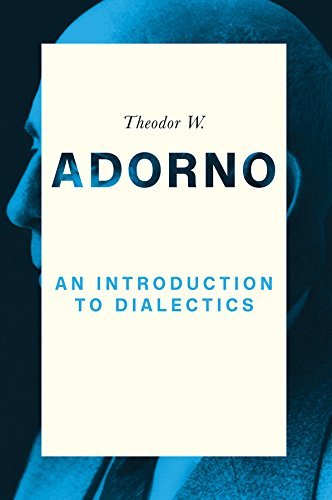
This volume comprises Adorno's first lectures specifically dedicated to the subject of the dialectic, a concept which has been key to philosophical debate since classical times. While discussing connections with Plato and Kant, Adorno concentrates on the most systematic development of the dialectic in Hegel's philosophy, and its relationship to Marx, as well as elaborating his own conception of dialectical thinking as a critical response to this tradition.Delivered in the summer semester of 1958, these lectures allow Adorno to explore and probe the significant difficulties and challenges this way of thinking posed within the cultural and intellectual context of the post-war period. In this connection he develops the thesis of a complementary relationship between positivist or functionalist approaches, particularly in the social sciences, as well as calling for the renewal of ontological and metaphysical modes of thought which attempt to transcend the abstractness of modern social experience by appeal to regressive philosophical categories. While providing an account of many central themes of Hegelian thought, he also alludes to a whole range of other philosophical, literary and artistic figures of central importance to his conception of critical theory, notably Walter Benjamin and the idea of a constellation of concepts as the model for an 'open or fractured dialectic' beyond the constraints of method and system.These lectures are seasoned with lively anecdotes and personal recollections which allow the reader to glimpse what has been described as the 'workshop' of Adorno's thought. As such, they provide an ideal entry point for all students and scholars in the humanities and social sciences who are interested in Adorno's work as well as those seeking to understand the nature of dialectical thinking.

Kant is a pivotal thinker in Adorno's intellectual world. Although he wrote monographs on Hegel, Husserl, and Kierkegaard, the closest Adorno came to an extended discussion of Kant are two lecture courses, one concentrating on the Critique of Pure Reason and the other on the Critique of Practical Reason . This new volume by Adorno comprises his lectures on the former. Adorno attempts to make Kant's thought comprehensible to students by focusing on what he regards as problematic aspects of Kant's philosophy. Adorno examines Kant's dualism and what he calls the Kantian "block": the contradictions arising from Kant's resistance to the idealism that his successors—Fichte, Schelling, and Hegel—saw as the inevitable outcome of his ideas. These lectures also provide an accessible introduction to and rationale for Adorno's own philosophy as expounded in Negative Dialectics and his other major writings. Adorno's view of Kant forms an integral part of his own philosophy, since he argues that the way out of the Kantian contradictions is to show the necessity of the dialectical thinking that Kant himself spurned. This in turn enables Adorno to criticize Anglo-Saxon scientistic or positivist thought, as well as the philosophy of existentialism. This book will be of great interest to those working in philosophy and in social and political thought, and it will be essential reading for anyone interested in the foundations of Adorno's own work.
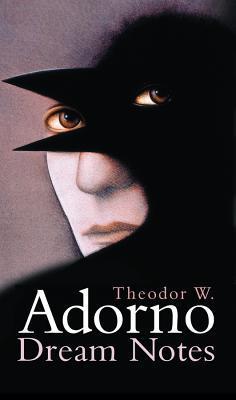
Dreams are as black as death. --Theodor W. Adorno Adorno was fascinated by his dreams and wrote them down throughout his life. He envisaged publishing a collection of them although in the event no more than a few appeared in his lifetime.Dream Notes offers a selection of Adornos writings on dreams that span the last twenty-five years of his life. Readers of Adorno who are accustomed to high-powered reflections on philosophy, music and culture may well find them disconcerting: they provide an amazingly frank and uninhibited account of his inner desires, guilt feelings and anxieties. Brothel scenes, torture and executions figure prominently. They are presented straightforwardly, at face value. No attempt is made to interpret them, to relate them to the events of his life, to psychoanalyse them, or to establish any connections with the principal themes of his philosophy.Are they fiction, autobiography or an attempt to capture a pre-rational, quasi-mythic state of consciousness? No clear answer can be given. Taken together they provide a highly consistent picture of a dimension of experience that is normally ignored, one that rounds out and deepens our knowledge of Adorno while retaining something of the enigmatic quality that energized his own thought.
Richard Wagner’s works are among the most controversial in the history of European music because of their powerful aesthetic qualities and, in wider political terms, because of their eventual assimilation into the official culture of the Third Reich.This concise synoptic account by the most brilliant exponent of Frankfurt School Marxism subtly interweaves these artistic and ideological qualities. It provides deft musicological analyses of Wagner’s scores and of his compositional techniques, orchestration and staging methods, quoting copiously from the music dramas themselves. At the same time it offers incisive reflections on Wagner’s social character and the ideological impulses of his artistic activity.

Im Herbst 1962 nahm Theodor W. Adorno an einer Tagung des Deutschen Koordinierungsrats der Gesellschaften für christlich-jüdische Zusammenarbeit teil, auf der er über die Bekämpfung des Antisemitismus sprach. Dieser Vortrag hat in seiner dichten und äußerst vielschichtigen Analyse nichts an Aktualität eingebüßt.Vor dem Hintergrund der Schuldabwehr und des »sekundären Antisemitismus« der deutschen Nachkriegsgesellschaft begreift Adorno den Antisemitismus als zentrales Bindemittel rechtsradikaler Bewegungen, das die diversen Strömungen eines militanten und exzessiven Nationalismus vereint. Er ist das »Gerücht über die Juden«, das halböffentliche Getuschel, mit dem sich die autoritäre Persönlichkeit zum Opfer stilisiert. Antiintellektualismus und Konformismus sind seine Triebfedern, und mit dem Rassismus teilt er eine identische Struktur. Zugleich warnt Adorno vor einer Idealisierung und Verkitschung der Juden und des Judentums im Kampf gegen den Antisemitismus und plädiert für unverbrüchliche Treue zur Wahrheit im Umgang mit den historischen sowie politischen Realitäten.Ein antiautoritäres Erziehungsprogramm zur Prävention antisemitischer Charakterbildung und hartes Durchgreifen bei antisemitischen Ausbrüchen sind die einander ergänzenden Elemente der Bekämpfung des Antisemitismus damals wie heute. Ein Nachwort von Jan Philipp Reemtsma zeigt die Bedeutung dieser brillanten Analyse für unsere Gegenwart.

Theodor W. Adorno goes beyond conventional thematic analysis to gain a more complete understanding of Mahler's music through his character, his social and philosophical background, and his moment in musical history. Adorno examines the composer's works as a continuous and unified development that began with his childhood response to the marches and folk tunes of his native Bohemia.Since its appearance in 1960 in German, Mahler has established itself as a classic of musical interpretation. Now available in English, the work is presented here in a translation that captures the stylistic brilliance of the original.Theodor W. Adorno (1903-69), one of the foremost members of the Frankfurt school of critical theory, studied with Alban Berg in Vienna during the late twenties, and was later the director of the Institute of Social Research at the University of Frankfurt from 1956 until his death. His works include Aesthectic Theory, Introduction to the Sociology of Music, The Jargon of Authenticity, Prism, and Philosophy of Modern Music.


Theodor W. Adorno (1903-1969), one of the leading social thinkers of the twentieth century, long concerned himself with the problems of moral philosophy, or "whether the good life is a genuine possibility in the present." This book consists of a course of seventeen lectures given in May-July 1963. Captured by tape recorder (which Adorno called "the fingerprint of the living mind"), these lectures present a somewhat different, and more accessible, Adorno from the one who composed the faultlessly articulated and almost forbiddingly perfect prose of the works published in his lifetime. Here we can follow Adorno's thought in the process of formation (he spoke from brief notes), endowed with the spontaneity and energy of the spoken word. The lectures focus largely on Kant, "a thinker in whose work the question of morality is most sharply contrasted with other spheres of existence." After discussing a number of the Kantian categories of moral philosophy, Adorno considers other, seemingly more immediate general problems, such as the nature of moral norms, the good life, and the relation of relativism and nihilism. In the course of the lectures, Adorno addresses a wide range of topics, theory and practice, ethics as bad conscience, the repressive character, the problem of freedom, dialectics in Kant and Hegel, the nature of reason, the moral law as a given, psychoanalysis, the element of the Absurd, freedom and law, the Protestant tradition of morality, Hamlet, self-determination, phenomenology, the concept of the will, the idea of humanity, The Wild Duck, and Nietzsche's critique of morality.

Critical Models combines into a single volume two of Adorno's most important postwar works -- Interventions: Nine Critical Models (1963) and Catchwords: Critical Models II (1969). Written after his return to Germany in 1949, the articles, essays, and radio talks included in this volume speak to the pressing political, cultural, and philosophical concerns of the postwar era. The pieces in Critical Models reflect the intellectually provocative as well as the practical Adorno as he addresses such issues as the dangers of ideological conformity, the fragility of democracy, educational reform, the influence of television and radio, and the aftermath of fascism.This new edition includes an introduction by Lydia Goehr, a renowned scholar in philosophy, aesthetic theory, and musicology. Goehr illuminates Adorno's ideas as well as the intellectual, historical, and critical contexts that shaped his postwar thinking.

This volume makes available in English for the first time Adorno's lectures on metaphysics. It provides a unique introduction not only to metaphysics but also to Adorno's own intellectual standpoint, as developed in his major work Negative Dialectics. Metaphysics for Adorno is defined by a central tension between concepts and immediate facts. Adorno traces this dualism back to Aristotle, whom he sees as the founder of metaphysics. In Aristotle it appears as an unresolved tension between form and matter. This basic split, in Adorno's interpretation, runs right through the history of metaphysics. Perhaps not surprisingly, Adorno finds this tension resolved in the Hegelian dialectic. Underlying this dualism is a further dichotomy, which Adorno sees as essential to while it dissolves belief in transcendental worlds by thought, at the same time it seeks to rescue belief in a reality beyond the empirical, again by thought. It is to this profound ambiguity, for Adorno, that the metaphysical tradition owes its greatness. The major part of these lectures, given by Adorno late in his life, is devoted to a critical exposition of Aristotle's thought, focusing on its central ambiguities. In the last lectures, Adorno's attention switches to the question of the relevance of metaphysics today, particularly after the Holocaust. He finds in metaphysical experiences, which transcend rational discourse without lapsing into irrationalism, a last precarious refuge of the humane truth to which his own thought always aspired. This volume will be essential reading for anyone interested in Adorno's work and will be a valuable text for students and scholars of philosophy and social theory.
Lectures on Negative Dialectics: Fragments of a Lecture Course 1965/1966
by Theodor W. Adorno
Rating: 4.3 ⭐
This volume comprises one of the key lecture courses leading up to the publication in 1966 of Adorno's major work, Negative Dialectics. These lectures focus on developing the concepts critical to the introductory section of that book. They show Adorno as an embattled philosopher defining his own methodology among the prevailing trends of the time.

An eminent philosopher of music defines the sociology of music, explores modes of musical conduct, and deals with popular and chamber music, opera, and the relation of music to public opinion

Quasi una Fantasia contains Adorno’s own selection from his essays and journalism over more than three decades. In its analytical profundity it can be compared to his Philosophy of Modern Music , but in the range of its topics and the clarity of its arguments it stands alone among Adorno’s writings on music. At the book’s core are illuminating studies of the founders of modern Mahler, Schoenberg and Berg, as well as sympathetic rediscoveries of Alexander Zemlinsky and Franz Schreker. Especially significant is Adorno’s “dialectical portrait” of Stravinsky in which he both reconsiders and refines the damning indictment he gave in Philosophy on Modern Music . In ‘Vers une musique informelle’, an influential essay, he plots a course for a music of the future ‘which takes up the challenge of an unrevised, unrestricted freedom’. More unexpectedly, there are moving accounts of earlier works, including Bizet’s Carmen and Weber’s Der Freischutz , along with an entertainingly caustic “Natural History of the Theatre.” Which explores the hierarchies of the auditorium, from upper circle to foyer.‘The positive element of kitsch’, Adorno remarks, ‘lies in the fact that it sets free for a moment the glimmering realization that you have wasted your life.’ Musical kitsch is the target of several of the shorter on Gounod’s Ave Maria or Tchaikovsky’s ‘clumsy naivety’; on the ‘Penny Serenade’ of the transformation of Mozart into chocolate-box rococo. Yet even while Adorno demolishes ‘commodity music’ he is sustained by the conviction that music is supremely human because it retains the capacity to speak of inhumanity and to resist it. It is a conviction which reverberates throughout these writings. For Adorno, music and philosophy were inextricably Quasi una Fantasia will enlarge our understanding of both.

[Kierkegaard, Søren] Adorno, Theodor W. Construction of the Aesthetic. Minneapolis, University of Minnesota Press, 1989. 8°. XXIII, 166 pages. Original Softcover. Very good condition with only minor signs of external wear. From the library of philosopher Graham Parkes. [Theory and History of Literature, Volume 61]. Includes for example the following Exposition of the Aesthetic / Constitution of Inwardness / Explication of Inwardness / Concept of Existance etc.