
Stuart A. Vyse
Stuart Vyse is a behavioral scientist, teacher, and writer. He writes the monthly “Behavior & Belief” column for Skeptical Inquirer and personal essays in a variety of places—lately for the Observer, Medium, The Atlantic, The Good Men Project, and Tablet. He also blogs very sporadically for Psychology Today. Vyse's book Believing in Magic: The Psychology of Superstition won the William James Book Award of the American Psychological Association and has been or will be translated into four languages. His book Going Broke: Why Americans Can’t Hold On To Their Money is an analysis of the current epidemic of personal debt and has been translated into Chinese. As an expert on irrational behavior, Vyse has been quoted in many news outlets, including the New York Times, the Washington Post, the Los Angeles Times and have appeared on CBS Sunday Morning, CNN International, the PBS NewsHour, and NPR”s Science Friday. Vyse holds a PhD in psychology and BA and MA degrees in English literature and is a Fellow of the Committee for Skeptical Inquiry. The majority of his teaching career was spent at Connecticut College in New London, CT, where I was the Joanne Toor ’50 Professor of Psychology. His academic interests are in decision making, behavioral economics, philosophy, behavior analysis, and belief in the paranormal.
5 Books Written
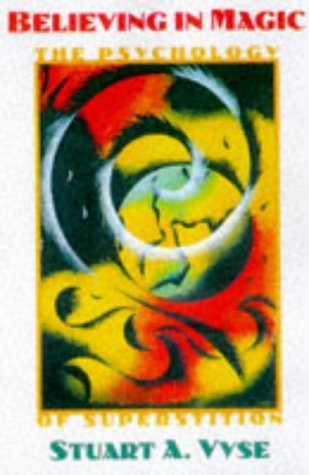
Although we live in a technologically advanced society, superstition is as widespread as it has ever been. Far from limited to athletes and actors, superstitious beliefs are common among people of all occupations and every educational and income level. Here, Stuart Vyse investigates our proclivity towards these irrational beliefs. Superstitions, he writes, are the natural result of several well-un

Over the last three decades, debt, bankruptcy, and home foreclosures have risen to epidemic levels. To make matters worse, the personal savings rate is at its lowest point since the Great Depression. Why, in the richest nation on earth, can't Americans hold on to our money?Winner of the prestigious William James Book Award for Believing in Magic and an authority on irrational behavior,

Do you touch wood for luck, or avoid hotel rooms on floor thirteen? Would you cross the path of a black cat, or step under a ladder? Is breaking a mirror just an expensive waste of glass, or something rather more sinister? Despite the dominance of science in today's world, superstitious beliefs - both traditional and new - remain surprisingly popular. A recent survey of adults in the United States

Critical Thinking: How to Effectively Reason, Understand Irrationality, and Make Better Decisions
by Stuart A. Vyse
Rating: 3.4 ⭐
Stuart Vyse, PhD, is the author of Believing in Magic: The Psychology of Superstition, which received the William James Book Award of the American Psychological Association. A celebrated psychologist and professor as well as a recognized author, he is the perfect guide for this audio series on the power of superstition. This wide-ranging course reveals the method to our madness in ever

A fascinating examination of delusional thinking and how it might benefit health, relationships, and wellbeing .Although reason and rationality are our friends in almost all contexts, in some cases people are better off putting reason aside. In a number of very important situations, we benefit by not seeing the world as it is, and by not behaving like logic-driven machines. Sometimes w