
Steven Runciman
A King's Scholar at Eton College, he was an exact contemporary and close friend of George Orwell. While there, they both studied French under Aldous Huxley. In 1921 he entered Trinity College, Cambridge as a history scholar and studied under J.B. Bury, becoming, as Runciman later commented, "his first, and only, student." At first the reclusive Bury tried to brush him off; then, when Runciman mentioned that he could read Russian, Bury gave him a stack of Bulgarian articles to edit, and so their relationship began. His work on the Byzantine Empire earned him a fellowship at Trinity in 1927. After receiving a large inheritance from his grandfather, Runciman resigned his fellowship in 1938 and began travelling widely. From 1942 to 1945 he was Professor of Byzantine Art and History at Istanbul University, in Turkey, where he began the research on the Crusades which would lead to his best known work, the History of the Crusades (three volumes appearing in 1951, 1952, and 1954). Most of Runciman's historical works deal with Byzantium and her medieval neighbours between Sicily and Syria; one exception is The White Rajahs, published in 1960, which tells the story of Sarawak, an independent nation founded on the northern coast of Borneo in 1841 by the Englishman James Brooke, and ruled by the Brooke family for more than a century.
29 Books Written

This classic account shows how the fall of Constantinople in May 1453, after a siege of several weeks, came as a bitter shock to Western Christendom. The city's plight had been neglected, and negligible help was sent in this crisis. To the Turks, victory not only brought a new imperial capital, but guaranteed that their empire would last. To the Greeks, the conquest meant the end of the civilisation of Byzantium, and led to the exodus of scholars stimulating the tremendous expansion of Greek studies in the European Renaissance.

A History of the Crusades, Volume 1: The First Crusade and the Foundations of the Kingdom of Jerusalem
by Steven Runciman
Rating: 4.3 ⭐
Sir Steven Runciman's three volume A History of the Crusades, one of the great classics of English historical writing, is being reissued. This volume deals completely with the First Crusade and the foundation of the kingdom of Jerusalem. As Runciman says in his preface: 'Whether we regard the Crusades as the most tremendous and most romantic of Christian adventures, or as the last of the barbarian invasions, they form a central fact in medieval history. Before their inception the centre of our civilization was placed in Byzantium and in the lands of the Arab caliphate. Before they faded out the hegemony in civilization had passed to western Europe. Out of this transference modern history was born.'
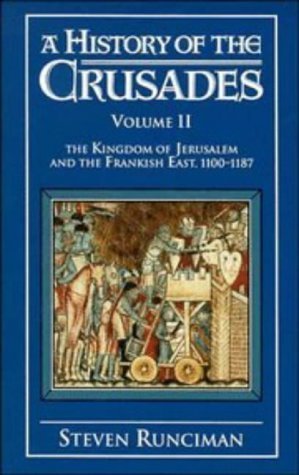
A History of the Crusades, Vol. II: The Kingdom of Jerusalem and the Frankish East, 1100-1187
by Steven Runciman
Rating: 4.3 ⭐
Sir Steven Runciman's three volume A History of the Crusades, one of the great classics of English historical writing, is now being reissued. This volume describes the Frankish states of Outremer from the accession of King Baldwin I to the re-conquest of Jerusalem by Saladin. As Runciman says in his preface, 'The politics of the Moslem world in the early twelfth-century defy straightforward analysis, but they must be understood if we are to understand the establishment of the Crusader states and the later causes of the recovery of Islam … The main theme in this volume is warfare … I have followed the example of the old chroniclers, who knew their business; for war was the background to life in Outremer and the hazards of the battlefield often decided its destiny.'

A History of the Crusades, Vol. III: The Kingdom of Acre and the Later Crusades
by Steven Runciman
Rating: 4.4 ⭐
Sir Steven Runciman's three volume A History of the Crusades, one of the great classics of English historical writing, is now being reissued. In this final volume, Runciman examines the revival of the Frankish kingdom at the time of the Third Crusade until its collapse a century later. The interwoven themes of the book include: Christiandom, the replacement of the cultured Ayubites by the less sympathetic Mameluks as leader of the Moslem world, and the coming of the Mongols. He includes a chapter on architecture and the arts, and an epilogue on the last manifestations of the Crusading spirit.

The Sicilian Vespers: A History of the Mediterranean World in the Later Thirteenth Century
by Steven Runciman
Rating: 4.2 ⭐
On 30 March 1282, as the bells of Palermo were ringing for Vespers, the Sicilian townsfolk, crying 'Death to the French', slaughtered the garrison and administration of their Angevin King. Seen in historical perspective it was not an especially big massacre: the revolt of the long-subjugated Sicilians might seem just another resistance movement. But the events of 1282 came at a crucial moment. Steven Runciman takes the Vespers as the climax of a great narrative sweep covering the whole of the Mediterranean in the thirteenth century. His sustained narrative power is displayed here with concentrated brilliance in the rise and fall of this fascinating episode. This is also an excellent guide to the historical background to Dante's Divine Comedy, forming almost a Who's Who of the political figures in it, and providing insight into their placement in Hell, Paradise or Purgatory.

Sir Steven Runciman's three volume A History of the Crusades, one of the great classics of English historical writing, is now being reissued. Volume I deals completely with the First Crusade and the foundation of the kingdom of Jerusalem. Volume II describes the Frankish states of Outremer from the accession of King Baldwin I to the re-conquest of Jerusalem by Saladin, and in the final volume, Runciman examines the revival of the Frankish kingdom from the time of the Third Crusade until its collapse a century later. The interwoven themes of the book include: Christiandom, the replacement of the cultured Ayubites by the less sympathetic Mameluks as leader of the Moslem world, and the coming of the Mongols. Runciman includes a chapter on architecture and the arts, and an epilogue on the last manifestations of the Crusading spirit.

Reveals the history, culture economic state, and political life of the Byzantine culture from the fourth to the fifteenth century

The Lost Capital of Byzantium: The History of Mistra and the Peloponnese
by Steven Runciman
Rating: 3.9 ⭐
Clinging to a rugged hillside in the lush valley of Sparta lies Mistra, one of the most dramatically beautiful Byzantine cities in Greece, a place steeped in history, myth, and romance. Following the Frankish conquest of the Peloponnese in the thirteenth century, William II of Villehardouin built a great castle on a hill near Sparta that later came to be known as Mistra. Ten years later, in a battle in northern Greece, Villehardouin was defeated and captured by the Byzantine emperor. The terms for his release included giving Mistra to the Byzantine Greeks. Under their rule, the city flourished and developed into a center of learning and the arts and was a focal point for the cultural development of Europe. Sir Steven Runciman, one of the most distinguished historians of the Byzantine period, traveled to Mistra on numerous occasions and became enchanted with the place. Now published in paperback for the first time, Lost Capital of Byzantium tells the story of this once-great city―its rise and fall and its place in the history of the Peloponnese and the Byzantine empire.

The Great Church in Captivity: A Study of the Patriarchate of Constantinople from the Eve of the Turkish Conquest to the Greek War of Independence
by Steven Runciman
Rating: 4.4 ⭐
This is Sir Steven Runciman's established and widely admired classic account of the Patriarchate of Constantinople, first published in 1968. The Great Church, as the Greeks called the Orthodox Patriarchate, was the spiritual centre of the Byzantine world. The Church's survival during the four centuries of Turkish rule which followed the fall of Constantinople bore witness to its strenght and to the unquenchable vitality of Hellenism. Sir Steven Runciman's history of the Great Church in this period is written with scholarship, sympathy and style.

A reissue of Sir Steven Runciman's classic account of the Dualist heretic tradition in Christianity from its Gnostic origins, through Armenia, Byzantium, and the Balkans to its final flowering in Italy and Southern France. The chief danger that early Christianity had to face came from the heretical Dualist sect founded in the mid-third century AD by the prophet Mani. Within a century of his death Manichaean churches were established from western Mediterranean lands to eastern Turkestan. Though Manichaeism failed in the end to supplant orthodox Christianity, the Church had been badly frightened; and henceforth it gave the hated epithet of 'Manichaean' to the churches of Dualist doctrines that survived into the late Middle Ages.

During the last two centuries of its existence the Byzantine Empire was politically in a state of utter decadence, but, in contrast, its intellectual life has never before shone so brilliantly. In these four lectures the author discusses the leading scholars of the period, their erudition, their intense individualism, their controversies and their achievements.

The Eastern Schism: A Study of the Papacy and the Eastern Churches During the Xith and Xiith Centuries
by Steven Runciman
Rating: 4.2 ⭐
The Eastern A Study of the Papacy and the Eastern Churches During the Xith and Xiith Centuries

The constitution of the Byzantine Empire was based on the conviction that it was the earthly copy of the Kingdom of Heaven. Just as God ruled in Heaven, so the Emperor, made in his image, should rule on earth and carry out his commandments. This was the theory, but in practice the state was never free from its Roman past, particularly the Roman law, and its heritage of Greek culture. Sir Steven Runciman's Weil lectures trace the various ways in which the Emperor tried to put the theory into practice - and thus the changing relationship between church and state - from the days of the first Constantine to those of the eleventh. The theocratic constitution remained virtually unchanged during those eleven centuries. No other constitution in the Christian era has endured for so long.

The Emperor Romanus Lecapenus and his Reign: A Study of Tenth-Century Byzantium
by Steven Runciman
Rating: 4.1 ⭐
This study, centred around the reign of the usurping Emperor Romanus Lecapenus, was originally published in 1929, reissued in 1963, and has been out of print for several years. It contributed to the revival of interest in Byzantine studies at that time, and has since remained one of the most authoritative and readable accounts of the period.


One of the greatest historical writers of the twentieth century, Steven Runciman was famous for throwing light on some very dark ages: his definitive A History of the Crusades, first published by Penguin in 1965, transformed the common view of the Holy Wars through its impartial and penetrating approach. In this extract, he describes the brutal and decisive tenth-century victory of the crusaders over Arab forces in Jerusalem, occupied for over four hundred years.

The Sultan of Brunei gave the title of Rajah and sovereignty of Sarawak, a province of Borneo, to James Brooke in 1841 as a reward for helping to peacefully resolve an uprising in the region. Brooke established his reign over the area, and two further Brooke descendants ruled Sarawak as a British protectorate for the next hundred years until Japanese occupation during World War II followed by cession to Britain. Between the three Rajahs they expanded Sarawak territory, successfully squashed piracy and put in place a structured government and justice system that brought harmony to a diverse multicultural society that had long been in turmoil from clashing cultures, particularly with the widespread practice of headhunting. Published first in 1960 as Sarawak ceded to Malaysia, The White Rajah documents this unique and fascinating time made possible by the 'human sympathy, selflessness and a high integrity' of three generations of Brooke men.

This book is not a serious contribution to travel-literature. (The author has) made no attempt to interpret the way of life in the lands (he has) visited or even to describe the beauties of nature and the works of art to be found there. (His) intention is only to record (his) own experiences in a number of places to which curiosity or circumstances ... have taken (him) ... In order to give some form to these disconnected anecdotes (the author has) arranged them alphabetically, place by place.

A three volume set. All volumes bound in metallic book cloth blocked with a different design to the front boards, by David Eccles. Numerous color illustrations throughout support the text. i. Byzantine Art and Civilization. 184pp.; ii. Gothic Art and Civilization. 210pp.; iii. Early Medieval Art and Civilization. 260pp.

Families of Outremer, 1099-1291
by Steven Runciman
Häresie und Christentum
by Steven Runciman
Byzantium, Russia and Caesaropapism
by Steven Runciman
Byzantium and the Renaissance
by Steven Runciman
The byzantine "Protectorate" in the Holy Land in the eleventh century
by Steven Runciman