
Stephen F. Cohen
Stephen F. Cohen was Professor Emeritus of Politics at Princeton University, where for many years he served as director of the Russian Studies Program, and Professor Emeritus of Russian Studies and History at New York University. He grew up in Owensboro, Kentucky, received his undergraduate and master’s degrees at Indiana University, and his Ph.D. at Columbia University. Cohen’s other books include Bukharin and the Bolshevik Revolution: A Political Biography; Rethinking the Soviet Experience: Politics and History Since 1917; Sovieticus: American Perceptions and Soviet Realities; (with Katrina vanden Heuvel) Voices of Glasnost: Interviews With Gorbachev’s Reformers; Failed Crusade: America and the Tragedy of Post-Communist Russia; Soviet Fates and Lost Alternatives: From Stalinism to the New Cold War; and The Victims Return: Survivors of the Gulag After Stalin. For his scholarly work, Cohen received several honors, including two Guggenheim fellowships and a National Book Award nomination. Over the years, he was also a frequent contributor to newspapers, magazines, television, and radio. His “Sovieticus” column for The Nation won a 1985 Newspaper Guild Page One Award and for another Nation article a 1989 Olive Branch Award. For many years, Cohen was a consultant and on-air commentator on Russian affairs for CBS News. With the producer Rosemary Reed, he was also project adviser and correspondent for three PBS documentary films about Russia: Conversations With Gorbachev; Russia Betrayed?; and Widow of the Revolution. Cohen visited and lived in Soviet and Post-Soviet Russia regularly for more than forty years. (source: Amazon)
11 Books Written

Bukharin and the Bolshevik Revolution: A Political Biography, 1888-1938
by Stephen F. Cohen
Rating: 4.2 ⭐
This classic biography carefully traces Bukharin's rise to and fall from power, focusing particularly on the development of his theories and programmatic ideas during the critical period between Lenin's death in 1924 and the ascendancy of Stalin in 1929.

In this wide-ranging and provocative book, Stephen F. Cohen cuts through Cold War stereotypes of the Soviet Union to arrive at fresh interpretations of that country's traumatic history and its present-day political realities.Cohen's lucidly written, revisionist analysis reopens an array of major historical questions. As he probes Soviet history, society, and politics, Cohen demonstrates how

What really happened in Russia after the end of the Soviet Union, and how badly experts and the media misjudged it. Failed Crusade is a deeply informed and passionate call for a fundamentally different American-Russian relationship in the post-Yeltsin era. Author Stephen Cohen shows that what US officials and other experts call "reform" has for most Russians been a catastrophic development―namely

“A unique and valuable contribution. . . .Cohen brings to his analyses a keen critical perception, vast knowledge and―most noteworthy―a lucid style that makes his informed comments accessible to the non-specialist reader.” ―Newspaper Guild, 1985 Page One Award Gorbachev, dissidents, and Cold War perils are some of the topics discussed in this book that provides the historical context and informed

Fourteen Soviet public figures talk about their personal and political struggles to change the Soviet system. No bibliography. Annotation copyright Book News, Inc. Portland, Or.
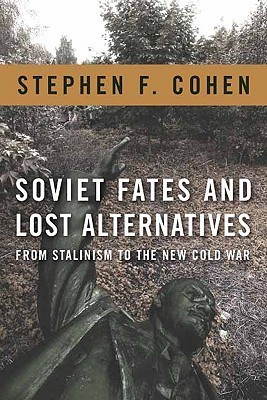
Soviet Fates and Lost Alternatives: From Stalinism to the New Cold War
by Stephen F. Cohen
Rating: 4.0 ⭐
In this wide-ranging and acclaimed book, Stephen F. Cohen challenges conventional wisdom about the course of Soviet and post-Soviet history. Reexamining leaders from Nikolai Bukharin, Stalin's preeminent opponent, and Nikita Khrushchev to Mikhail Gorbachev and his rival Yegor Ligachev, Cohen shows that their defeated policies were viable alternatives and that their tragic personal fates shaped the

Joseph Stalin's reign of terror in the Soviet Union has been called "the other holocaust." Over the course of 24 years, more innocent men, women, and children perished than died in Hitler's murder of European Jews. This book originated 30 years ago when Stephen F. Cohen, a professor of Russian studies and history at New York University, first began researching the lives of those victims released a

How should the West deal with Putin’s Russia? For the U.S. and some European powers the answer is obvious: isolate Russia with punishing economic sanctions, remove it from global institutions such as the G8, and arm the nations directly threatened by Putin. In short, return to the Cold War doctrine that froze Soviet aggression in Europe and helped bring about the collapse of communist Russia. Othe

The new East-West conflict, which broke out over the Ukrainian crisis in 2014, but which long predated it and soon spread through Europe and to the Middle East, is potentially the worst US-Russian confrontation in more than fifty years and the most fateful. A negotiated resolution is possible, but time may be running out. In this book, renowned Russia scholar and media commentator Stephen F. Cohen

Is America in a new Cold War with Russia? How does a new Cold War affect the safety and security of the United States? Does Vladimir Putin really want to destabilize the West? What should Donald Trump and America’s allies do?America is in a new Cold War with Russia even more dangerous than the one the world barely survived in the twentieth century. The Soviet Union is gone, but the two
Social dimensions of de-Stalinization, 1953-64: Final report to National Council for Soviet and East European Research
by Stephen F. Cohen