
Stephen E. Ambrose
Stephen Edward Ambrose was an American historian and biographer of U.S. Presidents Dwight Eisenhower and Richard M. Nixon. He received his Ph.D. in 1960 from the University of Wisconsin-Madison. In his final years he faced charges of plagiarism for his books, with subsequent concerns about his research emerging after his death.
30 Books Written

Stephen E. Ambrose draws upon extensive sources, an unprecedented degree of scholarship, and numerous interviews with Eisenhower himself to offer the fullest, richest, most objective rendering yet of the soldier who became president. He gives us a masterly account of the European war theater and Eisenhower's magnificent leadership as Allied Supreme Commander. Ambrose's recounting of Eisenhower's presidency, the first of the Cold War, brings to life a man and a country struggling with issues as diverse as civil rights, atomic weapons, communism, and a new global role. Along the way, Ambrose follows the 34th President's relations with the people closest to him, most of all Mamie, his son John, and Kay Summersby, as well as Franklin D. Roosevelt, Winston Churchill, Charles de Gaulle, Harry Truman, Nixon, Dulles, Khrushchev, Joe McCarthy, and indeed, all the American and world leaders of his time. This superb interpretation of Eisenhower's life confirms Stephen Ambrose's position as one of our finest historians.

Undaunted Courage: Meriwether Lewis, Thomas Jefferson, and the Opening of the American West
by Stephen E. Ambrose
Rating: 4.2 ⭐
• 2 recommendations ❤️
In this sweeping adventure story, Stephen E. Ambrose, the bestselling author of D-Day, presents the definitive account of one of the most momentous journeys in American history. Ambrose follows the Lewis and Clark Expedition from Thomas Jefferson's hope of finding a waterway to the Pacific, through the heart-stopping moments of the actual trip, to Lewis's lonely demise on the Natchez Trace. Along the way, Ambrose shows us the American West as Lewis saw it -- wild, awsome, and pristinely beautiful. Undaunted Courage is a stunningly told action tale that will delight readers for generations.

Citizen Soldiers: The US Army from the Normandy Beaches to the Bulge to the Surrender of Germany
by Stephen E. Ambrose
Rating: 4.2 ⭐
From Stephen E. Ambrose, bestselling author of Band of Brothers and D-Day , the inspiring story of the ordinary men of the U.S. army in northwest Europe from the day after D-Day until the end of the bitterest days of World War II.In this riveting account, historian Stephen E. Ambrose continues where he left off in his #1 bestseller D-Day. Citizen Soldiers opens at 0001 hours, June 7, 1944, on the Normandy beaches, and ends at 0245 hours, May 7, 1945, with the allied victory. It is biography of the US Army in the European Theater of Operations, and Ambrose again follows the individual characters of this noble, brutal, and tragic war. From the high command down to the ordinary soldier, Ambrose draws on hundreds of interviews to re-create the war experience with startling clarity and immediacy. From the hedgerows of Normandy to the overrunning of Germany, Ambrose tells the real story of World War II from the perspective of the men and women who fought it.

Band of Brothers: E Company, 506th Regiment, 101st Airborne from Normandy to Hitler's Eagle's Nest
by Stephen E. Ambrose
Rating: 4.4 ⭐
As good a rifle company as any, Easy Company, 506th Airborne Division, US Army, kept getting tough assignments--responsible for everything from parachuting into France early DDay morning to the capture of Hitler's Eagle's Nest at Berchtesgaden. In "Band of Brothers," Ambrose tells of the men in this brave unit who fought, went hungry, froze & died, a company that took 150% casualties & considered the Purple Heart a badge of office. Drawing on hours of interviews with survivors as well as the soldiers' journals & letters, Stephen Ambrose recounts the stories, often in the men's own words, of these American heroes.Foreword"We wanted those wings"; Camp Toccoa, 7-12/42"Stand up & hook up"; Benning, Mackall, Bragg, Shanks, 12/42-9/43"Duties of the latrine orderly"; Aldbourne, 9/43-3/44"Look out, Hitler! Here we come!"; Slapton Sands, Uppottery, 4/1-6/5/44"Follow me"; Normandy, 6/6/44"Move out!"; Carentan, 6/7-7/12/44Healing wounds & scrubbed missions; Aldbourne, 7/13-9/16/44"Hell's highway"; Holland, 9/17-10/1/44Island; Holland, 10/2-11/25/44Resting, recovering & refitting: Mourmelon-le-Grand, 11/26-12/18/44"They got us surrounded-the poor bastards"; Bastogne, 12/19-31/44Breaking point; Bastogne, 1/1-13/45 Attack; Noville, 1/14-17/45Patrol: Haguenau, 1/18-2/23/45"Best feeling in the world": Mourmelon, 2/25-4/2/45Getting to know the enemy: Germany, 4/2-30/45Drinking Hitler's champagne; Berchtesgaden, 5/1-8/45Soldier's dream life; Austria, 5/8-7/31/45Postwar careers; 1945-91Acknowledgments & SourcesIndex

It is the young men born into the false prosperity of the 1920s and brought up in the bitter realities of the Depression of the 1930s that this book is about. The literature they read as youngsters was anti-war and cynical, portraying patriots as suckers, slackers and heroes. None of them wanted to be part of another war. They wanted to be throwing baseballs, not handgrenades; shooting .22s at rabbits, not M-1s at other young men. But when the test came, when freedom had to be fought for or abandoned, they fought (from the Prologue).

Nothing Like It in the World: The Men Who Built the Transcontinental Railroad 1863-69
by Stephen E. Ambrose
Rating: 4.0 ⭐
Nothing Like It in the World gives the account of an unprecedented feat of engineering, vision, and courage. It is the story of the men who built the transcontinental railroad—the investors who risked their businesses and money; the enlightened politicians who understood its importance; the engineers and surveyors who risked, and sometimes lost, their lives; and the Irish and Chinese immigrants, the defeated Confederate soldiers, and the other laborers who did the backbreaking and dangerous work on the tracks.The U.S. government pitted two companies—the Union Pacific and the Central Pacific Railroads—against each other in a race for funding, encouraging speed over caution. Locomotives, rails, and spikes were shipped from the East through Panama or around South America to the West or lugged across the country to the Plains. In Ambrose's hands, this enterprise, with its huge expenditure of brainpower, muscle, and sweat, comes vibrantly to life.

In the early morning hours of June 6, 1944, a small detachment of British airborne troops stormed the German defense forces and paved the way for the Allied invasion of Europe. Pegasus Bridge was the first engagement of D-Day, the turning point of World War II.This gripping account of it by acclaimed author Stephen Ambrose brings to life a daring mission so crucial that, had it been unsuccessful, the entire Normandy invasion might have failed. Ambrose traces each step of the preparations over many months to the minute-by-minute excitement of the hand-to-hand confrontations on the bridge. This is a story of heroism and cowardice, kindness and brutality—the stuff of all great adventures.

The Wild Blue: The Men and Boys Who Flew the B-24s Over Germany 1944-45
by Stephen E. Ambrose
Rating: 4.0 ⭐
The Barnes & Noble ReviewMaster WWII military historian Stephen Ambrose, bestselling author of such classic works as Band of Brothers and D-Day , hits the front lines again with this exciting and compelling look at the courageous young men who flew the massive B-24 bombers over Germany during the last two years of World War II. The focus of the book is on George McGovern, the 1972 Democratic presidential candidate, who, ironically, was lambasted by the right for his anti-Vietnam stance. Here, he shines brightly as an American airborne hero, bravely piloting his huge and awkward bomber through massive German flak bombing. McGovern also comes across as a fine commanding officer, deeply caring about the men under his authority. McGovern, at the tender age of 22, wound up flying 35 missions and ultimately won the Distinguished Flying Cross.The B-24 was not an easy machine to fly. It had a thin aluminum skin, which made it sufficiently airworthy but terribly susceptible to attack from ground-based enemy gunfire. It was a simple machine, though -- built with one purpose in mind: dropping a maximum load of 8,800 pounds of bombs. There were no windshield wipers, so a pilot like McGovern was often forced to stick his head out the window of the plane to see where he was going! Above 10,000 feet, the only way to breathe was through an oxygen mask. There was no heat, which made the bombing runs that much more arduous. And there were no bathrooms, meaning that the pilots and their crews had to use "relief tubes."Ambrose goes into much useful detail on the origins of the pilots themselves. Interestingly, they were all volunteers -- the Army Air Corps (the precursor to the modern Air Force) did not want to make anyone take part in this difficult duty. They came from all walks of life. Some were college graduates, while others were still in high school. Many went straight from the farm to the airfield. The pilots were treated quite well by the AAC, considering that they were part of the same armed forces that tended to dehumanize servicemen in order to get the maximum use out of them. They got to wear winged insignia on their uniforms. They got extra pay. As volunteers, they knew what they were getting into, unlike the typical draftee. Most of all, they wanted to serve -- and they wanted to fly.Once again, Stephen Ambrose has turned his spotlight on a special and unique facet of the U.S. military and brought the heroism and courage of the American soldier back home to us. In his own way, Ambrose himself has done a great service to the American people. (Nicholas Sinisi)Nicholas Sinisi is the Barnes&Noble.com History editor.

On June 25, 1876, 611 men of the United States 7th Cavalry rode towards the banks of the Little Bighorn where three thousand Indians stood waiting for battle. The lives of two great war leaders would soon become forever linked: Crazy Horse, leader of the Oglala Sioux, and General George Armstrong Custer. This masterly dual biography tells the epic story of the lives of these two men: both were fighters of legendary daring, both became honoured leaders in their societies when still astonishingly young, and both died when close to the supreme political heights. Yet they - like the nations they represented - were as different as day and night. Custer had won his spurs in the American Civil War; his watchword was 'To promotion - or death!' and his restless ambition characterized a white nation in search of expansion and progress. Crazy Horse fought for a nomadic way of life fast yielding before the buffalo-hunters and the incursions of the white man. The Great Plains of North America provided the stage - and the prize.

From America’s preeminent military historian, Stephen E. Ambrose, comes the definitive telling of the war in Europe, from D-Day, June 6, 1944, to the end, eleven months later, on May 7, 1945.This authoritative narrative account is drawn by the author himself from his five acclaimed books about that conflict, most particularly from the definitive and comprehensive D-Day and Citizen Soldiers, about which the great Civil War historian James McPherson wrote, “If there is a better book about the experience of GIs who fought in Europe during World War II, I have not read it. Citizen Soldiers captures the fear and exhilaration of combat, the hunger and cold and filth of the foxholes, the small intense world of the individual rifleman as well as the big picture of the European theater in a manner that grips the reader and will not let him go. No one who has not been there can understand what combat is like but Stephen Ambrose brings us closer to an understanding than any other historian has done.”The Victors also includes stories of individual battles, raids, acts of courage and suffering from Pegasus Bridge, an account of the first engagement of D-Day, when a detachment of British airborne troops stormed the German defense forces and paved the way for the Allied invasion; and from Band of Brothers, an account of an American rifle company from the 506th Parachute Infantry Regiment who fought, died, and conquered, from Utah Beach through the Bulge and on to Hitter's Eagle’s Nest in Germany.Stephen Ambrose is also the author of Eisenhower, the greatest work on Dwight Eisenhower, and one of the editors of the Supreme Allied Commander's papers. He describes the momentous decisions about how and where the war was fought, and about the strategies and conduct of the generals and officers who led the invasion and the bloody drive across Europe to Berlin.But, as always with Stephen E. Ambrose, it is the ranks, the ordinary boys and men, who command his attention and his awe. The Victors tells their stories, how citizens became soldiers in the best army in the world. Ambrose draws on thousands of interviews and oral histories from government and private archives, from the high command—Eisenhower, Bradley, Patton—on down through officers and enlisted men, to re-create the last year of the Second World War when the Allied soldiers pushed the Germans out of France, chased them across Germany, and destroyed the Nazi regime.
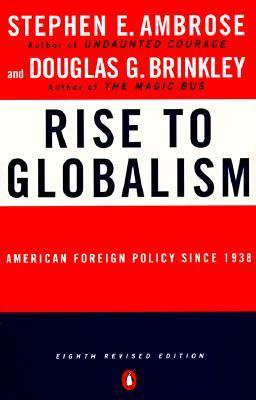
A survey of America's foreign policy from 1938 through to President Clinton's second term in 1995. Included in the text is commentary on Reagan's deal with Iran in 1980, Bush's deal with Iraq up to the invasion of Kuwait, the Middle East peace talks and the collapse of Soviet Union.

In To America, Stephen E. Ambrose, one of the country's most influential historians, reflects on his long career as an American historian and explains what an historian's job is all about. He celebrates America's spirit, which has carried us so far. He confronts its failures and struggles. As always in his much acclaimed work, Ambrose brings alive the men and women, famous and not, who have peopled our history and made the United States a model for the world. Taking a few swings at today's political correctness, as well as his own early biases, Ambrose grapples with the country's historic sins of racism, its neglect and ill treatment of Native Americans, and its tragic errors (such as the war in Vietnam, which he ardently opposed on campus, where he was a professor). He reflects on some of the country's early founders who were progressive thinkers while living a contradiction as slaveholders, great men such as Washington and Jefferson. He contemplates the genius of Andrew Jackson's defeat of a vastly superior British force with a ragtag army in the War of 1812. He describes the grueling journey that Lewis and Clark made to open up the country, and the building of the railroad that joined it and produced great riches for a few barons. Ambrose explains the misunderstood presidency of Ulysses S. Grant, records the country's assumption of world power under the leadership of Theodore Roosevelt, and extols its heroic victory of World War II. He writes about women's rights and civil rights and immigration, founding museums, and nation- building. He contrasts the presidencies of Dwight Eisenhower, John F. Kennedy, Richard Nixon, and Lyndon B. Johnson. Throughout, Ambrose celebrates the unflappable American spirit. Most important, Ambrose writes about writing history. "The last five letters of the word 'history' tell us that it is an account of the past that is about people and what they did, which is what makes it the most fascinating of subjects." To America is an instant classic for all those interested in history, patriotism, and the love of writing.

In North Africa, on the beaches at Normandy, and in the Battle of the Bulge, Dwight David Eisenhower proved himself as one of the world's greatest military leaders. Faced with conciliating or disagreeing with such stormy figures as Churchill, Roosevelt, and DeGaulle, and generals like Montgomery and Patton, General Eisenhower showed himself to be as skillful a diplomat as he was a strategist. Stephen E. Ambrose, associate editor of the General's official papers, analyzes his subject's decisions in The Supreme Commander, which Doubleday first published in 1970. Throughout the book Ambrose traces the steady development of Eisenhower's generalcy--from its dramatic beginnings through his time at the top post of Allied command. The New York Times Book Review said of The Supreme Commander, "It is Mr. Ambrose's special triumph that he has been able to fight through the memoranda, the directives, plans, reports, and official self-serving pieties of the World War II establishment to uncover the idiosyncratic people at its center. ... General Dwight Eisenhower comes remarkably alive. ...[Ambrose's] angle of sight is so fresh and lively that one reads as if one did not know what was coming next. It is better than One does know what's coming next--not only the winning of a war but the making of a general--but the interest is in seeing how." This study of Eisenhower's role in the world's biggest war is absorbing as reading and invaluable as a reference. Stephen E. Ambrose was Director Emeritus of the Eisenhower Center, Boyd Professor of History at the University of New Orleans, and president of the National D- Day Museum. He was the author of many books, most recently The Mississippi and the Making of a From the Louisana Purchase to Today . His compilation of 1,400 oral histories from American veterans and authorship of over 20 books established him as one of the foremost historians of the Second World War in Europe. He died October 13, 2002, in Bay St. Louis, Mississippi.

The American Heritage History of World War II was first published in 1966. At the time, author and Pulitzer Prize-winning journalist C.L. Sulzberger received widespread praise for his authoritative account of the six-year war that involved more than fifty-six nations, resulted in the death of some 22 million people, and shaped the course of history. His work became a standard reference on the war. Stephen E. Ambrose, one of the most highly regarded historians of our time, oversaw a major revision of this classic work. Seamlessly incorporating new material and insights, Ambrose produced a comprehensive and riveting account of the war’s key characters and events. In planes and foxholes, in deserts and jungles, on ships and beaches, Ambrose shines a light on the people involved - the leaders, the fighters, the victims. He also added new chapters on the atrocities of the Holocaust and revelations about the secret war of espionage. Ambrose’s analysis also offers insight into the events that precipitated the Cold War. This book captures the courage, commitment, military genius, and horror of the war that gave birth to a new era in world politics. For students, history buffs, and fascinated readers, The American Heritage History of World War II is the definitive single-volume work on the subject and will endure as a major narrative of world history.

From acclaimed biographer Stephen E. Ambrose comes the life of one of the most elusive and intriguing American political figures, Richard M. Nixon. From his difficult boyhood and earnest youth to bis ruthless political campaigns for Congress and Senate to his defeats in '60 and '62, Nixon emerges life-size in all his complexity. Ambrose charts the peaks and valleys of Nixon's first fifty years -- his critical support as a freshman congressman of the Truman Doctrine and the Marshall Plan; his involvement in the House Committee on Un-American Activities; his aggressive pursuit of Alger Hiss; his ambivalent relationship with Eisenhower; and more. It is the consummate biography; it is a stunning political odyssey.

From the author of Undaunted Courage and D-Day comes this celebration of male friendship, taken both from the pages of history and from Ambrose’s own life.Acclaimed historian Stephen Ambrose begins his examination with a glance inward—he starts this book with his brothers, his first and forever friends, and the shared experiences that join them for a lifetime, overcoming distance and misunderstandings. He writes of Dwight D. Eisenhower, who had a golden gift for friendship and who shared a perfect trust with his younger brother Milton in spite of their apparently unequal stations. With great feeling, Ambrose brings to life the relationships of the young soldiers of Easy Company who fought and died together from Normandy to Germany, and he describes with admiration three who fought in different armies on different sides in that war and became friends later. He recounts the friendships of Lewis and Clark and of Crazy Horse and He Dog, and he tells the story of the Custer brothers who died together at the Little Big Horn.Comrades concludes with the author’s moving recollection of his own friendship with his father. “He was my first and always most important friend. I didn’t learn that until the end, when he taught me the most important thing, that the love of father-son-father-son is a continuum, just as love and friendship are expansive.”

Collected here for the first time are fifteen essays that span over 100 years of American history--and the remarkable thirty-year career of America's foremost historian and New York Times bestselling author of D-Day , Undaunted Courage , and Citizen Soldiers .Stephen E. Ambrose's vivid and compelling essays take you to the heart of America's wars, from Grant's stunning Fourth of July victory at Vicksburg, to Nixon's surprise Christmas bombing of Hanoi. Ambrose brings to life the ambition and charisma that led to Custer's great success in the Civil War and fateful disaster at Little Big Horn. With vivid imagery and precise commentary, he puts you on the beaches of Normandy with the common footsoldier and in the headquarters of America's great commanders, Eisenhower, Patton and MacArthur. He takes you to the trenches of the homefront, ground zero of the Atomic Bomb, and into the arsenals of the twenty-first century.

Join bestselling author and historian Stephen Ambrose as he and his family journey in the footsteps of Lewis and Clark. Between each of the eight chapters is a visual essay of National Geographic photographer Sam Abell's modern images.

Dwight D. Eisenhower's public image was that of a wide-grinning Daddy Warbucks who preferred the golf course over the cabinet room. He was perceived as a military bureaucrat who never held a combat command. A Republican sandwiched between two Democratic administrations, he lacked the political vigor of his predecessor Harry S. Truman and the star quality of his successor JFK. Yet behind the placid image he was a sly fox who ran the most efficient espionage establishment in the world. His goal was to keep the Free World free. To do so, he fostered the growth of the CIA, overthrew governments, flew spy flights, and hatched assassination plots. At the top of the intelligence pyramid, Ike shouldered some of the greatest coups in espionage history, as well as some of its most ignominious failures. Among Ike's The "Man Who Never Was" strategem, the ULTRA-guided ambush of the German counterattack at Mortain, which opened the Allies' way to the Rhine, the 1954 overthrow of Jacobo Arbenz Guzman's government of Guatemala, Operation AJAX, which toppled Iran's Mossadegh, and the U-2 flights over Russia. But Ike can be credited likewise for the failure to predict the German attack during the Battle of the Bulge, the Francis Gary Powers fiasco, and the tragic and irresponsible encouragement of freedom fighters in Hungary, Indonesia, and Cuba. In writing this revealing probe into the 1950s spy world, Stephen E. Ambrose, the author of the most acclaimed full-scale biography of Eisenhower, interviewed the president and many of his agents and had access to much previously unpublished archival material. "The story he tells," said the New York Review of Books in 1981 when the book was first published, "is one of some very low deeds done in the name of high moral principles." Stephen E. Ambrose was Director Emeritus of the Eisenhower Center, Boyd Professor of History at the University of New Orleans, and president of the National D- Day Museum. He was the author of many books, most recently The Mississippi and the Making of a From the Louisana Purchase to Today . His compilation of 1,400 oral histories from American veterans and authorship of over 20 books established him as one of the foremost historians of the Second World War in Europe. He died October 13, 2002, in Bay St. Louis, Mississippi.

Stephen E. Ambrose’s biography of one of the most complex and puzzling US presidents at the apogee of his career, rebounding from defeat to an innovative, high-risk presidency, already sowing the seeds of his ruin.Starting with Nixon’s drive to the presidency, volume two of Ambrose’s major biography of America’s 37th president chronicles Nixon’s campaigns, his ultimate victory in 1962 as well as his first term as President, and culminates with the Nixon’s reelection on November 7, 1972.Nixon was a complex man graced with superb intellect, creative, knowledgeable about world activities and peerless in his talent for foreign affairs. Yet he could also be manipulative, quick to anger, driven by unseen ambitions, cynical about domestic politics, and sensitive to criticism.Culled from his private papers, speeches, hand-written notes, audio recordings of conversations in the Nixon White House and much more, Ambrose’s account offers insight into the thought patterns and attitudes of the man whose Presidency was marked by the debacles of Watergate and Vietnam, yet who also began the process of nuclear disarmament and opened up crucial diplomatic relations with China. This is a brilliant and detailed second part to Ambrose’s Nixon trilogy.

Watergate is a story of high drama and low skulduggery, of lies and bribes, of greed and lust for power. With access to the central characters, the public papers, and the trials transcripts, Ambrose explains how Nixon destroyed himself through a combination of arrogance and indecision, allowing a "third-rate burglary" to escalate into a scandal that overwhelmed his presidency. Within a decade and a half however, Nixon had become one of America's elder statesmen, respected internationally and at home even by those who had earlier clamoured loudest for his head. This is the story of Nixon's final fall from grace and astonishing recovery.

Eisenhower, Volume #1: Soldier, General of the Army, President-Elect, 1890-1952
by Stephen E. Ambrose
Rating: 4.2 ⭐
Stephen E. Ambrose draws upon extensive sources, an unprecedented degree of scholarship, and numerous interviews with Dwight D. Eisenhower himself to offer the fullest, richest, and most objective rendering yet of the soldier who became president.At various times in his life, Eisenhower was a soldier at wartime, the Chief of Staff, patron to the North American Treaty Organization, president of Columbia University, and the Supreme Commander of the United States. However, he was also a father, son, husband, and friend. This deeply personal biography concerns itself less with the “life and times” of Eisenhower and more on the man himself, his achievements and triumphs, failures and concerns, as well as his relationships with those closest to him.A charismatic leader with a high degree of intelligence, integrity, tremendous energy and a commitment to basic principles that drew soldiers, civilians, and foreigners alike to him, Eisenhower was also ambitious, sensitive to criticism, and avid sportsman who was terribly loyal to his friends and family.Ultimately, Ambrose presents a masterful portrait of Eisenhower that finely delves into his personal life during his presidency, the onset of the Cold war, and as the leader of a rapidly evolving nation struggling with issues as diverse as civil rights, atomic weapons, and a new global role. Ambrose shows what an extraordinary person Eisenhower was and the extent to which many who live in freedom today owe to him. This superb interpretation of Eisenhower's life confirms Stephen Ambrose's position as one of the nation’s finest historians.

Part Two Of Two PartsIn his second installment of the life of Eisenhower, Ambrose paints a man, both decent and complex, whose presidency is increasingly regarded as one of this century's most successful.Wide-ranging and inclusive, the book covers Eisenhower's rejection of advice to use nuclear weapons, his thinking on defense policy and the Cold War, his actions on civil rights and his views on Communism. We also see Eisenhower in action with Nixon, Truman, Churchill, Khrushchev, de Gaulle and other world leaders.

Stephen E. Ambrose, one of the finest historians of our time, has written an extraordinary chronicle of World War II for young readers.From Japanese warplanes soaring over Pearl Harbor, dropping devastation from the sky, to the against-all-odds Allied victory at Midway, to the Battle of the Bulge during one of the coldest winters in Europe's modern history, to the tormenting decision to bomb Nagasaki and Hiroshima with atomic weapons, The Good Fight brings the most horrific—and most heroic—war in history to a new generation in a way that's never been done before.In addition to Ambrose's accounts of major events during the war, personal anecdotes from the soldiers who were fighting on the battlefields, manning the planes, commanding the ships—stories of human triumph and tragedy—bring the war vividly to life.Highlighting Ambrose's narrative are spectacular color and black-and-white photos, and key campaign and battlefield maps. Stephen E. Ambrose's singular ability to take complex and multifaceted information and get right to its essence makes The Good Fight the best book on World War II for kids.

From America's foremost expert on matters of history comes this shrink wrapped set of two of his bestselling works, "D-Day" and "Citizen Soldier". November '98 publication date.

Even fifteen years after the end of the Cold War, it is still hard to grasp that we no longer live under its immense specter. For nearly half a century, from the end of World War II to the early 1990s, all world events hung in the balance of a simmering dispute between two of the greatest military powers in history. Hundreds of millions of people held their collective breath as the United States and the Soviet Union, two national ideological entities, waged proxy wars to determine spheres of influence–and millions of others perished in places like Korea, Vietnam, and Angola, where this cold war flared hot. Such a consideration of the Cold War–as a military event with sociopolitical and economic overtones–is the crux of this stellar collection of twenty-six essays compiled and edited by Robert Cowley, the longtime editor of The Quarterly Journal of Military History. Befitting such a complex and far-ranging period, the volume’s contributing writers cover myriad angles. John Prados, in “The War Scare of 1983,” shows just how close we were to escalating a war of words into a nuclear holocaust. Victor Davis Hanson offers “The Right Man,” his pungent reassessment of the bellicose air-power zealot Curtis LeMay as a man whose words were judged more critically than his actions. The secret war also gets its due in George Feiffer’s “The Berlin Tunnel,” which details the charismatic C.I.A. operative “Big Bill” Harvey’s effort to tunnel under East Berlin and tap Soviet phone lines–and the Soviets’ equally audacious reaction to the plan; while “The Truth About Overflights,” by R. Cargill Hall, sheds light on some of the Cold War’s best-kept secrets. The often overlooked human cost of fighting the Cold War finds a clear voice in “MIA” by Marilyn Elkins, the widow of a Navy airman, who details the struggle to learn the truth about her husband, Lt. Frank C. Elkins, whose A-4 Skyhawk disappeared over Vietnam in 1966. In addition there are profiles of the war’s “front lines”–Dien Bien Phu, the Cuban Missile Crisis, the Bay of Pigs–as well as of prominent military and civil leaders from both sides, including Harry S. Truman, Nikita Khrushchev, Dean Acheson, Gen. Douglas MacArthur, Richard M. Nixon, Gen. Vo Nguyen Giap, and others. Encompassing so many perspectives and events, The Cold War succeeds at an impossible illuminating and explaining the history of an undeclared shadow war that threatened the very existence of humankind.

A New York Times bestselling author writes about West Point. This new paperback edition of Stephen E. Ambrose's highly regarded history of the United States Military Academy features the original foreword by Dwight D. Eisenhower and a new afterword by former West Point superintendent Andrew J. Goodpaster.

In the final months of World War II, with the Allied forces streaming into Germany on two fronts, a major decision had to be made: where to draw a stop line to prevent an accidental clash between the Russian and the Anglo-American armies. Behind this decision lay another. Whose forces would be the first to reach Berlin? General Dwight David Eisenhower, supreme commander of the British and American armies, chose to halt at the Elbe River and leave Berlin to the Red Army. Could he have beaten the Russians to Berlin? If so, why didn't he? If he had, would the Berlin question have arisen? Would Germany have been divided as it was? Would the Cold War have assumed a direction more favorable to the West? In a narrative of steady fascination, Stephen E. Ambrose describes both the political and the military aspects of the situation, sketches the key players, explains the alternatives, and considers the results. The result is a sharply focused light on an important question of the postwar world. This paperback edition features a new introduction by the author. Maps

On a map, the Mississippi River cuts America neatly in half coursing from Minnesota to the Gulf of Mexico and separating East from West. But the Mississippi is in fact the “spine of our nation,” says Stephen Ambrose. It knits the nation together and connects the heartland to the world. It is our great natural wonder, a priceless treasure bought for a fledgling America by the visionary Thomas Jefferson just 200 years ago. Distinguished historians Stephen Ambrose and Douglas Brinkley, with acclaimed National Geographic photographer Sam Abell, explore the length of the Mississippi—from its mouth at Delacroix Island, Louisiana, to its source at Lake Itasca, Minnesota. The result is this lavish, entertaining, engrossing chronicle of the “father of the waters,” which has shaped the history, the culture, and the very landscape of America. Highlighted by Sam Abell’s evocative contemporary photographs and wonderful period illustrations, artwork, documents, and maps, this extraordinary panorama of America’s heartland offers a lively, informative journey through the history and the landscape carved by the mighty Mississippi.

This Vast Land: A Young Man's Journal of the Lewis and Clark Expedition
by Stephen E. Ambrose
Rating: 3.6 ⭐
In a story muscled with truth and imagination, Stephen E. Ambrose (1936-2002) recounts the epoch-making 1803 expedition of Lewis and Clark through the words of a young man. Finding foes and friends among Natives, surviving sickness and hunger, choosing between a woman and the life he left behind, George Shannon grows up as the corps forges a way west. Drawing on his encyclopedic knowledge of the subject, Ambrose creates the fictional diary of nineteen-year-old George Shannon, who was in fact the youngest member of Lewis and Clark's Corps of Discovery. He conjures the journey west with stunning clarity, calling on the bravery of Daniel Boone, the pragmatic courage of Sacajawea, the overarching, relentless vision of Meriwether Lewis.This is a book for young readers as well as for those who are looking for new insights into the Northwest Passage. Ambrose's vivid characters, his page-turning account, and the map that charts the explorers' route manifest the spirit of one nation and her indelible destiny.