
19 Books Written

Buddhism without Beliefs: A Contemporary Guide to Awakening
by Stephen Batchelor
Rating: 4.0 ⭐
• 5 recommendations ❤️
A national bestseller and acclaimed guide to Buddhism for beginners and practitioners alikeIn this simple but important volume, Stephen Batchelor reminds us that the Buddha was not a mystic who claimed privileged, esoteric knowledge of the universe, but a man who challenged us to understand the nature of anguish, let go of its origins, and bring into being a way of life that is available to us all. The concepts and practices of Buddhism, says Batchelor, are not something to believe in but something to do —and as he explains clearly and compellingly, it is a practice that we can engage in, regardless of our background or beliefs, as we live every day on the path to spiritual enlightenment.

Written with the same brilliance and boldness that made Buddhism Without Beliefs a classic in its field, Confession of a Buddhist Atheist is Stephen Batchelor’s account of his journey through Buddhism, which culminates in a groundbreaking new portrait of the historical Buddha.Stephen Batchelor grew up outside London and came of age in the 1960s. Like other seekers of his time, instead of going to college he set off to explore the world. Settling in India, he eventually became a Buddhist monk in Dharamsala, the Tibetan capital-in-exile, and entered the inner circle of monks around the Dalai Lama. He later moved to a monastery in South Korea to pursue intensive training in Zen Buddhism. Yet the more Batchelor read about the Buddha, the more he came to believe that the way Buddhism was being taught and practiced was at odds with the actual teachings of the Buddha himself. Charting his journey from hippie to monk to lay practitioner, teacher, and interpreter of Buddhist thought, Batchelor reconstructs the historical Buddha’s life, locating him within the social and political context of his world. In examining the ancient texts of the Pali Canon, the earliest record of the Buddha’s life and teachings, Batchelor argues that the Buddha was a man who looked at human life in a radically new way for his time, more interested in the question of how human beings should live in this world than in notions of karma and the afterlife. According to Batchelor, the outlook of the Buddha was far removed from the piety and religiosity that has come to define much of Buddhism as we know it today. Both controversial and deeply personal, Confession of a Buddhist Atheist is a fascinating exploration of a religion that continues to engage the West. Batchelor’s insightful, deeply knowledgeable, and persuasive account will be an essential book for anyone interested in Buddhism.

When world renowned Buddhist writer Stephen Batchelor turned sixty, he took a sabbatical from his teaching and turned his attention to solitude, a practice integral to the meditative traditions he has long studied and taught. He aimed to venture more deeply into solitude, discovering its full extent and depth. This beautiful literary collage documents his multifaceted explorations. Spending time in remote places, appreciating and making art, practicing meditation and participating in retreats, drinking peyote and ayahuasca, and training himself to keep an open, questioning mind have all contributed to Batchelor’s ability to be simultaneously alone and at ease. Mixed in with his personal narrative are inspiring stories from solitude’s devoted practitioners, from the Buddha to Montaigne, and from Vermeer to Agnes Martin. In a hyperconnected world that is at the same time plagued by social isolation, this book shows how to enjoy the inescapable solitude that is at the heart of human life.

Some twenty-five centuries after the Buddha started teaching, his message continues to inspire people across the globe, including those living in predominantly secular societies. But what does it mean to adapt religious practices to secular contexts? Stephen Batchelor, an internationally known author and teacher, is committed to a secularized version of the Buddha's teachings. The time has come, he feels, to articulate a coherent ethical, contemplative, and philosophical vision of Buddhism for our age. After Buddhism, the culmination of four decades of study and practice in the Tibetan, Zen, and Theravada traditions, is his attempt to set the record straight about who the Buddha was and what he was trying to teach. Combining critical readings of the earliest canonical texts with narrative accounts of five of the Buddha’s inner circle, Batchelor depicts the Buddha as a pragmatic ethicist rather than a dogmatic metaphysician. He envisions Buddhism as a constantly evolving culture of awakening, its long survival due to its capacity to reinvent itself and interact creatively with each society it encounters. This original and provocative book presents a new framework for understanding the remarkable spread of Buddhism in today’s globalized world. It also reminds us of what was so startling about the Buddha’s vision of human flourishing.

Stephen Batchelor's seminal work on humanity's struggle between good and evilIn the national bestseller Living with the Devil , Batchelor traces the trajectory from the words of the Buddha and Christ, through the writings of Shantideva, Milton, and Pascal, to the poetry of Baudelaire, the fiction of Kafka, and the findings of modern physics and evolutionary biology to examine who we really are, and to rest in the uncertainty that we may never know. Like his previous bestseller, Buddhism without Beliefs , Living with the Devil is also an introduction to Buddhism that encourages readers to nourish their "buddha nature" and make peace with the devils that haunt human life. He tells a poetic and provocative tale about living with life's contradictions that will challenge you to live your life as an existence imbued with purpose, freedom, and compassion—rather than habitual self-interest and fear.
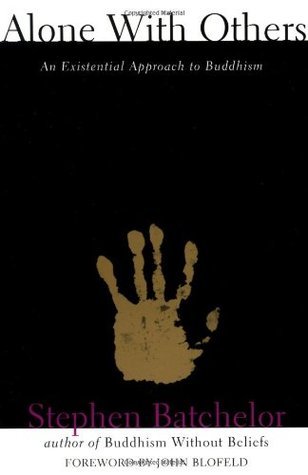
This uniquely contemporary guide to understanding the timeless message of Buddhism, and in particular its relevance in actual human relations, was inspired by Shantideva's 'Guide To The Bodhisattva's Way Of Life', which the author translated into English, the oral instructions of living Buddhist masters, Heidegger's classic 'Being and Time', and the writings of the Christian theologians Paul Tillich and John MacQuarrie.

An essential collection of Stephen Batchelor’s most probing and important work on secular BuddhismAs the practice of mindfulness permeates mainstream Western culture, more and more people are engaging in a traditional form of Buddhist meditation. However, many of these people have little interest in the religious aspects of Buddhism, and the practice occurs within secular contexts such as hospitals, schools, and the workplace. Is it possible to recover from the Buddhist teachings a vision of human flourishing that is secular rather than religious without compromising the integrity of the tradition? Is there an ethical framework that can underpin and contextualize these practices in a rapidly changing world? In this collected volume of Stephen Batchelor’s writings on these themes, the author explores the complex implications of Buddhism’s secularization. Ranging widely—from reincarnation, religious belief, and agnosticism to the role of the arts in Buddhist practice—he offers a detailed picture of contemporary Buddhism and its attempt to find a voice in the modern world.

Kierkegaard said that faith without doubt is simply credulity, the will to believe too readily, especially without adequate evidence, and that “in Doubt can Faith begin.” All people involved in spiritual practice, of whatever persuasion, must confront doubt at one time or another, and find a way beyond it to belief, however temporary. But “faith is not equivalent to mere belief. Faith is the condition of ultimate confidence that we have the capacity to follow the path of doubt to its end. And courage.”In this engaging spiritual memoir, Stephen Batchelor describes his own training, first as a Tibetan Buddhist and then as a Zen practitioner, and his own direct struggles along his path. “It is most uncanny that we are able to ask questions, for to question means to acknowledge that we do not know something. But it is more than an it includes a yearning to confront an unknown and illuminate it through understanding. Questioning is a quest.”Batchelor is a contemporary Buddhist teacher and writer, best known for his secular or agnostic approach to Buddhism. He considers Buddhism to be a constantly evolving culture of awakening rather than a religious system based on immutable dogmas and beliefs. Buddhism has survived for the past 2,500 years because of its capacity to reinvent itself in accord with the needs of the different Asian societies with which it has creatively interacted throughout its history. As Buddhism encounters modernity, it enters a vital new phase of its development. Through his writings, translations and teaching, Stephen engages in a critical exploration of Buddhism's role in the modern world, which has earned him both condemnation as a heretic and praise as a reformer.

The Awakening of the West: The Encounter of Buddhism and Western Culture
by Stephen Batchelor
Rating: 3.8 ⭐
From Greek kings to nineteenth-century adventurers, from missionaries to monks, the encounter of Buddhism and the West is filled with intriguing personalities in Awaking of the West.

A renowned Buddhist teacher turns to two of the most influential figures in history for guidance on how to face the ethical challenges of our time The Buddha’s revolutionary teachings transformed Asia, and his contemporary Socrates laid the foundations of Western philosophy. Although they never met, Socrates and the Buddha each addressed in a radically new and surprisingly similar way the core questions of how to lead a good, just, and dignified life amid turbulence and violence. Common to their teachings was an ethics of both refused to make truth claims about the ultimate nature of reality, insisting on the primacy of critical self‑evaluation as the basis of an ethical life. In this illuminating book, best-selling author Stephen Batchelor explores the philosophical, social, and political worlds of the Buddha and Socrates, showing how their teachings continue to provide lessons in how to lead a flourishing and engaged life. Keenly aware of the fickle and conflicted nature of the human mind, Gotama and Socrates inspired their followers to act with humility and courage, risk and resolve, doubt and confidence. Drawing on their insights, and those of their followers, Batchelor uncovers a middle way between Buddhist dharma and Greek philosophy that can serve as a starting point for a “secular faith” that addresses the most pressing spiritual and planetary issues of our age.

A concise discussion of the similarities between eastern and western thought on flight, refuge, and return. Batchelor starts with a description of the existentialist conception of Flight (as described by Heidegger and Sartre) as state of being arising from our anxiety towards our death; this escape mechanism drives us away from awareness of our Being and into the labyrinth of particular entities. He argues that this forms the allegorical substance of the story of the Siddartha's path to enlightenment, and thereby provides a bridge for the western thinker to cross over towards the wisdom of the Dharma.

The "best available companion for travelers to Tibet"--The New York Times Review of Books

Before it was a religion, a culture, or even a system of meditation, what was Buddhism? On Buddhism Without Beliefs, celebrated teacher, translator, and former Buddhist monk Stephen Batchelor takes us back to the first years after the Buddha's awakening to reveal the root insights of Buddhism hidden beneath centuries of history and interpretation.In eight compelling sessions of self-inquiry - including many fascinating exercises and practices - we learn how to awaken and refine our senses, introduce the essential spirit of curiosity into the practice of awareness, and comprehend with both our hearts and our minds the Buddha's astonishing (and often misunderstood) revelations on emptiness, compassion, and the self. Before he died, the Buddha did not appoint a successor. He simply remarked that each of us must be responsible for our own freedom.Buddhism without Beliefs is an invitation to hear what the Buddha taught - and to trust yourself on your own path to liberation.
![(- American Hen Buddhism from the world) a pointer to the awakening and freedom for the modern people - the practice of Dharma (2002) ISBN: 4884051327 [Japanese Import]](https://m.media-amazon.com/images/S/compressed.photo.goodreads.com/books/1678235288i/76998222.jpg)

Buddhas langer Weg nach Europa: 2500 Jahre der Begegnung von Buddhismus und europäischer Kultur
by Stephen Batchelor

Buddhism Without Beliefs: A Contemporary Guide to Awakening by Stephen Batchelor
by Stephen Batchelor
Confession of a Buddhist Atheist [HC,2010]
by Stephen Batchelor

Buddha, Socrates and Us: Ethical Living in Uncertain Times
by Stephen Batchelor
A renowned Buddhist teacher turns to two of the most influential figures in history for guidance on how to face the ethical challenges of our timeThe Buddha’s revolutionary teachings transformed Asia, and his contemporary Socrates laid the foundations of Western philosophy. Although they never met, Socrates and the Buddha each addressed in a radically new and surprisingly similar way the core questions of how to lead a good, just, and dignified life amid turbulence and violence. Common to their teachings was an ethics of both refused to make truth claims about the ultimate nature of reality, insisting on the primacy of critical self‑evaluation as the basis of an ethical life.In this illuminating book, best-selling author Stephen Batchelor explores the philosophical, social, and political worlds of the Buddha and Socrates, showing how their teachings continue to provide lessons in how to lead a flourishing and engaged life. Keenly aware of the fickle and conflicted nature of the human mind, Gotama and Socrates inspired their followers to act with humility and courage, risk and resolve, doubt and confidence. Drawing on their insights, and those of their followers, Batchelor uncovers a middle way between Buddhist dharma and Greek philosophy that can serve as a starting point for a “secular faith” that addresses the most pressing spiritual and planetary issues of our age.
By Rider The Psychology Of Awakening: Buddhism, Science and Our Day-to-day Lives Paperback - October 1999
by Stephen Batchelor