
Sinclair Lewis
Novelist Harry Sinclair Lewis satirized middle-class America in his 22 works, including Babbitt (1922) and Elmer Gantry (1927) and first received a Nobel Prize for literature in 1930. Middle-class values and materialism attach unthinking George F. Babbitt, the narrow-minded, self-satisfied main character person in the novel of Sinclair Lewis. People awarded "his vigorous and graphic art of description and his ability to create, with wit and humor, new types of characters." He knowingly, insightfully, and critically viewed capitalism and materialism between the wars. People respect his strong characterizations of modern women. Henry Louis Mencken wrote, "[If] there was ever a novelist among us with an authentic call to the trade...it is this red-haired tornado from the Minnesota wilds." https://en.wikipedia.org/wiki/Sinclai...
30 Books Written

It Can’t Happen Here is the only one of Sinclair Lewis’s later novels to match the power of Main Street, Babbitt, and Arrowsmith. A cautionary tale about the fragility of democracy, it is an alarming, eerily timeless look at how fascism could take hold in America. Written during the Great Depression, when the country was largely oblivious to Hitler’s aggression, it juxtaposes sharp political satire with the chillingly realistic rise of a president who becomes a dictator to save the nation from welfare cheats, sex, crime, and a liberal press. Called “a message to thinking Americans” by the Springfield Republican when it was published in 1935, It Can’t Happen Here is a shockingly prescient novel that remains as fresh and contemporary as today’s news.Includes an Introduction by Michael Meyerand an Afterword by Gary Scharnhorst

Babbitt is a satirical novel about American culture and society that critiques the vacuity of middle class life and the social pressure toward conformity. The controversy provoked by Babbitt was influential in the decision to award the Nobel Prize in Literature to Lewis in 1930.
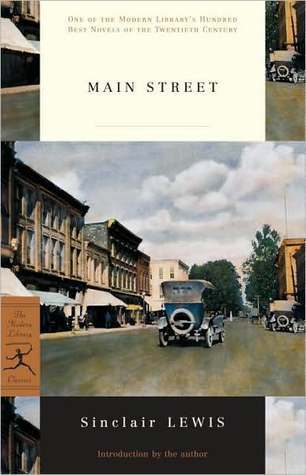
With Commentary by E. M. Forster, Dorothy Parker, H. L. Mencken, Lewis Mumford, Rebecca West, Sherwood Anderson, Malcolm Cowley, Alfred Kazin, Constance Rourke, and Mark Schorer. Main Street, the story of an idealistic young woman's attempts to reform her small town, brought Lewis immediate acclaim when it was published in 1920. It remains one of the essential texts of the American scene. Lewis Mumford observed: "In Main Street an American had at last written of our life with something of the intellectual rigor and critical detachment that had seemed so cruel and unjustified [in Charles Dickens and Matthew Arnold]. Young people had grown up in this environment, suffocated, stultified, helpless, but unable to find any reason for their spiritual discomfort. Mr. Lewis released them." Sinclair Lewis (1885-1951), was born in Sauk Centre, Minnesota and graduated from Yale in 1907. In 1930 he became the first American recipient of the Nobel Prize in Literature. Main Street (1920) was his first critical and commercial success. Lewis's other noted books include Babbitt (1922), Arrowsmith (1925), Elmer Gantry (1927), Dodsworth (1929), and It Can't Happen Here (1935).'

Arrowsmith is often described as the first "scientific" novel. The books explores medical and scientific themes in a fictional way and it is difficult to think of an earlier book that does this. Although he was not a doctor, Sinclair Lewis's father was and he was greatly helped in the preparation of the manuscript by the science writer Paul de Kruif. It was de Kruif who brings a reality to the book that is almost biographical.This reality means that the books heralds the real impact of advances in drugs, public health, and immunology that were about to change the world. It also satirises those medical and scientific practitioners whose pursuit of fame and fortune, at the expense of truth, remains just as pertinent today.The book was first published in 1925 and was a popular and commercial success. It was awarded a Pulitzer Prize in 1926 which was refused by Sinclair Lewis. He was later to win the Nobel Prize for Literature—which he accepted.

Universally recognized as a landmark in American literature, Elmer Gantry scandalized readers when it was first published, causing Sinclair Lewis to be "invited" to a jail cell in New Hampshire and to his own lynching in Virginia. His portrait of a golden-tongued evangelist who rises to power within his church--a saver of souls who lives a life of duplicity, sensuality, and ruthless self-indulgence--is also the record of a period, a reign of grotesque vulgarity, which but for Lewis would have left no trace of itself. Elmer Gantry has been called the greatest, most vital, and most penetrating study of hypocrisy that has been written since the works of Voltaire.

Yielding to the wishes of his spoiled wife, a wealthy American industrialist abandons his ideals to enter the frivolous world of European high society

A neglected tour de force by the first American to win the Nobel Prize in literature, Kingsblood Royal is a stirring and wickedly funny portrait of a man who resigns from the white race. When Neil Kingsblood, a typical middle-American banker with a comfortable life, makes the shocking discovery that he has African blood, the odyssey that ensues creates an unforgettable portrayal of two Americas, one black, one white. As timely as when it was first published in 1947, one need only open today's newspaper to see the same issues passionately being discussed between blacks and whites that we find in Kingsblood Royal, says Charles Johnson. Perhaps only now can we fully appreciate Sinclair Lewis's astonishing achievement.

Fame was just around the corner when Sinclair Lewis published Free Air in 1919, a year before Main Street . The latter novel zeroed in on the town of Gopher Prairie; the former stopped there briefly and then took the reader by automobile in search of America. Free Air heads toward a West that was brimming with possibilities for suddenly mobile Americans at the end of a world war. The vehicle in Lewis’s novel, not a Model T but a Gomez-Dep roadster, takes Claire Boltwood and her father from Minnesota to Seattle, exposing them all to the perils of early motoring. On the road, the upper-crust Boltwoods are at once more insignificant and more noble. The greatest distance to be overcome is the social one between Claire and a young mechanic named Milt, who, with a cat as his traveling companion, follows close behind. If Free Air anticipates many of the themes of Lewis’s later novels, it also looks forward to a genre that includes John Steinbeck’s Travels with Charley and Josh Greenfeld and Paul Mazursky’s Harry and Tonto . And the character of Claire, blazing her own trail across the West, looks back to the nineteenth-century pioneer woman and ahead to the independent-minded movie heroines played by Katherine Hepburn. In his introduction Robert E. Fleming discusses the place of this early novel in Lewis’s canon.

In Main Street and Babbitt, Sinclair Lewis drew on his boyhood memories of Sauk Centre, Minnesota, to reveal as no writer had done before the complacency and conformity of middle-class life in America. The remarkable novels presented here in this Library of America volume combine brilliant satire with a lingering affection for the men and women, who, as Lewis wrote of Babbitt, "want "to seize something more than motor cars and a house before it's too late.""Main Street (1920), Lewis's first triumph, was a phenomenal event in American publishing and cultural history. Lewis's idealistic, imaginative heroine, Carol Kennicott, longs "to get [her] hands on one of those prairie towns and make it beautiful," but when her doctor husband brings her to Gopher Prairie, she finds that the romance of the American frontier has dwindled to the drab reality of the American Middle West. Carol first struggles against and then flees the social tyrannies and cultural emptiness of Gopher Prairie, only to submit at last to the conventions of village life. The great romantic satire of its decade, Main Street is a wry, sad, funny account of a woman who attempts to challenge the hypocrisy and narrow-mindedness of her community."I know of no American novel that more accurately presents the real America," wrote H.L. Mencken when Babbitt appeared in 1922. "As an old professor of Babbittry I welcome him as an almost perfect specimen. Every American city swarms with his brothers. He is America incarnate, exuberant and exquisite."In the character of George F. Babbitt, the boisterous, vulgar, worried, gadget-loving real estate man from Zenith, Lewis fashioned a new and enduring figure in American literature—the total conformist. Babbitt is a "joiner," who thinks and feels with the crowd. Lewis surrounds him with a gallery of familiar American types—small businessman, Rotarians, Elks, boosters, supporters of evangelical Christianity. In biting satirical scenes of club lunches, after-dinner speeches, trade association conventions, fishing trips and Sunday School committees, Lewis reproduces the noisy restlessness of American commercial culture.In 1930 Sinclair Lewis was the first American to be awarded the Nobel Prize in Literature, largely for his achievement in Babbitt. These early novels not only define a crucial period in American history—from America's "coming of age" just before World War I to the dizzying boom of the twenties—they also continue to astonish us with essential truths about the country we live in today.

This novel was written late in the career of Sinclair Lewis, it explores themes of love, marriage, heartache, trust & redemption in a small Minnesota town.

This scarce antiquarian book is a facsimile reprint of the original. Due to its age, it may contain imperfections such as marks, notations, marginalia and flawed pages. Because we believe this work is culturally important, we have made it available as part of our commitment for protecting, preserving, and promoting the world's literature in affordable, high quality, modern editions that are true to the original work.

Some reviewers were outraged by Ann Vickers when it first appeared in 1933. "Persons unused to horrid and filthy things had better stay at a safe distance from this book," wrote one. Lewis's Ann Vickers is a complex character: a strong-minded prison superintendent dedicated to enlightened social reform, she also seeks to fulfill herself as a sexual being. Ann Vickers is in all respects her own person, standing up to the confining rules of her society.

This scarce antiquarian book is a facsimile reprint of the original. Due to its age, it may contain imperfections such as marks, notations, marginalia and flawed pages. Because we believe this work is culturally important, we have made it available as part of our commitment for protecting, preserving, and promoting the world's literature in affordable, high quality, modern editions that are true to the original work.

He stands out in the correspondence of the Souvenir and Art Novelty Company as "Our Mr. Wrenn," who would be writing you directly and explaining everything most satisfactorily. At thirty-four Mr. Wrenn was the sales-entry clerk of the Souvenir Company.

A burned-out New York lawyer's vacation in the Canadian wilderness takes a troubled detour in this novel by the Nobel Prize-winning author of Main Street.Lawyer Frank Prescott is exhausted. The forty-year-old bachelor works late into the night, poring over documents. When he sleeps, he wakes up in a panic. Not even a round of golf at his country club or a Broadway show helps calm him down. He just wants to escape the city and feel as though he can breathe again. So, when his fellow club member, E. Wesson Woodbury, invites him along on a canoeing and fishing trip in Saskatchewan, Prescott gladly accepts.However, nothing about the excursion is relaxing. As the journey begins, tensions mount and tempers flare between Prescott and Woodbury. When they meet the rugged Joe Easter, a Canadian trading company owner, the man welcomes Prescott to fish at his home in Mantrap Landing. Prescott is happy to join him. But between Easter's lonely wife, unrest among the area's indigenous Cree tribes, and a dangerous race down the rapids, getting back home safely will be the only thing that can calm Frank Prescott's nerves . . .

This volume contains Sinclair Lewis' 1915 novel, "The Trail of the Hawk: A Comedy of the Seriousness of Life." The story revolves around the life of Carl Ericson and follows him through his early life to maturity. This humorous and masterfully-written novel will appeal to those with a penchant for the comic, and it is not to be missed by fans and collectors of Sinclair's work. Harry Sinclair Lewis (1885 - 1951) was an American novelist, short-story writer, and playwright. He became the first American author to receive the Nobel Prize in Literature in 1930. Many vintage texts such as this are increasingly scarce and expensive, and it is with this in mind that we are republishing this book now, in an affordable, high-quality, modern edition. It comes complete with a specially commissioned biography of the author.

Written at the height of his powers in the 1920s, the three novels in this volume continue the vigorous unmasking of American middle-class life begun by Sinclair Lewis in Main Street and Babbitt. In Arrowsmith (1925) Lewis portrays the medical career of Martin Arrowsmith, a physician who finds his commitment to the ideals of his profession tested by the cynicism and opportunism he encounters in private practice, public health work, and scientific research. The novel reaches its climax as its hero faces his greatest challenges amid a deadly outbreak of plague on a Caribbean island.Elmer Gantry (1927) aroused intense controversy with its brutal depiction of a hypocritical preacher in relentless pursuit of worldly pleasure and power. Through his satiric expos? of American religion, Lewis captured the growing cultural and political tension in the 1920s between the forces of secularism and fundamentalism.Dodsworth (1929) follows Sam Dodsworth, a wealthy, retired Midwestern automobile manufacturer, as he travels through Europe with his increasingly restless wife, Fran. The novel intimately explores the unraveling of their marriage, while pitting the proud heritage of European culture against the rude vigor of American commercialism.

After the accident killed his wife, Hayden Chart felt it was time he really learned about life. Florence was the first city to capture his desire for culture and knowledge and knowledge. He also reveled in the cold beauty of Dr. Olivia Lomond, an authority on all things Italian.Sinclair Lewis (1885-1951) was an American novelist, short-story writer & playwright. In 1930, he became the first American to be awarded the Nobel Prize in Literature, "for his vigorous & graphic art of description and his ability to create, with wit & humor, new types of characters." His works are known for their insightful & critical views of American society & capitalist values, as well as their strong characterizations of modern working women. His final novel World So Wide,/i> (1951) was published posthumously.

Amidst Sinclair Lewis€™s many remarkable novels are more than a hundred short stories which he wrote over forty-four years. Selected Short Stories contains those selected by Lewis himself for a 1935 edition and illustrates the wide range of his art and tales of romantic fantasy or escape, melodramas of heroic or mock-heroic adventure, boy-meets-girl stories, satires of pretension and folly, and tales of isolation and loneliness. Lewis often played variations on themes more fully developed in his novels. In his introduction, James W. Tuttleton calls Lewis €œan excellent storyteller with an enviable command of narrative€¦At his best Lewis€™s short stories, like his novels, accomplish the remarkable feat described by E.M. €˜What Mr. Lewis has done for myself and thousands of others is to lodge a piece of a continent in our imagination.€™€

An all-American couple, Mr. and Mrs. Cornplow, rebel against the selfish actions of their college-aged son and daughter.

Sinclair Lewis was the first American to win the Nobel Prize for literature, and remains famous today for his Arrowsmith, Main Street, Elmer Gantry, It Can't Happen Here, Babbitt and Dodsworth.The God-Seeker is Lewis' second-to-last novel. Set in the mid-1800s, it follows the life of Aaron Gadd from boyhood to adulthood, and chronicles his journeys from New England into the American west in his efforts to find and understand God.

Works of Sinclair Lewis. Main Street, Babbitt, The Innocents, The Trail of the Hawk, The Job, Free Air & more.
by Sinclair Lewis
Rating: 4.4 ⭐
Features Navigate from Table of Contents or search for words or phrases Make bookmarks, notes, highlights Searchable and interlinked. Access the e-book anytime, anywhere - at home, on the train, in the subway. Automatic synchronization between the handheld and the desktop PC. You could read half of the book on the handheld, then finish reading on the desktop. Table of Contents BabbittFree AirThe InnocentsThe JobMain StreetOur Mr. WrennThe Trail of the Hawk AppendixSinclair Lewis BiographyAbout and Navigation

The Willow Walk is a short story by Sinclair Lewis. Harry Sinclair Lewis (February 7, 1885 - January 10, 1951) was an American novelist, short-story writer, and playwright. In 1930, he became the first writer from the United States to receive the Nobel Prize in Literature, which was awarded "for his vigorous and graphic art of description and his ability to create, with wit and humor, new types of characters." His works are known for their insightful and critical views of American capitalism and materialism between the wars. He is also respected for his strong characterizations of modern working women. H.L. Mencken wrote of him, "[If] there was ever a novelist among us with an authentic call to the trade ... it is this red-haired tornado from the Minnesota wilds." He has been honored by the U.S. Postal Service with a Great Americans series postage stamp. Lewis's earliest published creative work-romantic poetry and short sketches-appeared in the Yale Courant and the Yale Literary Magazine, of which he became an editor. After graduation Lewis moved from job to job and from place to place in an effort to make ends meet, write fiction for publication and to chase away boredom. While working for newspapers and publishing houses (and for a time at the Carmel-by-the-Sea, California writers' colony), he developed a facility for turning out shallow, popular stories that were purchased by a variety of magazines. He also earned money by selling plots to Jack London, including one for the latter's unfinished novel The Assassination Bureau, Ltd. Lewis's first published book was Hike and the Aeroplane, a Tom Swift-style potboiler that appeared in 1912 under the pseudonym Tom Graham. Sinclair Lewis's first serious novel, Our Mr. Wrenn: The Romantic Adventures of a Gentle Man, appeared in 1914, followed by The Trail of the Hawk: A Comedy of the Seriousness of Life (1915) and The Job (1917). That same year also saw the publication of another potboiler, The Innocents: A Story for Lovers, an expanded version of a serial story that had originally appeared in Woman's Home Companion. Free Air, another refurbished serial story, was published in 1919.


Harry Sinclair Lewis (1885 - 1951) was an American novelist, short-story writer, and playwright. In 1930, he became the first writer from the United States to receive the Nobel Prize in Literature, which was awarded "for his vigorous and graphic art of description and his ability to create, with wit and humor, new types of characters." His works are known for their insightful and critical views of American capitalism and materialism between the wars. He is also respected for his strong characterizations of modern working women.

A brand-new collection of Sinclair Lewis's prolific body of short fiction, focusing on the author's primary the issue of class, work and money in America.


The Man Who Knew Coolidge: Being the Soul of Lowell Schmaltz, Constructive and Nordic Citizen
by Sinclair Lewis
Rating: 3.5 ⭐
1927. A collection of works from the Nobel prize winning novelist. Contents: The Man Who Knew Coolidge; The Story by Mack McMack; You Know How Women Are; You Know How Relatives Are; Travel is So Broadening; and The Basic and Fundamental Ideals of Christian American Citizenship.

Sinclair Lewis's Collected Works is contained 11 works written by Sinclair Lewis (February 7, 1885 – January 10, 1951) was an American novelist, short-story writer, and plays who won the Nobel Prize for Literature in 1930.These are the 11 works of Sinclair Lewis in this book. 1.The Ghost Patrol (1917)2.Young Man Axelbrod (1917)3.The Willow Walk (1918) 4.The Cat of the Stars (1919)5.Things (1919)6.Speed (1919)7.The Kidnaped Memorial (1919)8.Moths in the Arc Light (1919)9.Free Air (1919)10.Main Street (1920) 11.Babbitt (1922)

Anthony Di Renzo makes available for the first time since their original publication some eighty years ago a collection of fifteen of Sinclair Lewis’s early business stories. Among Lewis’s funniest satires, these stories introduce the characters, themes, and techniques that would evolve into Babbitt. Each selection reflects the commercial culture of Lewis’s day, particularly Reason Why advertising, self-help manuals, and the business fiction of the Saturday Evening Post. The stories were published between October 1915 and May 1921 (nine in the Saturday Evening Post, four in Metropolitan Magazine, one in Harper’s Magazine, and one in American Magazine). Because some things have not changed in the American workplace since Lewis’s day, these highly entertaining and unflinchingly accurate office satires will appeal to the fans of Dilbert and The Drew Carey Show. In a sense, they provide lay readers with an archaeology of white-collar angst and regimentation. The horror and absurdities of contemporary corporate downsizing already existed in the office of the Progressive Era. For an audience contemplating the death of the American middle class, Lewis’s stories provide an important retrospective on earlier times and a preliminary autopsy on the American dream. Appearing just in time to celebrate the seventy-fifth anniversary of the publication of Babbitt, this collection rescues Lewis’s best early short fiction from obscurity, provides extensive information about his formative years in advertising and public relations, and analyzes both his genius for marketing and his carefully cultivated persona as the Great Salesman of American letters.