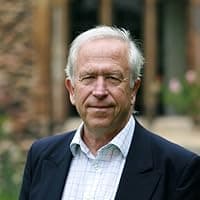
Simon Blackburn
Librarian Note: There is more than one author by this name in the Goodreads database. Simon Blackburn FBA is an English academic philosopher known for his work in metaethics, where he defends quasi-realism, and in the philosophy of language; more recently, he has gained a large general audience from his efforts to popularise philosophy. He retired as the professor of philosophy at the University of Cambridge in 2011, but remains a distinguished research professor of philosophy at the University of North Carolina at Chapel Hill, teaching every fall semester. He is also a Fellow of Trinity College, Cambridge, and a member of the professoriate of New College of the Humanities. He was previously a Fellow of Pembroke College, Oxford and has also taught full-time at the University of North Carolina as an Edna J. Koury Professor. He is a former president of the Aristotelian Society, having served the 2009–2010 term. He was elected a Fellow of the British Academy in 2002 and a Foreign Honorary Fellow of the American Academy of Arts & Sciences in 2008.
24 Books Written
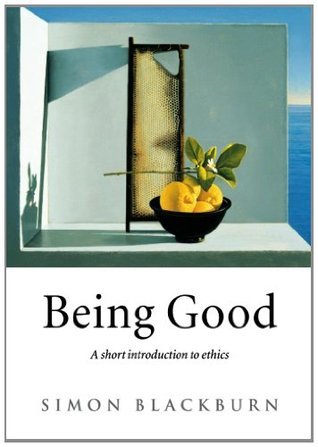
Writing with wit and elegance, Simon Blackburn tackles the basic questions of ethics in this lively book, highlighting the complications and troubling issues that spring from the very simple question of how we ought to live. Blackburn dissects the many common reasons for why we are skeptical about ethics. Drawing on examples from history, politics, religion and everyday personal experience, he sho

Here at last is a coherent, unintimidating introduction to the challenging and fascinating landscape of Western philosophy. Written expressly for "anyone who believes there are big questions out there, but does not know how to approach them," Think provides a sound framework for exploring the most basic themes of philosophy, and for understanding how major philosophers have tackled the questions t

Simon Blackburn puts forward a compelling and original philosophy of human motivation and morality. Why do we behave as we do? Can we improve? Is our ethics at war with our passions, or is it an upshot of those passions? Blackburn seeks the answers to such questions in an exploration of the nature of moral emotions and the structures of human motivation. He develops a naturalistic ethics, which in

This volume collects some influential essays in which Simon Blackburn, one of our leading philosophers, explores one of the most profound and fertile of philosophical the way in which our judgments relate to the world. This debate has centered on realism, or the view that what we say is validated by the way things stand in the world, and a variety of oppositions to it. Prominent among the latter a

The author of the highly popular book Think , which Time magazine hailed as "the one book every smart person should read to understand, and even enjoy, the key questions of philosophy," Simon Blackburn is that rara avis --an eminent thinker who is able to explain philosophy to the general reader. Now Blackburn offers a tour de force exploration of what he calls "the most exciting and engaging issu

In this book, Simon Blackburn provides a route into the central problems of modern philosophy of language. The text is designed not to give the student a superficial acquaintance with well-known writers and their results, but to foster a genuine appreciation of the problems which have dominated the area, and of the place these problems have in a wider philosophical context. Individual chapters on

Lust, says Simon Blackburn, is furtive, headlong, always sizing up opportunities. It is a trail of clothing in the hallway, the trashy cousin of love. But be that as it may, the aim of this delightful book is to rescue lust "from the denunciations of old men of the deserts, to deliver it from the pallid and envious confessor and the stocks and pillories of the Puritans, to drag it from the categor

Comprehensive and authoritative the Dictionary of Philosophy contains over 2,500 entries, including biographies of nearly 500 influential philosophers. The dictionary provides wide-ranging and lively coverage of not only Western philosophical traditions, but also themes from Chinese, Indian,Islamic, and Jewish philosophy. This clear and easy to use reference also contains in-depth analysis o

Plato is perhaps the most significant philosopher who has ever lived and The Republic , composed in Athens in about 375 BC, is widely regarded as his most famous dialogue. Its discussion of the perfect city — and the perfect mind — laid the foundations for Western culture and, for over two thousand years, has been the cornerstone of Western philosophy. As the distinguished Cambridge professor S

Simon Blackburn Philosophy Set: Consisting of Simon Blackburn's Truth, Being Good, and Think
by Simon Blackburn
Rating: 2.8 ⭐
Written by the leading philosopher Simon Blackburn, Think is a coherent, unintimidating introduction to the challenging and fascinating landscape of Western philosophy. In Being Good, Blackburn tackles the basic questions of ethics, highlighting the complications and troubling issues that spring from the very simple question of how we ought to live. Finally, Truth illuminates "the most exciting an

An original study of the philosophical problems associated with inductive reasoning. Like most of the main questions in epistemology, the classical problem of induction arises from doubts about a mode of inference used to justify some of our most familiar and pervasive beliefs. The experience of each individual is limited and fragmentary, yet the scope of our beliefs is much wider; and it is the r

David Hume is generally recognized as England's greatest philosopher, as well as a notable historian and essayist. Yet his work is delicately poised between scepticism and naturalism, between despair at the limited powers of the mind and optimism at the progress we can make by understanding it. This difficult balancing act has given rise to a multitude of different interpretations: reading Hume ha

The Big Questions series is designed to let renowned experts confront the 20 most fundamental and frequently asked questions of a major branch of science or philosophy. Each 3000-word essay simply and concisely examines a question that has eternally perplexed enquiring minds, and provides answers from history's great thinkers. This ambitious project is a unique distillation of humanity's best idea

The Blackburn Philosophy Set: Consisting of Think: A Compelling Introduction to Philosophy and Truth:A Guide
by Simon Blackburn
Rating: 3.0 ⭐
Simon Blackburn is that rara avis --an eminent thinker who is able to explain philosophy to the general reader. Now you can own his two coherent, unintimidating introductions to the challenging and fascinating landscape of Western philosophy, Think and Truth . Offered together for the first time, these fantastic guides make a gift for anyone interested in the questions that shape the world.

Simon Blackburn presents a selection of his philosophical essays from 1995 to 2010. He offers engaging and illuminating discussions of various problems which arise when such familiar notions as representation, truth, reason, and assertion are applied in the sphere of practical thought. It is puzzling how our thinking gets to grip with such things as values and norms. Blackburn explores how we can


From the author of Think , an enlightening and entertaining exploration of narcissism and self-esteemEveryone deplores narcissism, especially in others. The vain are by turns annoying or absurd, offending us whether they are blissfully oblivious or proudly aware of their behavior. But are narcissism and vanity really as bad as they seem? Can we avoid them even if we try? In Mirror, Mir

A Little Book of Quotes from Karl Marx
by Simon Blackburn
This book presents a collection of over 350 quotes from Karl Marx – as well as from his friend and collaborator, Frederick Engels – drawing on such major works as 'The Communist Manifesto' (1848), 'Capital' (1867), 'The Poverty of Philosophy' (1847), and 'Critique of the Gotha Programme' (1875). Additionally, a range of newspaper articles, personal correspondence, pamphlets and other manuscripts h

As with all animals, the decision to keepone as a pet, should only be done after dueconsideration is given to the thought process.Taking the time to gather a lot of knowledge on thesubject and the availability of the supporting toolsthat would be needed for the comfort of the animalchosen should be the priority. Get all the info youneed here.

Ideas in Small Introductions to Big TopicsTruth has always been a thorny topic. How does it work? Who decides what it is? And why is it seen as so important? In this lucid introduction to the topic, leading scholar Simon Blackburn describes the main approaches to the notion of truth and considers how these relate to different perspectives on belief, interpretation, facts, knowledge and action. He

Truth is not just a recent topic of contention. Arguments about it have gone on for centuries. Why is the truth important? Who decides what the truth is? Is there such a thing as objective, eternal truth, or is truth simply a matter of perspective, of linguistic or cultural vantage point? In this concise book Simon Blackburn provides an accessible explanation of what truth is and how w
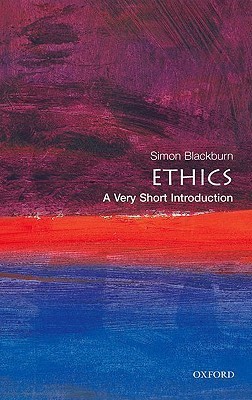
Our self-image as moral, well-behaved creatures is dogged by scepticism, relativism, hypocrisy, and nihilism, by the fear that in a Godless world science has unmasked us as creatures fated by our genes to be selfish and tribalistic, or competitive and aggressive. In this clear introduction to ethics Simon Blackburn tackles the major moral questions surrounding birth, death, happiness, desire and f


This important book is about truth, and the enemies of truth, and the wars that are fought between them. As Simon Blackburn says in his introduction, "the ground is complicated, strewn with abandoned fortresses and trenches, fought over by shifting alliances". Truth is an essential sure-footed guide through the territory, from classical to modern times. It looks at relativism and absolutism, toler