
Siegfried Sassoon
Siegfried Loraine Sassoon, CBE was born into a wealthy banking family, the middle of 3 brothers. His Anglican mother and Jewish father separated when he was five. He had little subsequent contact with ‘Pappy’, who died of TB 4 years later. He presented his mother with his first ‘volume’ at 11. Sassoon spent his youth hunting, cricketing, reading, and writing. He was home-schooled until the age of 14 because of ill health. At school he was academically mediocre and teased for being un-athletic, unusually old, and Jewish. He attended Clare College, Cambridge, but left without taking his degree. In 1911, Sassoon read ‘The Intermediate Sex’ by Edward Carpenter, a book about homosexuality which was a revelation for Sassoon. In 1913 he wrote ‘The Daffodil Murderer,’ a parody of a John Masefield poem and his only pre-war success. A patriotic man, he enlisted on 3rd August, the day before Britain entered the war, as a trooper in the Sussex Yeomanry. After a riding accident which put him out of action, in May 1915 he joined the Royal Welch Fusiliers as a second lieutenant. At the training depot he met David Thomas, with whom he fell in love. In November Sassoon received word that his brother Hamo had died at Gallipoli. On 17th Nov he was shipped to France with David Thomas. He was assigned to C Company, First Battalion. It was here that he met Robert Graves, described in his diary as ‘a young poet in Third Battalion and very much disliked.’ He took part in working parties, but no combat. He later became transport officer and so managed to stay out of the front lines. After time on leave, on the 18th of May, 1916 he received word that David Thomas had died of a bullet to the throat. Both Graves and Sassoon were distraught, and in Siegfried’s case it inspired ‘the lust to kill.’ He abandoned transport duties and went out on patrols whenever possible, desperate to kill as many Germans as he could, earning him the nickname ‘Mad Jack.’ In April he was recommended for the Military Cross for his action in bringing in the dead and wounded after a raid. He received his medal on the day before the Somme. For the first days of the Somme, he was in reserve opposite Fricourt, watching the slaughter from a ridge. Fricourt was successfully taken, and on the 4th July the First Battalion moved up to the front line to attack Mametz Wood. It was here that he famously took a trench single handed. Unfortunately, Siegfried did nothing to consolidate the trench; he simply sat down and read a book, later returning to a berating from Graves. It was in 1917, convalescing in 'Blighty' from a wound, that he decided to make a stand against the war. Encouraged by pacifist friends, he ignored his orders to return to duty and issued a declaration against the war. The army refused to court martial him, sending him instead to Craiglockhart, an institution for soldiers driven mad by the war. Here he met and influenced Wilfred Owen. In 1918 he briefly returned to active service, in Palestine and then France again, but after being wounded by friendly fire he ended the war convalescing. He reached the rank of captain. After the war he made a predictably unhappy marriage and had a son, George. He continued to write, but will be remembered as a war poet.
29 Books Written

Siegfried Sassoon - Counter-Attack & Other Poems: 'The visionless officialized fatuity, That once kept Europe safe for Perpetuity''
by Siegfried Sassoon
Rating: 4.0 ⭐
• 2 recommendations ❤️
Siegfried Loraine Sassoon was born on 8th September 1886. Sassoon was educated at the New Beacon School, Sevenoaks, Kent then Marlborough College, Wiltshire and finally at Clare College, Cambridge, where from 1905 to 1907 he read history. He went down from Cambridge without a degree and spent the next few years indulging himself hunting, playing cricket and writing verse. However, motivated by patriotism, Sassoon joined the Sussex Yeomanry of the British Army as the threat of war escalated into open conflict. His early poems exhibit a Romantic, dilettantish sweetness but his war poetry moves to an increasingly discordant beat, stridently conveying the ugly truths of the trenches to an audience hitherto placated by jingoistic and patriotic propaganda. Sassoon’s periods of duty on the Western Front were marked by near-suicidal missions, including the single-handed capture of a German trench. Armed with grenades, he scattered sixty German soldiers. In 1919 took up a post as literary editor of the socialist Daily Herald. Here he was responsible for employing several eminent reviewers, including E. M. Forster and Charlotte Mew. Sassoon also commissioned new material from the likes of Arnold Bennett and Osbert Sitwell. Sassoon was now, in 1928, preparing to take a new direction by branching out into prose, with ‘Memoirs of a Fox-Hunting Man’. This anonymously published first volume of a fictionalised autobiography, was acclaimed as a classic, bringing its author fame as a humorous writer. Other volumes including his own autobiography based on his youth and early manhood across three volumes followed. In his last years Sassoon converted to Roman Catholicism and was admitted to the faith at Downside Abbey in Somerset. Siegfried Loraine Sassoon, CBE, MC died from stomach cancer on 1st September 1967, a week before his 81st birthday.

Siegfried Sassoon, who lived through World War One and who died in 1967, was, as the introduction to this book tells us, irritated in his later years at always being thought of as a "war poet". Understandable perhaps from the point of view of the poet: readers on the other hand might wish to demur. The poems gathered here and chronologically ordered, thereby tracing the course of the war, are an extraordinary testimony to the almost unimaginable experiences of a combatant in that bitter conflict. Moving from the patriotic optimism of the first few poems (" ... fighting for our freedom, we are free") to the anguish and anger of the later work (where "hope, with furtive eyes and grappling fists / Flounders in mud ... "), there comes a point when the reality of trench-warfare and its aftershocks move beyond comprehension: Sassoon knows this, and it becomes a powerful element in his art. As a book, the images have a cumulative relentlessness that make it almost impossible to read more than a few poems in one sitting. Unlike the avant-garde experiments developing in Europe in the first decades of this century, Sassoon's verse is formally conservative--but this was perhaps necessary, for as one reads the poems, one feels that the form, the classically inflected tropes, the metre and rhyme, apart from ironising the rhetoric of glory and battle were necessary techniques for containing the emotion (and indeed, a tone of barely controlled irony may have been the only means by which these angry observations would have been considered publishable at the time). When Sassoon's line begins to fragment, as it does in several of the later poems, it is under the extreme pressure to express the inexpressible. Compassion and sympathy are omnipresent here, in their full etymological sense of suffering with or alongside others--something the higher echelons of command (those " ... old men who died / Slow, natural deaths--old men with ugly souls") were never able or willing to contemplate. But Sassoon intuited the future of warfare, could sense that this was not "the war to end all wars": the mock-religious invocation of the final poem prefigures the vicious euphemisms of more recent conflicts: "Grant us the power to prove, by poison gases, / The needlessness of shedding human blood." Sassoon's bile-black irony signals a deep-felt pessimism: it was with good reason. --Burhan Tufail

An irreverent look at British military leaders during WW1, written by the Hawthornden-Prize winning author.

A highly decorated English soldier and an acclaimed poet and novelist, Siegfried Sassoon won fame for his trilogy of fictionalized autobiographies that wonderfully capture the vanishing idylls of Edwardian England and the brutal realities of war. In this first novel of the semiautobiographical George Sherston trilogy, Sassoon wonderfully captures the vanishing idylls of the Edwardian English countryside. Never out of print since its original publication in 1928, when it won the James Tait Black Memorial Prize, Sassoon's reminiscences about childhood and the beginning of World War I are channeled through young George Sherston, whose life of local cricket tournaments and fox-hunts falls apart as war approaches and he joins up to fight. Sassoon's first novel, though rife with comic characters and a jaunty sense of storytelling, presents his own loss of innocence and the destruction of the country he knew and loved.Memoirs Of A Fox-Hunting Man Siegfried Sassoon Early Days - The Flower Show Match - A Fresh Start - A Day With the Potford - At the Rectory - The Colonel's Cup - Denis Milden as Master -Migration of the Midlands - In the Army - At the front Originally published in 1928.


The Complete Memoirs of George Sherston includes "Sherston's Progress" and both "Memoirs,"
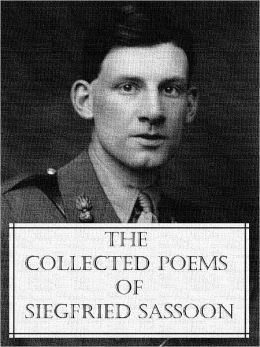
This collection of Siegfried Sassoon's poetry contains 2 collections of poems--War Poems and Counter Attack--totaling 103 poems! It includes an active table of contents for smooth navigation and has been formatted for optimal viewing on the Nook! The collection includes:War Poems, including:PRELUDE: THE TROOPSDREAMERSTHE REDEEMERTRENCH DUTYWIRERSBREAK OF DAYA WORKING PARTYSTAND-TO: GOOD FRIDAY MORNING"IN THE PINK"THE HEROBEFORE THE BATTLETHE ROADTWO HUNDRED YEARS AFTERTHE DREAMAT CARNOYBATTALION RELIEFTHE DUG-OUTTHE REAR-GUARDI STOOD WITH THE DEADSUICIDE IN TRENCHESATTACKCOUNTER-ATTACKTHE EFFECTREMORSEIN AN UNDERGROUND DRESSING-STATIONDIED OF WOUNDS"THEY"BASE DETAILSLAMENTATIONSTHE GENERALHOW TO DIEEDITORIAL IMPRESSIONFIGHT TO A FINISHATROCITIESTHE FATHERS"BLIGHTERS"GLORY OF WOMENTHEIR FRAILTYDOES IT MATTER?SURVIVORSJOY-BELLSARMS AND THE MANWHEN I'M AMONG A BLAZE OF LIGHTS …THE KISSTHE TOMBSTONE-MAKERTHE ONE-LEGGED MANRETURN OF THE HEROESTWELVE MONTHS AFTERTO ANY DEAD OFFICERSICK LEAVEBANISHMENTAUTUMNREPRESSION OF WAR EXPERIENCETOGETHERTHE HAWTHORN TREECONCERT PARTYNIGHT ON THE CONVOYA LETTER HOMERECONCILIATIONMEMORIAL TABLETTHE DEATH-BEDAFTERMATHSONG-BOOKS OF THE WAREVERYONE SANGCounter Attack, including:PRELUDE: THE TROOPSCOUNTER-ATTACKTHE REAR-GUARDWIRERSATTACKDREAMERSHOW TO DIETHE EFFECTTWELVE MONTHS AFTERTHE FATHERSBASE DETAILSTHE GENERALLAMENTATIONSDOES IT MATTER?FIGHT TO A FINISHEDITORIAL IMPRESSIONSSUICIDE IN THE TRENCHESGLORY OF WOMENTHEIR FRAILTYTHE HAWTHORN TREETHE INVESTITURETRENCH DUTYBREAK OF DAYTO ANY DEAD OFFICERSICK LEAVEBANISHMENTSONG-BOOKS OF THE WARTHRUSHESAUTUMNINVOCATIONREPRESSION OF WAR EXPERIENCETHE TRIUMPHSURVIVORSJOY-BELLSREMORSEDEAD MUSICIANSTHE DREAMIN BARRACKSTOGETHER

Siegfried's Journey 1916-1920


The distinguished poet depicts his childhood in a country house in Kent and his experiences at Cambridge University

The author describes his activities as a sportsman, his involvement in the London literary circle, and the beginnings of his career as a poet

An illustrated selection from Siegfried Sassoon's "The Complete Memoirs of George Sherston" as complied by Paul Fussell.


This scarce antiquarian book is a facsimile reprint of the original. Due to its age, it may contain imperfections such as marks, notations, marginalia and flawed pages. Because we believe this work is culturally important, we have made it available as part of our commitment for protecting, preserving, and promoting the world's literature in affordable, high quality, modern editions that are true to the original work.

75p navy cloth, from a Cambridge college library, spine rubbed, pages unmarked, binding firm, index, very good condition

, 304 pages including index at rear


This work has been selected by scholars as being culturally important and is part of the knowledge base of civilization as we know it.This work is in the public domain in the United States of America, and possibly other nations. Within the United States, you may freely copy and distribute this work, as no entity (individual or corporate) has a copyright on the body of the work.Scholars believe, and we concur, that this work is important enough to be preserved, reproduced, and made generally available to the public. To ensure a quality reading experience, this work has been proofread and republished using a format that seamlessly blends the original graphical elements with text in an easy-to-read typeface.We appreciate your support of the preservation process, and thank you for being an important part of keeping this knowledge alive and relevant.


The General and other poems: First world war poetry by Siegfried Sassoon
by Siegfried Sassoon
Rating: 4.3 ⭐
This new edition of poems draws from poems published during and shortly after the First World War by Siegfried Sassoon and offers a unique insight into his evolution as a poet with an introduction on his wartime experiences which prompted him to write his famous Soldier's Declaration and tracing the progress of his poetry from naive patriotism on the eve of war to something darker. As well as his most well known war poems, several early poems are included illustrating his early naïve ignorance of the terrible reality of war, prior to the death of his brother in 1915 and his experiences at the front, and then the full text of Sassoon's A Soldier's Declaration, which marks his break with the military authorities. Such was the uproar caused by his statement, which was read aloud in parliament and published in The Times in 1917, that he was afterwards diagnosed with shell shock and incarcerated in a hospital at Craiglockhart in Edinburgh, where he continued to write and where he was to meet, and greatly influence, the young Wilfred Owen. Poems included in this edition are: Absolution A Letter Home The Hero The Poet as Hero The General Attack Counter-Attack The Rear-Guard Wirers The Humbled Heart Prelude: The Troops Dreamers How to die The Effect A Soldier's Declaration The Fathers Lamentations Suicide in the trenches Does it matter? Fight to a finish Editorial Impression Glory of women Their frailty The Hawthorn Tree The Investiture Trench Duty Break of day To any dead officer Sick leave Banishment Song-books of the war Thrushes Autumn Invocation Repression of war experience The Triumph Joy Bells Remorse Dead Musicians The Dream In Barracks Conscripts Together Survivors Everyone Sang
The Road The road is thronged with women; soldiers pass And halt, but never see them; yet they’re here— A patient crowd along the sodden grass, Silent, worn out with waiting, sick with fear. The road goes crawling up a long hillside, All ruts and stones and sludge, and the emptied dregs Of battle thrown in heaps. Here where they died Are stretched big-bellied horses with stiff legs, And dead men, bloody-fingered from the fight, Stare up at caverned darkness winking white. You in the bomb-scorched kilt, poor sprawling Jock, You tottered here and fell, and stumbled on, Half dazed for want of sleep. No dream would mock Your reeling brain with comforts lost and gone. You did not feel her arms about your knees, Her blind caress, her lips upon your head. Too tired for thoughts of home and love and ease, The road would serve you well enough for bed.
Edited by Rupert Hart-Davis.
A collection of autobiographical pieces from the author's childhood, war service, and later life.
45p blue hardback, gilt titles, December 1928 third impression in very good condition, boards fresh with just a faded spine, text bright and clean, a little foxing to endpapers

Lacks DJ, Black cloth, embossed title on front, Gilted label title on spine. Corners bumped and lightly frayed. Some light pencil markings to text esle good, Frontispiece portrait of Meredith.

Sassoon was an English war poet during WWI.Decorated for bravery on the Western Front.