
Seymour M. Hersh
Seymour (Sy) Myron Hersh is an American Pulitzer Prize-winning investigative journalist and author based in Washington, D.C. He is a regular contributor to The New Yorker magazine on military and security matters. He has also won two National Magazine Awards and is a "five-time Polk winner and recipient of the 2004 George Orwell Award." He first gained worldwide recognition in 1969 for exposing the My Lai Massacre and its cover-up during the Vietnam War, for which he received the 1970 Pulitzer Prize for International Reporting. His 2004 reports on the US military's mistreatment of detainees at Abu Ghraib prison gained much attention.
23 Books Written

If the Kennedys are America's royal family, then John F. Kennedy was the nation's crown prince. Magnetic, handsome, and charismatic, his perfectly coifed image overshadowed the successes and failures of his presidency, and his assassination cemented his near-mythological status in American culture and politics. Struck down in his prime, he represented the best and the brightest of America's future, and when he died, part of the nation's promise and innocence went with him. That, at least, is the public version of the story.The private version, according to Pulitzer Prize-winning journalist Seymour M. Hersh, is quite different. His meticulous investigation of Kennedy has revealed a wealth of indiscretions and malfeasance, ranging from frequent liaisons with prostitutes and mistresses to the attempted assassination of Fidel Castro to involvement in organized crime. Though scandals in the White House are nothing new, Hersh maintains that Kennedy's activities went beyond minor abuses of power and personal indulgences: they threatened the security of the nation--particularly in the realm of foreign policy--and the integrity of the office. Hersh believes it was only a matter of time before Kennedy's dealings were exposed, and only his popularity and charm, compounded by his premature death, spared such an investigation for so long. Exposure was further stalled by Bobby Kennedy's involvement in nefarious dealings, enabling him to bury any investigation of his brother and--by extension--himself.Based on interviews with former Kennedy administration officials, former Secret Service agents, and hundreds of Kennedy's personal friends and associates, The Dark Side of Camelot rewrites the history of John F. Kennedy and his presidency.

Seymour Hersh's fearless reporting has earned him fame, front-page bylines in virtually every major newspaper in the free world, honors galore, and no small amount of controversy. Now in this memoir he describes what drove him and how he worked as an independent outsider, even at the nation's most prestigious publications. He tells the stories behind the stories--riveting in their own right--as he chases leads, cultivates sources, and grapples with the weight of what he uncovers, daring to challenge official narratives handed down from the powers that be. In telling these stories, Hersh divulges previously unreported information about some of his biggest scoops, including the My Lai massacre and the horrors at Abu Ghraib. There are also illuminating recollections of some of the giants of American politics and journalism: Ben Bradlee, A. M. Rosenthal, David Remnick, and Henry Kissinger among them. This is essential reading on the power of the printed word at a time when good journalism is under fire as never before.
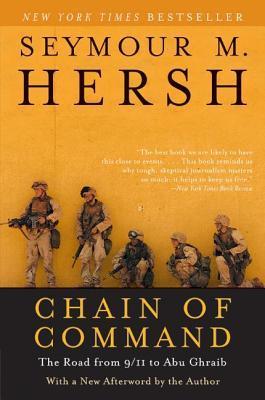
Since September 11, 2001, Seymour M. Hersh has riveted readers -- and outraged the Bush Administration -- with his explosive stories in The New Yorker , including his headline-making pieces on the abuse of prisoners at Abu Ghraib. Now, Hersh brings together what he has learned, along with new reporting, to answer the critical question of the last four How did America get from the clear morning when two planes crashed into the World Trade Center to a divisive and dirty war in Iraq? In Chain of Command , Hersh takes an unflinching look behind the public story of the war on terror and into the lies and obsessions that led America into Iraq. Hersh draws on sources at the highest levels of the American government and intelligence community, in foreign capitals, and on the battlefield for an unparalleled view of a critical chapter in America's recent history. In a new afterword, he critiques the government's failure to adequately investigate prisoner abuse -- at Abu Ghraib and elsewhere -- and punish those responsible. With an introduction by The New Yorker 's editor, David Remnick, Chain of Command is a devastating portrait of an administration blinded by ideology and of a president whose decisions have made the world a more dangerous place for America.

Electrifying investigation of White House lies about the assassination of Osama bin LadenIn 2011, an elite group of US Navy SEALS stormed an enclosure in the Pakistani city of Abbottabad and killed Osama bin Laden, the man the United States had begun chasing before the devastating attacks of 9/11. The news did much to boost President Obama’s first term and played a major part in his reelection victory of the following year. But much of the story of that night, as presented to the world, was incomplete, or a lie. The evidence of what actually went on remains hidden.At the same time, the full story of the United States’ involvement in the Syrian civil war has been kept behind a diplomatic curtain, concealed by doublespeak. It is a policy of obfuscation that has compelled the White House to turn a blind eye to Turkey’s involvement in supporting ISIS and its predecessors in Syria.This investigation, which began as a series of essays in the London Review of Books, has ignited a firestorm of controversy in the world media. In his introduction, Hersh asks what will be the legacy of Obama’s time in office. Was it an era of “change we can believe in” or a season of lies and compromises that continued George W. Bush’s misconceived War on Terror? How did he lose the confidence of the general in charge of America’s forces who acted in direct contradiction to the White House? What else do we not know?

The story of the Vietnam war atrocity as told by Pulitzer winning journalist Seymour M. Hersh who traveled more than 50,000 miles around the United States and interviewed nearly fifty members of Charlie Company to write this book.

s/t: Israel's Nuclear Arsenal & American Foreign PolicyAn investigation into Israel's nuclear capabilities discloses information about the country's rush toward nuclear status, its collaboration with South Africa and Iran, and its espionage activities. Reprint. NYT

Price of Power examines Henry Kissinger’s influence on the development of the foreign policy of the United States during the presidency of Richard Nixon.

The Soviet destruction in 9/1983 of 269 people aboard Korean Air Lines Flight 007 was one of the most upsetting crises of the Cold War era. The USA & USSR immediately blamed one another for the disaster; but, as Hersh powerfully argues, responsibility went far beyond ordinary governmental decision making & into the murky sphere of superpower intelligence calculations & confusion. He asserts that the catastrophe followed more from Soviet ignorance than viciousness, & that the whole episode demonstrates how the superpowers are more interested in gaining political advantage than the truest understanding of events. Hersh cannot provide a final recounting of this complex crisis. But he does show how one critical thinker can provide a more believable reconstruction of events than can any self-interested governmental regime.--Library Journal

"Why did the system fail the Gulf War veterans? Did national heroes such as Norman Schwarzkopf and Colin Powell, who were known during their careers for taking care of their troops, have an obligation to speak out on behalf of the veterans--as many sick GIs believe--and demand that America's military hospitals stop turning them away? The unsettling fact is that the Gulf War was far more costly to the United States than the Pentagon and its former leaders are willing to acknowledge. The ninety thousand or so victims of Gulf War syndrome are friendly-fire casualties just as surely as if they had been fired upon by their fellow soldiers. The military's inevitable dilemma is Can it protect our soldiers and sailors in future wars if it was unable to do so in the Gulf War?"--from AGAINST ALL ENEMIES

The Pulitzer Prize winner who first disclosed the massacre at My Lai 4 uncovers the full story of how those involved - from private to general - kept it secret. What he reveals is shocking - from the amorphous but very real "West Point Protective Association" to the fact that an extensive but closed investigation by the Army itself covered up another massacre by the same unit on the same morning.

"This comprehensive and thoroughly documented investigation of chemical and biological warfare (CBW) and America's prominence in the field is one of those rare books that will make news as well as report it. For the author has lifted the lid of secrecy from this controversy-charged, closely guarded subject to allow public scrutiny for the first time..."—inside cover, 1968

Présente et analyse le plan concocté par le gouvernement américain pour faire face au terrorisme : transformer les agents des services de renseignements en tueurs professionnels alors que l'assassinat d'ennemis des Etats-Unis par des agents secrets était interdit depuis 1976.




The Killing of Osama Bin Laden
by Seymour M. Hersh
The New York Times Magazine
by Seymour M. Hersh

Inconvenient Evidence: Iraqi Prison Photographs from Abu Ghraib
by Seymour M. Hersh
INCONVENIENT EVIDENCE Iraqi Prison Photographs from ABU GHRAIB 2004 Exhibit at the International Center of Photography in New York City, and at the Andy Warhol Museum in Pittsburgh. This 20-page catalog measures approx. 5 3/8" x 6 1/4. Catalogue for an exhibit of Iraqi Prison Photographs from Abu Ghraib in color. Some or most of these revolting and intense snapshots were what caused the Abu Ghraib scandal circa 2004.
The Reporter's Obligation The John Peter Zenger Award For Freedom of the Press and the People's Right to Know 1975
by Seymour M. Hersh
My Lai 4 : A Report on the Massacre and Its Aftermath
by Seymour M. Hersh
The Samson option : Israel’s nuclear arsenal and American foreign policy / Seymour M. Hersh
by Seymour M. Hersh
MY LAI 4 a Report on the Massacre and Its Aftermath
by Seymour M. Hersh
The Price Of Power
by Seymour M. Hersh