
Samuel R. Delany
Samuel Ray Delany, also known as "Chip," is an award-winning American science fiction author. He was born to a prominent black family on April 1, 1942, and raised in Harlem. His mother, Margaret Carey Boyd Delany, was a library clerk in the New York Public Library system. His father, Samuel Ray Delany, Senior, ran a successful Harlem undertaking establishment, Levy & Delany Funeral Home, on 7th Avenue, between 1938 and his death in 1960. The family lived in the top two floors of the three-story private house between five- and six-story Harlem apartment buildings. Delany's aunts were Sadie and Bessie Delany; Delany used some of their adventures as the basis for the adventures of his characters Elsie and Corry in the opening novella Atlantis: Model 1924 in his book of largely autobiographical stories Atlantis: Three Tales. Delany attended the Dalton School and the Bronx High School of Science, during which he was selected to attend Camp Rising Sun, the Louis August Jonas Foundation's international summer scholarship program. Delany and poet Marilyn Hacker met in high school, and were married in 1961. Their marriage lasted nineteen years. They had a daughter, Iva Hacker-Delany (b. 1974), who spent a decade working in theater in New York City. Delany was a published science fiction author by the age of 20. He published nine well-regarded science fiction novels between 1962 and 1968, as well as several prize-winning short stories (collected in Driftglass [1971] and more recently in Aye, and Gomorrah, and other stories [2002]). His eleventh and most popular novel, Dhalgren, was published in 1975. His main literary project through the late 1970s and 1980s was the Return to Nevèrÿon series, the overall title of the four volumes and also the title of the fourth and final book. Delany has published several autobiographical/semi-autobiographical accounts of his life as a black, gay, and highly dyslexic writer, including his Hugo award winning autobiography, The Motion of Light in Water. Since 1988, Delany has been a professor at several universities. This includes eleven years as a professor of comparative literature at the University of Massachusetts at Amherst, a year and a half as an English professor at the University at Buffalo. He then moved to the English Department of Temple University in 2001, where he has been teaching since. He has had several visiting guest professorships before and during these same years. He has also published several books of criticism, interviews, and essays. In one of his non-fiction books, Times Square Red, Times Square Blue (1999), he draws on personal experience to examine the relationship between the effort to redevelop Times Square and the public sex lives of working-class men, gay and straight, in New York City. In 2007, Delany was the subject of a documentary film, The Polymath, or, The Life and Opinions of Samuel R. Delany, Gentleman. The film debuted on April 25 at the 2007 Tribeca Film Festival.
30 Books Written

Alternate cover edition can be found here.Author of the bestselling Dhalgren and winner of four Nebulas and one Hugo, Samuel R. Delany is one of the most acclaimed writers of speculative fiction. Babel-17, winner of the Nebula Award for best novel of the year, is a fascinating tale of a famous poet bent on deciphering a secret language that is the key to the enemy’s deadly force, a task that requires she travel with a splendidly improbable crew to the site of the next attack. For the first time, Babel-17 is published as the author intended with the short novel Empire Star, the tale of Comet Jo, a simple-minded teen thrust into a complex galaxy when he’s entrusted to carry a vital message to a distant world. Spellbinding and smart, both novels are testimony to Delany’s vast and singular talent.

Babel-17 is all about the power of language. Humanity, which has spread throughout the universe, is involved in a war with the Invaders, who have been covertly assassinating officials and sabotaging spaceships. The only clues humanity has to go on are strange alien messages that have been intercepted in space. Poet and linguist Rydra Wong is determined to understand the language and stop the alien threat. (Paul Goat Allen)

Nebula Award Reality has come unglued and a mad civilization takes root in Bellona, in this science fiction classic. A young half–Native American known as the Kid has hitchhiked from Mexico to the midwestern city Bellona—only something is wrong there . . . In Bellona, the shattered city, a nameless cataclysm has left reality unhinged. Into this desperate metropolis steps the Kid, his fist wrapped in razor-sharp knives, to write, to love, to wound. So begins Dhalgren , Samuel R. Delany’s masterwork, which in 1975 opened a new door for what science fiction could mean. A labyrinth of a novel, it raises questions about race, sexuality, identity, and art, but gives no easy answers, in a city that reshapes itself with each step you take . . . This ebook features an illustrated biography of Samuel R. Delany including rare images from his early career.

These are [at least some of] the ways you can read NOVA: as a fast-action farflung interstellar adventure; as archetypal mystical/mythical allegory (in which the Tarot and the Grail both figure prominently); as modern myth told in the S-F idiom... the reader observes, recollects, or participates in a range of personal experience including violent pain and disfigurement, sensory deprivation and overload, man-machine communion, the drug experience, the creative experience - and inter-personal relationships which include incest and assassination, father-son, leader-follower, human-pet, and lots more!The balance of galactic power in the 31st century revolves around Illyrion, the most precious energy source in the universe. The varied and exotic crew who sign up with Captain Lorq van Ray know their mission is dangerous, and they soon learn that they are involved in a deadly race with the charismatic but vicious leader of an opposing space federation. But they have no idea of Lorq's secret obsession: to gather Illyrion at the source by flying through the very heart of an imploding star.

A nonhuman race reimagines human mythology.The Einstein Intersection won the Nebula Award for best science fiction novel of 1967. The surface story tells of the problems a member of an alien race, Lo Lobey, has assimilating the mythology of earth, where his kind have settled among the leftover artifacts of humanity. The deeper tale concerns, however, the way those who are "different" must deal with the dominant cultural ideology. The tale follows Lobey's mythic quest for his lost love, Friza. In luminous and hallucinated language, it explores what new myths might emerge from the detritus of the human world as those who are "different" try to seize history and the day.

The story of a truly galactic civilization with over 6,000 inhabited worlds.Stars in My Pocket Like Grains of Sand is a science fiction masterpiece, an essay on the inexplicability of sexual attractiveness, and an examination of interstellar politics among far-flung worlds. First published in 1984, the novel's central issues--technology, globalization, gender, sexuality, and multiculturalism--have only become more pressing with the passage of time.The novel's topic is information itself: What are the repercussions, once it has been made public, that two individuals have been found to be each other's perfect erotic object out to "point nine-nine-nine and several nines percent more"? What will it do to the individuals involved, to the city they inhabit, to their geosector, to their entire world society, especially when one is an illiterate worker, the sole survivor of a world destroyed by "cultural fugue," and the other is--you!

If one street in America can claim to be the most infamous, it is surely 42nd Street. Between Seventh and Eighth Avenues, 42nd Street was once known for its peep shows, street corner hustlers and movie houses. Over the last two decades the notion of safety-from safe sex and safe neighborhoods, to safe cities and safe relationships-has overcome 42nd Street, giving rise to a Disney store, a children's theater, and large, neon-lit cafes. 42nd Street has, in effect, become a family tourist attraction for visitors from Berlin, Tokyo, Westchester, and New Jersey's suburbs. Samuel R. Delany sees a disappearance not only of the old Times Square, but of the complex social relationships that developed the points of contact between people of different classes and races in a public space. In Times Square Red, Times Square Blue, Delany tackles the question of why public restrooms, peepshows, and tree-filled parks are necessary to a city's physical and psychological landscape. He argues that starting in 1985, New York City criminalized peep shows and sex movie houses to clear the way for the rebuilding of Times Square. Delany's critique reveals how Times Square is being "renovated" behind the scrim of public safety while the stage is occupied by gentrification. Times Square Red, Times Square Blue paints a portrait of a society dismantling the institutions that promote communication between classes, and disguising its fears of cross-class contact as "family values." Unless we overcome our fears and claim our "community of contact," it is a picture that will be replayed in cities across America.
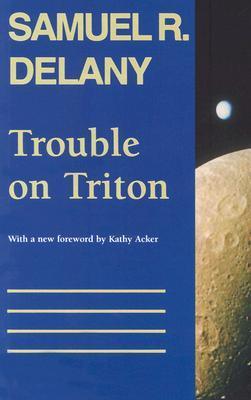
In a story as exciting as any science fiction adventure written, Samuel R. Delany's 1976 SF novel, originally published as Triton, takes us on a tour of a utopian society at war with . . . our own Earth! High wit in this future comedy of manners allows Delany to question gender roles and sexual expectations at a level that, 20 years after it was written, still make it a coruscating portrait of the happily reasonable man, Bron Helstrom -- an immigrant to the embattled world of Triton, whose troubles become more and more complex, till there is nothing left for him to do but become a woman. Against a background of high adventure, this minuet of a novel dances from the farthest limits of the solar system to Earth's own Outer Mongolia. Alternately funny and moving, it is a wide-ranging tale in which character after character turns out not to be what he -- or she -- seems.

In his four-volume series Return to Nevèrÿon, Hugo and Nebula award-winner Samuel R. Delany appropriated the conceits of sword-and-sorcery fantasy to explore his characteristic themes of language, power, gender, and the nature of civilization. Wesleyan University Press has reissued the long-unavailable Nevèrÿon volumes in trade paperback. The eleven stories, novellas, and novels in Return to Nevèrÿon's four volumes chronicle a long-ago land on civilization's brink, perhaps in Asia or Africa, or even on the Mediterranean. Taken slave in childhood, Gorgik gains his freedom, leads a slave revolt, and becomes a minister of state, finally abolishing slavery. Ironically, however, he is sexually aroused by the iron slave collars of servitude. Does this contaminate his mission — or intensify it? Presumably elaborated from an ancient text of unknown geographical origin, the stories are sunk in translators' and commentators' introductions and appendices, forming a richly comic frame.

The Motion of Light in Water: Sex and Science Fiction Writing in the East Village
by Samuel R. Delany
Rating: 4.3 ⭐
Winner of the Hugo Award for Non-fictionThe unexpurgated edition of the award-winning autobiographyBorn in New York City's black ghetto Harlem at the start of World War II, Samuel R. Delany married white poet Marilyn Hacker right out of high school. The interracial couple moved into the city's new bohemian quarter, the Lower East Side, in summer 1961. Through the decade's opening years, new art, new sexual practices, new music, and new political awareness burgeoned among the crowded streets and cheap railroad apartments. Beautifully, vividly, insightfully, Delany calls up this era of exploration and adventure as he details his development as a black gay writer in an open marriage, with tertiary walk-ons by Bob Dylan, Stokely Carmichael, W. H. Auden, and James Baldwin, and a panoply of brilliantly drawn secondary characters.

The classic and controversial novel made available again; Acclaimed winner of the William Whitehead Memorial Award for a lifetime's contribution to gay and lesbian literature, bestselling and award-winning SF author Samuel R. Delany wrote Hogg three decades ago. Since then it has been one of America's most famous 'unpublishable' novels. The subject matter of Hogg is our culture of sexual violence and degeneration. Delany explores his disturbing protagonist Hogg on his own turf - rape, pederasty, sexual excess - exposing an area of violence and sexual abuse from the inside. As such, it is a brave but necessary book. A shocking and contemporary insight into a parallel world of sex and cravings that lies in wait in the shadows of our own world.

On a habitable moon near Tau Ceti, a young man named Comet Jo encounters a devil-kitten and sees a spaceship crash land. One of the people in the spaceship tells Jo that he has to take an urgent message to Empire Star, and dies. Another collapses to form Jewel, a compact, multicolored, multiplexed crystalline entity. Empire Star is the story of Comet Jo's journey to deliver the message, as narrated by Jewel.

A father must come to terms with his son's death in the war. In Venice an architecture student commits a crime of passion. A white southern airport loader tries to do a favor for a black northern child. The ordinary stuff of ordinary fiction--but with a difference! These tales take place twenty-five, fifty, a hundred-fifty years from now, when men and women have been given gills to labor under the sea. Huge repair stations patrol the cables carrying power to the ends of the earth. Telepathic and precocious children so passionately yearn to visit distant galaxies that they'll kill to go. Brilliantly crafted, beautifully written, these are Samuel Delany's award-winning stories, like no others before or since.

Centuries ago, the Star Folk had left Earth on twelve spaceships on a generations-long mission to colonize the distant stars. Ten of the ships had reached their destinations. Two had failed-and nobody, in the hundreds of years since the disaster, had the slightest inkling of what had happened. ~ ~~ ~ Joneny, a student of galactic anthropology, was assigned the problem. It had seemed routine to him. Just some faster-than-light travel to the two wrecked ships, a bit of poking around, and then writing up his findings. ~ ~~ ~ But he was ill-prepared for what he found in space at the site of the two ancient wrecks. One, the Sigma-9, was not subject to the laws of time-stasis (the only exception to a universal law), and it was covered entirely with a mysterious green fire that shimmered so much that it seemed alive! And the other ship, the Beta-2, was nowhere to be found. Only a fragment of a mysterious poem could possibly provide a clue.

Why?From Ganymede to Gomorrah, a bizarre breed of planet-hopping humans sell their sexless, neutered bodies... so that others may explore the outer limits of sexual perversion.Far beneath the surface of the planet earth, a doomed architect lives out the rest of his years in a hideous life-sustaining coffin... in a world where not dying is the ultimate form of punishment.And in a remote outpost near Canada, a lone cluster of Hell's Angels prepare for the final battle with a society which demands that all men share in the good life... whether they want to or not.This is the universe of Samuel R. Delany. Rooted in the present, projected into the future, it is an existence where anything can happen—and does!Contents:• The Star Pit• Dog in a Fisherman’s Net• Corona• Aye, and Gomorrah• Driftglass• We, in Some Strange Power’s Employ, Move on a Rigorous Line• Cage of Brass• High Weir• Time Considered as a Helix of Semi-Precious Stones• Night and the Loves of Joe Dicostanzo

One of the most universally acclaimed first novels in science fiction--by the man who become one of the most stellar writers in the genre's history. On the orders of Argo, the White Goddess, an itinerant poet and his three companions journey to the island of Aptor. Their mission: to seize a jewel from the dark god Hama and bring it back home. With this precious stone Argo may defeat the malign forces gathered against her and the land of Leptor. But, as the group presses deep into the enigmatic heart of Aptor, easy distinctions between good and evil blur, and somehow the task seems less straightforward. For Argo already owns two of the jewels, and possession of the third would give her unqualified power.And, as the four friends already know, power corrupts and absolute power corrupts absolutely.

In his four-volume series Return to Nevèrÿon, Hugo and Nebula award-winner Samuel R. Delany appropriated the conceits of sword-and-sorcery fantasy to explore his characteristic themes of language, power, gender, and the nature of civilization. Wesleyan University Press has reissued the long-unavailable Nevèrÿon volumes in trade paperback. The eleven stories, novellas, and novels in Return to Nevèrÿon's four volumes chronicle a long-ago land on civilization's brink, perhaps in Asia or Africa, or even on the Mediterranean. Taken slave in childhood, Gorgik gains his freedom, leads a slave revolt, and becomes a minister of state, finally abolishing slavery. Ironically, however, he is sexually aroused by the iron slave collars of servitude. Does this contaminate his mission — or intensify it? Presumably elaborated from an ancient text of unknown geographical origin, the stories are sunk in translators' and commentators' introductions and appendices, forming a richly comic frame.

Come and enter Samuel Delany’s tomorow, in this trilogy of high adventure, with acrobats and urchins, criminals and courtiers, fishermen and factory-workers, madmen and mind-readers, dwarves and ducheses, giants and geniuses, merchants and mathematicians, soldiers and scholars, pirates and poets, and a gallery of aliens who fly, crawl, burrow, or swim.

Essential reading for the creative writer.Award-winning novelist Samuel R. Delany has written a book for creative writers to place alongside E. M. Forster's Aspects of the Novel and Lajos Egri's Art of Dramatic Writing. Taking up specifics (When do flashbacks work, and when should you avoid them? How do you make characters both vivid and sympathetic?) and generalities (How are novels structured? How do writers establish serious literary reputations today?), Delany also examines the condition of the contemporary creative writer and how it differs from that of the writer in the years of Hemingway, Fitzgerald, and the high Modernists. Like a private writing tutorial, About Writing treats each topic with clarity and insight. Here is an indispensable companion for serious writers everywhere.

Award-winning science fiction author Samuel Delany and Dennis, a homeless New Yorker selling books from a blanket, discover sexual joy and explode stereotypes while exploring the possibilities for compassion and acceptance in this moving graphic novel -- all the more touching because it's true.
In his four-volume series Return to Nevèrÿon, Hugo and Nebula award-winner Samuel R. Delany appropriated the conceits of sword-and-sorcery fantasy to explore his characteristic themes of language, power, gender, and the nature of civilization. Wesleyan University Press has reissued the long-unavailable Nevèrÿon volumes in trade paperback. The eleven stories, novellas, and novels in Return to Nevèrÿon's four volumes chronicle a long-ago land on civilization's brink, perhaps in Asia or Africa, or even on the Mediterranean. Taken slave in childhood, Gorgik gains his freedom, leads a slave revolt, and becomes a minister of state, finally abolishing slavery. Ironically, however, he is sexually aroused by the iron slave collars of servitude. Does this contaminate his mission — or intensify it? Presumably elaborated from an ancient text of unknown geographical origin, the stories are sunk in translators' and commentators' introductions and appendices, forming a richly comic frame.
In his four-volume series Return to Nevèrÿon, Hugo and Nebula award-winner Samuel R. Delany appropriated the conceits of sword-and-sorcery fantasy to explore his characteristic themes of language, power, gender, and the nature of civilization. Wesleyan University Press has reissued the long-unavailable Nevèrÿon volumes in trade paperback. The eleven stories, novellas, and novels in Return to Nevèrÿon's four volumes chronicle a long-ago land on civilization's brink, perhaps in Asia or Africa, or even on the Mediterranean. Taken slave in childhood, Gorgik gains his freedom, leads a slave revolt, and becomes a minister of state, finally abolishing slavery. Ironically, however, he is sexually aroused by the iron slave collars of servitude. Does this contaminate his mission — or intensify it? Presumably elaborated from an ancient text of unknown geographical origin, the stories are sunk in translators' and commentators' introductions and appendices, forming a richly comic frame.

For his thesis, graduate student John Marr researches the life and work of the brilliant Timothy Hasler--a philosopher whose career was cut tragically short over a decade earlier. Marr encounters numerous obstacles as other researchers turn up evidence of Hasler's personal life that is deemed simply too unpleasant and disillusioning for the rarified air of academe. On another front, Marr finds himself increasingly drawn toward more shocking, depraved sexual entanglements with the homeless men of his neighborhood, until it begins to seem that Hasler's death might hold some key to his own life as a gay man in the age of AIDS. As John Marr learns more about the enigma that was Timothy Hasler, his own increasing sexual debasement leads him to a point where his and the philosopher's lives collide violently...

Arnold Hawley, a gay, African–American poet, has lived in NYC for most of his life. Dark Reflections traces Hawley's life in three sections — in reverse order. Part one: Hawley, at 50 years old, wins the an award for his sixth book of poems. Part two explores Hawley's unhappy marriage, while the final section recalls his college days. Dark Reflections, moving back and forth in time, creates an extraordinary meditation on social attitudes, loneliness, and life's triumphs.

A distant world that is similar to prehistoric Earth is home to the Winged Ones of Hi-Vator, a fun-loving race that experiences the ultimate sexual pleasure while in the air. Reprint.

From the four-time Nebula Award–winning author, an indispensable work of science fiction criticism, revised and expanded.Samuel R. Delany’s The Jewel-Hinged Jaw appeared originally in 1977, and is now long out of print and hard to find. The impact of its demonstration that science fiction was a special language, rather than just gadgets and green-skinned aliens, began reverberations still felt in science fiction criticism. This edition includes two new essays, one written at the time and one written about those times, as well as an introduction by writer and teacher Matthew Cheney, placing Delany’s work in historical context. Close textual analyses of Thomas M. Disch, Ursula K. Le Guin, Roger Zelazny, and Joanna Russ read as brilliantly today as when they first appeared. Essays such as “About 5,750 Words” and “To Read The Dispossessed” first made the book a classic; they assure it will remain one.“Delany’s first work of non-fiction, The Jewel Hinged Notes on the Language of Science Fiction , remains a benchmark of sf criticism thirty-three years after its initial publication in 1977. . . . Extensively revised and reissued in 2009, JHJ has become even stronger, containing twelve essays in ten chapters and two appendixes.” —Isiah Lavender, Science Fiction Studies“I re-read The Jewel-Hinged Jaw every year as a source of guidance, as a measure of what all criticism and literature should aspire to be, and as a challenge for those of us who want to write.” —Junot Díaz, Pulitzer Prize–winning author of The Brief Wondrous Life of Oscar Wao“What a joy it is to have The Jewel-Hinged Jaw back in print! These essays glitter with insights into writing, reading, society, and the multiple relationships of the three.” —Reginald Shepherd, author of Orpheus in the Bronx

Cultural Writing. Memoir. HEAVENLY BREAKFAST is Samuel R. Delaney's wise and vivid essay on urban communes and cooperatives in the winter of 'Sixty-seven/'Sixty-eight. It examines their function, structure, permanence, and impermanence as precisely as a sociological study. Because its method is narrative and anecdotal, however, it reads like a passionate memoir--a marvelous document from an extraordinary time. Based on journals he kept at the time, these pages recount his encounters with other communes and experimental living arrangements-some gentle, some brutal; of encounters between those inside and those outside the countercultural life; of idealism and hopes pushing against a resistant reality.

"Samuel R. Delany is not only one of the most profound and courageous writers at work today, he is a writer of seemingly limitless range."—Michael CunninghamA vast river of a novel alive with explicit sexuality and the richness of life itself, Through the Valley of the Nest of Spiders concerns a gay, working-class, interracial relationship. In 2007, just before Eric's seventeenth birthday, his father brings him to Diamond Harbor, a failing tourist town on the Georgia coast, to live with his mother. There Eric meets nineteen-year-old Morgan Haskell, who works with his father, Dynamite Haskell, and the two boys soon join their lives—and their bodies—together on the coast as a couple over the next seventy-five years.The author of more than forty books, Samuel R. Delany is a novelist and critic whose novel Dhalgren has sold over a million copies. He is a recipient of the William Whitehead Memorial Award for a Lifetime Contribution to Gay and Lesbian Writing and the Lambda Literary Pioneer Award. He is a professor of English and creative writing at Temple University in Philadelphia.

La trilogia di Samuel R. Delany: "La caduta delle torri", viene presentata integralmente, per la prima volta in Italia, dalla Longanesi & C. La versione originale è divisa nei seguenti titolo: "La città morta", "Le torri di Toron" e "La città dei ttà dei Mille Soli". Dopo il primo, anche gli altri, fedelmente tradotti, verranno pubblicati entro pochi mesi in questa collana. Il ciclo, nella sua completezza, è stato paragonato da critici e scrittori alla "Fondazione" di Asimov e a "Dune" di Herbert e costituisce, dunque, un autentico classico della fantascienza

Cover Artists: Greg and Tim Hildebrandt