
Roger L. Martin
Roger Martin is the Institute Director of the Martin Prosperity Institute and the Michael Lee-Chin Family Institute for Corporate Citizenship at the Rotman School of Management and the Premier’s Chair in Productivity & Competitiveness. From 1998 to 2013, he served as Dean. Previously, he spent 13 years as a Director of Monitor Company, a global strategy consulting firm based in Cambridge, Massachusetts, where he served as co-head of the firm for two years. His research work is in Integrative Thinking, Business Design, Strategy, Corporate Social Responsibility and Country Competitiveness. He writes extensively and is a regular contributor to: Harvard Business Review’s The Conversation blog, the Financial Times’ Judgment Call column, and the Guardian Sustainable Business. He has written 24 Harvard Business Review articles and published 10 books: Getting Beyond Better (with Sally Osberg); Harvard Business Review Press (HBRP, 2015); Playing to Win (with A.G. Lafley) (HBRP, 2013); Fixing the Game (HBRP, 2011); The Design of Business (HBRP, 2009); The Opposable Mind (HBRP, 2007); The Responsibility Virus (Basic Books, 2002); Canada: What It Is, What It Can Be (with Jim Milway, Rotman-UTP Publishing, 2012); and Diaminds (with Mihnea Moldoveanu, University of Toronto Press, 2009), and The Future of the MBA (with Mihnea Moldoveanu, Oxford University Press, 2008). In addition, he co-edited Rotman on Design (with Karen Christensen, Rotman-UTP Publishing, 2013). In 2013, Roger placed 3rd on the Thinkers50 list, a biannual ranking of the most influential global business thinkers, moving up from 6th in 2011 and 32nd in 2009. In 2010, he was named one of the 27 most influential designers in the world by Business Week. In 2007 he was named a Business Week 'B-School All-Star' for being one of the 10 most influential business professors in the world. Business Week also named him one of seven 'Innovation Gurus' in 2005. He serves on a number of public service boards: Skoll Foundation, Canadian Credit Management Foundation, Tennis Canada (past chair), and Bridgespan Group (academic advisory board chair). A Canadian from Wallenstein, Ontario, Roger received his AB from Harvard College, with a concentration in Economics, in 1979 and his MBA from the Harvard Business School in 1981.
15 Books Written

When More Is Not Better: Overcoming America's Obsession with Economic Efficiency
by Roger L. Martin
Rating: 3.8 ⭐
• 2 recommendations ❤️
American democratic capitalism is in imminent danger. More than forty years ago, a dangerous decline began that has created an unprecedented state of economic disparity. While the rich are getting richer faster than ever, the middle-class family has fallen so far behind it would take three generations to recover – perhaps even longer in the wake of the COVID-19 pandemic. The moment to rethink our economy and embark on a journey to repair our broken system is now. Roger L. Martin – former Dean of the Rotman School of Management and the world’s #1 management thinker (Thinkers50) – believes the problem is that we view our economy as a machine that can be perfected by pursuing increasing levels of efficiency. In his new book When More Is Not Better, Martin argues that we have relentlessly pursued efficiency at the expense of resilience, turning efficiency into a destructive force that has produced an unequal society and a fragile economy. That fragility makes our economy more vulnerable to shocks and brutally undermines our capacity to deal with catastrophic events like the pandemic.In the book, Martin reveals the dark side of efficiency, providing evidence, rigorous economic analysis, and insight to demonstrate that our constant effort to make the economic machine more efficient means fewer bigger winners and plenty left behind.

The Opposable Mind: How Successful Leaders Win Through Integrative Thinking
by Roger L. Martin
Rating: 3.7 ⭐
If you want to be as successful as Jack Welch, Larry Bossidy, or Michael Dell, read their autobiographical advice books, right? Wrong, says Roger Martin in The Opposable Mind . Though following best practice can help in some ways, it also poses a danger. By emulating what a great leader did in a particular situation, you'll likely be terribly disappointed with your own results. Why? Your situation is different. Instead of focusing on what exceptional leaders do, we need to understand and emulate how they think. Successful businesspeople engage in what Martin calls integrative thinking, creatively resolving the tension in opposing models by forming entirely new and superior ones. Drawing on stories of leaders as diverse as AG Lafley of Procter & Gamble, Meg Whitman of eBay, Victoria Hale of the Institute for One World Health, and Nandan Nilekani of Infosys, Martin shows how integrative thinkers are relentlessly diagnosing and synthesizing by asking probing questions including: What are the causal relationships at work here? and What are the implied trade-offs? Martin also presents a model for strengthening your integrative thinking skills by drawing on different kinds of knowledge including conceptual and experiential knowledge. Integrative thinking can be learned, and The Opposable Mind helps you master this vital skill.

The Design of Business: Why Design Thinking is the Next Competitive Advantage
by Roger L. Martin
Rating: 3.9 ⭐
Most companies today have innovation envy. They yearn to come up with a game—changing innovation like Apple's iPod, or create an entirely new category like Facebook. Many make genuine efforts to be innovative—they spend on R&D, bring in creative designers, hire innovation consultants. But they get disappointing results.Why? In The Design of Business, Roger Martin offers a compelling and provocative answer: we rely far too exclusively on analytical thinking, which merely refines current knowledge, producing small improvements to the status quo.To innovate and win, companies need design thinking. This form of thinking is rooted in how knowledge advances from one stage to another—from mystery (something we can't explain) to heuristic (a rule of thumb that guides us toward solution) to algorithm (a predictable formula for producing an answer) to code (when the formula becomes so predictable it can be fully automated). As knowledge advances across the stages, productivity grows and costs drop-creating massive value for companies.Martin shows how leading companies such as Procter & Gamble, Cirque du Soleil, RIM, and others use design thinking to push knowledge through the stages in ways that produce breakthrough innovations and competitive advantage.Filled with deep insights and fresh perspectives, The Design of Business reveals the true foundation of successful, profitable innovation.

If you could imagine the ultimate guide to the essentials of strategy and management, from one of the world's top business thinkers, what would that look like?It would look like this book. Over a stellar career, Roger Martin has advised CEOs of some of the world's most successful companies. From the beginning, he noted that almost every executive he talked to had a "model"—a framework or way of thinking that guided their strategy and activities. But these models tended to become automatic, so much so that when one didn't work, the response was typically to just apply it again—with greater enthusiasm.Martin took a fresh, critical approach to helping. When company leaders came to him with fundamental questions—How do you decide where to play and how to win? What is the key to shaping and changing corporate culture? How can you design a successful, sustainable innovation process?—his first response was to break the spell of the current model with a memo articulating a new way to think about the problem at hand, and a more powerful and effective way to successfully overcome it.Over time, these ideas worked their way into Martin's many Harvard Business Review articles. Now, for the first time, they appear together in A New Way to Think. With his trademark incisive intellect and clarity, Martin covers the entire breadth of the management landscape—illuminating the true nature of competition, explaining how company success revolves around customers, revealing how strategy and execution are really the same thing, and much more.Reading like a series of one-on-one sessions with one of the world's leading business thinkers, A New Way to Think is an essential primer for any current or aspiring business leader.
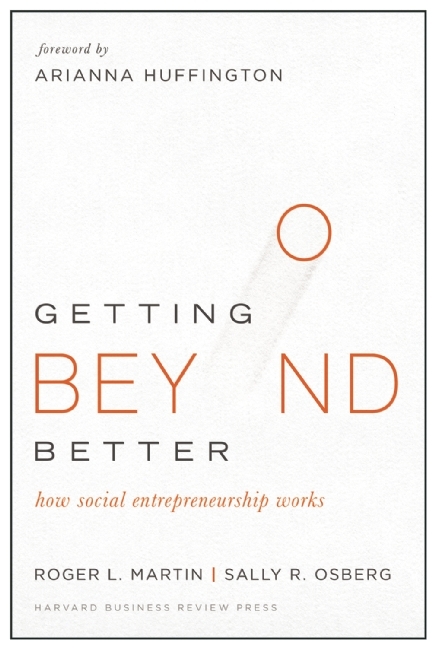
Who drives transformation in society? How do they do it? In this compelling book, strategy guru Roger L. Martin and Skoll Foundation President and CEO Sally R. Osberg describe how social entrepreneurs target systems that exist in a stable but unjust equilibrium and transform them into entirely new, superior, and sustainable equilibria. All of these leaders--call them disrupters, visionaries, or changemakers--develop, build, and scale their solutions in ways that bring about the truly revolutionary change that makes the world a fairer and better place. The book begins with a probing and useful theory of social entrepreneurship, moving through history to illuminate what it is, how it works, and the nature of its role in modern society. The authors then set out a framework for understanding how successful social entrepreneuars actually go about producing transformative change. There are four key understanding the world; envisioning a new future; building a model for change; and scaling the solution. With both depth and nuance, Martin and Osberg offer rich examples and personal stories and share lessons and tools invaluable to anyone who aspires to drive positive change, whatever the context. Getting Beyond Better sets forth a bold new framework, demonstrating how and why meaningful change actually happens in the world and providing concrete lessons and a practical model for businesses, policymakers, civil society organizations, and individuals who seek to transform our world for good.

Fixing the Game: Bubbles, Crashes, and What Capitalism Can Learn from the NFL
by Roger L. Martin
Rating: 3.7 ⭐
American capitalism is in dire straits, caught in a perilous pattern of increasing volatility, decreasing investor returns, and ongoing bad behavior by executives. And it’s getting worse. Since the turn of the twenty-first century, we’ve seen two massive value-destroying market meltdowns and a string of ethics breaches, including accounting scandals, options-backdating schemes, and the subprime mortgage debacle.Just what is going on here? Is it the inevitable decline of the American economy? Is it the new normal in a technology-enabled global marketplace? Or is it possible that the very theories we’ve embraced to underpin our capital markets are actually producing these crises?In Fixing the Game, Roger Martin reveals the culprit behind the sorry state of American capitalism: our deep and abiding commitment to the idea that the purpose of the firm is to maximize shareholder value. This theory has led to a massive growth in stock-based compensation for executives and, through this, to a naive and wrongheaded linking of the real market—the business of designing, making, and selling products and services—with the expectations market—the business of trading stocks, options, and complex derivatives. Martin shows how this tight coupling has been engineered and lays out its results: a single-minded focus on the expectations market that will continue driving us from crisis to crisis—unless we act now.Using the National Football League as his primary example, Martin illustrates that it is possible to take a much more thoughtful and effective approach than we now do to the intersection of the real and the expectations markets and to governance in general in the capital markets. Martin shows how we can act to end the destructive cycle, including:• Restructuring executive compensation to focus entirely on the real market, not the expectations market• Rethinking the meaning of board governance and role of board members• Reining in the power of hedge funds and monopoly pension fundsConcise, hard-hitting, and entertaining, Fixing the Game advocates seizing American capitalism from the jaws of the expectations market and planting it firmly in the real market—and it presents the steps we must take now to do so.

The Responsibility Virus: How Control Freaks, Shrinking Violets-and The Rest Of Us-can Harness The Power Of True Partnership
by Roger L. Martin
Rating: 3.7 ⭐
Are you a heroic leader? Or are you a passive follower? Chances are you act like one or the other, and it's doing serious damage to your company, your customers, and your colleagues. The reason behind your harmful behavior? The fear that you'll be held responsible for any failures -which often makes failure the inevitable outcome. Management guru Roger Martin calls this fear of failure and the behavior it causes "The Responsibility Virus." With lively case studies based on real business practice, he shows how the Virus "infects" corporations and nonprofit organizations large and small. No message could be more urgent in today's business climate.Martin lays out a wholly original way of understanding group dynamics. His impassioned belief in the "power of one" will be required reading for any of us who think about how we function in organizations, from the boardroom to the mail room.

Neste livro, Roger Martin revela uma nova forma de pensar que equilibra a investigação dos novos conhecimentos (inovação) com a exploração do conhecimento atual (eficiência), com o objetivo de gerar conceitos revolucionários e criar valor para as empresas. O autor mostra porque o design deveria ser a peça central ou o ponto inicial para a maioria dos trabalhos que são feitos no mundo dos negócios e a importância do conceito de design thinking, considerado por ele “a próxima vantagem competitiva”. Rico em exemplos de grandes companhias como IBM, Apple, Procter & Gamble, Cirque de Soleil, IDEO e outras que usaram o design thinking para promover o conhecimento, produzir inovação e vantagem competitiva, revelando a verdadeira base da inovação bem sucedida e lucrativa.

We can build a shared prosperity for Ontarians by drawing more broadly on the creative skills of our people and workforce, developing stronger clustered industries, and harnessing the creative potential of current and future generations to become a model for generating prosperity in the creative age. To accomplish this, we advance four setsof recommendations.

Gute Entscheidungen: Eine Anleitung Zum Integrativen Denken Für Führungskräfte
by Roger L. Martin
Rating: 5.0 ⭐
Viele Unternehmer und Manager haben Probleme, neue Ideen zu entwickeln. Oftmals bleiben sie dann doch ihren bisherigen Probleml sungen verhaftet und benutzen dieselben "alten" Tools. Aber wir m ssen anders und neu denken und uns von konventionellem Wissen verabschieden. Zum Beispiel von der Ansicht, dass bei einer Entscheidung mit 2 gegens tzlichen Polen nur ein Entweder-Oder oder Kompromiss (der kleinste gemeinsame Nenner, wenn es hart auf hart kommt) die einzigen M glichkeiten sind. Roger Martin fordert dann integratives Denken, also die Schaffung einer neuen L sung als Synthese aus den beiden gegens tzlichen Modellen. Wie Integrative Thinking in der Praxis umgesetzt werden kann, zeigt er in "Gute Entscheidungen". Das Buch von Roger Martin und Jennifer Riel liefert f r jede F hrungskraft und jeden Manager, die harte Entscheidungen treffen m ssen, eine vierstufige Methode zur integrativen L sung von komplexen und gro en Problemen. Damit und durch die zahlreich enthaltenen Storys und Praxisbeispiele integrativer Denker aus verschiedenen Unternehmen und Branchen ist es DAS Anwendungsbuch f r die Kunst des integrativen Denkens.


「頑張りすぎる人」が会社をダメにする―部下を無責任にしてしまう上司の法則―
by Roger L. Martin

Un nouveau système de pensée: Petites leçons de stratégie et management
by Roger L. Martin

Opposable Mind: Winning Through Integrative Thinking
by Roger L. Martin