
Robin Hahnel
Robin Eric Hahnel (born March 25, 1946) is Professor of Economics at Portland State University. He was a professor at American University for many years and traveled extensively advising on economic matters all over the world. He is best known for his work on participatory economics with Z Magazine editor Michael Albert. Hahnel is a radical economist and political activist. Politically he considers himself a product of the New Left and is sympathetic to libertarian socialism. He has been active in many social movements and organizations for forty years, notably as a participant in student movements opposed to the American invasion of South Vietnam, more recently with the Southern Maryland Greens, a local chapter of the Maryland Green Party, and the Green Party of the United States. Hahnel's work in economic theory and analysis is informed by the work of Marx, Keynes, Piero Sraffa, Michał Kalecki, and Joan Robinson, among others. He has served as a visiting professor or economist in Cuba, Peru, and England.
27 Books Written

Panic Rules!: Everything You Need to Know about the Global Economy
by Robin Hahnel
• 2 recommendations ❤️
A witty and accessible manual to the global economic crisis.

The ABCs of Political Economy is an accessible introduction to modern political economy. While informed by the work of Marx, Keynes, Veblen, Kalecki and other great political economists, Robin Hahnel teaches the reader the essential tools necessary to understand economic issues today from a modern perspective, searching for ways to replace the economics of competition and greed with the economics of equitable co-operation. The ABCs of Political Economy empowers people who are dissatisfied with today's economies but are often intimidated by conventional economic analysis. No previous economics background is assumed, and everything is explained in verbal form in eight core chapters.Examining the nature of today's economic market, issues of economic justice, macroeconomics and globalization, Robin Hahnel provides an ideal introduction to key economic ideas, offering a critical perspective on our present system and outlining clear alternatives for the future.

Two leading radical thinkers debate the answer to the question: what kind of society should we be fighting for instead of capitalism? N.B. This book is available for free download from www.newleftproject.org. "Many recognize that the various forms of 'really existing capitalism' have deficiencies that range from harmful to lethal. Few have carefully thought through 'really existing alternatives' that offer hope for escape from problems and dilemmas that are profound, and im-minent. Robin Hahnel and Erik Olin Wright are two of the most thoughtful and perceptive analysts to have pursued this critically important course. Their reasoned and informed interaction is a major contribution towards clarifying the paths forward." - Noam Chomsky. -- "This is an extraordinary book. At one level it is a profoundly informed discussion of critical issues of radical systemic structure. At another it is a model of how a thoughtful dialogue on challenging and highly contested issues should be carried on. A must read for anyone seriously interested in how to conceive the possible forms of fundamental systemic change." - Gar Alperovitz, author of What Then Must We Do: Straight Talk about the Next American Revolution, and Co-Founder of the Democracy Collaborative

Unless the economy is of the people and by the people it will never be for the people. This book is for people who want to know what a desirable alternative to capitalism might look like. It is for people who want more than rosy rhetoric and Pollyannaish descriptions of people working in harmony. It is for people who want to dig into what economic justice and economic democracy mean. It is a book for optimists—who believe the human species must be capable of something better than succumbing to competition and greed or authoritarianism, and would like to know how we can do it. It is also a book for skeptics—who demand to be shown, explicitly and concretely, how a modern economy can dispense with markets and authoritarian planning, and how hundreds of millions of people can manage their own division of labor efficiently and equitably.Praise for Of the People, By the People:"A lucid and compelling account of the outlines of a free and just society, how it would work, and how we can act to bring it about." —Noam Chomsky"This is the clearest and most refined presentation yet to appear of participatory economics. Among the books that must be read by anyone serious about building a democratic economy that takes us beyond both traditional socialism and corporate capitalism. Robin Hahnel at his best!" —Gar Alperovitz
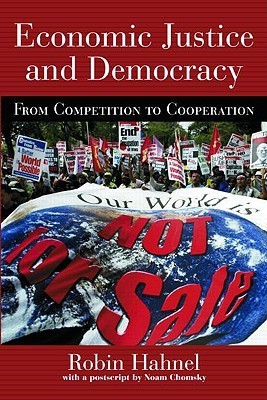
In Economic Justice and Democracy Robin Hahnel argues that progressives need to go back to the drawing board and rethink how they conceive of economic justice and economic democracy. He presents a coherent set of economic institutions and procedures that can deliver economic justice and democracy through a "participatory economy." But this is a long-run goal; he also explores how to promote the economics of equitable cooperation in the here and now by emphasizing ways to broaden the base of existing economic reform movements while deepening their commitment to more far reaching change.

As of June 2021, 54% of Gen Z adults view capitalism negatively and over 41% have a positive view on socialism. A Participatory Economy is written for people who desire an equitable, ecological economy, but want to know what an alternative to capitalism could look like.A Participatory Economy presents a fascinating, new alternative to capitalism. It proposes and defends concrete answers to how all society's economic decisions can be made without resort to unaccountable and inhumane markets (capitalism) or central planning authorities (communism). It explains the viability of early socialism's vision of an economy in which the workers come together to decide among themselves what to produce and consume. At the same time, Hahnel proposes new features to this economic model including proposing how “reproductive labor” might be socially organized, how to plan investment and long-term development to maximize popular participation and efficiency, and finally, how a participatory economy might engage in international trade and investment without violating its fundamental principles in a world where economic development among nations has been historically unfair and unequal.

This book's pluralistic, non-dogmatic, and committed investigation of the values of ecological sustainability, economic justice, and human dignity provides balanced analysis of environmental problems and their potential solutions.

Democratic Economic Planning presents a concrete proposal for how to organize, carry out, and integrate comprehensive annual economic planning, investment planning, and long-run development planning so as to maximize popular participation, distribute the burdens and benefits of economic activity fairly, achieve environmental sustainability, and use scarce productive resources efficiently. The participatory planning procedures proposed provide workers in self-managed councils and consumers in neighbourhood councils with autonomy over their own activities while ensuring that they use scarce productive resources in socially responsible ways without subjecting them to competitive market forces.Certain mathematical and economic skills are required to fully understand and evaluate the planning procedures discussed and evaluated in technical sections in a number of chapters. These sections are necessary to advance the theory of democratic planning, and should be of primary interest to readers who have those skills. However, the book is written so that the main argument can be followed without fully digesting the more technical sections.Democratic Economic Planning is written for dreamers who are disenamored with the economics of competition and greed want to know how a system of equitable cooperation can be organized; and also for sceptics who demand "hard proof" that an economy without markets and private enterprise is possible.

For too long radical political economy has suffered for lack of a coherent alternative to formal Marxian economic theory. People have had to choose between (1) continuing to use a formal model based on the labor theory of value as Marx developed in Capital to justify and retain one’s opposition to capitalism, or (2) abandoning the formal Marxian framework as outdated, and risk losing a critical evaluation of capitalism. Radical Political Sraffa Versus Marx provides readers with a third choice. A point-by-point comparison of Sraffian and Marxian treatments of prices, profits, technological change, economic crises, environmental sustainability, and the moral case against capitalism, are presented in six core chapters. They explain how the Sraffian treatment surpasses the formal Marxian treatment in every case. Both Marxian and Sraffian theories are presented in a highly accessible way, while large professional literatures are thoroughly referenced throughout. Marx was not the first, but remains the greatest, critic of capitalism, and richly deserves his place in history. However it is time to use intellectual tools unavailable to Marx in the nineteenth century to improve upon his formal analysis. This book is of great importance to those who study Sraffa and Marx, as well as academics and students who are interested in political economy, the history of economic thought, and economic and philosophical theory.

In a world where so many obfuscate, distort, and misrepresent economic argument for venal purposes, citizens are wise to arm themselves with basic economic literacy to avoid being cowed or misled. This short book, written by an economics professor who taught for forty years at universities in the United States, Europe, and Latin America, provides a relatively painless immunization. Economics for Commoners distills economic wisdom down to its most essential insights, requires no prior economic training, and no math beyond high school algebra. Six chapters in part one explain how prices, wages, profits, and rents are determined, how government fiscal and monetary policy work, and what money, banks, and finance are all about. Three chapters in part two explain how to evaluate economic performance: Is our labor being used efficiently? Are we adequately protecting the natural environment? Are the burdens and benefits of economic activity being distributed fairly?

![Economic Justice and Democracy : From Competition to Cooperation (Hardcover)--by Robin Hahnel [2005 Edition]](/placeholder.svg?height=400&width=300)
Economic Justice and Democracy : From Competition to Cooperation (Hardcover)--by Robin Hahnel [2005 Edition]
by Robin Hahnel
A Critique of Environmental Economics: A Heterodox Approach
by Robin Hahnel
A Critique of Environmental Economics draws on insights in radical political economy, institutionalist economics, ecological economics, feminist economics, and other heterodox traditions to fill-in the gaps in our understanding of the relationship between economy and ecology left by mainstream environmental economics. The book is divided into four parts, each part in turn bringing the discussion forward. The first part explores the important components of a new environmental/economic paradigm as it moves to develop a much broader intellectual framework than previously available. The second part moves current discussion beyond platitudes about population growth and industrialization and focuses attention instead on perverse incentives intrinsic in our economic institutions which put the natural environment at much greater risk than people once realized. The third part concentrates on equipping environmentalists with the information they need to contend with professional economists who often do not share their values or priorities in debates over environmental policy. The fourth part applies this new inter-disciplinary understanding of climate change to reviewing the history of climate negotiations, identifying important lessons to be learned, and applying these lessons to designing an effective, efficient, and fair post-Kyoto treaty. Professor Hahnel’s book provides an analysis of environmental problems and their potential solutions that environmentalists, as well as economists, can trust. Its pluralistic, non-dogmatic and committed investigation into the values of ecological sustainability, economic justice, and human dignity should be a welcome offering to those who are frustrated with mainstream treatments of environmental issues. A Critique of Environmental Economics should be of interest to Environmental Economists as well as Environmental Scientists, Climate Scientists and Political Scientists.

Climate Change Policy: The Eleventh Hour
by Robin Hahnel
Social Justice in Political Economy
by Robin Hahnel
Green Economics (10) by Hahnel, Robin [Paperback (2010)]
by Robin Hahnel
Green Economics (10) by Hahnel, Robin [Paperback (2010)]

![[(Green Economics: Confronting the Ecological Crisis )] [Author: Robin Hahnel] [Jan-2011]](https://m.media-amazon.com/images/S/compressed.photo.goodreads.com/books/1697579324i/147830421.jpg)
[(Green Economics: Confronting the Ecological Crisis )] [Author: Robin Hahnel] [Jan-2011]
by Robin Hahnel
![[Green Economics: Confronting the Ecological Crisis] (By: Robin Hahnel) [published: October, 2014]](https://m.media-amazon.com/images/S/compressed.photo.goodreads.com/books/1696916685i/142261074.jpg)
[Green Economics: Confronting the Ecological Crisis] (By: Robin Hahnel) [published: October, 2014]
by Robin Hahnel

The ABC's of Political A Modern Approach [Paperback] Robin Hahnel (Author)

Green Economics: Confronting the Ecological Crises,
by Robin Hahnel

¿Es posible vivir en otro tipo de economía alejada del neoliberalismo? Este libro está dirigido a aquellas personas que desean conocer las características de una alternativa deseable al capitalismo. Está dirigido a aquellos que desean algo más que una cándida descripción de individuos trabajando en armonía. Está pensado para personas que desean profundizar más en el significado de la justicia y de la democracia económicas. Es un libro dirigido a los optimistas, quienes creen que la especie humana merece algo más que sucumbir a la competencia y la avaricia o el autoritarismo y que desean saber cómo podemos lograrlo. Es también un libro para aquellos que dudan, que demandan una demostración concreta y explícita del modo en que una moderna economía puede prescindir tanto de los mercados como de la planificación autoritaria, y cómo cientos de millones de personas pueden administrar su propia división del trabajo de manera eficiente y equitativa. Este libro está escrito por alguien que comprende que el capitalismo no desaparecerá de la noche a la mañana como consecuencia de alguna mítica contradicción interna. Está escrito por alguien que comprende que el capitalismo puede ser reemplazado únicamente por un sistema económico superior cuando una mayoría se encuentre preparada para hacerlo. Robin Hahnel (1946) es profesor de economía en la Universidad Estatal de Portland (EE.UU.). Durante muchos años fue profesor de la Universidad Americana y ha viajado por todo el mundo como asesor en cuestiones económicas. Se le conoce especialmente por sus trabajos sobre economía participativa, realizados conjuntamente con Michael Albert, editor de la revista estadounidense Z Magazine. Hahnel es un economista radical, además de activista político. En el plano político se considera a sí mismo un orgulloso producto del movimiento de la Nueva Izquierda estadounidense de la década de 1960, muy afín al socialismo libertario. Durante más de cuarenta años ha participado en diversos movimientos y organizaciones sociales, comenzando con su militancia en los movimientos estudiantiles que se oponían a la invasión estadounidense de Vietnam. Más recientemente ha centrado su activismo en las filas del Partido Verde de Estados Unidos. Las investigaciones de Hahnel en teoría y análisis económicos están influenciadas por las obras de Marx, Keynes, Piero Sraffa, Michal; Kalecki, Karl Polanyi y Cornelius Castoriadis, entre otros. También ha sido como profesor visitante o asesor económico en Cuba, Perú e Inglaterra.

La Panique Aux Commandes
by Robin Hahnel
Petite leçon à l’usage de ceux qui se sont lassés de la vulgate économiste, ce livre s’appuie sur la crise asiatique de 1997 pour montrer comment les économies dominantes ne répondent, en théorie comme en pratique, qu’aux soucis de placement des biens de l’infime minorité détenant la presque totalité des richesses. Robin Hahnel est professeur d’économie à l’American University (Washington D.C.). Il est aussi l’auteur, avec Michael Albert, de nombreux ouvrages d’inspiration libertaire qui allient leurs conception à la critique de tout impérialisme – qu’il soit politique, militaire ou économique. Le capitalisme est un patient maniaco-dépressif. L’exubérance, l’optimisme débridé et l’euphorie – suivis par la mélancolie, l’apathie et la dépression – sont ses états naturels. Quel que soit le nombre de fois où le cycle se répète, le patient croit à chaque fois que le dernier « boom » sera éternel. Il se retrouve alors comme un imbécile lorsque la bulle éclate. Et quel que soit le nombre de fois où le patient rechute lorsqu’il interrompt le traitement, le « centre psychiatrique » économique finit toujours par céder à ses supplications et le laisse suspendre la thérapie pendant les moments d’euphorie, libérant son économie exubérante de toutes mesures contraignantes, pour finalement s’apercevoir que le patient doit recommencer à prendre ses cachets lorsqu’il s’effondre faute de soins. Le fonctionnement d’un tel système ne tient souvent qu’à d’heureux concours de circonstances qui permettent aux heureux participants d’engraisser et aux manuels d’économie de chanter les louanges des systèmes de crédit. Mais qu’advient-il quand un problème surgit ? – par exemple, dans un pays émergent où les capitaux occidentaux sont venus prospérer. Arrive alors le FMI et ses conseils dont les effets sur les économies locales n’intéressent en rien ceux qui les imposent puisque leur seul but est de permettre le remboursement des créditeurs internationaux.

Income Distribution and Environmental Sustainability
by Robin Hahnel
Any economics that does not deal forthrightly with economic inequality is no longer suitable for the twenty-first century. Similarly, any economics which does not provide a coherent way to integrate environmental sustainability into economic analysis will fail to command allegiance in the century ahead. This book demonstrates how the Sraffian framework provides important advantages in both areas. Divided into three chapters, Income Distribution and Environmental Sustainability provides a rigorous exposition of Sraffian theory emphasizing what it means for the economy to be productive, extends Sraffian theory to address environmental sustainability, and adds a normative theory of income distribution to Sraffa’s positive theory. In Chapter 1, a rigorous version of the basic Sraffa model is presented which focuses on what it means for the economy to be capable of producing a physical surplus, explains the origin of profits, and shows how to measure changes in overall labor productivity resulting from any technical change. In Chapter 2, the basic model is extended to incorporate primary inputs from the natural environment, rigorously measure changes in environmental throughput efficiency, and establish sufficient conditions for environmental sustainability. In Chapter 3, an explicit "normative" theory of economic justice is elaborated which is a natural extension of Sraffa’s "positive" theory of income determination and consistent with modern egalitarian literature on distributive justice. This book is of interest to academics and students who study political economy, economic theory, and philosophy, as well as those interested in the work of Piero Sraffa.