
Robin DiAngelo
Robin J. DiAngelo is an American academic, lecturer, and author working in the fields of critical discourse analysis and whiteness studies. She formerly served as a tenured professor of multicultural education at Westfield State University and is currently an Affiliate Associate Professor of Education at the University of Washington in Seattle. She is known for her work pertaining to white fragility, a term which she coined in 2011. In a 2011 academic paper she first put forward the concept of white fragility, the notion that the tendency for white people to become defensive when confronted with their racial advantage functions to protect and maintain that advantage.
17 Books Written

White Fragility: Why It's So Hard for White People to Talk About Racism
by Robin DiAngelo
Rating: 4.0 ⭐
• 6 recommendations ❤️
The New York Times best-selling book exploring the counterproductive reactions white people have when their assumptions about race are challenged, and how these reactions maintain racial inequality.In this "vital, necessary, and beautiful book" (Michael Eric Dyson), antiracist educator Robin DiAngelo deftly illuminates the phenomenon of white fragility and "allows us to understand racism as a practice not restricted to 'bad people' (Claudia Rankine). Referring to the defensive moves that white people make when challenged racially, white fragility is characterized by emotions such as anger, fear, and guilt, and by behaviors including argumentation and silence. These behaviors, in turn, function to reinstate white racial equilibrium and prevent any meaningful cross-racial dialogue. In this in-depth exploration, DiAngelo examines how white fragility develops, how it protects racial inequality, and what we can do to engage more constructively.

We've all seen it. A white person is called to account for racism and responds with incredulity, offering a litany of justifications and excuses. White progressives will insist they cannot be racist, using evidence such as "I have a black friend" or "I have traveled extensively." Their friends will vouch that the behavior cannot be racist because "He's a really nice person." It's clear that many white people do not understand systemic racism and cannot separate intentions from impact. In this insightful follow-up to her acclaimed bestseller White Fragility, sociologist Robin DiAngelo illuminates the subtle and insidious racial patterns of progressive white people, revealing how a culture of niceness actually protects racism.Writing directly to white people as a white person, DiAngelo identifies many common white racial patterns and explains how white people who see themselves as racially progressive can cause the most daily harm to people of color. These patterns include rushing to prove that we are "not racist," downplaying white advantage, pretending white segregation "just happens," co-opting indigenous and other groups' rituals, and allowing shame or personal trauma to immobilize and excuse inaction. She challenges the ideology of individualism and explains why it is appropriate to generalize about white people in order to challenge racism. She demonstrates how white people who experience other oppressions still benefit from systemic racism. Writing candidly about her own missteps and struggles, and drawing on her insider's perspective, DiAngelo models a path forward, encouraging white readers to continually face their complicity and embrace courage, lifelong commitment, and accountability.

What does it mean to be white in a society that proclaims race meaningless yet is deeply divided by race? In the face of pervasive racial inequality and segregation, most whites cannot answer that question.Robin DiAngelo argues that a number of factors make this question difficult for whites: miseducation about what racism is; ideologies such as individualism and colorblindness; defensiveness; and a need to protect (rather than expand) our worldviews. These factors contribute to what she terms white racial illiteracy.Speaking as a white person to other white people, Dr. DiAngelo clearly and compellingly takes readers through an analysis of white socialization. She describes how race shapes the lives of white people, explains what makes racism so hard for whites to see, identifies common white racial patterns, and speaks back to popular white narratives that work to deny racism.Written as an accessible introduction to white identity from an anti-racist framework, What Does It Mean To Be White? is an invaluable resource for members of diversity and anti-racism programs and study groups and students of sociology, psychology, education, and other disciplines.

White Fragility / Why Are All the Black Kids Sitting Together in the Cafeteria / So You Want to Talk About Race
by Robin DiAngelo
Rating: 3.6 ⭐
White Fragility, Why Are All the Black Kids Sitting Together in the Cafeteria and So You Want to Talk About Race [Hardcover] 3 Books Collection Set. Description:- White Fragility: Anger. Fear. Guilt. Denial. Silence. These are the ways in which ordinary white people react when it is pointed out to them that they have done or said something that has - unintentionally - caused racial offence or hurt. But these reactions only serve to silence people of colour, who cannot give honest feedback to 'liberal' white people lest they provoke a dangerous emotional reaction. Why Are All the Black Kids Sitting Together in the Cafeteria?: The classic, bestselling book on the psychology of racism -- now fully revised and updated Walk into any racially mixed high school and you will see Black, White, and Latino youth clustered in their own groups. Is this self-segregation a problem to address or a coping strategy? Beverly Daniel Tatum, a renowned authority on the psychology of racism, argues that straight talk about our racial identities is essential if we are serious about enabling communication across racial and ethnic divides. So You Want to Talk About Race: In So You Want to Talk About Race, Editor at Large of The Establishment Ijeoma Oluo offers a contemporary, accessible take on the racial landscape in America, addressing head-on such issues as privilege, police brutality, intersectionality, micro-aggressions, the Black Lives Matter movement, and the "N" word. Perfectly positioned to bridge the gap between people of color and white Americans struggling with race complexities, Oluo answers the questions readers don't dare ask, and explains the concepts that continue to elude everyday Americans.

The Facilitator's Guide for White Affinity Groups: Strategies for Leading White People in an Anti-Racist Practice
by Robin DiAngelo
Rating: 3.1 ⭐
A first of its kind, accessible, in-depth resource for leading effective white racial affinity groups—an essential tool in anti-racism for building the skills and perspectives needed for white people to challenge racism.While there are a few short articles and guides addressing the challenges and complexities of leading white affinity groups, there has never been a detailed handbook exclusively for white racial affinity group facilitators. There are many challenges in facilitating these groups including the need to have a deep theoretical understanding of racism; a high degree of racial self-awareness; sensitivity to and the ability to work with the range of skills and degrees of awareness participants bring; and strong facilitation and conflict resolution skills.The Facilitator’s Guide for White Affinity Groups is the first in-depth guide for educators, mediators, workplace consultants and trainers, workplace diversity groups, community organizers, conference organizers, members of faith communities, and members of racial and social justice groups.Dr. Robin DiAngelo and Amy Burtaine, who collectively bring over 20 years of experience leading anti-racist education and racial affinity groups · a theoretical framework for understanding racism;· a case for the value of racial affinity groups as a tool for challenging racism;· guidelines for setting up affinity groups in a variety of contexts;· the skills and perspectives needed for effective facilitation;· scenarios to illustrate common challenges;· a glossary of definitions;· exercises, discussion prompts, and assessment tools.· an extensive list of common patterns and group dynamics and how to address themWritten accessibly for a wide range of readers and backgrounds, The Facilitator’s Guide for White Affinity Groups will be an important reference for anyone committed to anti-racism work.

White Fragility: Why Understanding Racism Can Be So Hard for White People
by Robin DiAngelo
Rating: 2.9 ⭐
A reimagining of the best-selling book that gives young adults the tools to ask questions, engage in dialogue, challenge their ways of thinking, and take action to create a more racially just world. “I was taught to treat everyone the same.” “I don’t see color.” “My parents voted for Obama.” When white people have the opportunity to think and talk about race and racism, they more often than not don’t know how. In this adaptation of Dr. Robin DiAngelo’s best-selling book White Fragility, anti-racist educators Toni Graves Williamson and Ali Michael explain the concept of systemic racism to young adult readers and how to recognize it in themselves and the world around them. Along the way, Williamson and Michael provide tools for taking action to challenge systems of inequity and racism as they move into adulthood. Throughout the book, readers will find the · A dialogue between the adaptors that models anti-racist discussions · Definitions of key terms · Personal stories from this multiracial team · Discussion prompts to encourage readers to journal their reactions and feelings · Illustrations to help concepts of white fragility and systemic racism come alive · Portraits of scholars and activists, including Carol Anderson, Ta-Nehisi Coates, and Ijeoma Oluo, whose work is amplified throughout Dr. DiAngelo’s theory of white fragility.

Please Note That The Following Individual Books As Per Original ISBN and Cover Image In this Listing shall be Dispatched Collectively: White Fragility, Natives, Black Listed 3 Books Collection Set: White Fragility: Anger. Fear. Guilt. Denial. Silence. These are the ways in which ordinary white people react when it is pointed out to them that they have done or said something that has - unintentionally - caused racial offence or hurt. But these reactions only serve to silence people of colour, who cannot give honest feedback to 'liberal' white people lest they provoke a dangerous emotional reaction. Black Listed: Taking a panoramic look at global Black history and contemporary culture, this book investigates the ways in which Black communities (and individuals) have been represented, oppressed, mimicked, celebrated and othered. Part autobiographical musing, part pop culture vivisection, it's a comprehensive attempt to make sense of blackness from the vantage point of the hilarious and insightful psyche of Jeffrey Boakye. British On Race Identity and Belonging: You're British.Your parents are British.Your partner, your children and most of your friends are British.So why do people keep asking where you're from? We are a nation in denial about our imperial past and the racism that plagues our present. Brit(ish) is Afua Hirsch's personal and provocative exploration of how this came to be - and an urgent call for change.
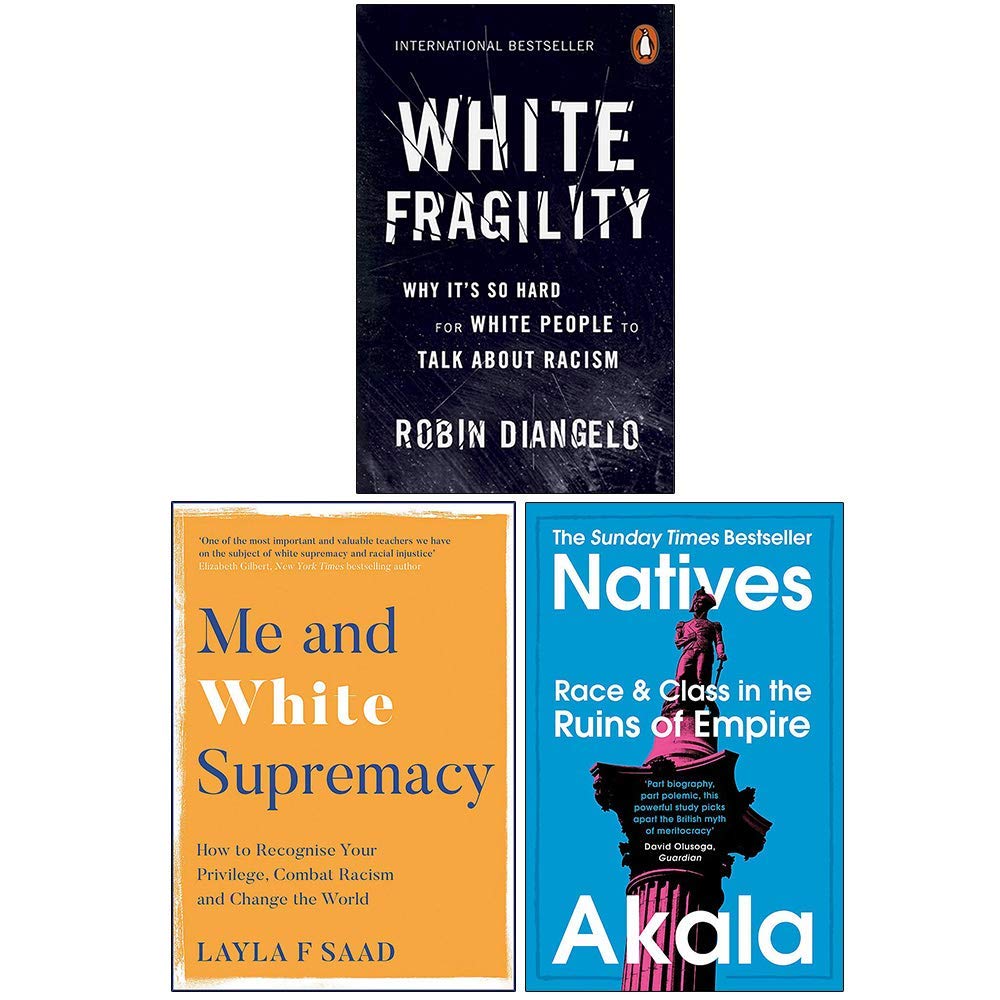
White Fragility / Me and White Supremacy / Natives Race and Class in the Ruins of Empire
by Robin DiAngelo
Rating: 2.6 ⭐


Long before the widespread success of the 2018 book White Why It’s So Hard for White People to Talk About Racism , Robin DiAngelo was breaking with white solidarity and writing, speaking, and teaching on the relationship among white supremacy, structural racism, and white identity. In this volume, DiAngelo has gathered a selection of her groundbreaking works leading up to White Fragility . Speaking as a white person to her fellow white people, she seamlessly blends the personal with the political. The result is an engaging and provocative analysis of the sociopolitical forces of race that shape our lives. Taking up familiar ideologies such as individualism and meritocracy, she breaks down how these concepts function to protect and obscure structural racism. Collectively, these essays show how racism infuses our society and its institutions; it is a system that goes well beyond individual intentions or conscious acts of meanness. By changing the question from if we are part of systemic racism to how each of us plays a part, DiAngelo’s body of work provides a transformative framework for white identity and antiracist action. Featured Chapter 1 : My Class Didn’t Trump My Using Oppression to Face Privilege Chapter 2 : Why Can’t We All Just Be Individuals? Chapter 3 : "My Feelings Are Not About You": Personal Experience as a Move of Whiteness (with David Allen) Chapter 4 : Getting White Depictions of Race Dialogues as Arenas of Violence (with Özlem Sensoy) Chapter 5 : Nothing to A Challenge to White Silence in Racial Discussions Chapter 6 : White Fragility Chapter 7 : White Fragility Accessible Chapter 8 : “We Put It in Terms of 'Not-Nice': White Antiracists and Parenting (with Sarah Matlock) Chapter 9 : Respect Differences? Challenging the Common Guidelines in Social Justice Education Chapter 10 : Leaning A Student’s Guide to Engaging Constructively With Social Justice Content (with Özlem Sensoy) Chapter 11 : Showing What We Tell (with Darlene Flynn) Chapter 12 : “We Are All For Diversity, But…”: How Faculty Hiring Committees Reproduce Whiteness and Practical Suggestions for How They Can Change (with Özlem Sensoy) “In this book, Robin DiAngelo treats us to a rare glimpse into the evolution of her influential thought, from discernment about the varieties and effects of racism, through limitations and lessons learned in anti-oppression education, to the reliable conditions for deep engagement toward justice and social transformation. Her reflections and best practices provide solace and scaffolding to many of us who are engaged in the work of confronting structural racism.”― Leticia Nieto , leadership coach, psychotherapist, and educator; author, Beyond Inclusion, Beyond A Developmental Strategy to Liberate Everyone“Without prioritizing the development of white racial literacy, white people will continue to consciously and unconsciously perpetuate systemic racism. DiAngelo’s voice cuts through the noise and compels white people to confront and dismantle the deeply ingrained and normalized beliefs and behaviors that sustain racial hierarchies. This invaluable collection of essays is a gift to the ongoing struggle for racial justice.”― Bree Picower , professor, Montclair State University and author, Reading, Writing and Disrupting Whiteness in Teacher Education and in the Classroom

Is Everyone Really Equal?: An Introduction to Key Concepts in Social Justice Education
by Robin DiAngelo
Rating: 4.0 ⭐

White Fragility, Why I’m No Longer Talking to White People About Race, Natives Race and Class in the Ruins of Empire 3 Books Collection Set
by Robin DiAngelo
Rating: 1.0 ⭐
Please Note That The Following Individual Books As Per Original ISBN and Cover Image In this Listing shall be Dispatched White Fragility, Why I’m No Longer Talking to White People About Race, Natives Race and Class in the Ruins of Empire 3 Books Collection White Robin DiAngelo coined the term 'White Fragility' in 2011 to describe this process and is here to show us how it serves to uphold the system of white supremacy. Using knowledge and insight gained over decades of running racial awareness workshops and working on this idea as a Professor of Whiteness Studies. Why I’m No Longer Talking to White People About The book that sparked a national conversation. Exploring everything from eradicated black history to the inextricable link between class and race, Why I'm No Longer Talking to White People About Race is the essential handbook for anyone who wants to understand race relations in Britain today. Natives Race and Class in the Ruins of From the first time he was stopped and searched as a child, to the day he realised his mum was white, to his first encounters with racist teachers - race and class have shaped Akala's life and outlook. In this unique book he takes his own experiences and widens them out to look at the social, historical and political factors that have left us where we are today.Covering everything from the police.9781473661233/9780141990569/9781408870587
The Guardian
by Robin DiAngelo

The Facilitator's Guide for White Affinity Groups: Strategies for Leading White People in an Anti-Racist Practice
by Robin DiAngelo
While there are a few short articles and guides addressing the challenges and complexities of leading white affinity groups, there has never been a detailed handbook exclusively for white racial affinity group facilitators. There are many challenges in facilitating these groups, including the need to have a deep theoretical understanding of racism, a high degree of racial self-awareness, sensitivity to and the ability to work with the range of skills and degrees of awareness participants bring, and strong facilitation and conflict-resolution skills.This book is the first in-depth guide for educators, mediators, workplace consultants and trainers, workplace diversity groups, community organizers, conference organizers, members of faith communities, and members of racial and social justice groups. Dr. Robin DiAngelo and Amy Burtaine, who collectively bring over twenty years of experience leading anti-racist education and racial affinity groups, present the a theoretical framework for understanding racism; a case for the value of racial affinity groups as a tool for challenging racism; guidelines for setting up affinity groups in a variety of contexts; the skills and perspectives needed for effective facilitation; scenarios to illustrate common challenges; a glossary of definitions; exercises, discussion prompts, and assessment tools; an extensive list of common patterns and group dynamics and how to address them This accessible guide is an important reference for anyone committed to anti-racism work.

Is Everyone Really Equal?: An Introduction to Key Concepts in Social Justice Education
by Robin DiAngelo

Não basta não ser racista - sejamos antirracistas
by Robin DiAngelo
É hora de todos os brancos abandonarem a ideia de superioridade e, de fato, atuarem no combate ao racismo. Negação, silêncio, raiva, medo, culpa... essas são algumas das reações mais comuns quando se diz a uma pessoa que agiu, geralmente sem intenção, de modo racista. Ser abertamente racista não é algo socialmente aceitável. Ninguém quer ser visto assim. Mas cada vez que se nega o racismo, impedimos que ele seja abordado e que nossos preconceitos sejam discutidos. As reações de negação não servem apenas para silenciar quem sofre o preconceito, também escondem um sentimento que a autora Robin Diangelo passou a chamar de fragilidade branca. Em seus estudos, Diangelo catalogou frases, palavras e sentimentos de voluntários que se veem sem qualquer preconceito e demonstrou que, no fundo, ele estava lá. Sua proposta é que todos comecem a ouvir melhor, estabeleçam conversas mais honestas e reajam a críticas com educação e tentando se colocar no lugar do outro. Não basta apenas sustentar visões liberais ou condenar os racistas nas redes sociais. A mudança começa conosco. A ROBIN DIANGELO é professora universitária, autora e consultora em questões de justiça racial e social há mais de vinte anos. Não basta não ser racista ― Sejamos antirracistas ocupa as primeiras posições das listas de livros mais vendidos do mundo desde seu lançamento.

Is Everyone Really Equal?: An Introduction to Key Concepts in Social Justice Education
by Robin DiAngelo
This is the long-awaited third edition of the bestselling, multi-award–winning introduction to foundational concepts in social justice education. Accessible to students from high school through graduate school, this comprehensive resource addresses the most common stumbling blocks to understanding social justice. In response to the deep divides in public discourse, this edition provides a framework for reaching common ground on issues of justice within a pluralistic democracy.The authors have updated statistics, research, and examples, and revised discussion questions and extension activities to guide classroom dialogue and engagement with today’s complex issues. New topics include the science of sex and gender, and the political backlash against equity and racial justice efforts. The authors trace the roots of white supremacy globally in the history of colonialism. Concepts such as oligarchy, kleptocracy, and capitalism’s relationship to democracy are introduced and discussed.Is Everyone Really Equal? is an up-to-date and engaging textbook and professional development resource that includes many user-friendly features, examples, vignettes, and activities to not just define but illustrate key concepts.Book User-friendly features such as accessible language, “definition boxes” to reinforce concepts, “perspective checks” to acknowledge multiple viewpoints, and “stop boxes” that anticipate and address common points of resistance.A glossary that includes an explanation of social justice language and its complexities and changes over time.Discussion questions, extension activities, and exercises for book groups and classroom study.An accessible resource for instructors in disciplines including education, sociology, political science, criminal justice, nursing, social work, health sciences, gender and sexuality studies, and race and ethnic studies in the United States and Canada.