
Robertson Davies
William Robertson Davies, CC, FRSC, FRSL (died in Orangeville, Ontario) was a Canadian novelist, playwright, critic, journalist, and professor. He was one of Canada's best-known and most popular authors, and one of its most distinguished "men of letters", a term Davies is sometimes said to have detested. Davies was the founding Master of Massey College, a graduate college at the University of Toronto. Novels: The Salterton Trilogy • Tempest-tost (1951) • Leaven of Malice (1954) • A Mixture of Frailties (1958) The Deptford Trilogy • Fifth Business (1970) • The Manticore (1972) • World of Wonders (1975) The Cornish Trilogy • The Rebel Angels (1981) • What's Bred in the Bone (1985) • The Lyre of Orpheus (1988) The Toronto Trilogy (Davies' final, incomplete, trilogy) • Murther and Walking Spirits (1991) • The Cunning Man (1994) http://en.wikipedia.org/wiki/Robertso...
30 Books Written

Ramsay is a man twice born, a man who has returned from the hell of the battle-grave at Passchendaele in World War I decorated with the Victoria Cross and destined to be caught in a no man's land where memory, history, and myth collide. As Ramsay tells his story, it begins to seem that from boyhood, he has exerted a perhaps mystical, perhaps pernicious, influence on those around him. His apparently innocent involvement in such innocuous events as the throwing of a snowball or the teaching of card tricks to a small boy in the end prove neither innocent nor innocuous. Fifth Business stands alone as a remarkable story told by a rational man who discovers that the marvelous is only another aspect of the real.
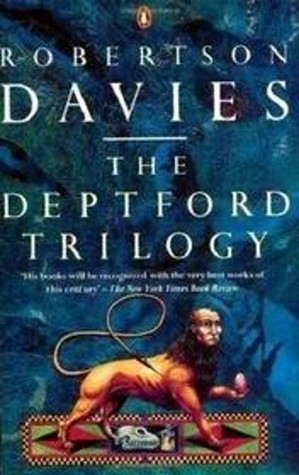
Around a mysterious death is woven a glittering, fantastical, cunningly contrived trilogy of novels. Luring the reader down labyrinthine tunnels of myth, history, and magic, The Deptford Trilogy provides an exhilarating antidote to a world from where "the fear and dread and splendour of wonder have been banished."Fifth BusinessThe ManticoreWorld of Wonders

Francis Cornish was always good at keeping secrets. From the well-hidden family secret of his childhood to his mysterious encounters with a small -town embalmer, an expert art restorer, a Bavarian countess, and various masters of espionage, the events in Francis's life were not always what they seemed.In this wonderfully ingenious portrait of an art expert and collector of international renown, Robertson Davies has created a spellbinding tale of artistic triumph and heroic deceit. It is a tale told in stylish, elegant prose, endowed with lavish portions of Davies's wit and wisdom.

Hailed by the Washington Post Book World as "a modern classic," Robertson Davies’s acclaimed Deptford Trilogy is a glittering, fantastical, cunningly contrived series of novels, around which a mysterious death is woven. The Manticore—the second book in the series after Fifth Business—follows David Staunton, a man pleased with his success but haunted by his relationship with his larger-than-life father. As he seeks help through therapy, he encounters a wonderful cast of characters who help connect him to his past and the death of his father.

Defrocked monks, mad professors, and wealthy eccentrics - a remarkable cast peoples Robertson Davies' brilliant spectacle of theft, perjury, murder, scholarship, and love at a modern university. Only Mr. Davies, author of Fifth Business, The Manticore, and World of Wonders, could have woven together their destinies with such wit, humour-and wisdom.

Hailed by the Washington Post Book World as "a modern classic," Robertson Davies’s acclaimed Deptford Trilogy is a glittering, fantastical, cunningly contrived series of novels, around which a mysterious death is woven. World of Wonders—the third book in the series after The Manticore—follows the story of Magnus Eisengrim—the most illustrious magician of his age—who is spirited away from his home by a member of a traveling sideshow, the Wanless World of Wonders. After honing his skills and becoming better known, Magnus unfurls his life’s courageous and adventurous tale in this third and final volume of a spectacular, soaring work.

Hailed as a literary masterpiece, Robertson Davies' The Cornish Trilogy comes to a brilliant conclusion in the bestselling Lyre of Orpheus.There is an important decision to be made. The Cornish Foundation is thriving under the directorship of Arthur Cornish when Arthur and his beguiling wife, Maria Theotoky, decide to undertake a project worthy of Francis Cornish -- connoisseur, collector, and notable eccentric -- whose vast fortune endows the Foundation. The grumpy, grimy, extraordinarily talented music student Hulda Schnakenburg is commissioned to complete E. T .A. Hoffmann's unfinished opera Arthur of Britain, or The Magnanimous Cuckold; and the scholarly priest Simon Darcourt finds himself charged with writing the libretto.Complications both practical and emotional arise: the gypsy in Maria's blood rises with a vengeance; Darcourt stoops to petty crime; and various others indulge in perjury, blackmail, and other unsavory pursuits. Hoffmann's dictum, "the lyre of Orpheus opens the door of the underworld," seems to be all too true -- especially when the long-hidden secrets of Francis Cornish himself are finally revealed.Baroque and deliciously funny, this third book in The Cornish Trilogy shows Robertson Davies at his very considerable best."Robertson Davies is the sort of novelist readers can hardly wait to tell their friends about." -- The Washington Post Book World

When Father Hobbs mysteriously dies at the high altar on Good Friday, Dr Jonathan Hullah - whose holistic work has earned him the label "Cunning Man' (for the wizard of folk tradition) - wants to know why. The physician-cum-diagnostician's search for answers compels him to look back over his own long life. He conjures vivid memories of the dazzling intellectual high jinks and compassionate philosophies of himself and his circle, including flamboyant, mystical curate Charlie Iredale; cynical, quixotic professor Brocky Gilmartin; outrageous banker Darcy Dwyer; and jocular, muscular artist Pansy Todhunter. In compelling and hilarious scenes from the divine comedy of life, The Cunning Man reveals profound truths about being human.

The Cornish Trilogy: The Rebel Angels / What's Bred in the Bone / The Lyre of Orpheus
by Robertson Davies
Rating: 4.5 ⭐
Woven around the pursuits of the energetic spirits and erudite scholars of the University of St. John and the Holy Ghost, this dazzling trilogy of novels lures the reader into a world of mysticism, historical allusion, and gothic fantasy that could only be the invention of Canada's grand man of letters.

The Salterton Trilogy: Tempest-Tost / Leaven of Malice / A Mixture of Frailties
by Robertson Davies
Rating: 4.4 ⭐
In the small university town of Salterton, Ontario, dreams are quietly taking shape, or falling apart. There's the Salterton Little Theatre Company, in which professional director Valentine Rich is tormented by the amateurish efforts of his actors. The families Vambrace and Bridgetower almost go to war over a fake notice of engagement in the local paper. And a family fortune is lavished on an aspiring singer because there is no male heir to claim it. Tracing the lives and incidents of a small community in the middle of the last century, "The Salterton Trilogy" peels off the public veneer of geniality and respectability to reveal the private passions churning beneath.

An amateur production of The Tempest provides a colourful backdrop for an hilarious look at unrequited love. Mathematics teacher Hector Mackilwraith, stirred and troubled by Shakespeare's play, falls in love with the beautiful Griselda Webster. When Griselda shows that she has plans of her own, Hector despairs and tries to commit suicide on the play's opening night.

Murdered by his wife's lover, Gil must spend his afterlife seated next to his murderer at a film festival, where he views the exploits of his ancestors from the Revolutionary era to his parents' time

A false engagement announcement, printed in the Salterton Evening Bellman and heralding the impending marriage of a university instructor and a professor's daughter, sets off a chain of misadventures and misunderstandings

"A Mixture of Frailties", the third volume of Robertson Davies "Salterton" Trilogy, is his first extended engagement with one of the great neuroses of Canadian culture: Canada's artistic relationship to Europe, and particularly to Britain. Davies begins his story with the funeral of Louisa Bridgetower, the Salterton matron whose imposing presence ranges throughout the earlier volumes of the "Salterton" Trilogy. The substantial income from her estate is to be used to send an unmarried young woman to Europe to pursue an education in the arts. Mrs. Bridgetower's executors end up selecting Monica Gall, an almost entirely unschooled singer whose sole experience comes from performing with the Heart and Hope Gospel Quartet, a rough outfit sponsored by a small fundamentalist group. Monica soon finds herself in England, a pupil of some of Britain's most remarkable teachers and composers, and she gradually blossoms from a Canadian rube to a cosmopolitan soprano with a unique - and tragicomic - career.

A collection of ghost storiesRobertson Davies first hit upon the notion of writing ghost stories when he joined the University of Toronto's Massey College as a Master. Wishing to provide entertainment at the College's Gaudy Night, the annual Christmas party, Professor Davies created a "spooky story," which he read aloud to the gathering. That story, "Revelation from a Smoky Fire," is the first in this wonderful, haunting collection. A tradition quickly became established and, for eighteen years, Davies delighted and amused the Gaudy Night guests with his tales of the supernatural. Here, gathered together in one volume, are those eighteen stories, just as Davies first read them.

In this collection of his newspaper pieces, mostly from the late Forties, Davies introduces us to his alter ego, a mildly irascible curmudgeon whose opinions and observations have been so popular in Canada that three volumes of his columns have been published there: The Diary , The Table Talk , and The Garland of Miscellania. Davies has re-edited them to produce a single volume and in the prefatory "A Drink with Marchbanks" even given us his own view of the journalist he created. A pleasant entertainment covering such diverse topics as politics, theater, and manners, this volume offers a humorous and insightful picture of postwar Canadian life as seen through the eyes of a delightful eccentric who reminds this reader of a boozeless W. C. Fields.

The Merry Heart: Reflections on Reading Writing & the World of Books
by Robertson Davies
Rating: 4.2 ⭐
Readers around the world continue to mourn the 1995 death of a beloved literary icon, but this rich and varied collection of Robertson Davies' writings on the world of books and the miracle of language captures his inimitable voice and sustains his presence among us. Coming almost entirely from Davies' own files of unpublished material, these twenty-four essays and lectures range over themes from "The Novelist and Magic" to "Literature and Technology," from "Painting, Fiction, and Faking," to "Can a Doctor Be a Humanist?" and "Creativity in Old Age."For devotees of Davies and all lovers of literature and language, here is the "urbanity, wit, and high seriousness mixed by a master chef" — Cleveland Plain DealerVintage delights from an exquisite literary menu. Davies himself says "Lucky writers. . . like wine, die rich in fruitiness and delicious aftertaste, so that their works survive them." • Viking will publish Robertson Davies' Happy Alchemy in July 1998 • Many fine works by Robertson Davies are available from Penguin including The Deptford Trilogy, The Cornish Trilogy , and The Salterton Trilogy

A collection of public addresses by the Canadian scholar and novelist provide portraits of literary personalities, advice on writers and writing, and comments on academia and the modern world

First published in the U.S. last year, this updated collection contains the best of Robertson Davies' newspaper and magazine articles written over the past 50 years. "Each piece is entertaining and enlightening. . . ."--Publishers Weekly.

A posthumous treasury of brilliant essays that shines with Davies's unmistakable wit, erudition, and magic.One of Canada's--and the world's--most beloved authors, Robertson Davies was also a devoted fan of opera and the theater. In this follow-up to his first posthumous collection, A Merry Heart , Davies ruminates on these lifelong passions, offering a diverse sampling of personal reflections on everything from the ancient Greeks to Lewis Carroll, Scottish folklore to Laurence Olivier, the sins of Verdi to the virtues of melodrama. The combined effect of these thirty-three essays, lectures, plays, and librettos-- edited by his widow and daughter--is true alchemy, as "readers . . . come away with a renewed appreciation of the ease with which Davies routinely transformed his sometimes erudite passions into delightful entertainments" ( The New York Times Book Review ).The book in thoroughly entertaining fashion acquaints us with Davies' expansive erudition and gift for rendering literary and historical complexities in simple, human terms." -- The New York Times"Lovingly collected. . . . A welcome addition to a corpus like no other in contemporary literature." -- Kirkus Reviews

A collection of letters by one of the nation's greatest writers and poets includes Davies's correspondence with John Gielgud, Margaret Atwood, and Salvador Dali, among many others. 10,000 first printing.

Robertson Davies first hit upon the notion of writing ghost stories when he joined the University of Toronto's Massey College as a Master. Wishing to provide entertainment at the College's Gaudy Night, the annual Christmas party, Professor Davies created a "spooky story," which he read aloud to the gathering. That story, "Revelation from a Smoky Fire," is the first in this wonderful, haunting collection. A tradition quickly became established and, for eighteen years, Davies delighted and amused the Gaudy Night guests with his tales of the supernatural. Here, gathered together in one volume, are those eighteen stories, just as Davies first read them.

- This production is a dramatization with a full cast, sound effects, and orchestration.
Discusses the impact of reading, the way books should be read, the life of a writer, the role of the critic, and the use of language

A record of the Stratford Shakespearean Festival in Canada 1955Critics by Robertson Davies on Julius Caesar King Oedipus The Merchant of VeniceMusic of the Festival by Neel Boyd.The Production of King Oedipus by Tyrone Guthrie and TanyaMoiseiwitsch.

The selected diaries of Robertson Davies, one of Canada’s literary legends, and a celebrated playwright, novelist, journalist, and academic. Published for the first time, the diaries are a self-portrait of a brilliant and charismatic man and an insider’s view of a writer’s life and the Canadian cultural scene in the 1960s.Robertson Davies (1913-1995) had a remarkable literary career that extended through the entire second half of the twentieth century. After university in Canada and at Oxford, Davies had begun working in British theatre, but with the outbreak of war in 1939 he returned to Canada where he swiftly established himself as an outstanding editor, columnist and literary critic, and as an increasingly prominent playwright and novelist. Tall, ample, and bearded, with a richly developed theatrical voice, he had an imposing and distinctive appearance that made him seem older than he was. His rather magisterial presence hid well the mixture of ambition, anxieties, and insecurities, and often conflicting perceptions and emotions that all bubbled furiously within and that are recorded in the diaries. Chronicling his time as editor of the Peterborough Examiner, his role as the founding master of Massey College, and most of all his life as a writer, from the failure of a play in New York to the beginnings of an idea for a novel that would become Fifth Business, A Celtic Temperament is entertaining and illuminating and a major addition to Davies’s body of work.

The third of Robertson Davies’ editions of Samuel Marchbanks’ writings, and originally published by McClelland & Stewart in 1967, Samuel Marchbanks’ Almanack is available here in e-book for the first time ever.In 1942, two years after returning to Canada from Britain, Robertson Davies took up the role of editor of the Peterborough Examiner , in the small city of Peterborough, Ontario, northeast of Toronto. During his tenure as editor at the Examiner , a post he held until 1955, and later as publisher of the newspaper (1955–65), Davies published witty, curmudgeonly, mischievous, and fiercely individualistic editorials under the name of his alter ego, Samuel Marchbanks, “one of the choice and master spirits of his age.”Taking pen in hand, Samuel Marchbanks, philosopher, purveyor of trivia and benefactor of mankind, once again proves there is nothing so beneficial to the weary and heavy-laden of the world as a good belly laugh. As the reader proceeds through the zodiacal year from Aries to Pisces, he will find an infinity of information and rumination on matters important and unimportant, orthodox and outrageous. Who would remain unmoved by the discourse of yo-yo virtuosity of the reflections on the Modern Reader! Who will not share the righteous anger of Mr. Marchbanks toward the civil servant, Mr. Hydra, on the gross inconvenience of Daylight Savings Time! The reader will also have the opportunity of meeting other such remarkable characters as Dr. Raymond Cataplasm, the lawyer, Mordecai Mouseman, Mrs. Kedijah Scissorbill, the committee woman, and even Dick Dandiprat, the great practical joker. There can be no better tonic for flagging spirits than Marchbanks’ Almanack .
The second of the Samuel Marchbanks volumes, originally published in 1949, is available in eBook form for the first time.In 1942, two years after returning to Canada from Britain, Robertson Davies took up the role of editor of the Peterborough Examiner . During his tenure as editor at the Examiner , a post he held until 1955, and later as publisher of the newspaper (1955–65), Davies published witty, curmudgeonly, mischievous, and fiercely individualistic editorials under the name of his alter ego, Samuel Marchbanks, “one of the choice and master spirits of his age.”The Table Talk of Samuel Marchbanks gathers together a number of Marchbanks' columns from 1947 and 1948, presenting them as observations purportedly made by Marchbanks during a seven-course formal dinner. Funny, delightful, and timeless, The Table Talk of Samuel Marchbanks reveals one of the most entertaining periods in a Canadian literary giant’s career.

On his publishers: They are so insufferably pretentious in theory and such botchers in practice.On his role as Master: God, how I loathe the young. Do you suppose we were such grasping, crooked, self-important cabbageheads as these?On projected BBC radio talks: They want me to give Marchbanks’ impressions of Britain. They seem to have some notion that I am a newcomer to these shores, chewing tobacco and swinging my lariat as I gape at the sights. I shall strive to oblige.Robertson Davies was 25 and a student at Oxford when these letters begin. By the end of the book, in 1975, he has become the magisterial author of the Deptford Trilogy, Fifth Business, The Manticore and World of Wonders.The letters show us his career in all its variety. He was – among other things – an actor at the Old Vic in London, a newspaperman in Peterborough, Ontario, and a playwright who writes despairingly that “I am getting to hate and despise actors more every day.” A surprising theme is his constant disappointment with his achievements. Although happily married with three daughters, the editor of a respected newspaper, a major national book reviewer, and the author of several well-received plays and half a dozen books, he feels that he has failed. Even when in 1961 he switches careers to become the founding Master of Massey College and to teach Drama at the University of Toronto his doubts persist. It is only in the later years that he begins to sense that his life has not been wasted.The book’s greatest charm, however, lies in his letters to the great (letters to H.L. Mencken, Alfred Knopf, Hugh Maclennan, Tyrone Guthrie, Margaret Laurence, among others) and to the not-so-great – like the arrogant applicant for a job at his newspaper who received blistering advice on professionalism. All are written with great style appropriate to the occasion. For above all Robertson Davies was a professional. His astonishingly revealing letters show a promising young man turning into a great literary figure.

Robertson Davies has been called the most important Canadian playwright of the postwar period. These two plays from the 1940s prove that great writing and important themes never go out of style.