
Robert Penn Warren
Robert Penn Warren was an American poet, novelist, and literary critic and was one of the founders of New Criticism. He was also a charter member of the Fellowship of Southern Writers. He founded the literary journal The Southern Review with Cleanth Brooks in 1935. He received the 1947 Pulitzer Prize for the Novel for All the King's Men (1946) and the Pulitzer Prize for Poetry in 1958 and 1979. He is the only person to have won Pulitzer Prizes for both fiction and poetry.
28 Books Written

His version of the widely known work, which, as a novel, was the recipient of the Pulitzer Prize, had a highly successful Off-Broadway run during the 1959 season. s told by Atkinson: "Eliminate the story of Huey Long, which Mr. Warren says is not what he is trying to interpret. He is anatomizing the career with nothing but purity in his heart. Discovering that he is being used by a cynical machine, [Willie] adopts their methods, and presently, he is in control of the state. By resorting to corrupt methods he accomplishes things for the people that were only abstract ideals when he was campaigning honestly. As a portrait of politics, this is effective and provocative."

All the King's Men is a 1946 novel by Robert Penn Warren. Its title is drawn from the nursery rhyme "Humpty Dumpty". The novel tells the story of charismatic populist governor Willie Stark and his political machinations in the Depression-era Deep South. It is commonly thought to have been loosely inspired by the real-life story of U.S. Senator Huey P. Long, who was assassinated in 1935. Warren won the Pulitzer Prize for All the King's Men in 1947. The novel has received critical acclaim and remained perennially popular since its first publication. It was rated the 36th greatest novel of the 20th century by Modern Library, and it was chosen as one of Time magazine's 100 best novels since 1923. All the King's Men portrays the dramatic and theatrical political rise and governorship of Willie Stark, a cynical populist in the 1930s American South.

After achieving world renown as a classical and medieval literary scholar, marrying twice, fathering a son, and having an ill-fated love affair, uprooted and alienated Jed Tewksbury returns to his Alabama hometown to visit his mother's grave and make peace with himself

Amantha Starr, born and raised by a doting father on a Kentucky plantation in the years before the Civil War, is the heroine of this powerfully dramatic novel. At her father's death Amantha learns that her mother was a slave and that she, too, is to be sold into servitude. What follows is a vast panorama of one of the most turbulent periods of American History as seen through the eyes of star-crossed young woman. Amantha soon finds herself in New Orleans, where she spends the war years with Hamish Bond, a slave trader. At war’s end, she marries Tobias Sears, a Union officer and Emersonian idealist. Despite sporadic periods of contentment, Amantha finds life with Tobias trying, and she is haunted still by her tangled past. “Oh, who am I?” she asks at the beginning of the novel. Only after many years, after achieving a hard-won wisdom and maturity, does she begin to understand that question.Band of Angels puts on ready display Robert Penn Warren’s prodigious gifts. First published in 1955, it is one of the most searing and vivid fictional accounts of the Civil War era ever written.

In the admixture of wilderness and elegant society that was 1826 Kentucky, Jeremiah Beaumont, a brilliant, imaginative lawyer, stood trial for murdering his benefactor and father figure, the politician Colonel Cassius Fort. Now all the documents are in hand to reconstruct Beaumont's life story -- his crime, his trial, his ultimate sin and punishment -- and the historian-narrator of World Enough and Time sets about doing just that. Based on the famous murder case known as the Kentucky Tragedy, World Enough and Time is, like its precursor All the King's Men, a fictional wonder that personifies history, philosophy, politics, and passion.

Warren's first novel, set during the "tobacco wars" that raged in Kentucky and Tennessee in the early part of this century. Percy Munn is one of Warren's innocent idealists whose delusions become murderous as he attempts to define himself by action in the unfolding violence around him. Southern Classics Series.

“A moving and disturbing work—one which goes beyond events, to brood upon their meanings.”—Samuel Hynes, New York Times Book ReviewIn the summer of 1863, Adam Rosenzweig leaves a Bavarian ghetto and sails for the United States to fight for the North in the Civil War. Fired by a revolutionary idealism inherited from his father, he hopes to aid a cause that he believes to be as simple as he knows it to be just.Over the course of his journey, Adam becomes witness to a world whose complexity does not readily conform to his ideals of liberty. When his twisted foot attracts unwanted attention on his voyage to America, he is threatened with return to Europe. He jumps ship in New York, only to be caught up in the violence and horror of the anti-draft riots. Eventually he reaches the Union Army, serving not as a soldier but as a civilian provisioner’s assistant. Adam’s encounters with others—among them a wealthy benefactor, a former slave, an exiled Southerner, a bushwacker and his wife—further challenge the absolutism that informs his view of the world and of his place in it.First published in 1961, Wilderness remains a profoundly provocative meditation on the significance of the Civil War and the varieties of human experience. This new edition of the novel includes an insightful introductory essay by James H. Justus, Distringuished Professor Emeritus at Indiana University and author of The Achievement of Robert Penn Warren.The Robert Penn Warren (1905–1989)was born in Kentucky and studied at Vanderbilt and Oxford Universities. As a novelist, teacher, poet, and critic, he became one of America’s most celebrated men of letters and the only writer to receive Pulitzer Prizes for both poetry and fiction. In addition to Wilderness, his novels included All the King’s Men, World Enough and Time, and Band of Angels.

A collection of Penn Warren’s best short two novelettes and twelve stories that skillfully handle a variety of themes and styles.”Worth reading for their craftsmanship and variety” (Charles Poore, New York Times).

In his sixth novel, The Cave (1959), Robert Penn Warren tells the story of a young man trapped in a cave in fictional Johntown, Tennessee. His predicament becomes the center of national attention as television cameras, promoters, and newscasters converge on the small town to exploit the rescue attempts and the thousands of spectators gathered at the mouth of the cave.

The significantly revised version of Brother to Dragons appeared in 1979, twenty-six years after the original. It is, Warren wrote, “in some important senses, a new work.” Told in the distinct voices of characters long dead and now gathered at an unspecified place and time, the poem recalls events leading to and resulting from the 1811 murder of a young slave by Thomas Jefferson’s nephew. “R.P.W.” is the narrator of the versified tale, whose poignant ending brings not only reconciliation among the ghostly figures but healing for Warren’s persona as well.

A narrative poem based upon the heroic life of the great chief of the Nez Perce Indians, is told partly in the first person by Joseph, partly in the voice of the poet

Remember the Alamo! is the acclaimed classic accounts of one of the most thrilling moments in the history of the United States frontier. The battle for the Alamo was an epic event in the fight for Texas independence from Mexico. Davy Crockett, Colonel Jim Bowie and Colonel Travis are just three of the legendary and colorful heroes whose courageous and doomed defense of the Alamo against an overwhelming Mexican army led by General Santa Anna earned them immortality. Their valiant stand and death inspired the rallying cry, 'Remember the Alamo! that inspired Texans to continue their struggle and ultimate win their independence from Mexico.

Two film makers arrive in a small Tennessee town which will soon vanish when the massive dam being built downriver is completed. Originally published in 1963, this is Warren's last novel and a eulogy for the agrarian South."

At Heaven's Gate is a novel of violence, of human beings struggling against a fate beyond their power to alter, of corruption, and of honor. It is the story of Sue Murdock, the daughter of an unscrupulous speculator who has created a financial empire in the South, and the three men with whom she tries to escape the dominance of her father and her father's world. The background is the capital of a Southern state in the late twenties and the promoters and politicians, the aristocrats and poor whites, the labor organizers and the dispossessed farmers, the backwoods prophets and the university intellectuals who are drawn into its orbit. Warren's picture of the South is as fresh, dramatic, and powerful today as it was when the book was first published. Its plot structure is a tour de force.From the jacket of the New Directions (1985) edition.

Serving as something of a "collected works" compendium, author and poet Robert Penn Warren published these selected poems on 1975, fourteen years before his death. Evident in the selection are the hallmarks of his entire range of poetic output.

First edition stated. RANDOM HOUSE, NY 1971. A really strange and complex story of love, betrayal, revenge, and murder in a suspenseful setting. TITLE: MEET ME IN THE GREEN GLEN By ROBERT PENN WARREN 1ST EDITIONAUTHOR: ROBERT PENN WARRENPUBLISHER - (LOCATION) /COPYRIGHT: RANDOM HOUSE, NY 1971SIZE: 5 ½ x 8 ½ (approximately) PAGES: 376 pagesEDITION: First edition statedCATEGORY: First edition?..SIGNED: No??. BINDING/COVER: Hardback with dust jacket COLOR: Cream
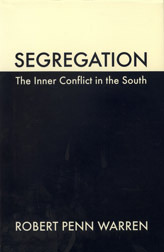
First published in 1956, Segregation is a collection of Robert Penn Warren's informal conversations with southerners in the wake of the Brown v. Board of Education decision. Warren, who in his own writings often explored the theme of race in American life, traveled through his native region to talk with scores of individuals―taxi drivers, NAACP leaders, members of White Citizens groups, college students, preachers―to report their responses to the Court's decision.

A collection of poems inspired by the life and writings of the famous naturalist

In 1979 Robert Penn Warren returned to his native Todd Country, Kentucky, to attend ceremonies in honor of another native son, Jefferson Davis, president of the Confederacy, whose United States citizenship had just been restored, ninety years after his death, by a special act of Congress. From that nostalgic journey grew this reflective essay on the tragic career of Jefferson Davis―"not a modern man in any sense of the word but a conservative called to manage what was, in one sense, a revolution." Jefferson Davis Gets His Citizenship Back is also a meditation by one of our most respected men of letters on the ironies of American history and the paradoxes of the modern South.

Thirty-seven of Warren's poems written between 1976 and 1978, presented in reverse chronological order.

Records the author's penetrating interviews with leaders of the Negro Revolution expressing their views on present achievements and future problems

Leather Binding on Spine and Corners with Golden Leaf Printing on round Spine (extra customization on request like complete leather, Golden Screen printing in Front, Color Leather, Colored book etc.) Reprinted in 2018 with the help of original edition published long back [1946]. This book is printed in black & white, sewing binding for longer life, Printed on high quality Paper, re-sized as per Current standards, professionally processed without changing its contents. As these are old books, we processed each page manually and make them readable but in some cases some pages which are blur or missing or black spots. If it is multi volume set, then it is only single volume, if you wish to order a specific or all the volumes you may contact us. We expect that you will understand our compulsion in these books. We found this book important for the readers who want to know more about our old treasure so we brought it back to the shelves. Hope you will like it and give your comments and suggestions. - English, Pages 66. EXTRA 10 DAYS APART FROM THE NORMAL SHIPPING PERIOD WILL BE REQUIRED FOR LEATHER BOUND BOOKS. COMPLETE LEATHER WILL COST YOU EXTRA US$ 25 APART FROM THE LEATHER BOUND BOOKS. {FOLIO EDITION IS ALSO AVAILABLE.} Complete Blackberry winter 1946 Warren Robert Penn

John Burt’s Selected Poems of Robert Penn Warren is more broadly representative of Warren’s poetry than any previous selected gathering. More than two hundred poems from every phase grace the volume, a vehicle ideal for sampling―or soaking in―the finest of Warren’s rich output.With each poem, Burt has carefully located the version that constitutes Warren’s final revision. His introduction gives an eloquent overview of the poet’s career, touching on every published book of verse and highlighting significant lines. A “selected” collection in the truest sense, featuring several previously unpublished pieces, this treasure is at once new and familiar.At the heart of Warren’s poetry is a celebration of man’s intellect and imagination, his integral place within nature, and his relationship to time and the past; ultimately, joy coexists with the knowledge of life’s many mysteries, including its tragedies. Selected Poems, a generous survey and a convenient compendium, is the shining portal to this greatly gifted poet.

In these two essays, one of America’s most honored writers fastens on the interrelation of American democracy and poetry and the concept of selfhood vital to each. “I really don’t want to make a noise like a pundit,” Mr. Warren declares, “What I do want to do is to return us—and myself most of all—to a scrutiny of our own experience of our own world.” Indeed, Democracy and Poetry offers one of the most pertinent and strongly personal meditations on our condition to have appeared in recent letters. Our native “poetry,” that is, literature and art, in general, is a social document, is “diagnostic,” and has often been a corrosive criticism of our democracy, Mr. Warren argues. Persuasively, and movingly, he shows that all of “art” and all that goes into the making of democracy require a free and responsible self. Yet the American experience has been one of the decay of the notion of self. Our astounding success jeopardized what we promised to create—the free man. For a century and a half the conception of the self has been dwindling, separating itself from traditional values, moral identity, and a secure relation with community. Lonely heroes in a bankrupt civilization, then protest, despair, aimlessness, and violence, have marked our literature. The anguish of Robert Penn Warren’s own poetic vision of art and democracy is soothed only by his belief that poetry—the making of art can nourish and at least do something toward the rescue of democracy; he shows how art can be- come a healer, can be “therapeutic.” In the face of disintegrative forces set loose in a business and technetronic society, it is poetry that affirms the notion of the self. It is a model of the organized self, an emblem of the struggle for the achieving self, and of the self in a community. More and more as our modern technetronic society races toward the abolition of the self, and diverges from a culture created to enhance the notion of selfhood, poetry becomes indispensable. Compelling, resonant, memorable, Democracy and Poetry is a major testament not only to the vitality of poetry, but also to a faith in democracy.

An acclaimed poet and novelist, Robert Penn Warren continues to add to an impressive career and body of work with this volume of expansive and vibrant verse

Essays discuss Hawthorne, Twain, Conrad, Hemingway, Faulkner, Melville, Whittier, Frost, and Coleridge.

Captures the contemporary poet's thoughts about the changing faces of time and being