
Robert M. Sapolsky
Robert Morris Sapolsky is an American neuroendocrinology researcher and author. He is currently a professor of biology, and professor of neurology and neurological sciences and, by courtesy, neurosurgery, at Stanford University. In addition, he is a research associate at the National Museums of Kenya.
16 Books Written

Now in a third edition, Robert M. Sapolsky's acclaimed and successful Why Zebras Don't Get Ulcers features new chapters on how stress affects sleep and addiction, as well as new insights into anxiety and personality disorder and the impact of spirituality on managing stress.As Sapolsky explains, most of us do not lie awake at night worrying about whether we have leprosy or malaria. Instead, the diseases we fear—and the ones that plague us now—are illnesses brought on by the slow accumulation of damage, such as heart disease and cancer. When we worry or experience stress, our body turns on the same physiological responses that an animal's does, but we do not resolve conflict in the same way—through fighting or fleeing. Over time, this activation of a stress response makes us sick.

Behave: The Biology of Humans at Our Best and Worst
by Robert M. Sapolsky
Rating: 4.4 ⭐
• 1 recommendation ❤️
***'Awe-inspiring… You will learn more about human nature than in any other book I can think of' Henry MarshTHE NEW YORK TIMES BESTSELLER / WINNER OF THE 2017 LA TIMES BOOK PRIZE'One of the best scientist-writers of our time' Oliver SacksWhy do human beings behave as they do? We are capable of savage acts of violence but also spectacular feats of kindness: is one side of our nature destined to win out over the other?Every act of human behaviour has multiple layers of causation, spiralling back seconds, minutes, hours, days, months, years, even centuries, right back to the dawn of time and the origins of our species.In the epic sweep of history, how does our biology affect the arc of war and peace, justice and persecution? How have our brains evolved alongside our cultures?This is the exhilarating story of human morality and the science underpinning the biggest question of all: what makes us human?

Behave By Robert M. Sapolsky, How Emotions Are Made By Lisa Feldman Barrett, The Brain By David Eagleman 3 Books Collection Set
by Robert M. Sapolsky
Rating: 4.2 ⭐
Please Note That The Following Individual Books As Per Original ISBN and Cover Image In this Listing shall be Dispatched Behave By Robert M. Sapolsky, How Emotions Are Made By Lisa Feldman Barrett, The Brain By David Eagleman 3 Books Collection From the celebrated neurobiologist and primatologist, a landmark, genre-defining examination of human behavior, both good and bad, and an answer to the Why do we do the things we do? Sapolsky's storytelling concept is delightful but it also has a powerful intrinsic he starts by looking at the factors that bear on a person's reaction in the precise moment a behavior occurs, and then hops back in time from there, in stages, ultimately ending up at the deep history of our species and its evolutionary legacy.How Emotions Are Preeminent psychologist Lisa Barrett lays out how the brain constructs emotions in a way that could revolutionize psychology, health care, the legal system, and our understanding of the human mind. “Fascinating . . . A thought-provoking journey into emotion science.”??―??The Wall Street Journal “A singular book, remarkable for the freshness of its ideas and the boldness and clarity with which they are presented.”??―??Scientific American.The The Story of Locked in the silence and darkness of your skull, your brain fashions the rich narratives of your reality and your identity. Join renowned neuroscientist David Eagleman for a journey into the questions at the mysterious heart of our existence. What is reality? Who are “you”? How do you make decisions? Why does your brain need other people? How is technology poised to change what it means to be human? In the course of his investigations.

A Primate's Memoir: A Neuroscientist's Unconventional Life Among the Baboons
by Robert M. Sapolsky
Rating: 4.4 ⭐
In the tradition of Jane Goodall and Dian Fossey, Robert Sapolsky, a foremost science writer and recipient of a MacArthur Genius Grant, tells the mesmerizing story of his twenty-one years in remote Kenya with a troop of Savannah baboons.“I had never planned to become a savanna baboon when I grew up; instead, I had always assumed I would become a mountain gorilla,” writes Robert Sapolsky in this witty and riveting chronicle of a scientist’s coming-of-age in remote Africa. An exhilarating account of Sapolsky’s twenty-one-year study of a troop of rambunctious baboons in Kenya, A Primate’s Memoir interweaves serious scientific observations with wry commentary about the challenges and pleasures of living in the wilds of the Serengeti — for man and beast alike. Over two decades, Sapolsky survives culinary atrocities, gunpoint encounters, and a surreal kidnapping, while witnessing the encroachment of the tourist mentality on the farthest vestiges of unspoiled Africa. As he conducts unprecedented physiological research on wild primates, he becomes evermore enamored of his subjects — unique and compelling characters in their own right — and he returns to them summer after summer, until tragedy finally prevents him.By turns hilarious and poignant, A Primate’s Memoir is a magnum opus from one of our foremost science writers.
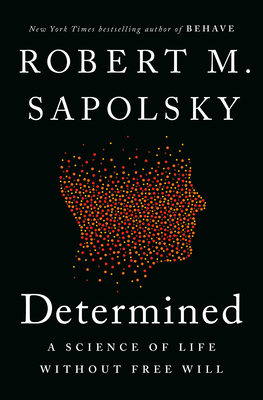
One of our great behavioral scientists, the bestselling author of Behave, plumbs the depths of the science and philosophy of decision-making to mount a devastating case against free will, an argument with profound consequences.Robert Sapolsky's Behave, his now classic account of why humans do good and why they do bad, pointed toward an unsettling conclusion: we may not grasp the precise marriage of nature and nurture that creates the physics and chemistry at base of human behavior, but that doesn't mean it doesn't exist. Now, in Determined, Sapolsky takes his argument all the way, mounting a brilliant (and in his inimitable way, delightful) full-frontal assault on the pleasant fantasy that there's some separate self telling our biology what to do.Determined offers a marvelous synthesis of what we know about how consciousness works--the tight weave between reason and emotion, and between stimulus and response, in the moment and over a life. One by one, Sapolsky tackles all the major arguments for free will and takes them out, cutting a path through the thickets of chaos and complexity science and quantum physics, as well as touching ground on some of the wilder shores of philosophy. He shows us that the history of medicine is in no small part the history of learning that fewer and fewer things are somebody's "fault"; for example, for centuries we thought seizures were a sign of demonic possession. Yet as he acknowledges, it's very hard, and at times impossible, to uncouple from our zeal to judge others, and to judge ourselves. Sapolsky applies the new understanding of life beyond free will to some of our most essential questions around punishment, morality, and living well together. By the end, Sapolsky argues that while living our daily lives recognizing that we have no free will is going to be monumentally difficult, doing so is not going to result in anarchy, pointlessness and existential malaise. Instead, it will make for a much more humane world.

The Trouble with Testosterone and Other Essays on the Biology of the Human Predicament
by Robert M. Sapolsky
Rating: 4.2 ⭐
As a professor of biology and neuroscience at Stanford and a recipient of a MacArthur Foundation "genius grant," Robert Sapolsky carries impressive credentials. Best of all, he's a gifted writer who possesses a delightfully devilish sense of humor. In these essays, which range widely but mostly focus on the relationships between biology and human behavior, hard and intricate science is handled with a deft touch that makes it accessible to the general reader. In one memorable piece, Sapolsky compares the fascination with tabloid TV to behavior he's observed among wild African baboons. "Rubber necks," notes the professor, "seem to be a common feature of the primate order." In the title essay of The Trouble with Testosterone, Sapolsky ruminates on the links, real or perceived, between that hormone and aggression.Covering such broad topics as science, politics, history, and nature, the author of Why Zebras Don't Get Ulcers writes accessible and interesting essays that explore the human struggle with moral and ethical problems in today's world. 20,000 first printing.

How do imperceptibly small differences in the environment change one's behavior? What is the anatomy of a bad mood? Does stress shrink our brains? What does People magazine's list of America's "50 Most Beautiful People" teach us about nature and nurture? What makes one organism sexy to another? What makes one orgasm different from another? Who will be the winner in the genetic war between the sexes?Welcome to Monkeyluv , a curious and entertaining collection of essays about the human animal in all its fascinating variety, from Robert M. Sapolsky, America's most beloved neurobiologist/primatologist. Organized into three sections, each tackling a Big Question in natural science, Monkeyluv offers a lively exploration of the influence of genes and the environment on behavior; the social and political -- and, of course, sexual -- implications of behavioral biology; and society's shaping of the individual. From the mating rituals of prairie dogs to the practice of religion in the rain forest, the secretion of pheromones to bugs in the brain, Sapolsky brilliantly synthesizes cutting-edge scientific research with wry, erudite observations about the enormous complexity of simply being human. Thoughtful, engaging, and infused with pop-cultural insights, this collection will appeal to the inner monkey in all of us.
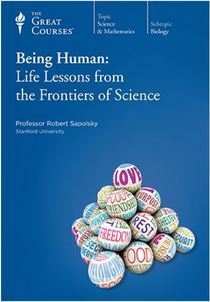
Understanding our humanity-the very essence of who we are and how we live our lives-is one of the deepest mysteries and biggest challenges in modern science. Why do we have bad moods? Why are we capable of having such strange and vivid dreams? How can metaphors and symbols in our language hold such a powerful sway on our thoughts and actions?As we learn more about the mechanisms of human behavior through evolutionary biology, neuroscience, anthropology, psychology, sociology, and other related fields, we're discovering just how intriguing the human species is. And while scientists are continually uncovering deep similarities between our behavior and that of other animals, they're also finding a wealth of insights into everything that makes us unique from any other species on Earth.Join acclaimed neurobiologist and award-winning Professor Robert Sapolsky of Stanford University for a surprising, amusing, and undeniably fascinating study of what makes you you. Being Human: Life Lessons from the Frontiers of Science is a 12-lecture course that takes you to the front lines of scientific research and offers you a new perspective on the supposedly quirky nature of being ourselves. Thought-provoking, witty, and sometimes myth-shattering, this course is sure to have you thinking about, observing, and even appreciating your own life in novel ways.

Biology and Human Behavior: The Neurological Origins of Individuality
by Robert M. Sapolsky
Rating: 4.5 ⭐
High quality, university level teaching! 12 audio CDs with guidebooks which outline the course. Course Lecture Titles1. Biology and BehaviorAn Introduction 2. The Basic Cells of the Nervous System 3. How Two Neurons Communicate 4. Learning and Synaptic Plasticity 5. The Dynamics of Interacting Neurons 6. The Limbic System 7. The Autonomic Nervous System (ANS) 8. The Regulation of Hormones by the Brain 9. The Regulation of the Brain by Hormones 10. The Evolution of Behavior 11. The Evolution of BehaviorSome Examples 12. Cooperation, Competition, and Neuroeconomics 13. What Do Genes Do? Microevolution of Genes 14. What Do Genes Do? Macroevolution of Genes 15. Behavior Genetics 16. Behavior Genetics and Prenatal Environment 17. An Introduction to Ethology 18. Neuroethology 19. The Neurobiology of Aggression I 20. The Neurobiology of Aggression II 21. Hormones and Aggression 22. Early Experience and Aggression 23. Evolution, Aggression, and Cooperation 24. A Summary

Feeling stressed? You're not alone. Stress is an inherent aspect of life that can have tremendous negative effects on your mental and physical health. This makes coping with stress a critical part of how well we live. Once you understand the inner workings of your stress response system, you'll possess powerful knowledge that will help you understand and better deal with this common aspect of your busy life. Now, from one of the world's foremost researchers on stress and neurobiology, comes a fascinating series of 24 lectures that guide you through the psychological and psychosocial stress that is a central part of everyday life in Western society. You'll learn how the stress-response system is actually a natural survival system-giving, for example, a zebra the best chance to escape from a pursuing lion - that can change from a safety mechanism into a real problem for our physical and mental well-being. You'll see it coming into play against situations it wasn't designed to combat, such as traffic, troublesome thoughts and memories, and concerns over the economy, environment, and international events. And you'll gain valuable insights into how and why stress can affect every part of your body-including your cardiovascular, digestive, and immune systems - and learn about its relationship to important disorders and behaviors, like depression, anxiety, and even addiction.

Honorable Mention in the category of Biological Sciences, 1992 Professional/Scholarly Publishing Annual Awards Competition presented by the Association of American Publishers, Inc.Looking beyond the now widely recognized relationships between stress and physical illness, this accessible and engagingly written book suggests that stress and stress-related hormones can also endanger the brain. Strategies to reduce stress and methods to protect neurons from further damage are proposed, and the relevance for humans of the animal research findings are clearly delineated.Sapolsky provides an extensive review of the recent, exciting data on glucocorticoids, the adrenal steroid hormones (hydrocortisone or cortisol in humans) that are released during stress. Excessive exposure to these hormones can damage the brain and make neurons more vulnerable to neurological insults. The findings he reports and ideas he synthesizes may have profound implications for understanding brain aging and resistance of the brain to the damaging effects of strokes, seizures, and possibly Alzheimer's disease.In part I Sapolsky focuses on how the failure of glucocorticoid regulation and subsequent excessive secretion combine to cause a complex cascade of degeneration in the brain during aging. In part 11 he addresses the implications of glucocorticoid neurotoxicity for neurology. Each chapter includes a helpful summary of the major points discussed as well as a capsule review of information from the previous chapters.Robert M. Sapolsky is Associate Professor of Biology and Neuroscience at Stanford University. He is also Research Associate at the Institute for Primate Research, National Museums of Kenya, Nairobi, and a MacArthur Fellow.

Behave, fitness mindset and mindset with muscle 3 books collection set
by Robert M. Sapolsky
Rating: 5.0 ⭐
Behave: The Biology of Humans at Our Best and Worst From the celebrated neurobiologist and primatologist, a landmark, genre-defining examination of human behavior, both good and bad, and an answer to the question: Why do we do the things we do? Sapolsky's storytelling concept is delightful but it also has a powerful intrinsic logic: he starts by looking at the factors that bear on a person's reaction in the precise moment a behavior occurs, and then hops back in time from there, in stages, ultimately ending up at the deep history of our species and its evolutionary legacy. The Fitness Mindset: Eat for energy, Train for tension, Manage your mindset, Reap the results How Would It Feel To Have The Body You'Ve Always Wanted, A Huge Boost In Energy, And The Mindset To Keep It Forever? Have you ever felt frustrated about not getting the results you want? Do you feel you are eating the right foods and doing the correct workouts but your body still isn't changing as quickly as you want? Are you grinding through your workday with low energy levels, praying for the next day off so you can sleep in? If this sounds familiar, then The Fitness Mindset is the book for you. Mindset With Muscle: Proven Strategies to Build Up Your Brain, Body and Business HOW WOULD IT FEEL TO HAVE THE BODY AND BUSINESS YOU'VE ALWAYS DREAMED OF? Mindset with Muscle takes you on a different transformation journey. Rather than hitting the gym and obsessing about success, this book brings you 'sets and reps for the brain'.

A NATURAL HISTORY OF PEACE
by Robert M. Sapolsky
Amahl and the Night Visitors - VHS
by Robert M. Sapolsky
Robert M Sapolsky 2 Books Collection Set
by Robert M. Sapolsky
Please Note That The Following Individual Books As Per Original ISBN and Cover Image In this Listing shall be Dispatched Robert M Sapolsky 2 Books Collection Set (Determined The Science of Life Without Free Will & Behave): Determined The Science of Life Without Free What if free will is an illusion? As Robert Sapolsky shows in this masterful account of the science of human behaviour, everything we think and do is caused by the luck of our biology and the influence of our environment, and ultimately both are beyond our control. In a world without free will, we must completely rethink what we mean by choice, responsibility, morality and justice. Sapolsky’s extraordinary book does exactly this, guiding us toward a profoundly fairer, more humane way of living together. We are capable of savage acts of violence but also spectacular feats of is one side of our nature destined to win out over the other? Every act of human behaviour has multiple layers of causation, spiralling back seconds, minutes, hours, days, months, years, even centuries, right back to the dawn of time and the origins of our species.In the epic sweep of history, how does our biology affect the arc of war and peace, justice and persecution? How have our brains evolved alongside our cultures? This is the exhilarating story of human morality and the science underpinning the biggest question of what makes us human?9781529920062/9780143110910
