
Robert L. Heilbroner
Robert L. Heilbroner (March 24, 1919 – January 4, 2005) was an American economist and historian of economic thought. The author of some twenty books, Heilbroner was best known for The Worldly Philosophers, a survey of the lives and contributions of famous economists, notably Adam Smith, Karl Marx, and John Maynard Keynes. Written in 1953, The Worldly Philosophers has sold nearly four million copies—the second-best-selling economics text of all time. The seventh edition of the book, published in 1999, included a new final chapter entitled "The End of Worldly Philosophy?", which included both a grim view on the current state of economics as well as a hopeful vision for a "reborn worldly philosophy" that incorporated social aspects of capitalism. Although a highly unconventional economist, who regarded himself as more of a social theorist and "worldly philosopher" (philosopher pre-occupied with "worldly" affairs, such as economic structures), and who tended to integrate the disciplines of history, economics and philosophy, Heilbroner was nevertheless recognized by his peers as a prominent economist. He was elected Vice President of the American Economic Association in 1972. He also came up with a way of classifying economies, as either Traditional (primarily agriculturally-based, perhaps subsistence economy), Command (centrally planned economy, often involving the state), Market (capitalism), or Mixed. He was a trustee of the Economists for Peace and Security. Heilbroner died on January 4, 2005 in New York, NY at the age of 85.
30 Books Written
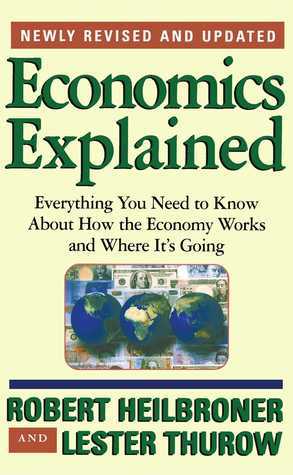
Economics Explained has an announced purpose to explain that mysterious thing called economics. But there is a new urgency to the book. It is announced in the first sentence of the introduction: "Just in case the reader-to-be hasn't noticed, disturbing things are going on in the American economy these days." This new edition is about these disturbing things: a trend toward inequality of incomes, the appearance of a new "globalized" capitalism, the "specter" of inflation. As before, Robert Heilbroner and Lester Thurow treat these problems in language that seeks to make clear their causes and treatments. In this straightforward, highly accessible reference, Heilbroner and Thurow--two of America's most respected and articulate economists--offer all the economics essential for becoming an effective investor, a savvy business decision maker, or simply an informed member of society.

The bestselling classic that examines the history of economic thought from Adam Smith to Karl Marx—“all the economic lore most general readers conceivably could want to know, served up with a flourish” (The New York Times).The Worldly Philosophers not only enables us to see more deeply into our history but helps us better understand our own times. In this seventh edition, Robert L. Heilbroner provides a new theme that connects thinkers as diverse as Adam Smith and Karl Marx. The theme is the common focus of their highly varied ideas—namely, the search to understand how a capitalist society works. It is a focus never more needed than in this age of confusing economic headlines.In a bold new concluding chapter entitled “The End of the Worldly Philosophy?” Heilbroner reminds us that the word “end” refers to both the purpose and limits of economics. This chapter conveys a concern that today’s increasingly “scientific” economics may overlook fundamental social and political issues that are central to economics. Thus, unlike its predecessors, this new edition provides not just an indispensable illumination of our past but a call to action for our future.

Selections from great writings on economics, annotated and introduced by a distinguished economist and teacher. Author of The Worldly Philosophers , a 3-million-copy seller, Robert Heilbroner offers here a compendium of readings from the "worldly philosophers" themselves. The selections range from the earliest economic thought to such towering volumes as Adam Smith's The Wealth of Nations , Thomas Malthus's Essay on the Principle of Population , David Ricardo's Principles of Political Econom y, and John Maynard Keynes's The General Theory of Employment, Interest, and Money . Acting as "a docent, not merely an editor," he takes the reader through the core arguments with "brilliantly clear commentary" ( New York Times Book Review ).

With its roots in history and eyes on the future, this book gives readers a balanced perspective of why our economic society is the way it is and where it may be headed by tracing its development from the Middles Ages to the present. Showing that today's economic problems cannot be understood unless we have an understanding of how they first arose, it explores the catalytic role past economic trends and dynamics have played in creating the present challenges we face, and offers suggestions on how we may deal with them most effectively.Focuses on problems and challenges of capitalism after the Golden Age (1945-1973), examining why the age came to an end and how globalization and income inequalities have changed the nature of capitalism. Considers the prospects of capitalism, outlines the essential features of a capitalist system, and stresses that capitalism can take many forms. Explores the concept of institutions, paying particular attention to the relation between states and markets, and workers and employers.

"Genuinely open-minded and inquiring. . . .it intelligently summarizes and shrewdly questions four central topics of Marxist thought―the dialectical approach to philosophy, the materialist interpretation of history, the socio-analysis of capitalism and the commitment to socialism." ―Raymond Williams, Cambridge University In the lucid style and engaging manner that have become his trademark, Robert L. Heilbroner explains and explores the central elements of Marxist the meaning of a "dialectical" philosophy, the usefulness and problems of a " materialist" interpretation" of history, the power of Marx's "socioanalytic" penetration of capitalism, and the hopes and disconcerting problems involved in a commitment to socialism. Scholarly without being academic, searching without assuming a prior knowledge of the subject, Dr. Heilbroner enables us to appreciate the greatness of Mark while avoiding an uncritical stance toward his work.

In search of an answer, The Nature and Logic of Capitalism takes us on a far-ranging exploration to the unconscious levels of the human psyche and the roots of domination and submission; to the organization of primitive society and the origins of wealth; to the sources of profit and the conception of a "regime" of capital; to the interplay of relatively slow-changing institutions and the powerful force of the accumulation of wealth. By the end of this tour we have grappled not only with ideas of Adam Smith and Karl Marx but with Freud and modern anthropologists as well. And we are far closer to understanding capitalism in our time, its possibilities and limits.

"It is my hope that some grasp of what the twenty-first century holds in store for capitalism may enable us to avoid at least some of the pain we might otherwise have to endure," writes the eminent economist Robert Heilbroner in this important book on the world's economic future. Although communism lies shattered almost everywhere it once existed, no single form of capitalism has emerged worldwide. Which of the varieties of capitalism will be hardy enough to survive into the next century? Will the private sector make way for government to redress the failures of the market system? Does the defeat of the socialist vision portend that unbridled acquisitiveness will dominate the world?In tackling these questions, Heilbroner takes us to the roots of capitalist society. He views capitalism from a wide angle as both an economic system and a political order, showing the integral connections between the two that are often overlooked; finally, he addresses the overarching challenge ahead―a society that no longer believes in the inevitability of progress.

The Economic Transformation of America: 1600 to the Present, 4th Edition
by Robert L. Heilbroner
Rating: 3.8 ⭐
This extraordinary text offers a proven combination of scholarship from an insightful economist and a renowned American historian. It recounts the development of capitalism and the age of machines through the voices of business leaders, working people, inventors, and an unusual cast of presidents, generals, and patriots. Unlike other books in the field of economic history, this text tells a story. While not ignoring statistics and percentages, this narrative focuses on the fact that America's economic transformation is an extraordinary drama--a drama that continues today.

An Inquiry into the Human Prospect: Updated & Reconsidered for the 1990s
by Robert L. Heilbroner
Rating: 3.7 ⭐
Is there hope for man? That "terrible question" was posed by Robert L. Heilbroner in the original version of An Inquiry into the Human Prospect . In this third edition of a book that has become a classic, Professor Heilbroner leaves the question in place on the first page, believing some twenty years later that that interrogative sounds the themes of the 1990s as well. The main components of the global predicament he described in the first edition are still with us today: runaway populations, obliterative weaponry, and a closing environmental vise. Writing now, in the aftermath of the extraordinary events that caused communism as a challenger to capitalism to vanish "like a puff of smoke," Professor Heilbroner traces out the difficulties that beset those attempting centrally planned economics. He shows how Soviet-style systems became mired in bureaucratic swamps. But he warns that the triumph of profit-driven, market-directed economies will not delay the looming encounter with the ecological barrier. "The absorption capacities of the environment," writes Professor Heilbroner, "whether in terms of the greenhouse effect or the overrunning of other physico-chemical capabilities of the planet" still determine the limits of the economic expansion. Trenchant and unflinching, Professor Heilbroner's look at the sum and substance of our prospects for the remaining years of this century is provocative and indispensable reading for those who prefer not to avert their gaze from the hard realities of our times.

"[These essays] are rich in argument, in clear and provocative presentation of complicated issues, and are often delightfully quotable. Behind the Veil of Economics makes instructive, disturbing, and lively reading." ―Elizabeth Wolgast, New York Times Book Review What lies behind the veil of economics? Power and ideology, answers Robert Heilbroner―the power of our economic involvement in society to shape the ways we think about it; the visions and values that add unsuspected ideological color to our economic beliefs about it. Most important, Heilbroner shows why economics has become the reigning form of social inquiry and how we might penetrate its mystique.Table of contentsPreface1. Behind the veil of Economics2. Capitalism as a regime3. On the future of Capitalism4. The world of work5. The problem of value6. Adam Smith's Capitalism7. Schumpeter's vision8. Vision and ideologyIndex

A deep and widespread crisis affects modern economic theory, a crisis that derives from the absence of a "vision"--a set of widely shared political and social preconceptions--on which all economics ultimately depends. This absence, in turn, reflects the collapse of the Keynesian view that provided such a foundation from 1940 through the early 1970s, comparable to earlier visions provided by Smith, Ricardo, Mill, and Marshall. The "unraveling" of Keynesianism has been followed by a division into discordant and ineffective camps whose common denominator seems to be their shared analytical refinement and lack of practical applicability. This provocative analysis attempts both to describe this state of affairs, and to suggest the direction in which economic thinking must move if it is to regain the relevance and remedial power it now pointedly lacks.

The Great Ascent: The Struggle for Economic Development in Our Time
by Robert L. Heilbroner
Rating: 3.5 ⭐
MapThe Measure of the ChallengeThe Tableau of UnderdevelopmentThe Shackles of BackwardnessThe Great ResolveThe Engineering of DevelopmentThe Speed of DevelopmentThe Social CostThe Challenge to the WestIndex

An analysis of capitalism in America, its social and economic limitations, and its future evolution


"This is an exceedingly long short book, stretching at least fifty thousand years into the past and who knows how many into the future." So begins Visions of the Future , the prophetic new book by eminent economist Robert Heilbroner. Heilbroner's basic premise is stunning in its elegant simplicity. He contends that throughout all of human history, despite the huge gulf in social organization, technological development, and cultural achievement that divides us from the earliest known traces of homo sapiens, there have really only been three distinct ways of looking at the future.During a period Heilbroner refers to simply as the Distant Past, stretching from prehistory to the appearance of modern nation-states in seventeenth century Europe, there was no notion of a future measurably and materially different from the present or the past. From the Stone Age to the Bronze, Mesopotamia and Egypt to Greece and Rome, and throughout the Middle Ages, a continuum of cultures and civilizations shared one defining expectation--the absence of any expectation of material progress for the great masses of people.Heilbroner maintains that it was not until the first stirrings of the period he refers to as Yesterday, spanning from roughly 1700 to 1950, that the future entered into human consciousness as a great beckoning force. Capitalism, continually reinvigorated by the seemingly endless forward march of science and an evolving sense of democracy, appeared to promise all levels of society some expectation of a future at least somewhat better than the past. It was this unwavering faith in the superiority of the future that separated Yesterday from the age we have now entered, that of Today. While we are still driven towards tomorrow by the same forces that determined the recent past, the lessons of Hiroshima and Chernobyl, the chaos in the former Soviet Union, the stagnation of the West, and the anarchic rage unleashed in our inner cities and in hot spots around the globe have brought on a palpable anxiety that is quite apart from both the resignation of the Distant Past or the bright optimismof Yesterday.In a brilliant conclusion drawing together the threat of nuclear blackmail, global warming and the growing commodification of life represented by video games, voice mail, and VCRs, Visions of the Future issues a call to face the challenges of the twenty-first century with a new resolve strengthened by the inspiration of our collective past.

In one of the most widely hailed books of recent years, Robert L. Heilbroner has set forth a powerful and brilliantly written analysis of the forces at work in the modern world and where they are taking us. Clear, convincing, and comprehensive, Heilbroner's view illuminates every headline-making event of our complex times: the impact of the Bomb, the drift away from capitalism, the challenge of communism, the need for social planning, the wrath of the underdeveloped nations, the possibilities before America. It is must reading for everyone who cares about what is happening to America and to humanity.

As the British trade deficit continues to grow, this trenchant, original and timely book on the US deficit and national debt offers much to readers on this side of the Atlantic. The authors explain what national debts and deficits are, and what they are not. One thing they are not nearly as big as we think. Another thing they are not is a burden on the shoulders of our grandchildren. And one thing they are is a potential means of financing economic growth. Heilbroner and Bernstein do not shrug aside the debt and deficit. "The only remedy for our present frightened state of mind", they write, "is explanations that are simple but accurate, facts that will defuse unreasoning panic, and arguments that will stand up under the most skeptical examination."

The definitive source in the field of micro- and macroeconomics.
An eminent economist examines the social, technological, and political conditions which illuminate America's present economic state

The noted economist predicts another worldwide capitalist crisis, explaining that capitalism is always undergoing crises and any sure way to end inflation would bring certain death to the system
Addressing the most critical economic challenges of the closing decades of this century, the authors explore the causes and effects of inflation, recession, big government, the weakening dollar, and the energy crisis

Projects widespread economic planning in the immediate future, increased industrial socialism within twentyfive years, and a new, tightly controlled society within a century

This introduction to macroeconomics emphasizes the dynamics of growth.
Paperback book. Stated First Edition 1963.

The Worldy Philosphers. The Lives, Times & Ideas of the Great Economic Thinkers
by Robert L. Heilbroner
Rating: 3.7 ⭐
Revised Edition from 1961 The Worldy Philosphers. The Lives, Times & Ideas of the Great Economic Thinkers Author Robert L. Heilbroner

Famous professor of economics and philosopher Robert L. Heilbroner is the author of this introduction to the concepts included in microeconomics.
The Wordly Philophers: The lives, TImes and Ideas of the Great Economic Thinkers
by Robert L. Heilbroner
Rating: 4.0 ⭐

Said One “Why should my conscience bother me?”Here are dramatic true stories of executives whose desire for profit leads them into shameful decisions. Naming actual executive of major American companies, the authors portray corporate irresponsibility in human term. One executive is shown as he orders his subordinates to fake a lab report, even though the result might be loss of life. Others are shown as they bribe a city official, as they knowingly sell a dangerous drug, as they enrich themselves by betraying their stockholders. These men are not the familiar fast-buck artists, the petty cheats who can be dismissed as “bad apples.” The authors reveal themselves as solid citizens, educated and well-respected. Yet in the course of business they easily yield to ambition, avarice or the corporate culture. And almost always, after they are exposed, they are promoted by their companies.Together these profiles, all of them written especially for this book, give life to questions raised by books such as America, Inc. and The Greening of · What kind of men run some super-corporations?· How can “good men” behave so badly”· Does working for a corporation mean violating one’s conscience? After all the stories are told, the brilliant economist and social critic Robert L. Heilbroner offers a chapter of perspective. First he confronts the various positions on corporate responsibility—at one extreme, breaking up the big corporations; at the other, leaving executive entirely free to maximize profits. And then he cuts through to the realities if the matter, showing us where the best chance of remedy lies.

The Making of the Economic Society 13th (thirteenth) edition Text Only
by Robert L. Heilbroner
Rating: 3.0 ⭐

This extraordinary text offers a proven combination of scholarship from an insightful economist and a renowned American historian. It recounts the story of capitalism and the age of machines through the voices of business leaders, working people, inventors and an unusual cast of presidents, generals and patriots.