
Robert H. Frank
Robert H. Frank is the Henrietta Johnson Louis Professor of Management and a Professor of Economics at Cornell University's S.C. Johnson Graduate School of Management. He contributes to the "Economic View" column, which appears every fifth Sunday in The New York Times.
30 Books Written

Under the Influence: Putting Peer Pressure to Work
by Robert H. Frank
Rating: 3.4 ⭐
• 2 recommendations ❤️
From New York Times bestselling author and economics columnist Robert Frank, a revelatory look at the power and potential of social contextAs psychologists have long understood, social environments profoundly shape our behavior, sometimes for the better, but often for the worse. Less widely noted is that social influence is a two-way street: Our environments are in large part themselves a product of the choices we make.Society embraces regulations that limit physical harm to others, as when smoking restrictions are defended as protecting bystanders from secondhand smoke. But we have been slower to endorse parallel steps that discourage harmful social environments, as when regulators fail to note that the far greater harm caused when someone becomes a smoker is to make others more likely to smoke.In Under the Influence, Robert Frank attributes this regulatory asymmetry to the laudable belief that individuals should accept responsibility for their own behavior. Yet that belief, he argues, is fully compatible with public policies that encourage supportive social environments.Most parents hope, for example, that their children won't grow up to become smokers, bullies, tax cheats, sexual predators, or problem drinkers. But each of these hopes is less likely to be realized whenever such behaviors become more common. Such injuries are hard to measure, Frank acknowledges, but that's no reason for policymakers to ignore them. The good news is that a variety of simple policy measures could foster more supportive social environments without ushering in the dreaded nanny state or demanding painful sacrifices from anyone.

From New York Times bestselling author and economics columnist Robert Frank, a compelling book that explains why the rich underestimate the importance of luck in their success, why that hurts everyone, and what we can do about itHow important is luck in economic success? No question more reliably divides conservatives from liberals. As conservatives correctly observe, people who amass great fortunes are almost always talented and hardworking. But liberals are also correct to note that countless others have those same qualities yet never earn much. In recent years, social scientists have discovered that chance plays a much larger role in important life outcomes than most people imagine. In Success and Luck, bestselling author and New York Times economics columnist Robert Frank explores the surprising implications of those findings to show why the rich underestimate the importance of luck in success--and why that hurts everyone, even the wealthy.Frank describes how, in a world increasingly dominated by winner-take-all markets, chance opportunities and trivial initial advantages often translate into much larger ones--and enormous income differences--over time; how false beliefs about luck persist, despite compelling evidence against them; and how myths about personal success and luck shape individual and political choices in harmful ways.But, Frank argues, we could decrease the inequality driven by sheer luck by adopting simple, unintrusive policies that would free up trillions of dollars each year--more than enough to fix our crumbling infrastructure, expand healthcare coverage, fight global warming, and reduce poverty, all without requiring painful sacrifices from anyone. If this sounds implausible, you'll be surprised to discover that the solution requires only a few, noncontroversial steps.Compellingly readable, Success and Luck shows how a more accurate understanding of the role of chance in life could lead to better, richer, and fairer economies and societies.

The Economic Naturalist: In Search of Explanations for Everyday Enigmas
by Robert H. Frank
Rating: 3.5 ⭐
Why do the keypads on drive-up cash machines have Braille dots? Why are round-trip fares from Orlando to Kansas City higher than those from Kansas City to Orlando? For decades, Robert Frank has been asking his economics students to pose and answer questions like these as a way of learning how economic principles operate in the real world--which they do everywhere, all the time.Once you learn to think like an economist, all kinds of puzzling observations start to make sense. Drive-up ATM keypads have Braille dots because it's cheaper to make the same machine for both drive-up and walk-up locations. Travelers from Kansas City to Orlando pay less because they are usually price-sensitive tourists with many choices of destination, whereas travelers originating from Orlando typically choose Kansas City for specific family or business reasons. The Economic Naturalist employs basic economic principles to answer scores of intriguing questions from everyday life, and, along the way, introduces key ideas such as the cost benefit principle, the "no cash left on the table" principle, and the law of one price. There is no more delightful and painless way of learning these fundamental principles.

Who was the greater economist--Adam Smith or Charles Darwin? The question seems absurd. Darwin, after all, was a naturalist, not an economist. But Robert Frank, New York Times economics columnist and best-selling author of The Economic Naturalist, predicts that within the next century Darwin will unseat Smith as the intellectual founder of economics. The reason, Frank argues, is that Darwin's understanding of competition describes economic reality far more accurately than Smith's. And the consequences of this fact are profound. Indeed, the failure to recognize that we live in Darwin's world rather than Smith's is putting us all at risk by preventing us from seeing that competition alone will not solve our problems.Smith's theory of the invisible hand, which says that competition channels self-interest for the common good, is probably the most widely cited argument today in favor of unbridled competition--and against regulation, taxation, and even government itse

The Return of The Economic Naturalist: How Economics Helps Make Sense of Your World
by Robert H. Frank
Rating: 3.5 ⭐
The Economic Naturalist is back with a whole batch of intriguing new questions and answers, drawn from his New York Times columns, that reveal how we really behave when confronted with economic choices. Do tax cuts for business owners really stimulate employment? Why shouldn't we just leave everything to the market? And why do we all save so little? Discover the answers to these and many more questions. With his trademark plain-speaking wit and insight, Robert Frank shows through dozens of examples how our personal choices about everything from paying for food and housing to large-scale policy decisions about taxation and the regulation of markets all boil down to the same simple economic principles, often resulting in the same wasteful mistakes. He shows that while our desires may be boundless, the resources necessary to satisfy them remain limited and argues that choices are always best made pragmatically - by carefully weighing the costs and benefits of competing options. This is a fascinating, entertaining and revealing collection full of insights that have more bearing than ever on our bank balances and our personal happiness.

The Winner-Take-All Society: Why the Few at the Top Get So Much More Than the Rest of Us
by Robert H. Frank
Rating: 3.7 ⭐
Disney chairman Michael Eisner topped the 1993 Business Week chart of America's highest-paid executives, his $203 million in earnings roughly 10,000 times that of the lowest paid Disney employee. During the last two decades, the top one percent of U.S. earners captured more than 40 percent of the country's total earnings growth, one of the largest shifts any society has endured without a revolution or military defeat. Robert H. Frank and Philip J. Cook argue that behind this shift lies the spread of "winner-take-all markets"—markets in which small differences in performance give rise to enormous differences in reward. Long familiar in sports and entertainment, this payoff pattern has increasingly permeated law, finance, fashion, publishing, and other fields. The result: in addition to the growing gap between rich and poor, we see important professions like teaching and engineering in aching need of more talent. This relentless emphasis on coming out on top—the best-selling book, the blockbuster film, the Super Bowl winner—has molded our discourse in ways that many find deeply troubling.

Falling Behind: How Rising Inequality Harms the Middle Class (Volume 4)
by Robert H. Frank
Rating: 3.7 ⭐
Although middle-income families don't earn much more than they did several decades ago, they are buying bigger cars, houses, and appliances. To pay for them, they spend more than they earn and carry record levels of debt. In a book that explores the very meaning of happiness and prosperity in America today, Robert Frank explains how increased concentrations of income and wealth at the top of the economic pyramid have set off "expenditure cascades" that raise the cost of achieving many basic goals for the middle class. Writing in lively prose for a general audience, Frank employs up-to-date economic data and examples drawn from everyday life to shed light on reigning models of consumer behavior. He also suggests reforms that could mitigate the costs of inequality. Falling Behind compels us to rethink how and why we live our economic lives the way we do. Russell Sage Foundation
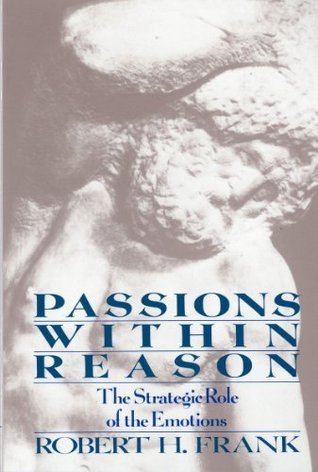
In this book, I make use of an idea from economics to suggest how noble human tendencies might not only have survived the ruthless pressures of the material world, but actually have been nurtured by them. The idea rests on a simple paradox, namely, that in many situations the conscious pursuit of self-interest is incompatible with its attainment. We are all comfortable with the notion that someone who strives to be spontaneous can never succeed. So too, on brief reflection, will it become apparent that someone who always pursues self-interest is doomed to fail.

The turn of the twenty-first century witnessed a spectacular rise in gross consumption. With the super-rich setting the pace, everyone spent furiously in a desperate attempt to keep up. As cars and houses grew larger and more expensive, the costs were enormous--not only monetarily but also socially. Consumers spent more time at work and less time with their family and friends; they saved less money and borrowed more.In this book, Robert Frank presents the first comprehensive and accessible account of these financial choices. Frank uses scientific evidence to demonstrate how these spending patterns have not made us happier or healthier. Luxury Fever offers an exit from the rat race, suggesting ways to curb the culture of excess and restore true value to our lives.

Robert Frank’s Microeconomics and Behavior covers the essential topics of microeconomics while exploring the relationship between economics analysis and human behavior. The book’s clear narrative appeals to students, and its numerous examples help students develop economic intuition. This book introduces modern topics not often found in intermediate textbooks. Its focus throughout is to develop a student’s capacity to "think like an economist."

This listing is for the study guide to accompany "Principles of Microeconomics" 3rd edition.

In recent years, innovative texts in mathematics, science, foreign languages, and other fields have achieved dramatic pedagogical gains by abandoning the traditional encyclopedic approach in favor of attempting to teach a short list of core principles in depth. Two well-respected writers and researchers, Bob Frank and Ben Bernanke, have shown that the less-is-more approach affords similar gains in introductory economics. Although recent editions of a few other texts have paid lip service to this new approach, Frank/Bernanke is by far the best thought out and best executed principles text in this mold. Avoiding excessive reliance on formal mathematical derivations, it presents concepts intuitively through examples drawn from familiar contexts. The authors introduce a well-articulated short list of core principles and reinforcing them by illustrating and applying each in numerous contexts. Students are periodically asked to apply these principles to answer related questions, exercises, and problems. The text also encourages students to become "Economic Naturalists," people who employ basic economic principles to understand and explain what they observe in the world around them. An economic naturalist understands, for example, that infant safety seats are required in cars but not in airplanes because the marginal cost of space to accommodate these seats is typically zero in cars but often hundreds of dollars in airplanes. Such examples engage student interest while teaching them to see each feature of their economic landscape as the reflection of an implicit or explicit cost-benefit calculation. The Second Edition of Frank/Bernanke follows the successful First Edition with several pedagogical improvements. Based on reviewer feedback, this edition offers (1) even more streamlined coverage of the cost-benefit approach in the introductory chapter; (2) exercises that are more closely tied to the examples; (3) expanded narrative explanations of important principles, making them more accessible to average students; and (4) expanded coverage of several key topics. The result is a revision that is motivating to students, an effective text for teaching, and an exciting first course in Economics.
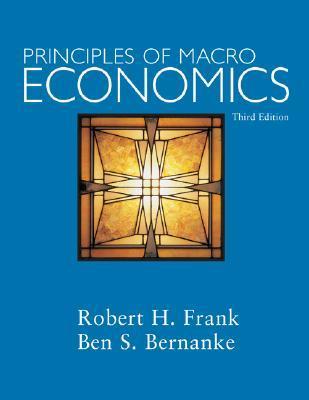
In recent years, innovative texts in mathematics, science, foreign languages, and other fields have achieved dramatic pedagogical gains by abandoning the traditional encyclopedic approach in favor of attempting to teach a short list of core principles in depth. Two well-respected writers and researchers, Bob Frank and Ben Bernanke, have shown that the less-is-more approach affords similar gains in introductory economics. Although recent editions of a few other texts have paid lip service to this new approach, Frank/Bernanke is by far the best thought out and best executed principles text in this mold. Avoiding excessive reliance on formal mathematical derivations, it presents concepts intuitively through examples drawn from familiar contexts. The authors introduce a well-articulated short list of core principles and reinforcing them by illustrating and applying each in numerous contexts. Students are periodically asked to apply these principles to answer related questions and exercises.. . The text also encourages students to become �Economic Naturalists,� people who employ basic economic principles to understand and explain what they observe in the world around them. An economic naturalist understands, for example, that infant safety seats are required in cars but not in airplanes because the marginal cost of space to accommodate these seats is typically zero in cars but often hundreds of dollars in airplanes. Such examples engage student interest while teaching them to see each feature of their economic landscape as the reflection of an implicit or explicit cost-benefit calculation. .

Is it better to be a big frog in a small pond or a small frog in a big pond? Here, economist Robert H. Frank argues that concerns about status permeate and profoundly alter a broad range of human behavior. He shows how status considerations affect the salaries people earn, the way they spend them, and even many of the laws, regulations, and cultural norms they adopt. Provocative and insightful, this book is sure to spark widespread and lively debate in classrooms and boardrooms alike.

The Economic Naturalist: Why Economics Explains Almost Everything by Robert H Frank
by Robert H. Frank
Rating: 3.7 ⭐

What Price the Moral High Ground?: How to Succeed without Selling Your Soul
by Robert H. Frank
Rating: 3.7 ⭐
Financial disasters--and stories of the greedy bankers who precipitated them--seem to underscore the idea that self-interest will always trump concerns for the greater good. Indeed, this idea is supported by the prevailing theories in both economics and evolutionary biology. But is it valid?In What Price the Moral High Ground? , economist and social critic Robert Frank challenges the notion that doing well is accomplished only at the expense of doing good. Frank explores exciting new work in economics, psychology, and biology to argue that honest individuals often succeed, even in highly competitive environments, because their commitment to principle makes them more attractive as trading partners.Drawing on research he has conducted and published over the past decade, Frank challenges the familiar homo economicus stereotype by describing how people create bonds that sustain cooperation in one-shot prisoner's dilemmas. He goes on to describe how people often choose modestly paid positions in the public and nonprofit sectors over comparable, higher-paying jobs in the for-profit sector; how studying economics appears to inhibit cooperation; how social norms often deter opportunistic behavior; how a given charitable organization manages to appeal to donors with seemingly incompatible motives; how concerns about status and fairness affect salaries in organizations; and how socially responsible firms often prosper despite the higher costs associated with their business practices.Frank's arguments have important implications for the conduct of leaders in private as well as public life. Tossing aside the model of the self-interested homo economicus, Frank provides a tool for understanding how to better structure organizations, public policies, and even our own lives.

Book by Frank, Robert, Bernanke, Ben

In recent years, innovative texts in mathematics, science, foreign languages, and other fields have achieved dramatic pedagogical gains by abandoning the traditional encyclopedic approach in favor of teaching a shorter list of core principles in depth. Two well-respected writers and researchers, Bob Frank and Ben Bernanke, have shown that the less-is-more approach affords similar gains in introductory economics. The authors introduce a coherent short list of core principles and reinforce them by illustrating and applying each in numerous contexts. Students are periodically asked to apply these principles and to answer related questions and exercises. The BRIEF editions were developed for instructors who appreciate core principles approach, and desire a more manageable amount of content and slightly less rigor. In the brief editions, the authors made careful choices of material to eliminate and condense, in order to produce of more concise coverage. Connect is the only integrated learning system that empowers students by continuously adapting to deliver precisely what they need, when they need it, and how they need it, so that your class time is more engaging and effective.

繼《蘋果橘子經濟學》之後,二次解放經濟學最有趣的經濟學,在電影院、在你家裡,有時也在街上 137種日常生活經濟法則 ●為什麼牛奶多以長方形容器出售,而一般飲料容器則為圓柱形? ●為何硬幣的人頭像多為側面,而紙鈔則是正面肖像? ●為什麼女性願意忍受穿高跟鞋的不舒服? ●為什麼高速公路北上車道發生車禍,分隔島對面的南下車道也會塞車? ●為什麼開車可以吃漢堡或喝咖啡,講手機卻違法? 所謂「經濟自然學」,就是以生物學界自然觀察的敘述方式來解讀經濟學原理,也就是將觀念用故事的敘述方式呈現,並在日常生活中活用落實。 最有趣的經濟學不會出現在課堂上或難解的方程式中,而是出現在真實世界裡——在電影院、在你車上,有時也在街上。從一九八○年代開始,獲獎無數的經濟學家羅伯.法蘭克就開始要求他的學生,針對日常生活所遇見的有趣事件與行為模式提出問題,並用經濟學原理加以解釋。他們的問題,以及讓人瞠目結舌的答案,顯示出經濟學原理確實在你我日常生活中運行。 作者在經濟學入門的課程裡,要求學生寫一篇短文,題目是:「運用經濟學單一(或多種)原理,針對你在日६

Render Floor Plans with Photoshop emphasizes a step-by-step process showing how to render CAD floor plans. It includes detailed instructions on how to add seamless fabric textures to furniture, render wood floors, carpet, stainless steel, and many other common architectural elements and materials. In addition this book shows how to add shadows and shading, giving floor plans a 3D quality. The book focuses on rendering a residential floor plan from start to finish. Each chapter is broken down by room and the rendering of common materials associated with them. Start from the beginning or jump to different sections to learn specific techniques relevant to your own projects. Developed for both students and professionals alike. Written and illustrated by Robert H. Frank who has a degree in architecture from Rhode Island School of Design. He has extensive experience as an architectural illustrator and college instructor.

Smartbook Access Card for Principles of Macroeconomics, a Streamlined Approach
by Robert H. Frank
Rating: 5.0 ⭐

This brand-new principles of economics text is the most exciting new entry in years. Written by two well-known and well-respected economists,Bob Frank and Ben Bernanke,the text seeks to teach introductory students the core economic concepts—the essence of economics—without overwhelming them with details. Principles of Economics presents the material in an intuitive way that avoids excessive math. The authors introduce a well-articulated short list of core principles,reinforce them by illustrating and applying each principle in several contexts,and then ask students to work exercises to see what they've learned. The text seeks to create "Economic Naturalists"; that is,after reading the text,students will ask (and answer) questions about their economic environment. For example,students will see Braille dots on drive-up ATMs and ask why they're there. Peppered with such thought-provoking examples,Frank and Bernanke not only engage students,but teach them to see each feature of their economic landscape as the reflection of an implicit or explicit cost-benefit calculation.

Principles of Economics: A Streamlined Approach seeks to promote a deeper understanding of economics by focusing on core concepts. Fewer themes, less math rigor, and a new suite of video resources allow instructors the flexibility to teach the course they want to teach, whether it's adopting a flipped classroom format, administering a course online, or just bringing more engaging, digital content into their lectures. Students benefit from more repetition of basic concepts and support through the interactive resources in Connect, resulting in a greater mastery and retention of core economic ideas. Connect is the only integrated learning system that empowers students by continuously adapting to deliver precisely what they need, when they need it, and how they need it, so that your class time is more engaging and effective.

McGraw-Hill Connect(r) is a subscription-based learning service accessible online through your personal computer or tablet. Choose this option if your instructor will require Connect to be used in the course. Your subscription to Connect includes the following: SmartBook(r) - an adaptive digital version of the course textbook that personalizes your reading experience based on how well you are learning the content. Access to your instructor s homework assignments, quizzes, syllabus, notes, reminders, and other important files for the course. Progress dashboards that quickly show how you are performing on your assignments and tips for improvement. The option to purchase (for a small fee) a print version of the book. This binder-ready, loose-leaf version includes free shipping. Complete system requirements to use Connect can be found here: http: //www.mheducation.com/highered/platform..."
Powered by the intelligent and adaptive LearnSmart engine, SmartBook facilitates the reading process by identifying what content a student knows and doesn't know. As a student reads, the material continuously adapts to ensure the student is focused on the content he or she needs the most to close specific knowledge gaps.

Financial Skills and Concepts - FIN 3134 - Virginia Tech
Book by Davis, James R

Distributional Consequences of Direct Foreign Investment examines the net effect of direct foreign investment (DFI) on both U.S. employment demand in the short run and on the level and distribution of domestic income in the long run. Topics covered range from measurement of home-foreign substitution to the employment impact of DFI and the long-run distributional consequences of overseas investment. Short-run labor market adjustments to unemployment resulting from overseas production transfers are also discussed. Comprised of nine chapters, this volume begins with a survey of existing studies of the DFI phenomenon that critically evaluates the question of what firms would or could have done in the absence of a DFI alternative. The reader is then introduced to an alternative framework within which to estimate the degree of substitutability of home for foreign production. This framework consists of a microeconomic model of the multinational firm as it operates under two alternative policy regimes, one of which places no restrictions on the firm's activities and the second denies it the option of establishing a foreign production subsidiary. Input-output techniques, together with information on substitutability, are used to obtain estimates of the net employment impact of DFI. A probabilistic model of an industry labor market is also presented. In addition, the book analyzes the effect of technology transfer through licensing on the size and composition of domestic income. This monograph will be useful to practitioners who employ econometrics and mathematical economics.