
Robert Graves
Robert von Ranke Graves was an English poet, soldier, historical novelist and critic. Born in Wimbledon, he received his early education at King's College School and Copthorne Prep School, Wimbledon & Charterhouse School and won a scholarship to St John's College, Oxford. While at Charterhouse in 1912, he fell in love with G.H. Johnstone, a boy of fourteen ("Dick" in Goodbye to All That) When challenged by the headmaster he defended himself by citing Plato, Greek poets, Michelangelo & Shakespeare, "who had felt as I did". At the outbreak of WWI, Graves enlisted almost immediately, taking a commission in the Royal Welch Fusiliers. He published his first volume of poems, Over the Brazier, in 1916. He developed an early reputation as a war poet and was one of the first to write realistic poems about his experience of front line conflict. In later years he omitted war poems from his collections, on the grounds that they were too obviously "part of the war poetry boom". At the Battle of the Somme he was so badly wounded by a shell-fragment through the lung that he was expected to die, and indeed was officially reported as 'died of wounds'. He gradually recovered. Apart from a brief spell back in France, he spent the rest of the war in England. One of Graves's closest friends at this time was the poet Siegfried Sassoon, who was also an officer in the RWF. In 1917 Sassoon tried to rebel against the war by making a public anti-war statement. Graves, who feared Sassoon could face a court martial, intervened with the military authorities and persuaded them that he was suffering from shell shock, and to treat him accordingly. Graves also suffered from shell shock, or neurasthenia as it is sometimes called, although he was never hospitalised for it. Biographers document the story well. It is fictionalised in Pat Barker's novel Regeneration. The intensity of their early relationship is nowhere demonstrated more clearly than in Graves's collection Fairies & Fusiliers (1917), which contains a plethora of poems celebrating their friendship. Through Sassoon, he also became friends with Wilfred Owen, whose talent he recognised. Owen attended Graves's wedding to Nancy Nicholson in 1918, presenting him with, as Graves recalled, "a set of 12 Apostle spoons". Following his marriage and the end of the war, Graves belatedly took up his place at St John's College, Oxford. He later attempted to make a living by running a small shop, but the business failed. In 1926 he took up a post at Cairo University, accompanied by his wife, their children and the poet Laura Riding. He returned to London briefly, where he split with his wife under highly emotional circumstances before leaving to live with Riding in Deià, Majorca. There they continued to publish letterpress books under the rubric of the Seizin Press, founded and edited the literary journal Epilogue, and wrote two successful academic books together: A Survey of Modernist Poetry (1927) and A Pamphlet Against Anthologies (1928). In 1927, he published Lawrence and the Arabs, a commercially successful biography of T.E. Lawrence. Good-bye to All That (1929, revised and republished in 1957) proved a success but cost him many of his friends, notably Sassoon. In 1934 he published his most commercially successful work, I, Claudius. Using classical sources he constructed a complexly compelling tale of the life of the Roman emperor Claudius, a tale extended in Claudius the God (1935). Another historical novel by Graves, Count Belisarius (1938), recounts the career of the Byzantine general Belisarius. During the early 1970s Graves began to suffer from increasingly severe memory loss, and by his eightieth birthday in 1975 he had come to the end of his working life. By 1975 he had published more than 140 works. He survived for ten more years in an increasingly dependent condition until he died from heart
30 Books Written

The definitive edition of one of the more extraordinary and influential books of our timeThis labyrinthine and extraordinary book, first published more than sixty years ago, was the outcome of Robert Graves's vast reading and curious research into strange territories of folklore, mythology, religion, and magic. Erudite and impassioned, it is a scholar-poet's quest for the meaning of European myths, a polemic about the relations between man and woman, and also an intensely personal document in which Graves explores the sources of his own inspiration and, as he believed, all true poetry.Incorporating all of Graves's final revisions, his replies to two of the original reviewers, and an essay describing the months of illumination in which The White Goddess was written, this is the definitive edition of one of the most influential books of our time.

Milano, Bompiani, 1955, 8vo (cm. 20,5 x 12) brossura editoriale con sovraccoperta illustrata a colori, pp. 479 (I delfini).

With the same brilliance that characterized his classic I, Claudius, Robert Graves continues the tumultuous life of the Roman who became emperor in spite of himself and his handicaps. Claudius the God reveals the splendor, vitality and decadence of the Roman Empire through the eyes of the wry and bemused Claudius who reigns as emperor for thirteen years. The crippled Claudius describes himself as the fool of the royal family, whom none of his ambitious and blood-thirsty relatives considered worth the trouble of killing. Once in the throne, however, he finds himself at last at the center of the political maelstrom.

An autobiographical work that describes firsthand the great tectonic shifts in English society following the First World War, Robert Graves's Goodbye to All That is a matchless evocation of the Great War's haunting legacy, published in Penguin Modern Classics.In 1929 Robert Graves went to live abroad permanently, vowing 'never to make England my home again'. This is his superb account of his life up until that 'bitter leave-taking': from his childhood and desperately unhappy school days at Charterhouse, to his time serving as a young officer in the First World War that was to haunt him throughout his life. It also contains memorable encounters with fellow writers and poets, including Siegfried Sassoon and Thomas Hardy, and looks at his increasingly unhappy marriage to Nancy Nicholson. Goodbye to All That, with its vivid, harrowing descriptions of the Western Front, is a classic war document, and also has immense value as one of the most candid self-portraits of an artist ever written.Robert Ranke Graves (1895-1985) was a British poet, novelist, and critic. He is best known for the historical novel I, Claudius and the critical study of myth and poetry The White Goddess. His autobiography, Goodbye to All That, was published in 1929, quickly establishing itself as a modern classic. Graves also translated Apuleius, Lucan and Suetonius for the Penguin Classics, and compiled the first modern dictionary of Greek Mythology, The Greek Myths. His translation of The Rubáiyát of Omar Khayyám (with Omar Ali-Shah) is also published in Penguin Classics.

Combines in a single volume the complete text of the definitive two-volume classic, citing all the ancient myths. For a full appreciation of literature or visual art, knowledge of the Greek myths is crucial. In this much-loved collection, poet and scholar Robert Graves retells the immortal stories of the Greek myths. Demeter mourning her daughter Persephone, Icarus flying too close to the sun, Theseus and the Minotaur … all are captured here with the author’s characteristic erudition and flair.The Greek Myths is the culmination of years of research and careful observation, however what makes this collection extraordinary is the imaginative and poetic style of the retelling. Drawing on his experience as a novelist and poet, Graves tells the fantastic stories of Ancient Greece in a style that is both absorbing and easy for the general reader to understand. Each story is accompanied by Graves’ interpretation of the origins and deeper meaning of the story, giving a reader an unparalleled insight into the customs and development of the Greek world.

A work of historical fiction which recreates the life and times of Emperor Claudius, who lived from 10 BC to AD 41, a time when poisoning, blasphemy, treachery, incest and unnatural vice were commonplace. From the author of CLAUDIUS THE GOD AND HIS WIFE MESSALINA.

The sixth century was not a peaceful time for the Roman empire. Invaders threatened on all fronts, but they grew to respect and fear the name of Belisarius, the Emperor Justinian's greatest general. With this book Robert Graves again demonstrates his command of a vast historical subject, creating a startling and vivid picture of a decadent era.

In a work that has become a classic reference book for both the serious scholar and the casual inquirer, Graves retells the adventures of the important gods and heroes worshipped by the ancient Greeks. Each entry provides a full commentary which examines problems of interpretation in both historical and anthropological terms, and in light of contemporary research.

Recounts the glorious days when gods and goddesses who dwelt on Mount Olympus ruled over the world of mortals below, and fabled heroes performed mighty deeds of valor.

Reissued by Creative Age Press in 1945 as Hercules, My Shipmate, a novel about the voyage of the Argo. Written with ideas on The White Goddess as a cultural/anthropological backdrop to the ancient Greek tale. What the Golden Fleece really was—a cloak tossed to earth by a drunken Zeus, a sheepskin book of alchemic secrets or the gilded epidermis of a young human sacrifice named Mr. Ram—nobody knows. But Graves is quite sure that, whatever the Golden Fleece was, the voyage of Jason & his Argonauts really happened. His story shows the legendary cruise as one of the bawdiest, bloodiest, most boisterous expeditions of all time. In I, Claudius & its Claudius the God sequel, Graves brought the teeming life of Claudian Rome so vividly alive that they became bestsellers. In the not-so-successful Wife to Mr. Milton, his blend of imagination & scholarship projected his readers into 17th-Century England & the bedchamber temper tantrums of the blind poet-politician. With Hercules & shipmates, Graves becomes an ancient Greek, moving among demigods & goddesses, myths & monsters with an easy familiarity & a wealth of erudite detail. Both sometimes seem too much of a good thing. Atomic-age readers, ill-attuned to the leisurely, formal talk of myth-age Greeks, may find themselves skipping some of the longer speeches. Most of the Argo's 50-oar crew were princes, each with a special talent & gift of the gods. The only woman aboard was a princess: Atalanta of Calydon, a virgin huntress who could outrun any man in Greece. Argus, who built the Argo, was the world's finest shipwright. Castor & Pollux, sons of Leda & Zeus-as-swan, were champion prizefighters. Nauplius, Poseidon's son, was an unrivaled navigator. Orpheus could make sticks & stones dance to his lyre. Hercules of Tiryns was the world's strongest man. He would've captained the Argonauts were it not that in moments of insanity he murdered friend & foe alike. Captaincy devolved on Jason of lolcos—a man nobody liked or trusted, but who had a power denied to all the others: women instantly fell in love with him. Even surly Hercules agreed it a quality worth all the rest. Backed by divine blessings & equinoctal winds, the Argonauts set sail. On the Island of Lemnos, peopled solely by women, they generously stopped off to help out with spring sowing. Nine months later, 200 children were born, of whom no less than 60 were said to be the spitting image of Hercules. On Samothrace, they were initiated into the sacred mysteries. The Goddess of All Being mated with the Serpent Priapus to be delivered of a bull. Then the sacred nymphs leapt on them & scratched & bit until even Hercules passed out. Thereafter, the Argonauts glowed with "a faint nimbus of light." The Argonauts boldly pushed on thru the dread Hellespont & entered the Black Sea. To their dismay, Hercules deserted, summoned home to perform another of his mighty labors. "Holy Serpents!" he growled. "Tell me what this time?" The job—cleaning the Augean Stables—didn't take long. He stayed around afterwards with the Lydian high priestess—who in due time bore male triplets. In gratitude, she taught him to spin, tying up his hair in blue braids. He was crazy about it, admitting confidentially he'd always wanted to be a woman. The Argonauts went on without Hercules. Reaching Colchis, Aphrodite won the Fleece for them. She made her son Eros wait behind a pillar with his bow until handsome Jason strode into the King of Colchis' palace. Eros shot Medea thru the heart, & the smitten princess helped to get the Fleece from her father's temple. Mythology's most famous voyage had reached its goal, but Graves takes 150 more pages to wind things up.

Robert Graves, classicist, poet, and unorthodox critic, retells the Greek legends of gods and heroes for a modern audience And, in the two volumes of The Greek Myths, he demonstrates with a dazzling display of relevant knowledge that Greek Mythology is “no more mysterious in content than are modern election cartoons.” His work covers, in nearly two hundred sections, the creation myths; the legends of the births and lives of the great Olympians; the Theseus, Oedipus, and Heracles cycles; the Argonaut voyage; the tale of Troy, and much more. All the scattered elements of each myth have been assembled into a harmonious narrative, and many variants are recorded which may help to determine its ritual or historical meaning, Full references to the classical sources, and copious indexes, make the book as valuable to the scholar as to the general reader; and a full commentary on each myth explains and interprets the classical version in the light of today’s archaeological and anthropological knowledge.

King Jesus,is one of the most controversial historical novels of all time. In it, Robert Graves has summoned his superb narrative powers, his painstaking scholarship, his wit and unsurpassed ability to recreate the past, to produce a magnificent portrayal of the life of Christ on earth.

Nausicaa, a Sicilian princess of the eighth century B.C., looks back on the events of her life and tells how she came to write the epic poem known as the Odyssey.

This exploration of Hebrew myths & the book of Genesis resulted from a collaboration between a scholar raised as a strict Protestant & another raised as a strict Jew. It goes beyond Christian biblical & Judaic myth & incorporates midrashes, folk tales, apocryphal texts & other obscure sources to extend & complete the stories. An intriguing view of the suppressed & censored pre-biblical accounts is the result, along with a rich sense of a culture consisting of oral & literary traditions, where the spiritual is rooted in landscape & history.

This book is a retelling of the mythical side of the Trojan war with the various Greek Gods taking sides of different warrious throughout the story. It retold the famous epics of the Illiad and the Odissey.

A full and intimate account of Lawrence's life and adventures. The author, a personal friend of Lawrence, had his permission to write this biography as a discouragement to possible misleading and inaccurae ones. He had also the advice and assistance of many of those who were with Lawrence during the Arab campaign.Author's Note: In this concise edition of Lawrence and the Arabs I repeat my thanks to Lawrence (who has now changed his name to Shaw) for his generous permission to use copyright material from his own account of the campaign, Seven Pillars of Wisdom, a book that will not be issued for public sale in his lifetime: and to the many authorities on the campaign who have helped me. R.G.

"The long week-end" is Robert Grave's and Alan Hodge's evocative phrase for the period in Great Britain's social history between the twin devastations of the Great War and World War II. With brilliant wit and trenchant judgments they offer a scintillating survey of seemingly everything that went on of any consequence (or inconsequence) in those years in politics, business, science, religion, art, literature, fashion, education, popular amusements, domestic life, sexual relations -- much else.Across this crowded canvas of British life stride the Duke of Windsor and Mrs. Wallis Simpson, Neville Chamberlain, Charlie Chaplin, Virginia Woolf, Lord Beaverbrook, Evelyn Waugh, Winston Churchill, Marie Stopes, Aldous Huxley, Lloyd George, and dozens of other figures great and small who put their stamp on the era. From a postwar period of prosperity and frivolity defined by the high jinks of the Bright Young Things through the ever-darkening decade of the thirties punctuated by spiraling economic and political crises and shadowed by the inevitable conflagration to come The Long Week-End deftly and movingly preserves the details and captures the spirit of the time. It is social history the way it is meant to be written -- a classic of its kind.*Table of contents:Armistice, 1918Revolution averted, 1919Women Reading matter Post-war politicsVarious conquestsSex AmusementsScreen & stageRevolution again averted, 1926Domestic life Art, literature & religionEducation & ethicsSport & controversy The depression, 1930Pacifism, nudism, hikingThe days of the Loch Ness monsterRecovery, 1935 The days of non-intervention'The deepening twilight of barbarism'Three kings in one year Keeping fit & doing the Lambeth walkSocial consciences 'Markets close firmer'Still at peace Rain stops play, 1939

The war between the Greeks and the Trojans has reached a fever pitch. Offended by Agamemnon, the great Greek warrior Achilles is in his tent, refusing to fight. But then Trojan prince Hector slaughters Patroclus, Achilles’ close friend. Willing or not, Achilles must take revenge for his friend’s death, even if it will result in his own.The Anger of Achilles is a novelized interpretation of Homer’s Iliad, told by noted classicist and historical novelist Robert Graves. In this innovative take on the classic tale, Achilles comes to life in all his vivid rage, bravery, passion, and lust for battle. Combining his advanced expertise in ancient Greek warfare and culture with a talent for telling a compelling story, Robert Graves is the ideal translator to bring this ancient epic of war to a modern audience.ABOUT THE AUTHOR Robert Graves (1895-1985) was an English novelist, poet, and translator of Classical Greek and Roman literature, and one of the most prominent English writers of the 20th century. He was an extremely prolific writer, who published more than 140 novels and collections of poetry. In addition to novels and poetry, he published groundbreaking analysis of Greek mythology, as well as memoir. Graves is best known for his historical novels, which include I, Claudius, Claudius, the God, The Golden Fleece, King Jesus, and Count Belisarius.Robert Graves served in combat in World War I and was gravely wounded at the Battle of the Somme. Following his recovery, he wrote several works of war poetry as well as a memoir of his time in combat, entitled Goodbye to All That. In 1934, Robert Graves was awarded the James Tait Black Memorial Prize for his historical novels dealing with the Roman Emperor Claudius.

Like the three monkeys, the New Cretans see no evil, speak no evil and hear no evil. When Edward Venn-Thomas wakes up to find himself in their midst he realizes that much has happened since the mid-20th century from which he has been whisked. His hosts live in peace and prosperity in a society which knows no hunger and no dissatisfaction, where war has become a game played on village greens, where the poets and magicians of a strange occult religion keep all classes of the population happy with their lot.But idyllic though their civilization may be, it is insipid and boring, a Utopia utterly lacking in danger, excitement or spice. And as Venn-Thomas begins to understand the bewildering adventures which befall him, he realizes that he has been chosen by The Goddess to inject New Crete with disruption and misery, to create disaster and chaos, to reintroduce the New Cretans to a force they have forgotten about - evil. In short, to teach them to live again.[Taken from the back cover]

This novel takes place in the early years of the American Revolution and is based on the adventures of one Sergeant Lamb, a Dublin man in the service of His Majesty's army. It begins with Lamb's early days in Dublin and ends with his arrival in Boston as a member of the regiment taken prisoner after Burgoyne's surrender at Saratoga.

"Ammesso che si possa riconoscere l'anima di un altro essere umano, non è mai dato riconoscere la propria". Nel racconto di un alienato a un altro se stesso, la lotta dilaniante e mortale per strapparsi a luoghi che da sempre generano terrore allo stato più puro: i propri sogni.

"An orphan boy who finds a big green book of magic in his guardians' attic . . . turns himself into a little old man, defeats his aunt and uncle at cards, and lets a rabbit chase the dog, before turning back into a child".--New York Times Book Review.

From the dust jacket...With impressive literary power, with a beauty that makes this novel live and glow in the consciousness of the reader, Robert Graves unfolds the story of the tragic and eventful life of Marie Powell, who, at the age of sixteen, was pushed into marrying the man who was England’s greatest epic poet—and knew it—John Milton.The story, by an acknowledged master of the historical novel, has a triple fascination.First, for its tender account of the romance Marie Powell found outside the walls of her tyrannical husband’s house, and the utter misery to which he enforced her.Then, for the astute study of the “sublime” Milton of Paradise Lost, at last portrayed in his true light, in those characteristics which led him to become Oliver Cromwell’s Dr. Goebbels.And further, for the brilliant account of one of the most breath-taking epochs in English history, when that kingdom was ravaged by a bloody civil war and the tides of fortune swayed from one to the other side of the opposing camps—the King against his parliament, tyranny against freedom—culminating in the dramatic execution of Charles I, and the establishment of a republic, all of which assumes added significance in the light of today’s events.

Published by Penguin for more than sixty years, the author and scholar Robert Graves wrote two of the greatest historical novels of the twentieth century: I Claudius and Claudius the God. Written as Claudius' autobiography, they follow his progress from a stammering figure of fun to the ruler of the Roman Empire. Here, in extracts from both books, he describes the glory and decadence of the mad Emperor Caligula's reign - an age of wild debauchery and whimsical cruelty.

"My story is true... every word of it. Or when I say that my story is 'true', I mean at least I am telling it in a new way..."So begins "The Shout," the tale of a man possessed by a lethal magic, perhaps Robert Graves's most famous story. This collection spans 1924-62; it takes in the worlds of love and war, history and myth, and settings as various as England, Ancient Rome and Majorca. In so far as its author asserts the truth of his stories, they can be read as episodes of autobiography, this collection forming an essential companion to "Goodbye to All That."
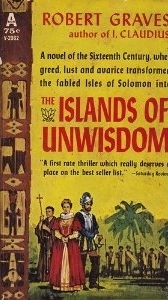
he Islands of Unwisdom is an historical novel by Robert Graves, published in 1949. It was also published in the UK as The Isles of Unwisdom. It is a reconstruction of an historic event, the voyage of Álvaro de Mendaña de Neira to find the Solomon Islands. Graves tells a story with many surprising twists, in which some characters turn out to be quite different from how they are first portrayed. In Graves's telling, when the Spanish first come into contact with Solomon Islanders, the relationship is cordial. However, the Spanish expedition's need for fresh food and water quickly leads to tension and conflict, the Solomon Islanders’ subsistence economy being unable to provide continuous supplies. The real prizes are pigs, desperately needed by the Spanish, while vital to the local people’s economy. The tensions cannot be resolved, and so the Spaniards sail home. Graves also considered that the story summarizes the reasons Spain lost its early lead in exploring the world.(Source; wiki)

For a full appreciation of literature or visual art, knowledge of the Greek myths is crucial. In this much-loved collection, poet and scholar Robert Graves retells the immortal stories of the Greek myths. Demeter mourning her daughter Persephone, Icarus flying too close to the sun, Theseus and the Minotaur … all are captured here with the author’s characteristic erudition and flair.The Greek Myths is the culmination of years of research and careful observation, however what makes this collection extraordinary is the imaginative and poetic style of the retelling. Drawing on his experience as a novelist and poet, Graves tells the fantastic stories of Ancient Greece in a style that is both absorbing and easy for the general reader to understand. Each story is accompanied by Graves’ interpretation of the origins and deeper meaning of the story, giving a reader an unparalleled insight into the customs and development of the Greek world.This two-volume work is both a valuable reference book and a magical point of entry into the minds of those who lived so many centuries ago. This edition, one of The Folio Society’s all-time bestsellers, is edited and introduced by Kenneth McLeish, with illustrations by Grahame Baker.[Source: http://www.foliosociety.com/book/GRL/...]

Solutions to the common problems encountered in writing English prose are discussed and illustrated in critical examinations of the work of prominent writers

Robert Graves was one of the greatest and most prolific British writers of the 20th century, the author of numerous volumes of poetry, as well as countless essays, historical novels (including the well-known I, Claudius and Claudius the God ), and the marvelous nonfiction work The WhiteGoddess .A writer of striking originality, he spoke with a highly individual yet ordered voice in which lucidity and intensity combine to a remarkable degree. His love poetry, some of his best-known and most distinctive work, is at once cynical and passionate, romantic and erotic, personal and universal. Hewanted his poetry to act as a "spiritual cathartic" to the poet and the reader. His work has been described as "romanticism boiled dry," a striving for the pure, the unpretentious, the essential, the vigorous, and the "non-literary."This volume represents Graves' final thoughts on his prodigious body of work, containing those poems which he most wanted to see survive. Long out of print, it is being reissued to honor his death in early 1986.

Fairies and Fusiliers collects poems written during World War I, when Graves served in the Royal Welsh Fusiliers on the Western Front, alongside Siegfried Sassoon, another one of WWI's most celebrated poets. Unlike Graves, who survived the war, Sassoon was killed in combat. Robert Graves always considered himself a poet first, but unable to support his family through poetry alone, he wrote novels, works of criticism and nonfiction, and taught at Oxford in the 1960s, becoming a lecturer at age 66.