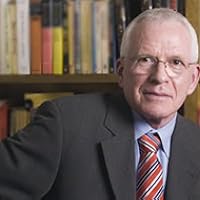
Robert Gellately
Robert Gellately (born 1943) is a Newfoundland-born Canadian academic who is one of the leading historians of modern Europe, particularly during World War II and the Cold War era. He is Earl Ray Beck Professor of History at Florida State University. He often teaches classes about World War II and the Cold War, but his extensive interest in the Holocaust has led to his conducting research regarding other genocides as well. He is occasionally known to give lectures on specific genocides. Gellately has very strict guidelines for what he will deem a genocide, and has had several televised debates regarding his somewhat controversial views. Gellately's most recent work is Stalin's Curse: Battling for Communism in War and Cold War (Knopf (March 5, 2013) Gellately recently published a set of original documents by Leon Goldensohn dealing with the 1945-46 Nuremberg trials of war criminals in The Nuremberg Interviews: An American Psychiatrist's Conversations With The Defendants and Witnesses (Alfred A. Knopf, 2004). His other books include Backing Hitler: Consent and Coercion in Nazi Germany, 1933-1945 (Oxford University Press, 2001). It has been published in German, Dutch, Spanish, Czech, and Italian. Japanese and French translations are in press. Backing Hitler was chosen as a main selection for book clubs in North America and the United Kingdom. In the book Backing Hitler: Consent and Coercion in Nazi Germany, 1933-1945, Gellately argues that the Gestapo were not in fact all-pervasive and intrusive as they have been described. The Gestapo only numbered 32,000 for the entire population of Germany, and this clearly limited their impact. In the city of Hanover there were only 42 officers. Instead, Gellately says that the atmosphere of terror and fear was maintained by 'denunciations' from ordinary Germans, whereby they would inform any suspicious 'anti-Nazi' activity to the local Nazi authority. According to Gellatley, these denunciations were the cause of most prosecutions, as in Saarbrücken 87.5 per cent of cases of 'slander against the regime' came from denunciations. This diminished the Gestapo's role in maintaining fear and terror throughout the Third Reich, however they still proved to be a powerful instrument for Hitler and continued to provide the security apparatus needed for the Nazi Regime. His first book was The Politics of Economic Despair: Shopkeepers in German Politics, 1890-1914 (London, 1974). In 1991 he published The Gestapo and German Society: Enforcing Racial Policy, 1933-1945 (Oxford University Press.) It has been translated into German and Spanish. In addition, Gellately has co-edited a volume of essays with Russian specialist Sheila Fitzpatrick, Accusatory Practices: Denunciation in Modern European History, 1789-1989 (University of Chicago Press, 1997). With his colleague Nathan Stoltzfus (also at Florida State University) he co-edited a collection called Social Outsiders in Nazi Germany (Princeton University Press, 2001). With Ben Kiernan, Director of the Genocide Studies program at Yale, he recently co-edited The Specter of Genocide: Mass Murder in Historical Perspective (Cambridge University Press, 2003). Professor Gellately has won numerous research awards, including grants from the Alexander von Humboldt Foundation in Germany and the Social Sciences and Humanities Research Council of Canada. Many of the books written or edited by him are used as textbooks in college classrooms across America. Credits: https://en.wikipedia.org/wiki/Robert_...
7 Books Written

Lenin, Stalin, and Hitler: The Age of Social Catastrophe
by Robert Gellately
Rating: 4.6 ⭐
• 1 recommendation ❤️
A bold new accounting of the great social and political upheavals that enveloped Europe between 1914 and 1945—from the Russian Revolution through the Second World War.In Lenin, Stalin, and Hitler, acclaimed historian Robert Gellately focuses on the dominant powers of the time, the Soviet Union and Nazi Germany, but also analyzes the catastrophe of those years in an effort to uncover its political and ideological nature. Arguing that the tragedies endured by Europe were inextricably linked through the dictatorships of Lenin, Stalin, and Hitler, Gellately explains how the pursuit of their “utopian” ideals turned into dystopian nightmares. Dismantling the myth of Lenin as a relatively benevolent precursor to Hitler and Stalin and contrasting the divergent ways that Hitler and Stalin achieved their calamitous goals, Gellately creates in Lenin, Stalin, and Hitler a vital analysis of a critical period in modern history.

Debate still rages over how much ordinary Germans knew about the concentration camps and the Gestapo's activities during Hitler's reign. Now, in this well-documented and provocative volume, historian Robert Gellately argues that the majority of German citizens had quite a clear picture of the extent of Nazi atrocities, and continued to support the Reich to the bitter end.Culling chilling evidence from primary news sources and citing dozens of case studies, Gellately shows how media reports and press stories were an essential dimension of Hitler's popular dictatorship. Indeed, a vast array of material on the concentration camps, the violent campaigns against social outsiders, and the Nazis' radical approaches to "law and order" was published in the media of the day, and was widely read by a highly literate population of Germans. Hitler, Gellately reveals, did not try to hide the existence of the Gestapo or of concentration camps. Nor did the Nazis try to cow the people into submission. Instead they set out to win converts by building on popular images, cherished ideals, and long-held phobias. And their efforts succeeded, Gellately concludes, for the Gestapo's monstrous success was due, in large part, to ordinary German citizens who singled out suspected "enemies" in their midst, reporting their suspicions and allegations freely and in a spirit ofcooperation and patriotism.Extensively documented, highly readable and illustrated with never-before-published photographs, Backing Hitler convincingly debunks the myth that Nazi atrocities were carried out in secret. From the rise of the Third Reich well into the final, desperate months of the war, the destruction of innocent lives was inextricably linked to the will of the German people.

A chilling, riveting account based on newly released Russian documentation that reveals Joseph Stalin’s true motives—and the extent of his enduring commitment to expanding the Soviet empire—during the years in which he seemingly collaborated with Franklin D. Roosevelt, Winston Churchill, and the capitalist West.At the Big Three conferences of World War II, Joseph Stalin persuasively played the role of a great world leader, whose primary concerns lay in international strategy and power politics, and not communist ideology. Now, using recently uncovered documents, Robert Gellately conclusively shows that, in fact, the dictator was biding his time, determined to establish Communist regimes across Europe and beyond. His actions during those years—and the poorly calculated responses to them from the West—set in motion what would eventually become the Cold War. Exciting, deeply engaging, and shrewdly perceptive, Stalin’s Curse is an unprecedented revelation of the sinister machinations of Stalin’s Kremlin.

Understanding Adolf Hitler's ideology provides insights into the mental world of an extremist politics that, over the course of the Third Reich, developed explosive energies culminating in the Second World War and the Holocaust. Too often the theories underlying National Socialism or Nazism are dismissed as an irrational hodge-podge of ideas. Yet that ideology drove Hitler's quest for power in 1933, colored everything in the Third Reich, and transformed him, however briefly, into the most powerful leader in the world. How did he discover that ideology? How was it that cohorts of leaders, followers, and ordinary citizens adopted aspects of National Socialism without experiencing the leader first-hand or reading his works? They shared a collective desire to create a harmonious, racially select, community of the people to build on Germany's socialist-oriented political culture and to seek national renewal. If we wish to understand the rise of the Nazi Party and the new dictatorship's remarkable staying power, we have to take the nationalist and socialist aspects of this ideology seriously.

Focusing on the twentieth century, this collection of essays by leading international experts offers an up-to-date, comprehensive history and analysis of multiple cases of genocide and genocidal acts. The book contains studies of the Armenian genocide; the victims of Stalinist terror; the Holocaust; and Imperial Japan. Contributors explore colonialism and address the fate of the indigenous peoples in Africa, North America, and Australia. In addition, extensive coverage of the post-1945 period includes the atrocities in the former Yugoslavia, Bali, Cambodia, Ethiopia, Rwanda, East Timor, and Guatemala. Robert Gellately is Professor and Strassler Family Chair for the Study of Holocaust History at Clark University, where he teaches a variety of courses in modern German history, modern European history and the history of the Holocaust with a concentration on the study of Nazi Germany and the Gestapo. In Backing Hitler (Oxford, 2001), Gellately uses new evidence to demolish long-held beliefs about what ordinary Germans knew of the concentration camps. His internationally acclaimed book, The Gestapo and German Society (Oxford, 1990) challenges conventional concepts of the Gestapo and daily life in Nazi Germany. He has won numerous fellowships, and awards, most recently from the Alexander von Humboldt Foundation in Germany. Ben Kiernan is A. Whitney Griswold Professor of History and Director of the Genocide Studies Program at Yale University and Convenor of the Yale East Timor Project. Kiernan is the author of The Pol Pot Regime (Yale, 1996), How Pol Pot Came to Power (Verso Books, 1985) and three other works and over a hundred scholarly articles on Southeast Asia and the history of genocide. Choice called him "the most knowledgeable observer of Cambodia anywhere in the Western world." Pol Pot's Khmer Rouge "indicted" and then "sentenced" him as an "arch war criminal." Kiernan is a member of the Editorial Boards of Human Rights Review, the Journal of Human Rights, and the Journal of Genocide Research. He is currently writing a global history of genocide since 1500.

How was the Gestapo able to detect the smallest signs of non-compliance with Nazi doctrines--especially "crimes" pertaining to the private spheres of social, family, and sexual life? How could the police enforce policies such as those designed to isolate Jews, or the foreign workers brought to Germany after 1939, with such apparent ease? Addressing these questions, Gellately argues that the key factor in the successful enforcement of Nazi racial policy was the willingness of German citizens to provide authorities with information about suspected "criminality." He demonstrates that without some degree of popular participation in the operation of institutions such as the Gestapo, the regime would have been seriously hampered in the "realization of the unthinkable," not only inside Germany but also in many of the occupied countries. Offering an intriguing examination of the everyday operations of the Gestapo and the product of extensive archival research, this incisive studysurveys the experiences of areas across Germany, drawing out national, local, and regional implications.

The Politics of Economic Despair: Shopkeepers and German Politics, 1890-1914
by Robert Gellately
Book by Gellately, Robert