
Robert Conquest
George Robert Ackworth Conquest was a British historian who became a well known writer and researcher on the Soviet Union with the publication, in 1968, of his account of Stalin's purges of the 1930s, The Great Terror.
29 Books Written

The definitive work on Stalin's purges, Robert Conquest's The Great Terror was universally acclaimed when it first appeared in 1968. Harrison Salisbury called it "brilliant...not only an odyssey of madness, tragedy, and sadism, but a work of scholarship and literary craftsmanship." And in recent years it has received equally high praise in the former Soviet Union, where it is now considered the definitive account of the period.When Conquest wrote the original volume, he relied heavily on unofficial sources. With the advent of glasnost, an avalanche of new material became available, and Conquest mined this enormous cache to write, in 1990, a substantially new edition of his classic work, adding enormously to the detail. Both a leading historian and a highly respected poet, Conquest blends profound research with evocative prose, providing not only an authoritative account of Stalin's purges, but also a compelling and eloquent chronicle of one of this century's most tragic events. He provides gripping accounts of everything from the three great "Moscow Trials," to methods of obtaining confessions, the purge of writers and other members of the intelligentsia, life in the labor camps, and many other key matters.On the fortieth anniversary of the first edition, in the light of further archival releases, and new material published in Moscow and elsewhere, it remains remarkable how many of Conquest's most disturbing conclusions have continued to bear up. This volume, featuring a new preface by Conquest, rounds out the picture of this huge historical tragedy, further establishing the book as the key study of one of the twentieth centurys most lethal, and longest misunderstood, offenses against humanity.

Poetry. Edited by Elizabeth Conquest. This volume brings together eight decades of work by a writer described in the Dictionary of National Biography as "a man of letters, attaining equal distinction as poet, historian, and political commentator." Robert Conquest's many honours include the PEN Brazil Prize (for the best long poem about the Second World War), a Festival of Britain verse prize, and the Michael Braude Award for Light Verse. His poems cover an astonishing Clive James praised his "fastidiously chiselled poems which proved his point that cool reason was not necessarily lyricism's enemy," while Philip Larkin, applauding Conquest's virtuosity with the limerick form, inscribed a copy of High Windows "To Bob, Il Miglior Fabbro (or whatever it was) -- at least over five lines." Conquest neatly skewered pretension wherever he found it, but throughout his long life also wrote eloquent poems of love, longing, and loss. As the poet and critic David Mason observed, "These are poems by a man of the world who has seen and studied much and has apparently lived with gusto. It is good to be in his company." "All Conquest's strengths are evident here -- wit, love of life, ferocious technique, and the infinite taking of pains."--Martin Amis "These vigorous poems have an exquisite colour sense ... They linger wittily over longing ... They are irreverent to the cosmos ... and, with a nod to Larkin, savage to biographers."--Alison Brackenbury, Poetry Review "Much of Conquest's best-known poetry is funny, even absurdly hilarious, but when it is serious it is continuous with the voice that wrote on history and politics."--Dick Davis, The Hopkins Review "A strong and individual voice talking about things that matter ... hard energetic movement ... lucidity and power."--Thom Gunn, The Spectator "Only a first-rate poet could have written stanzas of such deceptive lightness and ease."--Selina Hastings "In poems about love, the subversive, lyrical proof that desire goes on into old age is alive in every cadence and perception. As ever, he makes many a younger writer look short of energy."--Clive James "[Conquest's] virtues--precision, wit, craftsmanship--only seem old fashioned to those who believe poetry can do without them. For others, this book will be a continual reminder of times when poetry was turned to in the sure and certain hope of pleasure and instruction."--Alan Jenkins "The poems ... are smart, funny, tough-minded, generous, and utterly individual."--Zachary Leader "A fully developed and impressive style ... he writes with clarity, authority and cunning."-- New York Times Book Review "Among the most original short pieces to be published in recent years ... remarkable in their combination of lyrical rhetoric and delicate observation."-- The Times Literary Supplement "Conquest's red-blooded approach to Eros in these poems refreshes rather than repels. For someone critics have accused of blokishness, Conquest writes with great subtlety and often with great tenderness."--David Yezzi, The New Criterion "These are poems of elegant irreverence from the same humane writer of history, the same Renaissance man, good with a joke, who practiced what one of his poems calls 'strong, natural art.'"--David Mason, The Wall Street Journal

The Harvest of Sorrow is the first full history of one of the most horrendous human tragedies of the 20th century. Between 1929 and 1932 the Soviet Communist Party struck a double blow at the Russian peasantry: dekulakization, the dispossession and deportation of millions of peasant families, and collectivization, the abolition of private ownership of land and the concentration of the remaining peasants in party-controlled "collective" farms. This was followed in 1932-33 by a "terror-famine," inflicted by the State on the collectivized peasants of the Ukraine and certain other areas by setting impossibly high grain quotas, removing every other source of food, and preventing help from outside--even from other areas of the Soviet Union--from reaching the starving populace. The death toll resulting from the actions described in this book was an estimated 14.5 million--more than the total number of deaths for all countries in World War I.Ambitious, meticulously researched, and lucidly written, The Harvest of Sorrow is a deeply moving testament to those who died, and will register in the Western consciousness a sense of the dark side of this century's history.

Of all the despots of our time, Joseph Stalin lasted the longest and wielded the greatest power, and his secrets have been the most jealously guarded—even after his death.In this book, the first to draw from recently released archives, Robert Conquest gives us Stalin as a child and student; as a revolutionary and communist theoretician; as a political animal skilled in amassing power and absolutely ruthless in maintaining it. He presents the landmarks of Stalin’s the class with Lenin; collectivization; the Great Terror; the Nazi-Soviet pact and the Nazi-Soviet war; the anti-Semitic campaign that preceded his death; and the legacy he left behind.Distilling a lifetime’s study, weaving detail, analysis, and research, Conquest has given us an extraordinarily powerful narrative of this incredible figure.“Thoughtful and thorough and shot through with insight.”— The Washington Post Book World“Definitive . . . a magnificent, even poetic, act of historical retribution.”— The New Leader“Brilliant . . . this book probably is the most cogent and readable account of Stalin’s life yet published.”— The San Diego Union

"Illuminates the past with a mighty searchlight and clears away mountains of nonsense."―Gabriel Schoenfeld, Wall Street Journal Robert Conquest has been called by Paul Johnson "our greatest living modern historian." As a new century begins, Conquest offers an illuminating examination of our past failures and a guide to where we should go next. Graced with one of the most acute gifts for political prescience since Orwell, Conquest assigns responsibility for our century’s cataclysms not to impersonal economic or social forces but to the distorted ideologies of revolutionary Marxism and National Socialism. The final, sobering chapters of Reflections on a Ravaged Century concern themselves with some coming storms, notably that of the European Union, which Conquest believes is an economic, cultural, and geographical misconception divisive of the West and doomed to failure. Winner of the Ingersoll Prize; winner of the Richard M. Weaver Prize; a New York Times Notable Book. "Provides many glowing embers of reasoned and wise argument."―Richard Bernstein, The New York Times "A book that ought to be required reading for everyone about to enter college, and by every member of Congress."―Frank Wilson, Philadelphia Inquirer

The Dragons of Expectation: Reality and Delusion in the Course of History
by Robert Conquest
Rating: 3.8 ⭐
A landmark defense of civilization that illuminates the political degradations and intellectual fetishisms of our world. The publication of The Dragons of Expectation in 2005 reaffirmed Robert Conquest's stature as a leading intellectual and one of the world's great humanists. In the tradition of Isaiah Berlin's The Crooked Timber of Humanity and George Orwell's Essays , this book brilliantly traces how seductive ideas have come to corrupt modern minds; to often disastrous effects. In what Publishers Weekly called "a frontal assault on the pieties of the left," Conquest masterfully examines how false nostrums have infected academia, politicians, and the public, showing how their reliance on "isms" and the destructive concepts of "People, Nation, and Masses" have resulted in a ruinous cycle of turbulence and war. Including fresh analyses of Russia's October Revolution, World War II, and the Cold War, The Dragons of Expectation is one of the most important contributions to modern thought in recent years. 3 illustrations
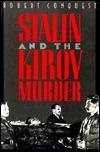
On December 1, 1934, a lone gunman shot and killed Sergei Kirov, Secretary of the Central and Leningrad Party Organization, member of the Moscow Politburo, and once considered Joseph Stalin's possible successor. As one of the most significant crimes of the century, the assassination notonly sealed the fates of thousands--and, indirectly, millions--of people spuriously connected to the killer, but it eliminated the second most powerful man in Russian politics and gave Stalin free rein to dominate Soviet policy.Written by the highly acclaimed author of The Harvest of Sorrow , Stalin and the Kirov Murder presents the first book-length examination of the case. Robert Conquest chronicles the details of the Kirov affair and all of its astonishing consequences. He tells us that now, fifty-five years afterKirov's murder, glasnost has prompted a new examination of this singular crime--one that will perhaps reveal the truth about the case for the first time. Based on all the available evidence, including official documents as well as the reports of numerous Russian defectors, Conquest has written afascinating, at times chilling, account of the murder and its aftermath. He firmly establishes that Stalin not only sanctioned Kirov's assassination, but used it as a justification for the terror that culminated in 1937 and '38.

While moonlighting with the local police, social worker Hildy Schneider is drawn into the darker side of small-town Sorenson, Wisconsin, as she teams up with Detective Bob Richmond to solve a seemingly supernatural case.


Discusses the changes that would occur in public and private life under Russian occupation

Covers worn, page edges tanned. Orders received by 3pm Sent from the UK that weekday.

Soviet historian Robert Conquest looks to the literature of the Communist world in this book which considers the nature of truth and truth-tellers under what he still sees as a tyranny. He calls in evidence literature - Pasternak, Djlias, Solzhenitsyn, and political figures, such as Sakharov, Lenin and Kremlinologists, to form critical theories about the Soviet Union and its writings.

In the free world of the future, many people are uneasy about the government's psychological power to control, even benevolently, its citizens' upbringing.Four friends, an artist, a scientist, an administrator, and an amorist, each find their own novel and surprising solutions to the problem of how to retain independence of mind and action in a world where conformity has reached way out beyond just one planet...



The historical background, the present position, and the future prospects of both the non-Russian and Russian peoples are considered in their many aspects, as are the maneuvers of the Communist regime to suppress, appease, or make use of them. The future of the Soviet Union, and thus of the world, depends greatly on whether, and how, the Communist leadership, whose own ideology has lost most of its appeal, can adjust to a new surge of national feeling. The authors examine the question from many points of view, in a broad conspectus of political, cultural, economic, demographic, and other approaches.

Poetry. In this hilarious and irreverent new collection, Robert Conquest, now in his 95th year, lets us in on the musings of Old Fred, a man reflecting on the battle of the sexes, and wholly impervious to notions of political correctness. The poems give witty expression to a mind at once resigned and optimistic, baffled and amused, stoical and exuberant."All Conquest's strengths are evident here — wit, love of life, ferocious technique, and the infinite taking of pains." —Martin Amis"Never has blokishness appeared so witty, clever and charming as in these irresistible verses by Robert Conquest. Fred is the bloke whose lore this is, and Conquest treats us to Fred's robust male view of the opposite sex with a disarming candour. Only a first-rate poet could have written stanzas of such deceptive lightness and ease, engagingly propounding Fred's solidly masculine but far from simple sexual philosophy." —Selina Hastings"Fred Faraday may be Robert Conquest's liveliest poetic invention to date. Fred was a philosopher — of life, to be sure, but with a particular interest in the progress of the battle of the sexes. His 'blokesongs' are seasoned dispatches from behind the lines, where Fred frequently scouted (with copies of Ovid and Juvenal in his rucksack). Kingsley Amis's Welsh traveling salesman Dai Evans — another glorious bloke — would have enjoyed lifting a few pints with Fred, his elder and worldlier comrade-in-arms. Old Fred clearly won more battles than he lost, but to Conquest go the spoils!" —David Yezzi"Conquest's formidable reputation as a historian ... should not distract from his parallel achievement as a poet, critic and cultural arbiter who had his first poems published in 1937 ... Here Conquest restricts himself to straightforward four-line stanzas with regular rhymes and jaunty metres, a deceptively simple form that gives immediate pleasure and is naggingly memorable ... This is ... a very entertaining and sprightly collection."—David Collard

Poetry. "In the history of modern poetry, Conquest occupies a permanent place." So wrote the Nobel Prize winning poet, Czeslaw Milosz, and in PENULTIMATA, his seventh collection of poems, we see further evidence of Conquest's remarkable poetic talent, a talent that stresses the art's relationship to the phenomenal universe--in particular to landscape, women, art, and war. His entirely individual poetic voice, varying from achieved lyrical sound and structure to other well-rendered forms and finish, gives us disturbing fictions, emotive landscapes, vivid erotica, off-beat humour, historical sufferings--and even odd demons, planets and philosophies.
New Macmillan,, (1969.). Fine in fine dust jacket.. First US printing. A collection of 37 poems - Thom Gunn describes Conquest as having a 'strong and individual voice talking about things that matter.'
Justice. Laws. USSR. Reform.

Power and Policy in the U.S.S.R.: The Struggle for Stalin's Succession 1945 - 1960
by Robert Conquest
Rating: 3.3 ⭐
This book covers the political scene in the U.S.S.R. from the end of the Second World War to the latter half of 1960. It thus deals with the struggle for power under three different conditions: under an undisputed dictator (Stalin); under conditions of 'collective leadership,' up to Khrushchev's victory in 1957; and under a single, but not firmly established leader, from then on.

History, Humanity, and Truth: The 1993 Jefferson Lecture in the Humanities
by Robert Conquest
Rating: 3.5 ⭐


Pochi individui nella storia dell'umanità si sono lasciati alle spalle un'eredità tanto tragica e controversa, hanno così profondamente indirizzato il corso del Novecento e alterato il corso di tante vite, quanto Iosif Stalin. In questo libro, Robert Conquest - tra i più famosi studiosi dell'era staliniana - traccia un ritratto a tutto tondo del dittatore georgiano, attingendo a episodi della sua vita e della sua carriera politica non sempre noti ma centrali per capire il ruolo avuto da Stalin decennio dopo decennio. Dalla ricostruzione di Conquest emerge la complessa figura di un leader carismatico, sanguinario e paranoico, che fu in grado di raggiungere il potere e mantenerlo attraverso la propria abilità di manipolazione e il regime di terrore instaurato sotto di sé.Dai conflitti con Lenin alla Rivoluzione russa, fino alle due guerre mondiali e alla guerra fredda, l'autore ci offre un quadro essenziale della figura di Stalin tra gli eventi chiave del XX secolo, restituendoci con rigore e maestria un affresco del Novecento più che mai necessario per comprendere il mondo presente ed evitare gli errori del passato.