
Robert Axelrod
From wikipedia: Robert Axelrod (born 1943) is a Professor of Political Science and Public Policy at the University of Michigan. He has appointments in the Department of Political Science and the Gerald R. Ford School of Public Policy. Prior to moving to Michigan, he taught at the University of California, Berkeley (1968-1974). He holds a BA in mathematics from the University of Chicago (1964) and a PhD in political science from Yale University (1969). He is best known for his interdisciplinary work on the evolution of cooperation, which has been cited in numerous articles. His current research interests include complexity theory (especially agent-based modeling), and international security. Among his honors and awards are membership in the National Academy of Sciences, a five-year MacArthur Prize Fellowship, the Newcomb Cleveland Prize of the American Association for the Advancement of Sciences for an outstanding contribution to science, and the National Academy of Sciences Award for "Behavioral Research Relevant to the Prevention of Nuclear War". Recently Axelrod has consulted and lectured on promoting cooperation and harnessing complexity for the United Nations, the World Bank, the U.S. Department of Defense, and various organizations serving health care professionals, business leaders, and K-12 educators. Axelrod was the President of the American Political Science Association (APSA) for the 2006-2007 term. He focused his term on the theme of interdisciplinarity. In May 2006, Axelrod was awarded an honorary degree by Georgetown University.
8 Books Written

The Evolution of Cooperation provides valuable insights into the age-old question of whether unforced cooperation is ever possible. Widely praised and much-discussed, this classic book explores how cooperation can emerge in a world of self-seeking egoists—whether superpowers, businesses, or individuals—when there is no central authority to police their actions. The problem of cooperation is central to many different fields. Robert Axelrod recounts the famous computer tournaments in which the “cooperative” program Tit for Tat recorded its stunning victories, explains its application to a broad spectrum of subjects, and suggests how readers can both apply cooperative principles to their own lives and teach cooperative principles to others.

The Complexity of Cooperation: Agent-Based Models of Competition and Collaboration
by Robert Axelrod
Rating: 4.0 ⭐
Robert Axelrod is widely known for his groundbreaking work in game theory and complexity theory. He is a leader in applying computer modeling to social science problems. His book The Evolution of Cooperation has been hailed as a seminal contribution and has been translated into eight languages since its initial publication. The Complexity of Cooperation is a sequel to that landmark book. It collects seven essays, originally published in a broad range of journals, and adds an extensive new introduction to the collection, along with new prefaces to each essay and a useful new appendix of additional resources. Written in Axelrod's acclaimed, accessible style, this collection serves as an introductory text on complexity theory and computer modeling in the social sciences and as an overview of the current state of the art in the field.The articles move beyond the basic paradigm of the Prisoner's Dilemma to study a rich set of issues, including how to cope with errors in perception or implementation, how norms emerge, and how new political actors and regions of shared culture can develop. They use the shared methodology of agent-based modeling, a powerful technique that specifies the rules of interaction between individuals and uses computer simulation to discover emergent properties of the social system. The Complexity of Cooperation is essential reading for all social scientists who are interested in issues of cooperation and complexity.
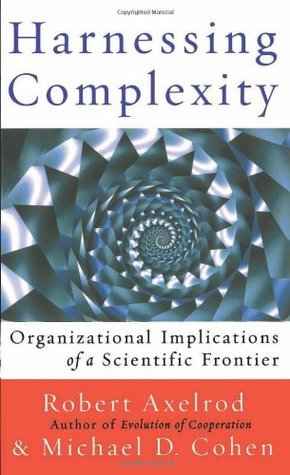
Recent advances in the study of complexity have given scientists profound new insights into how natural innovation occurs and how its power can be exploited. Now two pioneers in the field, Robert Axelrod and Michael D. Cohen, provide leaders in business and government with a guide to complexity that will help them make effective decisions in a world of rapid change. Building on evolutionary biology, computer science, and social design, Axelrod and Cohen have constructed a unique framework for improving the way people work together. Their approach to management is based on the concept of the Complex Adaptive System, which can describe everything from rain forests to the human gene pool, and from automated software agents to multinational companies. The authors' framework reveals three qualities that all kinds of managers must cultivate in their "Variation" What is the best way to manage the development of software? Should the problem be broken up into small pieces for programmers working independently, thus enhancing variation, or should there be a centralized hierarchy of programmers ruled by a chain of command? The authors show how the decentralized creation of variation combined with the centralized maintenance of standards was the key to the success of the Linux "open source software" project, which brought together thousands of volunteers in cyberspace to produce an operating system that can outperform Microsoft's. "Interaction" Why did northern Italy prosper while southern Italy remained poor? Recognizing the internal interactions of a Complex Adaptive System -- be it a national region, a company, or a nonprofit group -- reveals vitalnetworks of trust. Axelrod and Cohen explain that in successful adaptive systems, rich networks of horizontal linkages foster cooperation and provide an advantage over other less cooperatively networked groups. In the case of Italy, voluntary associations created networks of trust in the Middle Ages that became northern Italy's critical advantage over the south. "Selection" Is a Pulitzer Prize better than a National Book Award? How can foundations and corporations design competitions that have a positive effect on the evolution of excellence? The authors' framework makes clear that the worst selection processes are mired in orthodox standards that have not adapted to a new environment. The best selection processes, on the other hand, are created and run by leaders who understand how the standards they use can transform their organization and its environment. This simple, paradigm-shifting analysis of how people work together will transform the way we think about getting things done in a group. "Harnessing Complexity" is the essential guide to creating wealth, power, and knowledge in the 21st century.

A Passion for Cooperation is the exciting autobiography of Robert Axelrod, one of the most acclaimed and wide-ranging scientists of the last fifty years. After being recognized by President Kennedy for being a promising young scientist while in high school, Axelrod built a career dedicated to collaborating with business school professors, international relations scholars, political scientists, computer scientists, and even evolutionary biologists and cancer researchers. Fifty years later, he was honored by President Obama with the National Medal of Science for scientific achievement and leadership and his work has been referred to as the gold standard of interdisciplinary research. Yet Axelrod’s autobiography is not just an account of his wide-ranging passion for cooperation. It reveals his struggles to overcome failures and experience the joys of gaining new insights into how to achieve cooperation. A Passion for Cooperation recounts Robert Axelrod’s adventures talking with the leader of the organization Hamas, the Prime Minister of Israel, and the Foreign Minister of Syria. Axelrod also shares stories of being hosted in Kazakhstan by senior Soviet retired generals and visiting China with well-connected policy advisors on issues of military aspects of cyber conflict. Through stories of the difficulties and rewards of interdisciplinary collaborations, readers will discover how Axelrod’s academic and practical work have enriched each other and demonstrated that opportunities for cooperation are much greater than generally thought.

Conflict of interest;: A theory of divergent goals with applications to politics
by Robert Axelrod
Rating: 5.0 ⭐

Quid Pro Quo: The Theory of Cooperative Behaviour / Donnant, donnant: Théorie du comportement coopératif
by Robert Axelrod
Rating: 4.5 ⭐
Comment réussir dans un monde d'égoïstes ? Stratèges, négociateurs, décideurs, managers, hommes de bon sens, mais aussi de bonne ou de mauvaise foi, chacun trouvera matière à réflexion dans cette exploration des raisons qui permettent à la coopération de s'installer, même dans les situations les plus défavorables. Robert Axelrod, spécialiste en théorie des jeux, enseigne les sciences politiques à l'université du Michigan.
Framework for a general theory of cognition and choice
by Robert Axelrod
Die Evolution der Kooperation
by Robert Axelrod