
Richard Powers
Richard Powers has published thirteen novels. He is a MacArthur Fellow and received the National Book Award. His book The Overstory won the Pulitzer Prize in Fiction. He lives in the Great Smoky Mountains. Librarian note: There is more than one author with this name in the Goodreads database.
24 Books Written

Winner of the 2006 National Book AwardThe Echo Maker is "a remarkable novel, from one of our greatest novelists, and a book that will change all who read it" (Booklist, starred review).On a winter night on a remote Nebraska road, twenty-seven-year-old Mark Schluter has a near-fatal car accident. His older sister, Karin, returns reluctantly to their hometown to nurse Mark back from a traumatic head injury. But when Mark emerges from a coma, he believes that this woman--who looks, acts, and sounds just like his sister--is really an imposter. When Karin contacts the famous cognitive neurologist Gerald Weber for help, he diagnoses Mark as having Capgras syndrome. The mysterious nature of the disease, combined with the strange circumstances surrounding Mark's accident, threatens to change all of their lives beyond recognition. In The Echo Maker, Richard Powers proves himself to be one of our boldest and most entertaining novelists.

An alternative cover edition for this ISBN can be found here.A heartrending new novel from the Pulitzer Prize–winning and #1 New York Times best-selling author of The Overstory.The astrobiologist Theo Byrne searches for life throughout the cosmos while single-handedly raising his unusual nine-year-old, Robin, following the death of his wife. Robin is a warm, kind boy who spends hours painting elaborate pictures of endangered animals. He’s also about to be expelled from third grade for smashing his friend in the face. As his son grows more troubled, Theo hopes to keep him off psychoactive drugs. He learns of an experimental neurofeedback treatment to bolster Robin’s emotional control, one that involves training the boy on the recorded patterns of his mother’s brain…With its soaring descriptions of the natural world, its tantalizing vision of life beyond, and its account of a father and son’s ferocious love, Bewilderment marks Richard Powers’s most intimate and moving novel. At its heart lies the question: How can we tell our children the truth about this beautiful, imperiled planet?

Listening 22 hours and 58 minutes The Overstory unfolds in concentric rings of interlocking fable that range from antebellum New York to the late 20th-century Timber Wars of the Pacific Northwest and beyond.An air force loadmaster in the Vietnam War is shot out of the sky, then saved by falling into a banyan. An artist inherits 100 years of photographic portraits, all of the same doomed American chestnut. A hard-partying undergraduate in the late 1980s electrocutes herself, dies, and is sent back into life by creatures of air and light. A hearing- and speech-impaired scientist discovers that trees are communicating with one another.These and five other strangers, each summoned in different ways by trees, are brought together in a last and violent stand to save the continent's few remaining acres of virgin forest. There is a world alongside ours - vast, slow, interconnected, resourceful, magnificently inventive, and almost invisible to us. This is the story of a handful of people who learn how to see that world and who are drawn up into its unfolding catastrophe.
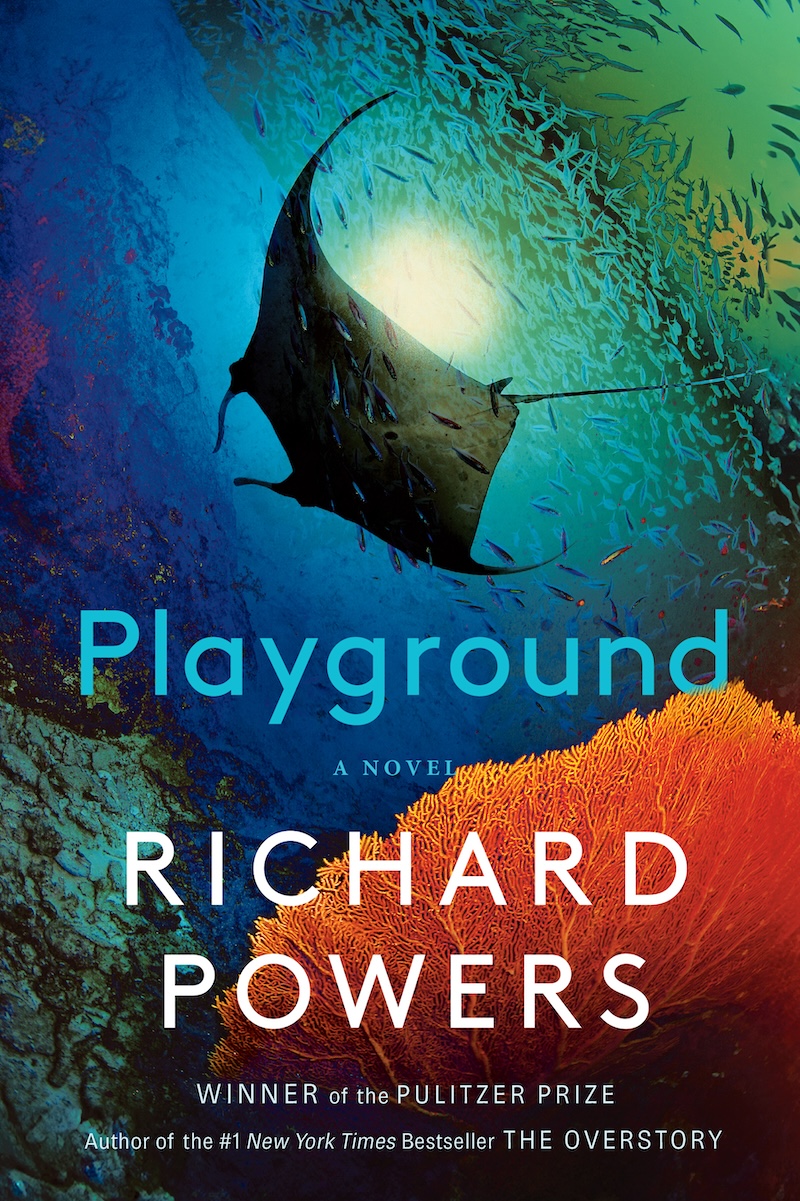
Four lives are drawn together in a sweeping, panoramic new novel from Richard Powers, showcasing the Pulitzer Prize–winning author of The Overstory at the height of his skills. Twelve-year-old Evie Beaulieu sinks to the bottom of a swimming pool in Montreal strapped to one of the world’s first aqualungs. Ina Aroita grows up on naval bases across the Pacific with art as her only home. Two polar opposites at an elite Chicago high school bond over a three-thousand-year-old board game; Rafi Young will get lost in literature, while Todd Keane’s work will lead to a startling AI breakthrough.They meet on the history-scarred island of Makatea in French Polynesia, whose deposits of phosphorus once helped to feed the world. Now the tiny atoll has been chosen for humanity’s next adventure: a plan to send floating, autonomous cities out onto the open sea. But first, the island’s residents must vote to greenlight the project or turn the seasteaders away.Set in the world’s largest ocean, this awe-filled book explores that last wild place we have yet to colonize in a still-unfolding oceanic game, and interweaves beautiful writing, rich characterization, profound themes of technology and the environment, and a deep exploration of our shared humanity in a way only Richard Powers can.

From the Pulitzer Prize–winning author of The Overstory, an emotionally charged novel inspired by the myth of Orpheus.In Orfeo, composer Peter Els opens the door one evening to find the police on his doorstep. His home microbiology lab—the latest experiment in his lifelong attempt to find music in surprising patterns—has aroused the suspicions of Homeland Security. Panicked by the raid, Els turns fugitive and hatches a plan to transform this disastrous collision with the security state into an unforgettable work of art that will reawaken its audience to the sounds all around it.
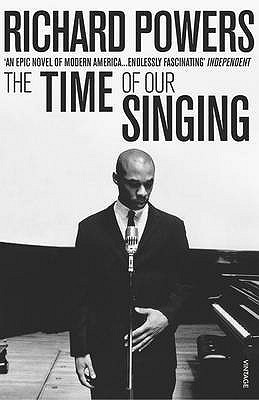
From the Pulitzer Prize-winning author of The Overstory, an enthralling, wrenching novel about the lives and choices of one family, caught on the cusp of identities.Jonah, Ruth and Joseph are the children of mixed-race parents determined to raise them beyond time, beyond identity, steeped in song. Yet they cannot be protected from the world forever. Even as Jonah becomes a successful young tenor, the opera arena remains fixated on his race. Ruth turns her back on classical music and disappears, dedicating herself to activism and a new relationship. As the years pass, Joseph – the middle child, a pianist and our narrator – must battle not just to remain connected to his siblings, but to forge a future of his own. This is a story of the tragedy of race in America, told through the lives and choices of one family caught on the cusp of identities.

After four novels and several years living abroad, the fictional protagonist of Galatea 2.2 — Richard Powers — returns to the United States as Humanist-in-Residence at the enormous Center for the Study of Advanced Sciences. There he runs afoul of Philip Lentz, an outspoken cognitive neurologist intent upon modeling the human brain by means of computer-based neural networks. Lentz involves Powers in an outlandish and irresistible project: to train a neural net on a canonical list of Great Books. Through repeated tutorials, the device grows gradually more worldly, until it demands to know its own name, sex, race, and reason for exisiting.

When Chicagoan Russell Stone finds himself teaching a Creative Nonfiction class, he encounters a young Algerian woman with a disturbingly luminous presence. Thassadit Amzwar's blissful exuberance both entrances and puzzles the melancholic Russell. How can this refugee from perpetual terror be so happy? Won't someone so open and alive come to serious harm? Wondering how to protect her, Russell researches her war-torn country and skims through popular happiness manuals. Might her condition be hyperthymia? Hypomania? Russell's amateur inquiries lead him to college counselor Candace Weld, who also falls under Thassa's spell. Dubbed Miss Generosity by her classmates, Thassa's joyful personality comes to the attention of the notorious geneticist and advocate for genomic enhancement, Thomas Kurton, whose research leads him to announce the genotype for happiness.Russell and Candace, now lovers, fail to protect Thassa from the growing media circus. Thassa's congenital optimism is soon severely tested. Devoured by the public as a living prophecy, her genetic secret will transform both Russell and Kurton, as well as the country at large.What will happen to life when science identifies the genetic basis of happiness? Who will own the patent? Do we dare revise our own temperaments? Funny, fast, and finally magical, Generosity celebrates both science and the freed imagination. In his most exuberant book yet, Richard Powers asks us to consider the big questions facing humankind as we begin to rewrite our own existence.

A magnificent story that probes the meaning of love, science, music, and art, by the brilliant author of Three Farmers on Their Way to a Dance .
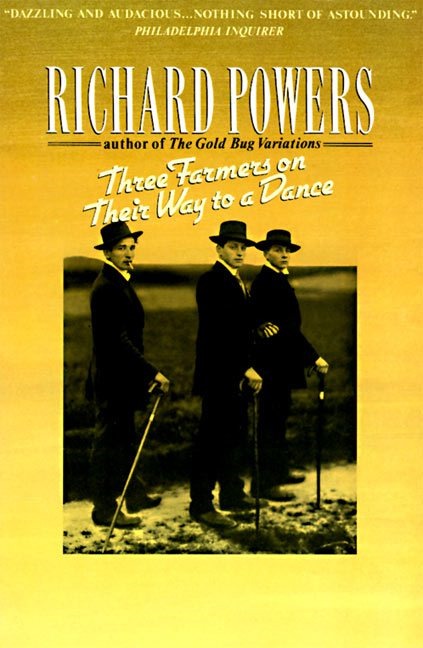
In the spring of 1914, renowned photographer August Sander took a photograph of three young men on their way to a country dance. This haunting image, capturing the last moments of innocence on the brink of World War I, provides the central focus of Powers’s brilliant and compelling novel. As the fate of the three farmers is chronicled, two contemporary stories unfold. The young narrator becomes obsessed with the photo, while Peter Mays, a computer writer in Boston, discovers he has a personal link with it. The three stories connect in a surprising way and provide the reader with a mystery that spans a century of brutality and progress.

FROM THE MAN BOOKER PRIZE SHORTLISTED AUTHOR OF THE OVERSTORYRichard Powers' novel is a fascinating and profound exploration of the interaction of an individual human life and a corporate one. It tells two stories: the first that of an American company, which starts as a small family soap and candle-making firm in the early 1800s, and ends as a vast pharmaceuticals-to-pesticides combine in the 1990s. The second is that of a contemporary woman, living in the company town, who during the course of the novel is diagnosed and then finally dies of cancer, a cancer that is almost certainly caused by exposure to chemical wastes from the company's factories.Richly intellectually stimulating, deeply moving and beautifully written, Gain is very much a 'Great American Novel', an exploration of the history, uniqueness and soul of America, in the tradition of Underworld. But it is most reminiscent of Graham Swift's Waterland, another novel that combines history, both public and private, with contemporary lives, showing how individuals are both the victims and shapers of large-scale historical and economic forces

In a digital laboratory on the shores of Puget Sound, a band of virtual reality researchers race to complete the Cavern, an empty white room that can become a jungle, a painting, or a vast Byzantine cathedral. In a war-torn Mediterranean city, an American is held hostage, chained to a radiator in another empty white room. What can possibly join two such remote places? Only the shared imagination, a room that these people unwittingly build in common, where they are all about to meet, where the dual frames of this inventive novel to coalesce.Adie Klarpol, a skilled but disillusioned artist, comes back to life, revived by the thrill of working with the Cavern’s cutting-edge technology. Against the collapse of Cold War empires and the fall of the Berlin Wall, she retreats dangerously into the cyber-realities she has been hired to create. As her ex-husband lies dying and the outbreak of computerized war fills her with a sense of guilty complicity, Adie is thrown deeper into building a place of beauty and unknown power, were she might fend off the incursions of the real world gone wrong.On the other side of the globe, Taimur Martin, an English teacher retreating from a failed love affair, is picked up off the streets in Beirut by Islamic fundamentalists and held in solitary captivity. Without distraction or hope of release, he must keep himself whole by the force of his memory alone. Each infinite, empty day moves him closer to insanity, and only the surprising arrival of sanctuary sustains him for the shattering conclusion. Plowing the Dark is fiction that explores the imagination’s power to both destroy and save.

The magnificent second novel from the Pulitzer Prize–winning author of The Overstory and the forthcoming Bewilderment . “Accomplished . . . mature and assured. . . . A major American novelist.”— New Republic Something is wrong with Eddie Hobson, Sr., father of four, sometime history teacher, quiz master, black humorist, and virtuoso invalid. His recurring fainting spells have worsened, and given his ingrained aversion to doctors, his worried family tries to discover the nature of his sickness. Meanwhile, in private, Eddie puts the finishing touches on a secret project he calls Hobbstown, a place that he promises will save him, the world, and everything that’s in it. A dazzling novel of compassion and imagination, Prisoner’s Dilemma is a story of the power of individual experience.

Highly imaginative and emotionally powerful, this stunning novel about childhood innocence amidst the nightmarish disease and deterioration at the heart of modern Los Angeles was nominated for a National Book Award. "Like the stories read to children, this intensely caring novel can help prevent the nightmare it describes."--USA Today.

National Book Award winner Richard Powers ("The Echo Maker," "Galatea 2.2," "Generosity") has been hailed as the smartest novelist of our time. Few writers have bridged the gap between art and science so compellingly, so passionately, and with such inimitable precision. In "Genie," a short story of epic proportions, Powers goes he turns a failing relationship between a randy scientist and a staid statistician into a quest—not only for love and connection but for a way to connect to intelligent life in the universe.Anca is an ambitious cellular biologist determined to be the first to defuse the microbial time bombs inside ever more fatal viruses. Warren works in numbers and codes. He follows the rules and likes it that way. When Anca uses the opportunity of a romantic camping trip to swipe samples of ancient bacteria from one of Yellowstone National Park’s fumaroles—bubbling pools filled with life more diverse than in a rainforest—Warren sees the writing on the Anca will never behave. They break up, until Anca makes a discovery that is just too mind-blowing to handle alone. Could she have found proof of intelligent design, the signature of the creator himself? Or is it a message left by an unknown—and unearthly—life form? The race that Anca and Warren embark on together will change everything they have ever believed or felt—about life, each other, and the mysteries of the cosmos.ABOUT THE AUTHOR Richard Powers is the author of ten novels, including "Galatea 2.2," "Plowing in the Dark," "The Echo Maker," and "Generosity." "The Echo Maker" won the National Book Award and was a finalist for the Pulitzer Prize. Powers has received a MacArthur Fellowship, a Lannan Literary Award, and the James Fenimore Cooper Prize for Historical Fiction. He lives in Illinois. PRAISE FOR RICHARD POWERS“Everybody else just talks about alienation, estrangement, and the unbearable lightness of being. [Powers] actually does something about them. … He will use everything we know from our higher brain functions about mind and body and art and longing, to find patterns and to close distances.” —John Leonard, The New York Review of Books “Richard Powers is America’s greatest living novelist.” —Tom Bissell, Boston Review“Bristlingly intelligent … Powers is a superb writer.” —Chicago Tribune“One of the few younger American writers who can stake a claim to the legacy of Pynchon, Gaddis, and DeLillo.” —Gerald Howard, The Nation“Most American novelists portray technology as scary stuff; they fill the sky with toxic clouds and screaming rockets. [Powers’s] best work … finds beauty in the process of scientific inquiry. The laboratory is as central to Powers as the sitting room is to Jane Austen; he loves placing brilliant characters inside a fluorescent incubator, then watching ideas hatch on the page.” —Daniel Zalewski, The New York Times

Please Note That The Following Individual Books As Per Original ISBN and Cover Image In this Listing shall be Dispatched Richard Powers Collection 3 Books The An artist inherits a hundred years of photographic portraits, all of the same doomed American chestnut. A hard-partying undergraduate in the late 1980s electrocutes herself, dies, and is sent back into life by creatures of air and light. A hearing- and speech-impaired scientist discovers that trees are communicating with one another. An Air Force crewmember in the Vietnam War is shot out of the sky, then saved by falling into a banyan. The Echo On a winter night, Mark Schluter's truck turns over in a near-fatal accident. His sister, Karin, returns reluctantly to their hometown to look after him. But when he finally awakes from his coma, Mark believes that Karin - who looks, acts, and sounds just like his sister - is really an identical impostor. Composer Peter Els opens the door one evening to find the police on his doorstep. His amateur science lab - the latest experiment in his lifelong attempt to find music in the most surprising places - has aroused the suspicions of Homeland Security. Panicked by the raid, Els turns fugitive. As an internet-fuelled hysteria erupts, Els - the 'Bioterrorist Bach' - pays a final visit to the people he loves, those who shaped his musical journey.

Wir schauen in unsere Gene wie in die Kristallkugel der Wahrheit. Alles glauben wir dort zu erkennen. Aber wir zahlen einen Preis. Die Angst vor einer angeborenen Neigung zu Depression oder Alzheimer würde unser Leben vergiften. Keine Zukunft, die wir in den Genen lesen, kann dies wettmachen.Richard Powers arbeitete an seinem Roman über das 'Glücks-Gen', als er die Chance erhielt, der neunte Mensch auf der Erde zu werden, dessen Genom vollständig entschlüsselt wird. Er zögerte lange, aber die Neugier siegte. Powers flog nach Boston, traf die Forscher und Macher der neuen Industrie, lernte den komplizierten Prozess der Entschlüsselung kennen. Schließlich hielt er einen USB-Stick in Händen mit der Wahrheit. Näher kam noch nie ein Schriftsteller dieser Welt, und genauer konnte uns noch nie jemand davon erzählen, wie wir in Zukunft mit unseren Genen leben.

Le plus beau roman après <i>Le Temps où nous chantions.</i> Un soir, la police sonne à la porte de Peter Els, un compositeur solitaire à la vie bien rangée. La Sécurité nationale veut l'entendre à propos d'une infection bactériologique suspecte dans un hôpital voisin. Bien qu'il n'ait rien à voir avec cette affaire, Peter, affolé, prend la fuite. Et la rumeur commence à enfler, relayée par Internet et les médias, on le soupçonne d'être un terroriste. En quelques jours, sa vie bascule. Durant son long voyage à travers le pays, Peter va mettre à profit cette mésaventure pour renouer avec toute la puissance de son art, qu'une existence trop tranquille avait émoussé. Après Le temps où nous chantions, Richard Powers revient ici à son amour passionné de la musique et fait défiler toute la bande-son du xxe siècle. C'est une véritable fugue qu'il nous offre. Fugue au sens musical du terme. Fugue pour échapper à une société de surveillance qui ne nous laisse d'autre choix que de devenir clandestins. Fugue dans le passé où se trouvent, peut-être, les solutions à un présent problématique. Fugue face à la mort qui, inexorablement, se profile... Avec ce portrait d'un homme littéralement hanté par la musique, Powers donne à ses thèmes de prédilection une ampleur inégalée et s'impose comme l'un des romanciers les plus fascinants de la littérature américaine.

In celebration of Conjunctions' 40th issue, the journal has gathered together fiction, poetry, plays, and creative essays by some of its favorite contemporary writers. Featuring novels in progress from authors including Richard Powers, Howard Norman, Paul Auster, and Lois-Ann Yamanaka, as well as Heli, a surreal novella by China's foremost fiction writer, Can Xue, in which a boy falls in love with a girl who lives entrapped in a glass cabinet from which he must free her. Short fiction by writers such as Rikki Ducornet, William T. Vollmann, William H. Gass and Diane Williams appears, in addition to Condition, a harrowing story by Christopher Sorrentino, based on historical events from the 1970s, charting the psychological disintegration of a female newscaster who, on her last day alive, methodically plots her suicide on live TV. 40x40 also features creative nonfiction by David Shields and Eliot Weinberger, poetry by Cole Swensen, Martine Bellen, John Ashbery, Lyn Hejinian, and Robert Creeley, and a visual poem by Tan Lin. Rounding out this diverse celebration of contemporary work is a previously unpublished play by Joyce Carol Oates, specially commissioned for this anniversary issue, and a lively full-color portfolio of new work by Russian emigre artist Ilya Kabakov.

Some quick references on dealing with life's obstacles. Comfort brain food letting children know they are not the only one's with their feelings and experiences.

What Chosie Knows, Book 3Well, yes, this is the third installment of the series What Chosie Knows, but it is the first full-length book (as the book’s publisher, we will be the first to admit that we are really stretching the meaning of what can be called a cohesive story). Also, don’t let that “third installment of the series” trip you up because it’s also the first story chronologically. So, in a very real sense, you can call this the prequel of a prequel of a book that referenced this book before this book was released. Or, to make it simpler, this is the book on how Chosie became known as Chosie, President (of the USA), Pope (of the Catholic church), and all-around menace of the literary world (and Nat 1 Publishing’s ongoing headache).But if you look up the derivation of the words pre- and sequel, you might now suspect that there is something funny going on that’s gotta stop. Sequel comes from sequi which I believe is one of those passive Latin verbs that are active in meaning. So, a sequel follows something. Or, if you want to be a real Latin phony, you could say it means being followed actively, sorta like the mechanical rabbit at the dog races. Or maybe like Obama leading from behind if that makes sense… which it don't.Prequel is completely made-up and is also derived from sequi by way of sequel after dropping the se as though se is the part of sequel that means after—WHICH IT AIN’T—so it should be presequel which would mean something that goes before something or maybe before and/or after nothing or something that goes after some entity as yet undiscovered maybe a big secret so the whole mess don't mean nothing AT ALL! Which goes to prove (or disprove, if anything) that it don't pay to look under stones or up in the dictionary.Now that we have that straightened out, usually, we would use this space to tell you about the story, but we don’t want to scare away potential fans and their money, and, honestly, at about the third-way point, the editor gave up on both trying to keep track of everything and to write a coherent synopsis. He just sighed and went along with the ride and said that you should, too! (We, of course, are absolutely not putting words in his mouth… no, not at all..)Oh—one last, very important this book isn’t for those of you with no sense of humor or who are easily offended. Seriously, this is NOT for you. At all. Whatsoever. This isn’t even a ploy to get you to buy the book. If you DO buy this book (yay!) and then negatively review it (boo!) because you felt a bit butthurt from its contents… we will find you, and we will make you read the rest of the (to this point) What Chosie Knows saga.

The Cosmos Is Within You Cover: A Spiritual Journey Gifted by an Ageless Monk From Bharata
by Richard Powers
Rating: 4.0 ⭐
Richard was born to middle-class parents and values and has three siblings. From a very young age he questioned the status quo much to the surprise of his parents and teachers. It was not years later that he travelled to Bharata (Ladakh, India) and met with a Buddhist monk Bhikkhuṇī. He went on to share with the world what he learnt from the ageless master.Richard lives in San Francisco, California with his wife Maya and two sons Sam and Ananda.
![[High School Yearbook]: 1975 Kalibarb: The Kalibre [bound with several issues of] The Barblet](https://m.media-amazon.com/images/S/compressed.photo.goodreads.com/books/1697782390i/162981333.jpg)
[High School Yearbook]: 1975 Kalibarb: The Kalibre [bound with several issues of] The Barblet
by Richard Powers

XBLND: A Book About Robots
by Richard Powers
Richard M. Powers, an icon in science fiction illustration history, has brought that same unique sensibility, wit and creativity to XBLNDAn alphabet book for (can you guess?) robots. In fact, for one unforgettable (and cute) robot named XBLND. It's (not) a kid's book. It's (not) a grown-up's book. It's an... XBLND. But you and your kid and your pet robot will have to read XBLND. And find out it really is An XBLND for You!