
Richard K. Lester
7 Books Written

Unlocking Energy Innovation: How America Can Build a Low-Cost, Low-Carbon Energy System
by Richard K. Lester
Rating: 3.7 ⭐
• 2 recommendations ❤️
Experts outline a plan to overhaul the U.S. energy innovation system for accelerated, large-scale adoption of reliable, low-cost, low-carbon energy technologies.Energy innovation offers us our best chance to solve the three urgent and interrelated problems of climate change, worldwide insecurity over energy supplies, and rapidly growing energy demand. But if we are to achieve a timely transition to reliable, low-cost, low-carbon energy, the U.S. energy innovation system must be radically overhauled.Unlocking Energy Innovation outlines an up-to-the-minute plan for remaking America's energy innovation system by tapping the country's entrepreneurial strengths and regional diversity in both the public and private spheres. "Business as usual" will not fill the energy innovation gap. Only the kind of systemic, transformative changes to our energy innovation system described in this provocative book will help us avert the most dire scenarios and achieve a sustainable and secure energy future.

Amid mounting concern over the loss of jobs to low-wage economies, one fact is America's prosperity hinges on the ability of its businesses to continually introduce new products and services. But what makes for a creative economy? How can the remarkable surge of innovation that fueled the boom of the 1990s be sustained?For an answer, Richard K. Lester and Michael J. Piore examine innovation strategies in some of the economy's most dynamic sectors. Through eye-opening case studies of new product development in fields such as cell phones, medical devices, and blue jeans, two fundamental processes emerge.One of these processes, analysis--rational problem solving--dominates management and engineering practice. The other, interpretation, is not widely understood, or even recognized--although, as the authors make clear, it is absolutely crucial to innovation. Unlike problem solving, interpretation embraces and exploits ambiguity, the wellspring of creativity in the economy. By emphasizing interpretation, and showing how these two radically different processes can be combined, Lester and Piore's book gives managers and designers the concepts and tools to keep new products flowing.But the authors also offer an unsettling critique of national policy. By ignoring the role of interpretation, economic policymakers are drawing the wrong lessons from the 1990s boom. The current emphasis on expanding the reach of market competition will help the analytical processes needed to implement innovation. But if unchecked it risks choking off the economy's vital interpretive spaces. Unless a more balanced policy approach is adopted, warn Lester and Piore, America's capacity to innovate--its greatest economic asset--will erode.

Global Taiwan: Building Competitive Strengths in a New International Economy
by Richard K. Lester
Rating: 4.0 ⭐
Global Taiwan examines the impact of globalization on the industry and economy of Taiwan since the spectacular growth of the 1990s. Drawing on hundreds of interviews with firms in Taiwan, China, the United States, Japan, Europe, and other areas, the book analyzes the strengths and weaknesses of Taiwanese firms at a time when they face new competition from powerful global leaders and new producers in China. The contributors cover topics of enormous importance for Taiwan as well as the rest of the world, including transformations in the international economy, technological advances that enabled modularization and fragmentation of the production system, contract manufacturers, regionalization, and links with Chinese industry. The book addresses such questions as: Can Taiwanese companies be maintained and expanded with the same corporate strategies and public policies as in the past? Can these strategies still work for other countries? If changes are required, what resources can be mobilized in the public and private sectors? As massive relocation of manufacturing and services moves plants and jobs to low-wage countries like China and India, what will remain at home in societies like Taiwan?

The Productive Edge: How U.S. Industries Are Pointing the Way to a New Era of Economic Growth
by Richard K. Lester
Analyzes the causes of the national decline in industrial productivity and discusses organizational and individual changes required to increase productivity

イノベーション―「曖昧さ」との対話による企業革新
by Richard K. Lester
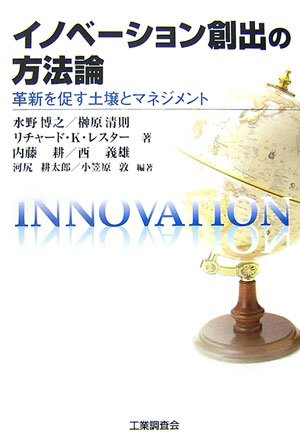
イノベーション創出の方法論―革新を促す土壌とマネジメント
by Richard K. Lester

Unlocking Energy Innovation: How America Can Build a Low-Cost, Low-Carbon Energy System
by Richard K. Lester
Energy innovation offers us our best chance to solve the three urgent and interrelated problems of climate change, worldwide insecurity over energy supplies, and rapidly growing energy demand. But if we are to achieve a timely transition to reliable, low-cost, low-carbon energy, the U.S. energy innovation system must be radically overhauled. Unlocking Energy Innovation outlines an up-to-the-minute plan for remaking America's energy innovation system by tapping the country's entrepreneurial strengths and regional diversity in both the public and private spheres. "Business as usual" will not fill the energy innovation gap. Only the kind of systemic, transformative changes to our energy innovation system described in this provocative book will help us avert the most dire scenarios and achieve a sustainable and secure energy future.