
Philip Goff
University of Liverpool, UK
5 Books Written
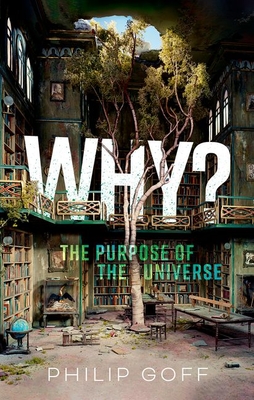
Why are we here? What's the point of existence? On the 'big questions' of meaning and purpose, Western thought has been dominated by the dichotomy of traditional religion and secular atheism. In this pioneering work, Philip Goff argues that it is time to move on from both God and atheism. Through an exploration of contemporary cosmology and cutting-edge philosophical research on consciousness, Goff argues for cosmic the idea that the universe is directed towards certain goals, such as the emergence of life.In contrast to religious thinkers, Goff argues that the traditional God is a bad explanation of cosmic purpose. Instead, he explores a range of alternative possibilities for accounting for cosmic purpose, from the speculation that we live in a computer simulation to the hypothesis that the universe itself is a conscious mind. Goff scrutinizes these options with analytical rigour, laying the foundations for a new paradigm of philosophical enquiry into the middle ground between God and atheism. Ultimately, Goff outlines a way of living in hope that cosmic purpose is still unfolding, involving political engagement and a non-literalist interpretation of traditional religion.

Galileo's Error: Foundations for a New Science of Consciousness
by Philip Goff
Rating: 3.9 ⭐
• 1 recommendation ❤️
From a leading philosopher of the mind comes this lucid, provocative argument that offers a radically new picture of human consciousness—panpsychism.Understanding how brains produce consciousness is one of the great scientific challenges of our age. Some philosophers argue that consciousness is something "extra," beyond the physical workings of the brain. Others think that if we persist in our standard scientific methods, our questions about consciousness will eventually be answered. And some even suggest that the mystery is so deep, it will never be solved. Decades have been spent trying to explain consciousness from within our current scientific paradigm, but little progress has been made.Now, Philip Goff offers an exciting alternative that could pave the way forward. Rooted in an analysis of the philosophical underpinnings of modern science and based on the early twentieth-century work of Arthur Eddington and Bertrand Russell, Goff makes the case for panpsychism, a theory which posits that consciousness is not confined to biological entities but is a fundamental feature of all physical matter—from subatomic particles to the human brain. In Galileo's Error, he has provided the first step on a new path to the final theory of human consciousness.

A core philosophical project is the attempt to uncover the fundamental nature of reality, the limited set of facts upon which all other facts depend. Perhaps the most popular theory of fundamental reality in contemporary analytic philosophy is physicalism, the view that the world is fundamentally physical in nature. The first half of this book argues that physicalist views cannot account for the evident reality of conscious experience, and hence that physicalism cannot be true. Unusually for an opponent of physicalism, Goff argues that there are big problems with the most well-known arguments against physicalism―Chalmers' zombie conceivability argument and Jackson's knowledge argument―and proposes significant modifications.The second half of the book explores and defends a recently rediscovered theory of fundamental reality―or perhaps rather a grouping of such theories―known as 'Russellian monism.' Russellian monists draw inspiration from a couple of theses defended by Bertrand Russell in The Analysis of Matter in 1927. Russell argued that physics, for all its virtues, gives us a radically incomplete picture of the world. It tells us only about the extrinsic, mathematical features of material entities, and leaves us in the dark about their intrinsic nature, about how they are in and of themselves. Following Russell, Russellian monists suppose that it is this 'hidden' intrinsic nature of matter that explains human and animal consciousness.Some Russellian monists adopt panpsychism, the view that the intrinsic natures of basic material entities involve consciousness; others hold that basic material entities are proto-conscious rather than conscious. Throughout the second half of the book various forms of Russellian monism are surveyed, and the key challenges facing it are discussed. The penultimate chapter defends a cosmopsychist form of Russellian monism, according to which all facts are grounded in facts about the conscious universe.

This volume, originally a special issue of the Journal of Consciousness Studies, uses the recent writings of Philip Goff as a jumping-off point for discussions of panpsychism — the idea that consciousness is a fundamental and pervasive aspect of our universe that cannot be understood in other, more basic, terms. The contributors to this book explore various issues of panpsychism from the perspectives of science, philosophy, and theology. Some papers focus on further motivating and developing the panpsychist position. Others explore various challenges that the panpsychist faces. Collectively, they shed new and important light not only on panpsychism, but on the fundamental question of the place of consciousness in nature more generally.
